Blog
LigoLab vs. NovoPath: Comparing LIS Features, Automation, RCM, and Scalability
August 28, 2026

Choosing the right laboratory information system (LIS) software is one of the most consequential technology decisions a pathology group or diagnostic laboratory can make.
What was once a simple database for entering orders and reporting test results has become the operational backbone of the laboratory, connecting accessioning, specimen tracking, histology, result entry, pathology reporting, molecular testing, digital pathology, interoperability, analytics, automation, compliance, and, in some of the most advanced LIS system platforms, laboratory billing and lab revenue cycle management (RCM).
That makes comparisons between leading laboratory information system vendors increasingly complex.
Two strong contenders for pathology laboratories ready to evaluate a new lab information system are LigoLab and NovoPath.
Both companies offer modern laboratory information systems designed to replace manual processes and fragmented technology with more connected workflows. Both support anatomic pathology, emphasize automation and interoperability, and offer functionality designed to help laboratories increase throughput.
But the platforms are not identical.
NovoPath's strongest differentiation is its pathology-first focus and cloud-native SaaS positioning. LigoLab's primary differentiation is its broader, highly configurable informatics architecture that unifies technical operations and laboratory revenue cycle management on the same platform.
For laboratories comparing LigoLab vs. NovoPath, therefore, the question isn't simply, "Which is the better LIS?"
A more useful question is:
Which laboratory information system best matches your laboratory's specialties, workflows, business model, growth strategy, and long-term technology requirements?
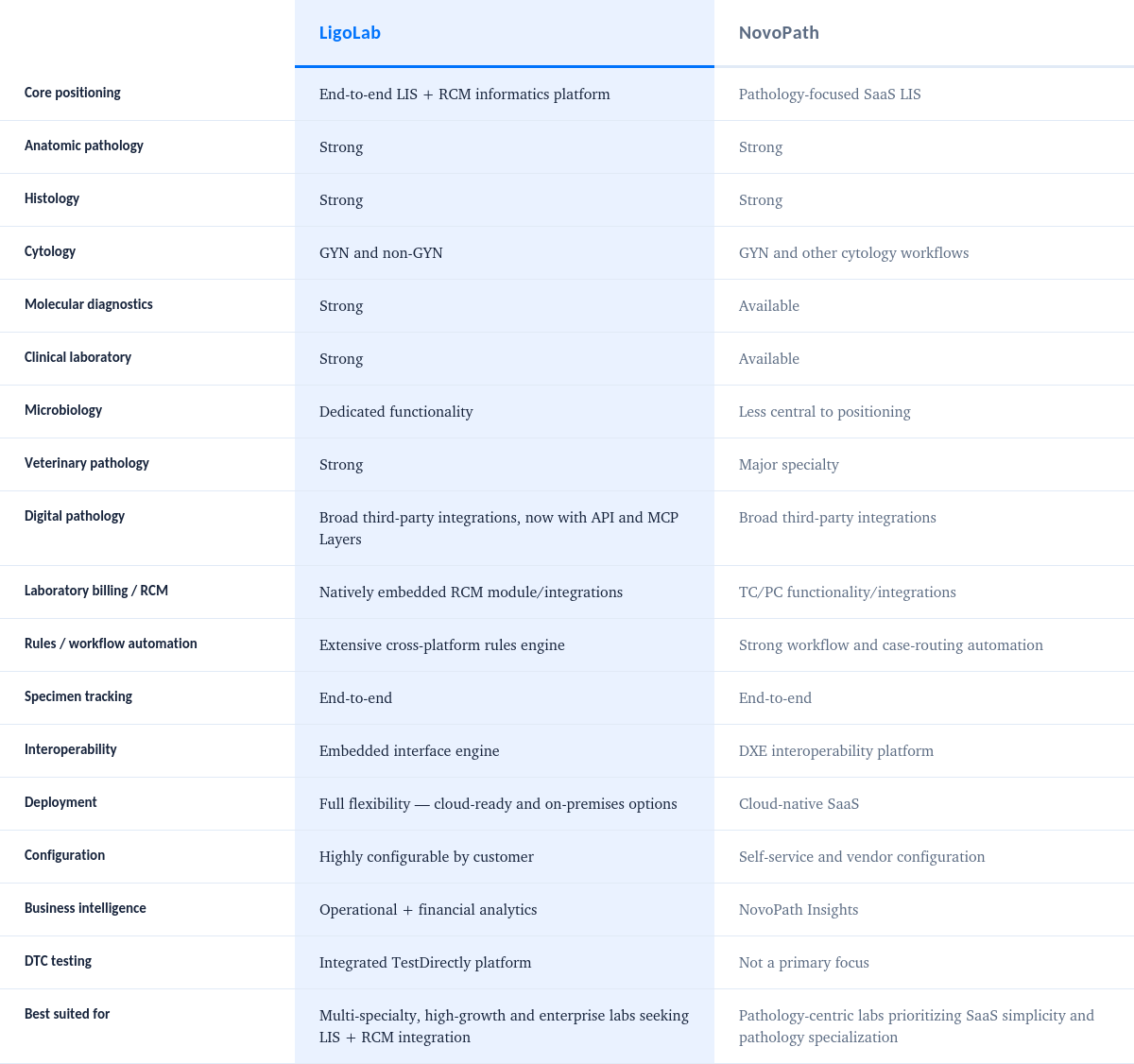
What Is NovoPath?
NovoPath is a long-established LIS company whose current flagship platform is positioned as a modern SaaS platform purpose-built for anatomic pathology LIS workflows.
That pathology specialization is important.
Rather than positioning NovoPath as a generalized healthcare information system, the company emphasizes workflows that pathologists, histotechnologists, laboratory managers, and pathology operations teams encounter every day.
The LIS company also places significant emphasis on usability, with workflows designed to reduce clicks when reviewing specimen information, ordering additional slides, collaborating, diagnosing cases, and releasing pathology reports.
For a pathology organization that wants a cloud-native laboratory information system with deep pathology specialization, NovoPath deserves consideration.
What Is LigoLab?
LigoLab takes a somewhat different approach.
Rather than positioning itself solely as a modern laboratory information system provider, LigoLab describes its product as an all-in-one medical LIS and laboratory billing informatics platform.
The comprehensive and flexible platform supports anatomic pathology LIS workflows, clinical laboratory testing, molecular diagnostics, microbiology, laboratory revenue cycle management, digital pathology, operational AI, outreach, business intelligence, specimen management, and direct-to-consumer lab testing from a single integrated diagnostic lab software infrastructure.
That breadth is the central idea behind the LigoLab architecture.
The platform is designed around a One Source of Truth LIS Model in which clinical, operational, and financial workflows share the same underlying environment rather than relying on separate interfaced LIS and billing databases.
The result is an enterprise laboratory information system intended to function as a powerful LIS System of Action, using rules, queues, automation, and real-time data to determine what should happen next.
Industry Insights: From System of Record to System of Action - The Next Evolution of Laboratory Information Systems
Anatomic Pathology Software: LigoLab vs. NovoPath
Both LIS systems offer robust anatomic pathology software capabilities that support the pathology case lifecycle from accessioning through final reporting.
NovoPath supports accessioning, specimen tracking, histology, cytology, diagnosis, reporting, and case distribution, with an emphasis on chain-of-custody management, automated case routing, worklists, discrepancy management, and real-time operational visibility.
LigoLab provides similarly comprehensive AP functionality, including barcode generation, specimen tracking, document scanning, grossing, electronic histology, result entry, image acquisition, image management system (IMS) interfaces, synoptic reporting, cytology, case distribution, and quality control.
Discover More: The Role of Anatomic Pathology LIS Software in Optimizing Laboratory Workflow Management
Sample Tracking and Laboratory Workflow Management
Sample tracking is a core capability of both pathology lab software platforms.
As mentioned earlier, NovoPath provides chain-of-custody tracking from accessioning through reporting, with real-time visibility to reduce lost specimens and case delays.
LigoLab uses unique specimen identifiers and barcode-driven workflows to maintain traceability throughout the specimen lifecycle, connecting accessioning, grossing, cassette creation, histology, slide preparation, testing, and reporting. The platform also supports configurable label printing and specimen-handling workflows.
Discover More: How Best Practices and Advanced Laboratory Information System Technology Help Ensure Lab Workflow Management
Molecular LIS Software
Molecular diagnostics has become an increasingly important requirement when comparing modern laboratory information systems.
NovoPath’s Molecular LIS supports NGS, PCR, toxicology, infectious disease, virology, LDT workflows, plate mapping, wet-lab capture, automatic reflex testing, batch processing, autoverification, instrument interfaces, and unified specimen tracking.
The important architectural point is that NovoPath enables pathology laboratories to add molecular testing without deploying a second LIS.
LigoLab follows a similar multi-specialty philosophy.
Its Molecular LIS module supports configurable workflows and result panels for molecular testing, including FISH, cytogenetics, flow cytometry, and other esoteric testing. Its broader molecular capabilities include configurable workflows for DNA/RNA extraction, PCR, sequencing, worklists, batch processing, automation, and integrated reporting.
Discover More: What is the Best LIS for Molecular Testing Labs?
Clinical Laboratory Information System Capabilities
Historically, pathology and clinical laboratory information systems were often evaluated as separate categories. As modern laboratories and LIS platforms become more integrated and multidisciplinary, that distinction is becoming increasingly less relevant.
NovoPath now offers clinical lab workflow functionality, including direct analyzer interfaces, automated result posting, auto-release and review routing, batch resulting, and QC capture.
LigoLab has long positioned clinical laboratory functionality as one of its core operating modules. It supports bidirectional analyzer connectivity, batch processing, automated routing, specimen tracking, audit trails, auto-release, QC validation, and rules-driven clinical lab workflow automation.
LigoLab also has dedicated microbiology capabilities for instrument connectivity, plate management, case workup, preliminary results, susceptibility data, and automated reporting.
Discover More: Manage Complex Processes and Streamline Operations with LigoLab's Clinical Laboratory Management Solutions
Digital Pathology Integration
Digital pathology is rapidly becoming a core requirement for modern anatomic pathology software.
Both laboratory information system companies have invested significantly in this area.
NovoPath describes its digital pathology architecture as platform-agnostic and supports integrated access to whole-slide images from within the pathology case. Its website lists integrations with technologies including PathAI, Paige, Hamamatsu, Leica Aperio, Motic, and Philips.
LigoLab follows a similar vendor-neutral philosophy.
LigoLab reports support for digital pathology integrations including PathPresenter, Proscia, Lumea, and other platforms. Its broader integration portfolio also includes Philips IntelliSite, Leica Aperio, Roche Navify, Hamamatsu, Sectra, Indica HALO AP, Ibex, Motic, and PathAI.
LigoLab’s Single sign-on and contextual launching enable pathologists to move directly from LIS cases into corresponding digital slides without manually searching for the case in a separate application.
Industry Insights: ECPC’s Strategic Leap into Digital Pathology - A Connected Vision for the Future
Laboratory Billing and Lab Revenue Cycle Management: The Biggest Differentiator
This is arguably where the two platforms diverge most clearly.
LigoLab's architecture extends beyond traditional laboratory information system software by embedding laboratory revenue cycle management into the same informatics platform.
Its lab RCM capabilities include clean-claim policy enforcement, automated CPT/ICD coding, eligibility and prior authorization workflows, payment functionality, automated statements, MIPS support, and other billing processes.
More importantly, the LIS and RCM modules operate on the same lab database software infrastructure.
That means the operational event that creates a billable service and the financial event associated with that service can be managed within a single connected data environment.
The goal is to protect revenue integrity upstream, resolving incomplete orders, missing diagnoses, demographic errors, and coding issues before they lead to claim denials. LigoLab uses its rules engine and integrated LIS-RCM architecture to identify and correct these issues within the laboratory workflow, helping ensure cleaner, billing-ready claims from the start.
NovoPath provides billing-related functionality and integrations, including support for technical component/professional component (TC/PC) billing. Its interoperability capabilities also enable laboratories to connect with external billing providers and related systems.
The architectural distinction remains important:
LigoLab treats laboratory billing and RCM as a native part of the laboratory informatics platform rather than simply an adjacent downstream function.
Industry Insights: Why LIS And RCM Integration Is A Laboratory Survival Imperative
Automation and Rules Engines
Automation is another major consideration when evaluating the best LIS software.
NovoPath supports automated case distribution, dynamic worklists, reflex testing, autoverification, intelligent routing, and configurable workflows. Together, these capabilities reduce manual intervention, streamline laboratory operations, and enable labs to manage growing test volumes without a proportional increase in staff.
LigoLab’s approach is built around its Rules and Automation Engines and configurable Workflow Designer to support routing, workflow decisions, result handling, exception management, prioritization, coding, reporting, and other actions across laboratory departments. Additionally, because LigoLab also contains RCM functionality, automation also crosses the traditional boundary between laboratory operations and laboratory billing.
Discover More: Unleashing Laboratory Excellence - Here’s How LigoLab’s Automation Engine Supercharges Lab Performance
AI Features and Intelligent Laboratory Automation
Artificial intelligence is becoming an increasingly important consideration when laboratories evaluate modern LIS software. The key distinction, however, is not simply whether an LIS vendor supports AI, but how artificial intelligence fits into existing laboratory workflows and data infrastructure.
NovoPath incorporates AI into its pathology-focused technology strategy and supports integrations with digital pathology and AI solutions. Its interoperability ecosystem enables laboratories to connect the LIS with external technologies that can assist with diagnostic workflows, image analysis, and other pathology applications.
LigoLab takes a broader approach by combining AI, intelligent automation, and rules-driven workflows across its laboratory informatics platform. Its AI strategy extends beyond digital pathology to operational and administrative processes, helping laboratories reduce manual work, improve data quality, identify exceptions, and determine the appropriate next action within a workflow.
One example is AI-powered requisition processing. Through integrated intelligent document processing and OCR technology, laboratories can extract patient demographics, insurance information, test orders, diagnoses, and other data from scanned, faxed, handwritten, and paper requisitions. High-confidence information can flow directly into the LIS workflow, while exceptions can be routed to staff for review.
Discover More: Best Practices for Preparing Medical Labs for AI Integration in Technical and Financial Operations
Reporting and Customization
Reporting is especially important in pathology, where laboratory reports are highly visible products delivered to referring physicians.
Both companies emphasize configuration.
NovoPath's current platform promotes self-service configuration for workflows, templates, and report structures, reducing dependency on vendor support for routine changes.
LigoLab also places significant emphasis on customer-controlled configuration.
Its report-building architecture enables administrators to create and modify templates, control layouts, incorporate images and case information, and customize distribution.
Discover More: How Modern Laboratories Produce and Distribute Reports
Interoperability: Connecting the LIS to the Laboratory Ecosystem
A laboratory information system rarely operates alone.
Modern medical laboratories need connectivity with:
- EHR platforms
- Laboratory analyzers
- Reference laboratories
- Digital pathology solutions
- Lab billing applications
- Clearinghouses
- Government agencies
- Client portals
- Patient portals
- Printers and labeling equipment
- Scanners
- Automation lines
- Third-party applications
NovoPath addresses this through its DXE interoperability platform, which connects with more than 150 EHRs, instruments, and billing providers.
The LigoLab platform features a native Interface Engine that supports bidirectional connectivity with EHRs, analyzers, government agencies, laboratory billing companies, and other laboratory software systems using healthcare standards and formats including HL7, FHIR, XML, JSON, ASTM, CCD, and CDA.
Discover More: LIS-EHR Integration Doesn't Have to Be Painful: How LigoLab and ModMed gGastro Simplify Connectivity for Independent Pathology Groups
Business Intelligence and Operational Visibility
Laboratories increasingly expect their LIS systems to do more than simply store information.
They need to turn data into action.
NovoPath provides visibility into open cases, turnaround time, workload, compliance flags, discrepancies, and production metrics.
LigoLab includes robust Business Intelligence plus configurable operational, statistical, compliance, and financial reporting, and that’s an important distinction. With LigoLab, leadership can examine operational and financial performance from an integrated data environment rather than reconciling separate LIS and billing reports. For laboratory executives focused on cost per test, reimbursement, payer performance, denial patterns, workflow productivity, turnaround time, and growth, that connection can be valuable.
Discover More: Unlocking Smarter Lab Operations - LigoLab’s Optional Automation and Intelligence Features
Cloud LIS Software: Different Approaches to Deployment
Deployment strategy is another area where the two LIS software platforms differ.
NovoPath emphasizes a cloud-native SaaS architecture, reporting 99.9% cloud infrastructure uptime. This approach may appeal to laboratories seeking to reduce local infrastructure requirements and standardize operations on a SaaS delivery model.
LigoLab also supports cloud deployment with its 99.9% uptime guarantee, while offering traditional on-premises installations for laboratories that prefer greater flexibility and control over their hosting environment.
Industry Insights: Examining the Pros and Cons of Cloud-Based LIS System Solutions
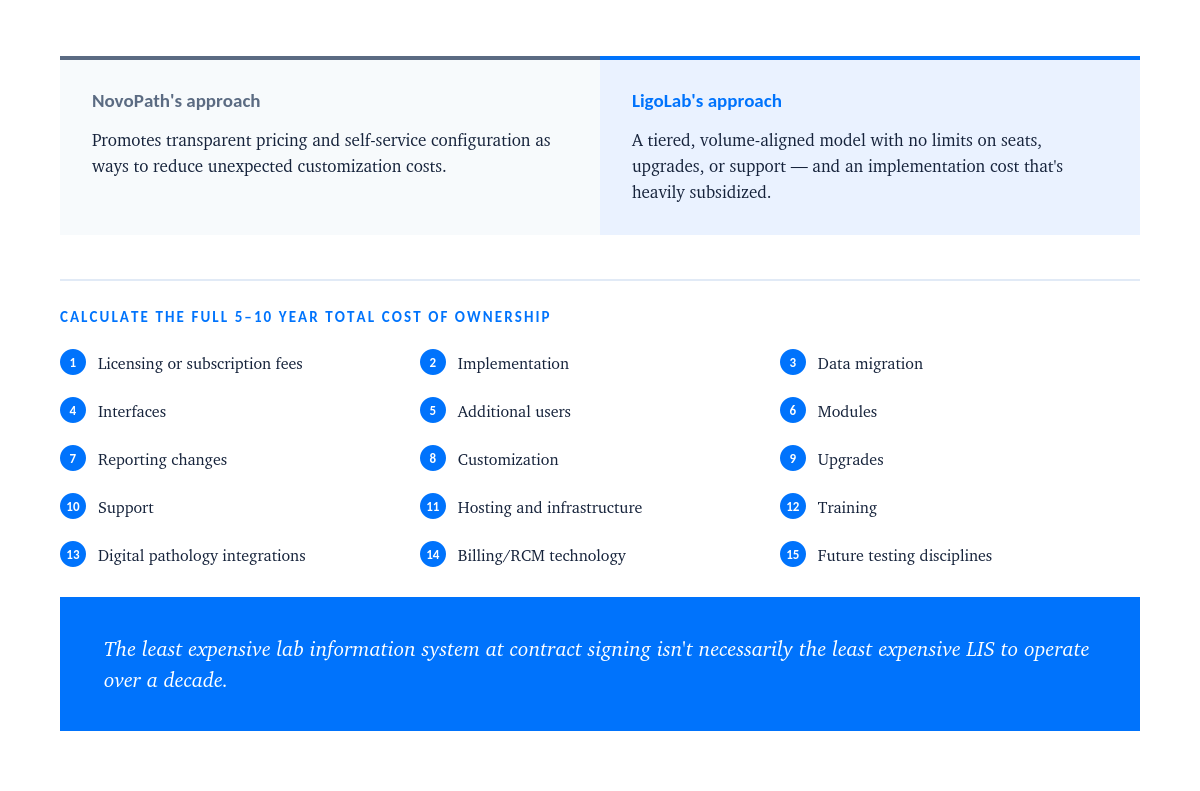
Discover More: What to Look Out for and Avoid When Shopping for a New LIS System
Support and Implementation
Implementation quality and ongoing support should be major considerations when evaluating any laboratory information system, as even the most capable LIS software can fall short without effective deployment, training, and long-term vendor support.
NovoPath brings decades of experience in anatomic pathology and provides implementation assistance and training resources to help laboratories adopt its platform. Third-party Capterra reviews include positive feedback about the system’s capabilities and user experience, but some reviewers have also cited occasional bugs, performance issues, and feature gaps as the company transitioned from its legacy platform to its current technology.
LigoLab takes a partnership-driven approach to implementation and ongoing customer support. Deployments include workflow discovery, configuration, interfaces, data migration, validation, training, testing, and go-live preparation, with the LIS tailored to each laboratory’s requirements. Support continues after launch with unlimited 24/7 assistance, ongoing training, and workflow optimization as operational needs evolve. Each customer is also paired with a Dedicated Success Director who provides strategic guidance through regular communication and Quarterly Customer Reviews. This long-term support model helps laboratories continually optimize performance, adopt new capabilities, expand services, and ensure the platform evolves alongside their operational and business growth.
White Paper: Vendor to Partner - How Aligning with Your LIS Provider Can Transform Your Lab
Where NovoPath Stands Out
NovoPath deserves a place on the shortlist for organizations looking for a modern anatomic pathology LIS.
Its key strengths include deep pathology specialization, more than three decades in the pathology market, cloud-native SaaS delivery, a modern interface, anatomic and molecular pathology functionality, veterinary pathology specialization, specimen tracking, automated case distribution, worklists, self-service configuration, digital pathology integration, and DXE interoperability.
It may be particularly attractive for a pathology organization that wants a streamlined SaaS platform without needing the broader financial and operational architecture of an LIS-RCM system.
Where LigoLab Stands Out
LigoLab's strongest differentiation is breadth and integration.
Rather than limiting itself to traditional medical LIS functionality, LigoLab unifies anatomic pathology, clinical, molecular, microbiology, specimen tracking, outreach, digital pathology, business intelligence, direct-to-consumer lab testing, and laboratory revenue cycle management within a single informatics architecture.
Its major differentiators include:
- Native LIS-RCM integration
- One Source of Truth architecture
- Multi-specialty support
- Highly configurable workflows
- Rules-driven automation
- Embedded Interface Engine
- Integrated laboratory billing and revenue integrity
- Broad digital pathology interoperability
- Flexible cloud/on-premises deployment
- Unlimited users and support under its published licensing model
- Direct-to-consumer lab testing through TestDirectly
- Operational and financial analytics
- Enterprise scalability
For laboratories seeking to consolidate multiple applications into a powerful, evolving laboratory informatics platform, these differences can become decisive.
The Bottom Line
Both LigoLab and NovoPath reflect the industry’s shift away from rigid, disconnected legacy laboratory information systems toward more modern LIS software platforms.
NovoPath offers a strong pathology-first approach, supported by decades of anatomic pathology experience and an expanding cloud-based SaaS platform. LigoLab takes a broader approach, combining a comprehensive laboratory information system with integrated lab revenue cycle management so clinical, operational, and financial data can move through a connected workflow.
For laboratories primarily seeking a modern pathology LIS, both platforms warrant consideration.
For organizations that support multiple testing disciplines and seek an enterprise-level connection between laboratory operations and financial performance, LigoLab provides a distinct advantage. Its unified architecture combines shared data, configurable workflows, intelligent rules, automation, and real-time visibility to streamline processes, improve decision-making, and drive greater operational and financial efficiency.
Ultimately, the right LIS should do more than replace existing technology. It should provide a scalable foundation that supports the laboratory today and where it intends to go next.
Ready to See What a Unified LIS + RCM Platform Can Do?
Discover how LigoLab can help your laboratory unify workflows, increase automation, improve revenue integrity, and build a scalable foundation for future growth.
Act Now: Speak with a LigoLab Product Specialist!
Frequently Asked Questions: LigoLab vs. NovoPath
What is the main difference between LigoLab and NovoPath?
NovoPath is primarily positioned as a pathology-focused SaaS laboratory information system supporting anatomic, molecular, clinical, veterinary, histology, cytology, and digital pathology workflows. LigoLab is positioned as a broader laboratory informatics platform that integrates anatomic pathology, clinical laboratory, molecular diagnostics, microbiology, digital pathology, direct-to-consumer lab testing, and laboratory revenue cycle management within a single unified environment.
Is NovoPath an anatomic pathology LIS?
Yes. Anatomic pathology is one of NovoPath's core specialties. The platform supports specimen tracking, histology, case management, pathologist workflows, reporting, automated case distribution, and digital pathology.
Is LigoLab an anatomic pathology LIS?
Yes. LigoLab provides comprehensive anatomic pathology LIS software supporting surgical pathology, histology, GYN and non-GYN cytology, hematopathology, molecular workflows, grossing, synoptic reporting, specimen tracking, case distribution, digital pathology, and pathology reporting.
Do LigoLab and NovoPath support molecular diagnostics?
Yes. Both platforms support molecular laboratory workflows. NovoPath promotes NGS, PCR, LDT, infectious disease, toxicology, plate mapping, reflex testing, and other molecular workflows. LigoLab supports molecular diagnostics, FISH, flow cytometry, cytogenetics, PCR, sequencing, configurable result panels, batch processing, and integrated reporting.
Does NovoPath support cytology?
Yes. Current NovoPath materials explicitly identify cytology as a supported solution, including GYN and Bethesda workflows. Historical descriptions stating that NovoPath lacks cytology should therefore not be applied to the current platform without further qualification.
Does LigoLab support cytology?
Yes. LigoLab supports both GYN and non-GYN cytology workflows, including Bethesda reporting, cytotechnologist screening, quality control, specimen tracking, and integrated reporting.
Which LIS is better for laboratory billing and RCM?
Organizations that view laboratory revenue cycle management as a strategic priority should take a close look at LigoLab, where RCM functionality is natively integrated with the LIS platform. While NovoPath supports billing workflows and provider interoperability, LigoLab differentiates itself by unifying LIS and RCM capabilities into a single informatics environment, connecting clinical, operational, and financial workflows.
Which LIS is better for digital pathology?
Both platforms have substantial digital pathology capabilities and support integrations with multiple whole-slide imaging and image-management technologies. Laboratories should compare compatibility with their exact scanners, viewers, image management platforms, AI algorithms, storage environments, and diagnostic workflows.
Is NovoPath cloud-based?
Yes. NovoPath is positioned as a cloud-native SaaS laboratory information system.
Is LigoLab cloud-based?
LigoLab supports both cloud and on-premises deployment, giving laboratories greater flexibility to choose the infrastructure model that best fits their operational and IT requirements.
Which laboratory information system is better for a small pathology practice?
Either may be appropriate. NovoPath's pathology specialization and SaaS approach may be attractive to pathology-focused organizations seeking a streamlined platform. LigoLab offers tiered options, including solutions designed for smaller pathology groups, molecular labs, and reference laboratories with more basic operational requirements.
Which LIS is better for enterprise laboratories?
Both platforms can support substantial laboratory operations. LigoLab is particularly differentiated for multi-site and multi-specialty organizations seeking to integrate AP, clinical, molecular, automation, interoperability, business intelligence, and laboratory RCM into a single enterprise platform.
What should laboratories compare before selecting LigoLab or NovoPath?
Laboratories should evaluate specialty coverage, workflow configuration, specimen tracking, automation, reporting, digital pathology, molecular functionality, interfaces, lab billing and RCM, analytics, implementation, migration, training, support, security, deployment architecture, pricing, scalability, and long-term total cost of ownership.
How should a laboratory choose the best LIS software?
Start by mapping current workflows and identifying operational and financial bottlenecks. Then define future requirements based on anticipated test volume, specialties, locations, staffing, digital pathology plans, interfaces, automation goals, and growth. During demonstrations, ask each LIS vendor to reproduce real laboratory workflows rather than relying solely on generic product demonstrations.
Why is LIS and RCM integration important?
Clinical and financial workflows are inherently connected. Upstream data such as patient demographics, insurance details, diagnoses, medical necessity, test orders, and CPT codes can directly influence whether a claim is paid or denied. Integrating LIS and lab RCM workflows helps identify and resolve issues earlier, improving revenue integrity while reducing the manual reconciliation required when clinical and billing data reside in separate systems.
Is replacing a laboratory information system worth the disruption?
It can be when an existing LIS is restricting automation, interoperability, growth, digital pathology adoption, reporting, or financial performance. Because LIS system replacement is a major undertaking, laboratories should compare the long-term operational benefits with implementation cost, migration complexity, training requirements, and disruption risk before making a decision.