Blog
How Best Practices and Advanced Laboratory Information System Technology Help Ensure Lab Workflow Management
July 22, 2026

Sometimes, the most fundamental challenges are also the most difficult to address, and Laboratory workflow management is a prime example of that.
Clinical laboratories and pathology groups must ensure streamlined lab workflow and end-to-end data integrity across every phase of the specimen lifecycle, from pre-analytic through analytic and post-analytic processes. When lab workflow and data management laboratory software systems are not optimized, processing errors and delayed results can occur, creating downstream consequences that directly impact patient care and increase organizational risk.
As a result, medical laboratories continue to seek more effective laboratory workflow management tools and efficiency-tracking software solutions that strengthen data integrity and safeguard the patients they serve.
Discover More: Automate Complex Processes & Simplify Clinical Lab Operations with LigoLab Informatics Platform
A Two-Pronged Approach to Laboratory Workflow Management and Data Integrity
To address the foundational challenges of laboratory workflow management and data integrity, leading medical laboratories take a dual approach, pairing strict adherence to proven best practices with advanced laboratory information system (LIS) solutions and modern laboratory data analysis software technology.
Together, these elements create the operational discipline and visibility required to support accurate and reliable pathology and clinical laboratory management, along with faster, safer, and more consistent patient outcomes.
Discover More: Beyond Risk - How LigoLab Fortifies Modern Clinical Laboratory Management
Five Best Practices That Directly Contribute to High-Quality Laboratory Operations
Quality Control
Medical laboratories should implement modern quality control programs to ensure the accuracy and reliability of their testing. This entails regularly monitoring test results and analyzer and equipment performance, conducting proficiency testing, and performing internal quality assessments.
Standard Operating Procedures
Medical laboratories should have well-documented and regularly updated standard operating procedures for all laboratory processes, from sample tracking to data reporting and everything in between. SOPs should include protocols for identifying, reporting, and promptly correcting errors and variances.
Staff Education and Training
Medical laboratories should prioritize ongoing training and education covering new testing methodologies, systems, equipment, and operational procedures. Regular, structured learning ensures laboratory staff remain knowledgeable, current on best practices, and confident in their roles.
Information Security
Medical laboratories should implement modern and robust data security protocols to protect patient privacy and prevent unauthorized access to Protected Health Information (PHI), including password protection, encryption, and restricted access to sensitive data.
External Quality Assurance
Additionally, participating in external quality assurance programs, such as proficiency testing and accreditation programs, helps ensure that laboratory testing meets recognized standards of quality and accuracy.
Discover More: A Detailed Look at How Modern Laboratory Information Systems Fully Support Quality Control
Ensuring End-to-End Data Integrity With Best Practices and Modern Laboratory Information System Technology
Experienced lab leaders understand that while best practices provide a strong foundation, they have practical limits. Modern clinical and pathology lab reporting software applications, as well as enterprise-grade laboratory information systems, are essential for organizations to scale productivity without increasing the risk of medical errors or compromising patient care.
The Compounding Pressures Facing Today's Labs
This need is further amplified by two closely linked challenges facing the industry: rising burnout driven by historically high testing volumes and an ongoing shortage of qualified laboratory professionals to manage that demand.
Fortunately, pathologists, medical directors, lab managers, technologists, and support staff are accustomed to operating efficiently under pressure. In today's challenging environment, this means adopting smarter pathology and clinical lab workflow, as well as advanced diagnostic lab software technology that enables greater efficiency and productivity, without adding headcount or escalating costs.
On-Demand Webinar: How Standardization and Enhanced Reporting Capabilities Improve Lab Workflow and Overall Business Operations
.webp)
The Advantages of Modern Laboratory Information Systems
The current laboratory environment demands efficiency achieved through deliberate process optimization, identifying and removing bottlenecks, paired with the best laboratory information system software enhancements that leverage automation.
Key Ways LIS-Driven Automation Improves Lab Workflow
Automating Data Entry: A modern medical LIS system can automate data entry, reducing manual steps and minimizing errors. For example, integrating a lab information system with a health system's electronic health record enables bidirectional digital transmission of patient and specimen data.
Streamlining Processes: A modern lab information system in healthcare can automate tasks such as sample tracking, test ordering, and test result reporting, improving efficiency and reducing the risk of delays caused by errors and lost specimens.
Improving Data Accuracy: An advanced LIS medical solution can help the laboratory enforce standard protocols for data entry and provide validation checks as data is entered into the system.
Enhancing Data Security: Today’s LIS system helps ensure data security across all departments, providing access controls, audit trails, and encryption.
Providing Real-Time Data Access: A modern healthcare LIS provides real-time access to laboratory data with just a few clicks, enabling staff to quickly retrieve test results, track specimen status, and monitor laboratory operations at both a high and granular level.
Facilitating Data Analysis: A modern laboratory information system helps facilitate data mining and analysis, enabling the C-suite and department heads to identify trends and patterns in laboratory data and proficiency.
Discover More: Best LIS Software - Maximize Growth With Cutting-Edge Pathology Lab Management Software
.webp)
Simplify, Automate, Succeed: The Role of the Modern Lab Information System in Lab Workflow Optimization
The modern LIS system supports other laboratory software systems and automation within the lab, uniting all informatics into one source of truth that improves accuracy, reduces test turnaround times, and frees up staff time for more complex tasks.
Five Examples of LIS-Supported Automation in Lab Workflow
Tissue Processing: Automation streamlines tissue preparation steps, including fixation, embedding, and sectioning, by enabling automated processors to handle multiple specimens simultaneously. These systems can be scheduled to run overnight, significantly reducing turnaround times while increasing throughput.
Slide Staining: Automated slide stainers apply stains to tissue sections with speed and consistency, and are configured to produce multiple stains on a single slide. This automation supports high-volume processing while improving accuracy and repeatability.
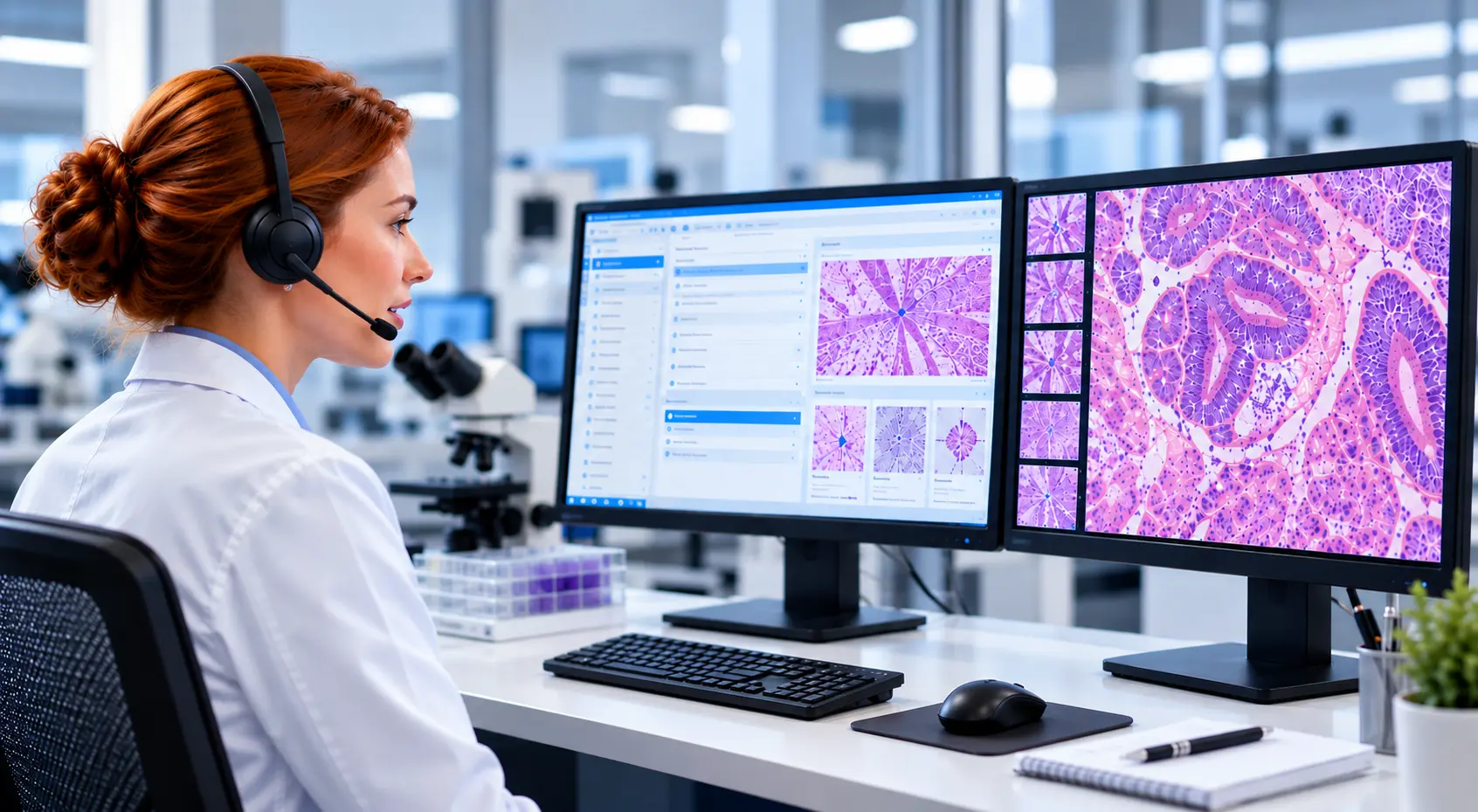
Digital Imaging: Digital pathology uses advanced imaging technology to capture high-resolution images of tissue specimens for on-screen review rather than traditional microscopy. When paired with a modern laboratory information system, digital images integrate seamlessly with diagnostic data within the laboratory report.
Image Analysis: Automated laboratory data analysis software can rapidly evaluate large volumes of digital pathology images, helping identify abnormalities such as cancer cells. These tools support pathologists by enhancing accuracy, consistency, and diagnostic confidence.
Report Generation: Automated clinical and pathology reporting software accelerates the creation of comprehensive diagnostic reports by summarizing analytical findings with precision. By reducing manual steps, automation minimizes the risk of errors and shortens the time to final diagnosis.
Industry Insights: The Rise and Fall of CoPath LIS - A Legacy Casualty of the Modern Lab Information System Era
Choosing the Best Laboratory Information System Software: What Modern Labs Need - and What to Avoid
A Word of Caution About Legacy LIS Software Platforms
Not all LIS software platforms offer the same level of automation or flexibility. While some laboratories operate with modern, highly automated information systems and data management solutions, others remain constrained by legacy LIS systems that are rigid, inflexible, and increasingly unreliable.
The best LIS software platforms combine advanced automation with comprehensive, highly configurable modules that can standardize both technical and financial processes, including laboratory revenue cycle management (RCM) and lab billing, while improving productivity and accuracy and integrating seamlessly with existing laboratory software systems.
Discover More: What You Need to Know Before Contracting with a Laboratory Information System (LIS) Company
Ready to Learn More?
Schedule a 15-minute introductory call with a LigoLab laboratory information system specialist to answer your initial questions.
Act Now: Speak with a Lab Information System Specialist!
Frequently Asked Questions About Laboratory Workflow Management and LIS System Automation
Why is laboratory workflow management so critical to patient safety and lab performance?
Laboratory workflow management directly determines whether specimens are processed accurately, results are delivered on time, and data remains consistent from order entry through final reporting. When information systems and data management are not optimized, processing errors and result delays occur, creating downstream consequences that impact patient care, increase compliance risk, and damage the lab's reputation with physicians and clients. In high-volume environments, every lab workflow inefficiency compounds quickly into significant operational and financial losses.
What are the most important best practices for maintaining data integrity in a medical laboratory?
The five most important best practices are implementing a robust quality control program that monitors test results and equipment performance, maintaining well-documented and regularly updated standard operating procedures, providing ongoing structured training for all laboratory staff, enforcing modern data security protocols, including encryption and access controls, and participating in external quality assurance and accreditation programs to validate performance against recognized industry standards.
How does LIS-driven automation reduce the risk of laboratory errors?
LIS-driven automation eliminates the manual data entry, paper-based tracking, and repetitive human decision-making steps that are most prone to error. Automated data entry eliminates transcription; automated specimen routing prevents misrouting and delays; automated validation checks flag inconsistencies before they propagate downstream; and automated result delivery ensures reports reach the right recipients through the proper channels, all without requiring staff to intervene at each step.
What role does a modern LIS system play in supporting digital pathology lab workflow?
A modern LIS system serves as the integration hub for digital pathology, capturing whole-slide images from scanners, automatically linking them to the correct case record, triggering AI-assisted image analysis based on defined parameters, and incorporating digital pathology results directly into the final diagnostic report. This seamless integration eliminates the manual data transfer and disconnected workflows that occur when digital pathology tools operate as standalone systems outside the LIS software.
Why are legacy LIS systems inadequate for modern laboratory workflow management?
Legacy LIS systems were designed for a previous era of laboratory operations, before digital pathology, AI-assisted analysis, high-volume molecular testing, and integrated lab billing became essential capabilities. They are rigid, difficult to configure without vendor intervention, unable to integrate smoothly with modern instruments and EHR systems, and incapable of supporting the level of automation that today's high-volume, cost-constrained labs require. Labs that remain on legacy LIS systems are effectively capped in their ability to optimize workflows or scale efficiently.
How does automated tissue processing and slide staining benefit high-volume pathology labs?
Automated tissue processing enables labs to handle multiple specimens simultaneously, with processors scheduled to run overnight, dramatically reducing turnaround times and increasing throughput without additional staff. Automated slide staining applies multiple stains with speed, consistency, and precision that manual staining cannot reliably achieve at scale. Together, these automation capabilities allow high-volume pathology labs to maintain quality and accuracy even as specimen volumes grow.
What should labs look for when evaluating LIS software for lab workflow automation capabilities?
Laboratories should verify that their LIS software platform includes a native rules engine capable of automating complex workflows through configurable conditional logic rather than custom programming. It should also provide an integrated interface engine for seamless connectivity with analyzers, EHR systems, and other third-party applications, along with real-time lab workflow queues that give staff complete visibility into specimen status throughout the testing process. Automated report generation and distribution should be standard features. Finally, labs should ensure the vendor delivers regular software updates that introduce new automation capabilities through a structured release process, eliminating the need for custom development or burdensome manual upgrades.