Blog
What is the Best LIS for Molecular Testing Labs?

September 16, 2026

If you are searching for the best laboratory information system (LIS) for molecular testing labs, you are likely facing a critical decision.
Molecular diagnostics has evolved rapidly. Testing complexity has increased. Reimbursement has tightened. Data volumes have exploded. And clinicians now expect faster, more actionable insights.
The LIS system that supported your lab five or ten years ago may no longer be sufficient.
Today’s molecular laboratories require a modern, scalable, and fully integrated molecular lab testing software platform built for precision medicine, interoperability, automation, and financial performance.
This guide explains what to look for and why legacy laboratory information systems are likely no longer enough for molecular LIS operations.
Discover More: The Best Laboratory Information Systems - LIS Software Solutions for Clinical and Pathology Labs
Why Have Legacy LIS Systems Become Obsolete for Molecular Labs?
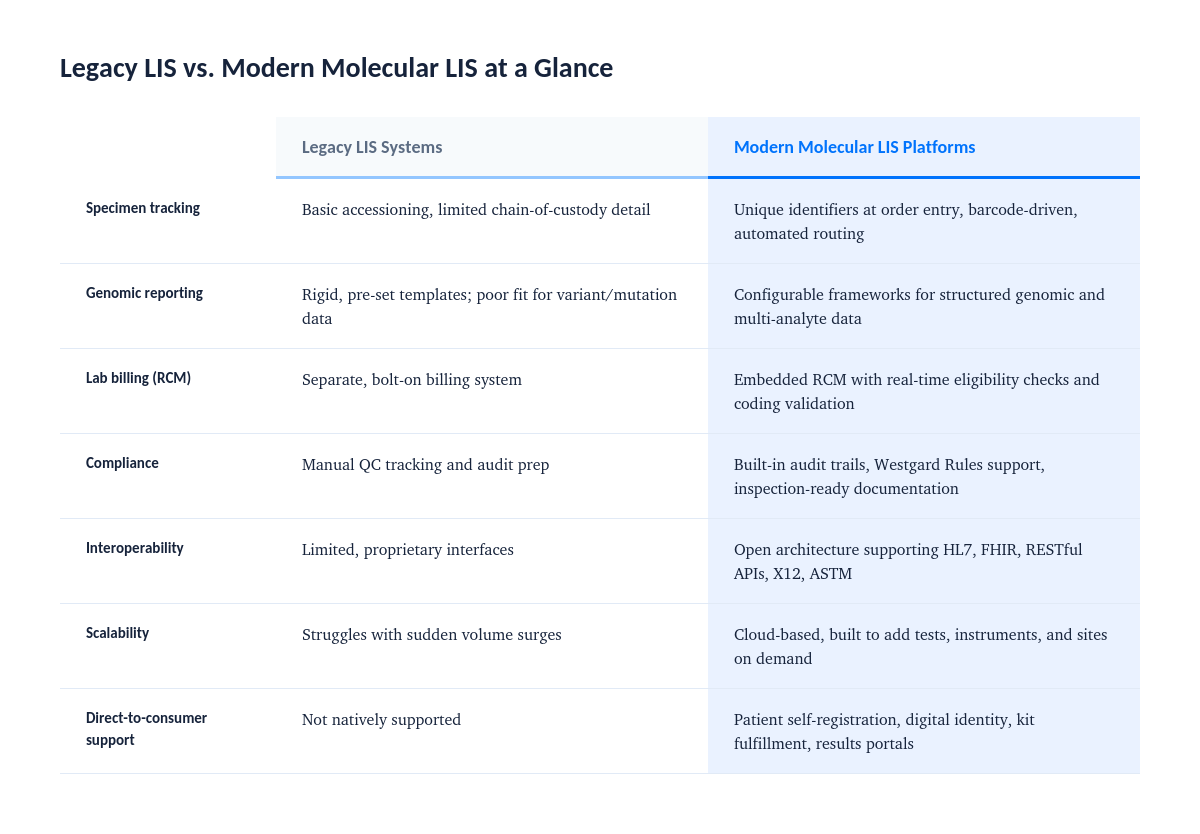
Molecular testing labs operate in one of healthcare's most dynamic segments. Over the past decade, nearly every aspect of the molecular laboratory ecosystem has transformed: lab workflow, service delivery expectations, reporting structures, instrumentation and automation, laboratory billing and reimbursement rules, third-party interoperability requirements, regulatory oversight, and patient consumerism.
Molecular labs are no longer tucked away as behind-the-scenes service providers. They now play a central role in oncology, infectious disease management, pharmacogenomics, hereditary testing, and population health. As testing grows more complex, demand on laboratory information systems grows too.
Many legacy LIS software platforms were originally designed for routine clinical chemistry or anatomic pathology environments. They often lack advanced specimen lifecycle tracking, flexible genomic reporting, embedded laboratory revenue cycle management (RCM) capabilities, real-time analytics, open interoperability architecture, and cloud scalability.
Molecular testing generates structured and unstructured datasets that are far more complex than standard lab results. Genomic variants, mutation panels, algorithmic interpretations, and multi-analyte profiles require configurable reporting frameworks and scalable databases. Older LIS systems struggle to adapt.
Discover More: Not All LIS Systems Are Created Equally
What Role Do Molecular Labs Play in Precision Medicine?
Precision medicine depends on molecular diagnostics. At the intersection of biospecimens and data, molecular labs interpret high-value clinical information that informs targeted cancer therapies, companion diagnostics, infectious disease detection, pharmacogenomic drug matching, and risk stratification and preventive care.
As diagnostic complexity increases, clinicians rely more on labs for clarity. Molecular laboratories are becoming clinical decision partners, not just result providers. This shift demands an advanced molecular lab software capable of structured genomic reporting, data-rich interpretation support, coding alignment (ICD/CPT), seamless EHR integration, and longitudinal patient data management.
Without a future-ready laboratory information system software platform, labs risk becoming bottlenecks instead of strategic contributors.
Discover More: A Scalable Solution for Molecular LIS Testing Labs

Can Your LIS Scale During Sudden Demand Surges?
The COVID-19 pandemic highlighted a key differentiator between molecular labs: scalability.
Labs on flexible, cloud-based medical LIS software platforms could rapidly add new test types, onboard additional instruments, expand specimen intake, automate reporting, integrate lab billing workflows, and support exponential volume growth.
Labs relying on rigid, legacy LIS systems often encounter delays, reporting backlogs, and revenue leakage. Scalability is no longer optional; it’s a survival requirement. The best molecular LIS platforms are engineered to handle sudden surges in testing volume without sacrificing performance, compliance, or financial integrity.
Get Insight: Unleashing Laboratory Excellence - Here’s How LigoLab’s Automation Engine Supercharges Lab Performance
What Core Features Should the Best Molecular LIS Include?
When evaluating molecular laboratory information systems, prioritize platforms that deliver these capabilities:
1. Unified Laboratory Workflow Management
Fragmented LIS systems create data silos. The best LIS software platforms unify order entry, accessioning, specimen tracking, testing workflows, reporting, lab billing, analytics, and compliance.
A unified infrastructure ensures end-to-end data integrity and eliminates redundant manual processes. When technical and financial workflows operate within the same environment, transparency improves, and operational friction decreases.
White Paper: Leveraging LIS & RCM Integration to Improve the Laboratory Billing Process
2. Advanced Specimen Management and Chain-of-Custody Tracking
Molecular testing depends on flawless specimen handling. Modern molecular LIS platforms assign unique identifiers at order entry, digitally track specimens at every stage, support barcode-driven workflows, minimize labeling errors, and enable automated routing.
Precise specimen lifecycle tracking protects patient safety and reduces costly rework.
Discover More: Reducing Risk in the Modern Laboratory - A Comprehensive Approach
3. Integrated Laboratory Revenue Cycle Management (Lab Billing)
Molecular diagnostics reimbursement is complex. Payer rules shift frequently. Prior authorization requirements evolve. Coding errors can trigger denials.
The best laboratory information system software embeds lab revenue cycle management (lab billing) directly into technical workflows, enabling real-time insurance eligibility checks, automated claim scrubbing, ICD/CPT coding validation, denial prediction and reduction, and laboratory billing initiation at the point of order entry.
Eliminating the separation between LIS and laboratory billing solutions improves clean claim rates and accelerates cash flow. Financial visibility becomes proactive, not reactive.
On-Demand Webinar: Outsourced vs. In-House Laboratory Billing - How to Make the Right Choice for Your Lab
4. Quality Control and Regulatory Compliance
Molecular labs operate under strict regulatory oversight, including CAP, CLIA, HIPAA, and state reporting mandates.
An advanced molecular LIS features built-in audit trails, quality control (QC) monitoring, support for Westgard Rules, automated alerts for abnormal readings, quality assurance (QA) tracking, and inspection-ready documentation.
Manual compliance management is risky and inefficient. Labs must embed compliance into the lab information system architecture.
Discover More: A Detailed Look at How Modern Laboratory Information Systems Fully Support Quality Control
5. Open Architecture and Interoperability
Interoperability is critical in modern diagnostics. A future-ready molecular LIS supports HL7, FHIR, RESTful APIs, XML, X12, ASTM, and CSV and flat file exchanges.
It connects seamlessly to EHR systems, analyzers and instruments, public health agencies, tumor registries, reference labs, and laboratory billing services. Interoperability determines how effectively a lab can collaborate across the healthcare continuum. Rigid LIS systems limit growth.
Get Insight: It’s Time for Medical Labs to Embrace the Potential of Laboratory Informatics
6. Real-Time Analytics and Performance Dashboards
Margin pressure in molecular testing is increasing. Reimbursement cuts and regulatory constraints require labs to operate with precision.
Modern LIS software platforms provide real-time analytics to monitor turnaround time (TAT), productivity, payer performance, denial rates, revenue trends, and operational bottlenecks. Data-driven leadership decisions are impossible without actionable insights. Analytics must be accessible, configurable, and embedded within daily workflows.
Industry Insights: Laboratory Information Systems and Their Key Role in Lab Data Analytics

Does a Molecular LIS Need to Support Direct-to-Consumer Lab Testing?
Patient consumerism is reshaping healthcare delivery. Molecular labs are increasingly exploring direct-to-consumer lab testing models that enable online test ordering, at-home specimen collection, digital results delivery, and telehealth consultations.
A modern molecular LIS can natively support direct-to-consumer labs. This includes patient self-registration, secure digital identity management, automated kit fulfillment, result distribution portals, and integrated lab billing.
Expanding into direct-to-consumer lab testing opens new revenue streams and strengthens brand visibility. However, success depends on a seamless, integrated informatics platform.
Discover More: Highlighting the Versatility of the TestDirectly Direct-to-Consumer Lab Testing Portal
Is a Fully Integrated All-in-One Informatics Platform Always the Right Choice for Molecular Labs?
Not for every lab, and it's worth saying so plainly. A very small, single-discipline molecular lab, for example, one running a narrow test menu for a research partner with no direct patient billing, may not need the full breadth of an all-in-one LIS + RCM platform. In that case, a lighter, more specialized molecular LIS solution focused purely on sample and data management could be more cost-effective, at least until the lab's billing complexity or test menu grows.
Likewise, a molecular lab operating as part of a larger health system already standardized on an enterprise EHR-based LIS may prioritize that existing integration over adopting an independent, best-of-breed molecular platform, even if it means sacrificing some genomic reporting flexibility.
For independent and mid-size molecular labs managing their own laboratory billing, navigating shifting payer rules, or planning to scale test volume and services, though, a modern, unified platform generally reduces the data silos and integration costs that come from stitching together separate laboratory software systems.
How Did Integration Impact Real-World Results?
Avero Diagnostics, a molecular testing lab, transitioned to an all-in-one medical LIS and lab billing platform to eliminate system fragmentation.
By integrating clinical workflows with laboratory revenue cycle management, the organization improved operational efficiency, increased data accuracy, and achieved a 35% increase in net collections.
Embedding the lab billing module within the LIS system reduced administrative overhead and improved financial transparency. This demonstrates how the right molecular lab software can directly impact revenue performance.
On-Demand Webinar: Unifying Technical and Financial Operations to Minimize Denials and Prevent Revenue Leakage
How Do You Future-Proof a Molecular Laboratory?
When evaluating the best laboratory information system for molecular testing labs, consider long-term adaptability. Healthcare LIS technology evolves quickly.
Your medical LIS platform should be cloud-based, continuously updated, configurable without heavy IT dependency, designed for integration with emerging AI tools, and scalable across multi-site operations.
Legacy LIS systems often require costly custom development to accommodate change. Modern LIS software platforms are built to evolve.
Industry Insights: From System of Record to System of Action - The Next Evolution of Laboratory Information Systems

What Are the Signs It's Time to Upgrade Your Molecular LIS?
You may need a new molecular LIS platform if your lab experiences:
- Workflow bottlenecks
- High denial rates
- Limited EHR integration
- Manual QC tracking
- Data silos between the LIS and laboratory billing system
- Difficulty scaling test volume
- Reporting limitations
- Compliance strain
An outdated LIS system quietly erodes margin and efficiency. Upgrading to a modern molecular LIS platform unlocks measurable improvements in productivity, revenue, and scalability.
Discover More: Comparing LigoLab Informatics Platform with Legacy Laboratory Information System Software
The Strategic Value of a Modern Molecular LIS
The best LIS for molecular testing labs connects clinical, operational, and financial workflows into a unified infrastructure. It enables labs to support precision medicine, scale during high-demand periods, maintain compliance, strengthen payer performance, expand into direct-to-consumer markets, and integrate seamlessly with healthcare partners.
In today's challenging and competitive environment, molecular labs must be agile, interoperable, and data-driven. That requires an advanced laboratory information system built for complexity and growth.
Get Insight: Best LIS Software - Maximize Growth With Cutting-Edge Pathology Lab Management Software
Continue Your Research
- Solution Page: A Scalable Solution for Molecular LIS Testing Labs
- Platform Comparison: Comparing LigoLab Informatics Platform with Legacy Laboratory Information System Software
- Buyer's Guide: Best LIS Software - Maximize Growth With Cutting-Edge Pathology Lab Management Software
- Direct-to-Consumer Lab Testing: Highlighting the Versatility of the TestDirectly Direct-to-Consumer Lab Testing Portal
Is Your Molecular Lab Ready for the Next Phase of Growth?
If your molecular lab is preparing to expand services, increase testing volume, improve revenue performance, strengthen interoperability, or reduce operational friction, evaluating your LIS system is a critical first step. A future-ready molecular LIS can transform your lab from a transactional testing facility into a high-performance, precision-driven clinical partner.
Don’t Wait: Speak with a LigoLab Product Specialist!
Frequently Asked Questions About the Best LIS for Molecular Testing Labs
What makes a molecular LIS different from a general-purpose LIS system?
A molecular LIS is built to handle structured and unstructured genomic data, such as variant calls, mutation panels, and multi-analyte profiles, requiring configurable reporting frameworks and scalable databases that general-purpose or legacy LIS systems typically lack.
Why do legacy LIS systems struggle with molecular testing labs?
Many legacy LIS software platforms were designed for routine clinical chemistry or anatomic pathology and lack advanced specimen lifecycle tracking, flexible genomic reporting, embedded lab revenue cycle management, real-time analytics, and open interoperability, all of which molecular testing requires.
What is chain-of-custody tracking, and why does it matter for molecular labs?
Chain-of-custody tracking assigns unique identifiers to specimens at order entry. It digitally tracks them through every stage of testing via barcodes, minimizing labeling errors and protecting both patient safety and data integrity.
How does an integrated LIS and lab RCM platform reduce claim denials?
By embedding laboratory revenue cycle management directly into technical workflows, organizations gain real-time insurance eligibility checks, automated claim scrubbing, and coding validation starting at order entry, catching issues before they become denials.
Can a molecular LIS support direct-to-consumer lab testing?
Yes, a modern molecular LIS can natively support patient self-registration, secure digital identity management, automated kit fulfillment, and results distribution portals to enable direct-to-consumer lab testing models.
Is an all-in-one LIS and RCM platform necessary for every molecular lab?
Not always. Small, single-discipline labs with minimal lab billing complexity, or labs already standardized on an enterprise EHR-based system, may be better served by a narrower point solution. Independent and mid-size labs that manage their own lab billing and scale test volume typically benefit most from a unified platform.
What are the clearest signs a molecular lab needs to upgrade its LIS?
Common warning signs include workflow bottlenecks, high denial rates, limited EHR integration, manual QC tracking, data silos between the LIS and laboratory billing system, difficulty scaling volume, reporting limitations, and compliance strain.