Blog
Molecular Labs Hold the Key to Evidence-Based Precision Medicine
September 18, 2026

Editor’s Note: A version of this article was originally published in MedCity News on August 12, 2021.
Molecular Labs Hold the Key to Evidence-Based Precision Medicine
Molecular testing labs are becoming central to evidence-based precision medicine (EBLM), supplying much of the clinical data behind personalized treatment decisions. The CDC reports that 70 percent of medical decisions rely on lab results, and molecular labs need modern laboratory information system (LIS) software platforms built for scalability, specimen tracking, decision support, and integrated lab revenue cycle management (RCM) to keep pace with this expanding role.
Why Are Molecular Testing Labs Becoming More Prominent in Healthcare?
Like many parts of the healthcare industry, molecular testing laboratories are evolving incredibly fast. Almost daily, advances emerge in everything from instrumentation to service delivery. No longer the mysterious hidden function tucked away in a remote part of the hospital, molecular testing labs are becoming a much more prominent part of the overall healthcare package.
One reason for this new prominence is the increased emphasis on data-driven personalized care.
"Molecular testing labs play an important role within evidence-based precision medicine," stated Avero Diagnostics Chief Operating Officer Jennifer Bull. "A big reason why there is increased demand for molecular testing labs is that biochemical and molecular genetics are moving medical care forward. Molecular labs are quite literally responsible for providing much of the evidence for evidence-based precision care."
Discover More: What is the Best LIS for Molecular Testing Labs?

What Is Evidence-Based Laboratory Medicine (EBLM)?
Evidence-based laboratory medicine is a unique branch of medicine that focuses on evaluating and using laboratory tests to improve patient outcomes.
This means enterprises using LIS systems with molecular lab testing software modules are becoming key collectors and interpreters of data from biological specimens, helping clinicians better understand pathways and treatment options, including drug selection, specialized therapeutics, and other treatments.
As EBLM evolves, diagnostic tests, particularly in molecular medicine, have become so complex that physicians and their staff often struggle to interpret them. As a result, labs are increasingly relied on to help healthcare providers understand the clinical significance of these test results.
Get Insight: A Scalable Solution for Molecular LIS Testing Labs
How Has the Molecular Lab's Role Shifted From Back-Office to Frontline Partner?
"One of the biggest changes we’ve experienced recently is in the role that labs now play regarding the diagnosis and treatment of disease," added Bull. "Traditionally, medical labs were only tasked with processing specimens and issuing reports. But because they have become so adept at understanding the treasure trove of medical data collected, labs are becoming a bigger part of the treatment team."
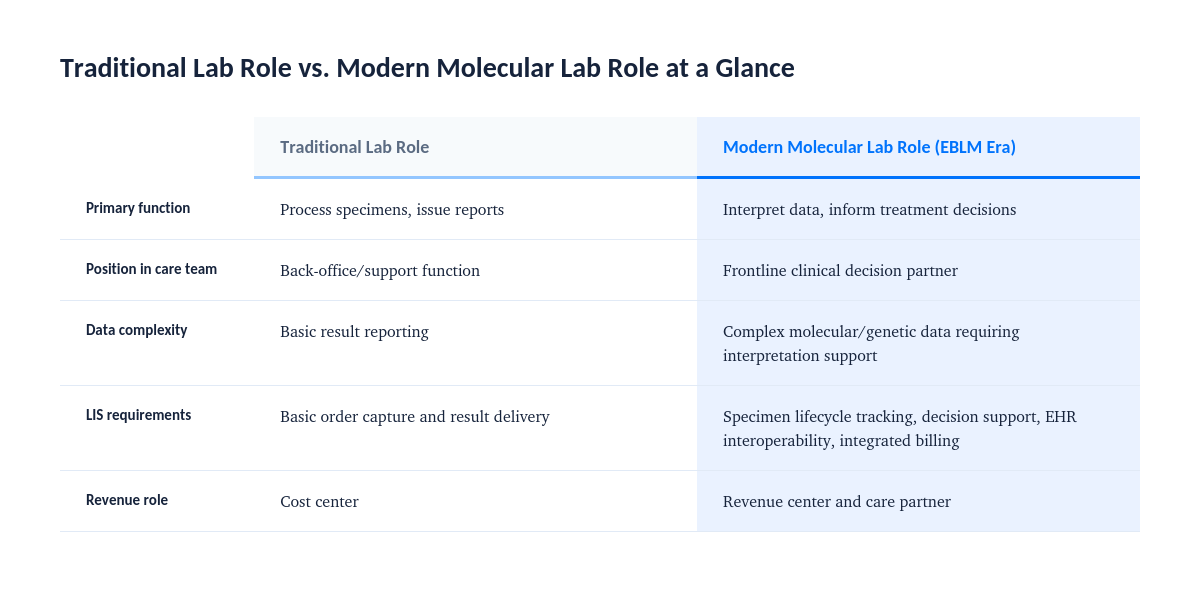
However, not all molecular lab software can fill this role, as some directors and managers still run legacy laboratory information system software, adding strain to heavy workloads.
To keep pace with the growing importance of advanced laboratory medicine, industry leaders are increasingly adopting future-ready molecular LIS technology to drive innovation and meet evolving diagnostic demands.
Discover More: How Test Orders are Accessioned in the Lab with LigoLab's Molecular LIS System

What Pressures Does the Growing Volume of Lab Testing Create?
Without the right diagnostic lab software and streamlined operating procedures, laboratories risk compromising safety, quality, and cost control, ultimately affecting the accuracy and timeliness of disease diagnosis and treatment.
What Should Modern Molecular LIS Platforms Include?
"Modern molecular labs require laboratory information systems that go beyond basic order capture and result delivery," said LigoLab CEO Suren Avunjian. "Labs need molecular LIS systems that ensure flexibility within and beyond an organization's network, feature specimen lifecycle tracking and support, promote scalability and efficiency, and enhance a lab's value as a revenue center and care partner."
LigoLab is a leading provider of molecular lab software, offering advanced LIS system solutions tailored to meet the demands.
"Traditional LIS systems no longer cut it in today's clinical lab environment," added Avunjian. "Molecular labs need molecular LIS systems that can connect across all corners of the diagnostic landscape, including instrumentation, lab management analytics, robust decision support, effective quality controls, third-party interoperability with electronic health record (EHR) systems, decision population health tools, and other laboratory software systems."
Avero Diagnostics (formerly Northwest Laboratory and Northwest Pathology) is a great example here, having provided a wide range of laboratory services for 30 years. The fast-growing, full-service, multi-state lab operation realized early on that a traditional LIS wouldn’t support its growth plans, so a decade ago partnered with LigoLab for its lab information system and in-house laboratory billing software solutions.
Get Insight: Maximizing Your Lab’s Profitability - The Case for In-House Lab Billing
Is Every Molecular Lab Ready to Take on a Frontline Clinical Role?
Not necessarily, and that's a fair question to ask before investing in a heavier platform than a lab actually needs. Contract and reference labs that process specimens for a large health system or biotech partner, without direct clinician-facing reporting responsibilities, may intentionally stay in a narrower, back-office role. For these labs, a simpler LIS focused on accurate, fast specimen processing may be more cost-effective than a full-featured platform built for decision support and population health tools they don't use.
Similarly, labs running only a handful of routine molecular assays, such as basic infectious disease PCR panels, may not yet need the heavier genomic interpretation tooling that oncology-focused or hereditary-testing labs require. As test menus expand into more complex genomic and multi-analyte territory, though, the case for a more capable molecular LIS grows quickly.
What Does the Future Hold for Molecular LIS Labs?
Despite the challenges that molecular lab directors and managers face, the future of evidence-based precision medicine remains bright for patients and the healthcare industry. Patients with complex or rare illnesses have better prospects than in the past, and molecular labs play a major role in that.
As the future unfolds, technological developments and the best laboratory information system software will help these organizations meet the challenges ahead, especially as molecular analysis tools continue to revolutionize disease diagnosis and treatment.
Take DNA analysis as one example. Today, clinicians can diagnose conditions that previously went unidentified, assess a patient's genetic risk for specific diseases, personalize treatment plans, and closely track how effectively a patient is responding to therapy.
Given their critical role in evidence-based precision medicine, molecular laboratories are poised for continued growth and innovation. However, labs that delay investment in modern molecular lab software and LIS system technology risk falling behind. That would be a missed opportunity, not only for patient care but also for driving cost efficiency across the entire healthcare system.
Industry Insights: Business Success Through Advanced Laboratory Information System Technology - Connecting All The Pieces
What Does LigoLab's Molecular Lab Testing Software Include?
As a comprehensive enterprise-grade laboratory information system software solution, the all-in-one LigoLab Informatics Platform includes modules for anatomic pathology, clinical laboratory, molecular diagnostics, laboratory billing, and direct-to-consumer lab testing (TestDirectly), all on a single, unified lab database software infrastructure that's infinitely configurable and that supports every department, role, and case.
LigoLab's medical LIS software also features end-to-end specimen barcoding and sample tracking, a comprehensive and searchable audit trail, compliance checkpoints at every step, an integrated interface engine, flexible rules and automation tools, and fully customizable reporting with multiple distribution options. With these capabilities, clinical laboratories can operate more efficiently, differentiate their services, and strengthen profitability as they grow.
Case Study: A Conversation With LIS System Administrator Kristie Becerra
How Does Integrated Lab Billing Reduce Denials for Molecular Labs?
LigoLab's advanced, embedded laboratory billing solutions are directly tied to the LIS software platform, enabling laboratory revenue cycle management to begin the moment an order is entered.
In addition, LigoLab strengthens the lab RCM cycle with real-time insurance verification, automated eligibility checks, claim scrubbing, and built-in ICD and CPT coding. Every lab billing function runs within LigoLab's live, queue-based workflow, giving organizations full visibility and creating seamless, end-to-end efficiency across medical LIS and lab RCM operations.
Get Insight: Six Reasons Why You Should Choose an Integrated Laboratory Billing Solution for Your Medical Lab
Continue Your Research
- Buyer's Guide: What is the Best LIS for Molecular Testing Labs?
- Solution Page: A Scalable Solution for Molecular LIS Testing Labs
- Case Study: A Conversation With LIS System Administrator Kristie Becerra
- Lab Billing: Six Reasons Why You Should Choose an Integrated Laboratory Billing Solution for Your Medical Lab
Ready to Modernize Your Lab Operations and Boost Revenue Performance?
Contact LigoLab today and request a brief introductory call to learn more.
Don’t Wait: Speak with a LigoLab Product Specialist!
Frequently Asked Questions About Molecular Labs and Precision Medicine
What is evidence-based laboratory medicine (EBLM)?
EBLM is a branch of medicine that evaluates and uses laboratory tests to improve patient outcomes, positioning molecular labs as key collectors and interpreters of the biological data behind precision medicine decisions.
Why are molecular labs becoming more central to patient care?
As molecular and genetic testing has grown more complex, physicians increasingly rely on labs to interpret results and provide clinical guidance, shifting labs from a back-office processing function to a frontline role on the care team.
How much of medical decision-making depends on lab test results?
According to the CDC, 70 percent of today's medical decisions depend on laboratory test results, underscoring how central diagnostic labs, including molecular labs, are to modern healthcare.
Does every molecular lab need advanced decision-support LIS features?
Not necessarily. Contract or reference labs without direct clinician-facing responsibilities, or labs running only routine assays, may not need the full decision-support and population health tooling that oncology- or hereditary-testing-focused labs require.
What should a modern molecular LIS platform include?
Look for specimen lifecycle tracking, scalability, decision support, quality control, EHR interoperability, and integrated laboratory billing capabilities that go well beyond basic order capture and result delivery.
How does integrated lab billing benefit molecular labs specifically?
By addressing eligibility, coding, and payer requirements at order entry, integrated billing can reduce late-stage denials by up to 98 percent and improve net collections, which matters given how complex molecular diagnostics reimbursement has become.