Blog
A Scalable Solution for Molecular LIS Testing Labs

November 5, 2026

Executive Summary: Molecular testing labs need a laboratory information system (LIS) that goes beyond order capture and result delivery, with specimen lifecycle traceability, scalability, quality control, and broad interoperability. LigoLab's all-in-one informatics platform adds specimen-specific identifiers at order entry, Westgard and Lean Six Sigma QC, an interface engine supporting FHIR and HL7, and direct-to-consumer lab testing through TestDirectly.
As the molecular laboratory ecosystem evolves, so too must the laboratory information systems that support it. Traditional clinical laboratory management and pathology lab reporting software is quickly becoming obsolete as modern LIS systems help labs navigate an ever-changing environment with agility and ease. The all-in-one LigoLab Informatics Platform, which integrates laboratory information system functions and lab billing into a single unified lab database software infrastructure, leads the way.
Discover More: The Benefits of a Modern Pathology Lab Management System
What Do Molecular Testing Labs Need From an LIS System at a Glance?
How Is the Molecular Lab Testing Software Landscape Changing?
Molecular lab testing software is changing significantly across multiple dimensions, including clinical lab workflow, service delivery, reporting structures, lab instrumentation, reimbursement procedures, and third-party interoperability. These changes are driving the need for a molecular LIS that can adapt to and support evolving needs.
What Role Does Molecular Lab Software Have in Healthcare Delivery?
Molecular lab software plays an increasingly prominent role in results delivery within LIS healthcare ecosystems. The molecular LIS has shifted from a workhorse hidden in hospital basements to a vital, visible component of modern care delivery. As a result, molecular labs now require modern laboratory information system software that offers more than just basic order capture and result delivery.
Key features of advanced molecular LIS platforms for testing labs include flexibility within and beyond the lab's network, specimen lifecycle traceability and sample tracking, and scalability and efficiency.
"Molecular LIS testing laboratories are essential to today's precision-driven healthcare landscape,” said Suren Avunjian, LigoLab CEO. “Breakthroughs in biochemical and molecular genetics are fueling the growth of precision medicine, creating demand for advanced capabilities. We understand their unique needs and have created an advanced medical LIS system that is not only agile but also helps these labs scale their operations efficiently."
Discover More: Automation in Pathology Labs Using Advanced LIS System Software

How Does the LigoLab Informatics Platform Deliver Agility and Scalability for Molecular Testing Labs?
LigoLab has developed an advanced clinical laboratory management and pathology lab reporting software platform that is agile and helps molecular testing labs scale operations efficiently. The platform's molecular lab software module effectively kept pace with unprecedented demand during the COVID-19 pandemic, demonstrating its power and adaptability.
"The fastest-growing laboratories in the U.S. during the pandemic were LigoLab molecular LIS system customers,” added Avunjian. “All of our molecular lab partners scaled their volumes exponentially, and some witnessed explosive growth."
Discover More: How Molecular Test Orders are Accessioned with LigoLab's LIS System
How Is Precision Medicine Driving Growth in Molecular Lab Testing?
As precision medicine advances, molecular labs are taking on increasingly significant roles within the LIS healthcare ecosystem. With advanced technology, molecular lab testing software support, and innovative laboratory information system companies, these important labs can adapt to manage complex diagnostic tests, support the broader diagnostics and treatment team, and leverage emerging digital technologies to unlock new revenue.
"When we say that molecular testing labs are coming out of the basement, this is what we mean. Today's labs go well beyond traditional collection and reporting. They are now often part of the broader diagnostics and treatment team,” Avunjian said.
Discover More: Introducing a New Revenue Source for Labs
How Are Molecular LIS Labs Interpreting Data-Rich Biospecimens?
Molecular testing laboratories are taking on an increasingly important role in interpreting complex, data-rich biospecimens, helping clinicians better understand disease pathways and make informed decisions about treatment options, including drug selection and targeted therapies. As diagnostic testing becomes more sophisticated, these laboratories rely on advanced molecular LIS software to manage complex data, streamline workflows, and deliver meaningful diagnostic insights that support clinical decision-making and personalized patient care.
While some molecular lab directors may resist expanding their roles within the healthcare ecosystem, forward-thinking lab leaders recognize the value clinical labs bring to advancing medicine and turn to modern laboratory information system platforms with comprehensive suites of applications for molecular testing operations and support.
Industry Insights: A State of the Lab Industry Discussion with Stan Schofield
How Can a Future-Ready Informatics Platform Unlock New Revenue Opportunities?
LigoLab's comprehensive informatics platform enables opportunistic lab operators to leverage emerging digital technologies and the rapid growth of patient consumerism.
One way testing organizations can achieve this is by offering direct-to-consumer lab testing services, including diagnostic and preventive screenings. This model supports online test ordering, home kit delivery, specimen processing and tracking, automated report delivery (consumer lab reports), and virtual consultations when needed.
"The TestDirectly platform enables laboratories to become direct-to-consumer labs as they gain visibility and grow their brands while aligning with consumers and providing them with a streamlined and unified experience,” Avunjian said.
Discover More: Highlighting the Versatility of the TestDirectly Direct-to-Consumer Lab Testing Portal

What Is the Avero Diagnostics and LigoLab Success Story?
LigoLab's flexible platform has helped numerous labs, including Avero Diagnostics (formerly Northwest Laboratory and Northwest Pathology), achieve remarkable growth and operational and financial efficiency.
How Did Avero Diagnostics Achieve Sustained Growth and Efficiency?
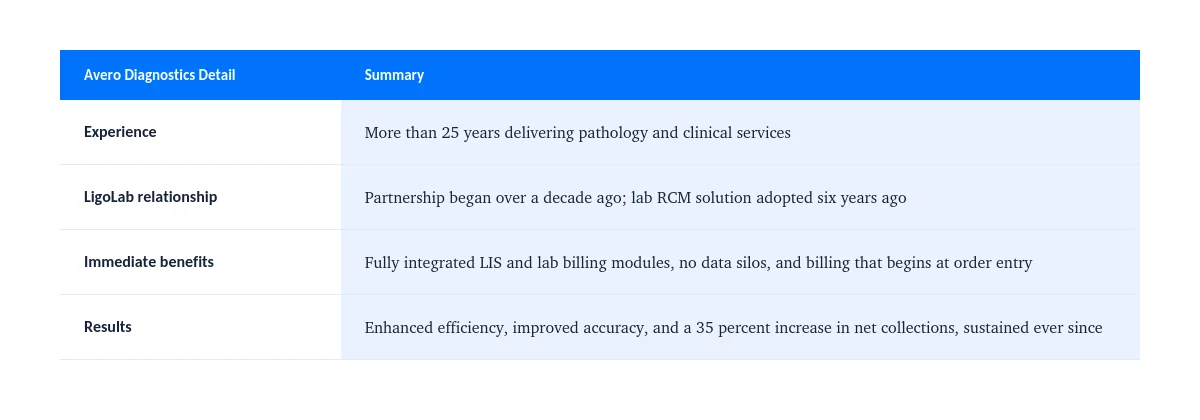
Avero Diagnostics has successfully delivered pathology and clinical services for more than 25 years. Its LigoLab partnership began over a decade ago, and seven years ago, it adopted LigoLab's laboratory revenue cycle management (RCM) solution. The transition delivered immediate benefits, including fully integrated medical LIS and lab billing modules, eliminated data silos, and a laboratory billing process that begins at order entry.
Within months of partnering with LigoLab, Avero experienced substantial improvements in operational efficiency and accuracy, along with a 35 percent increase in net collections that has been sustained over time.
Case Study: Leveraging LIS & RCM Integration to Improve the Laboratory Billing Process
Why Does Agility Matter When Choosing an LIS System for Molecular Labs?
Conventional laboratory information systems can no longer keep pace with the demands of today's pathology and clinical testing laboratories. Molecular labs need a lab information system that connects across the diagnostic landscape, including instrumentation, lab management and analytics, robust decision support, effective quality controls, third-party interoperability with EHRs and other laboratory software systems, and population health tools.
LIS systems lacking this level of flexibility are unlikely to help users expand their LIS healthcare network connections or evolve their diagnostic offerings as new opportunities emerge.
"When molecular testing laboratories shop for laboratory information systems and interact with LIS software vendors, they should carefully consider whether or not the LIS model they are evaluating can provide reliable interoperability and interfaces with an ever-changing array of healthcare partners and other mission-critical technologies,” noted Avunjian. “ It's not only about what the LIS system can do today, but it's also about how future-ready it is. LigoLab is a pathology and clinical laboratory management software built for success both today and tomorrow."
Discover More: Not All LIS Systems Are Created Equally
What Are LigoLab's Standout Laboratory Information System Functions?
The LigoLab platform is a fully integrated LIS software solution that equips a modern molecular testing laboratory with all the modules needed to perform specialized diagnostic testing with peak efficiency.
What Does Unified Lab Management Provide?
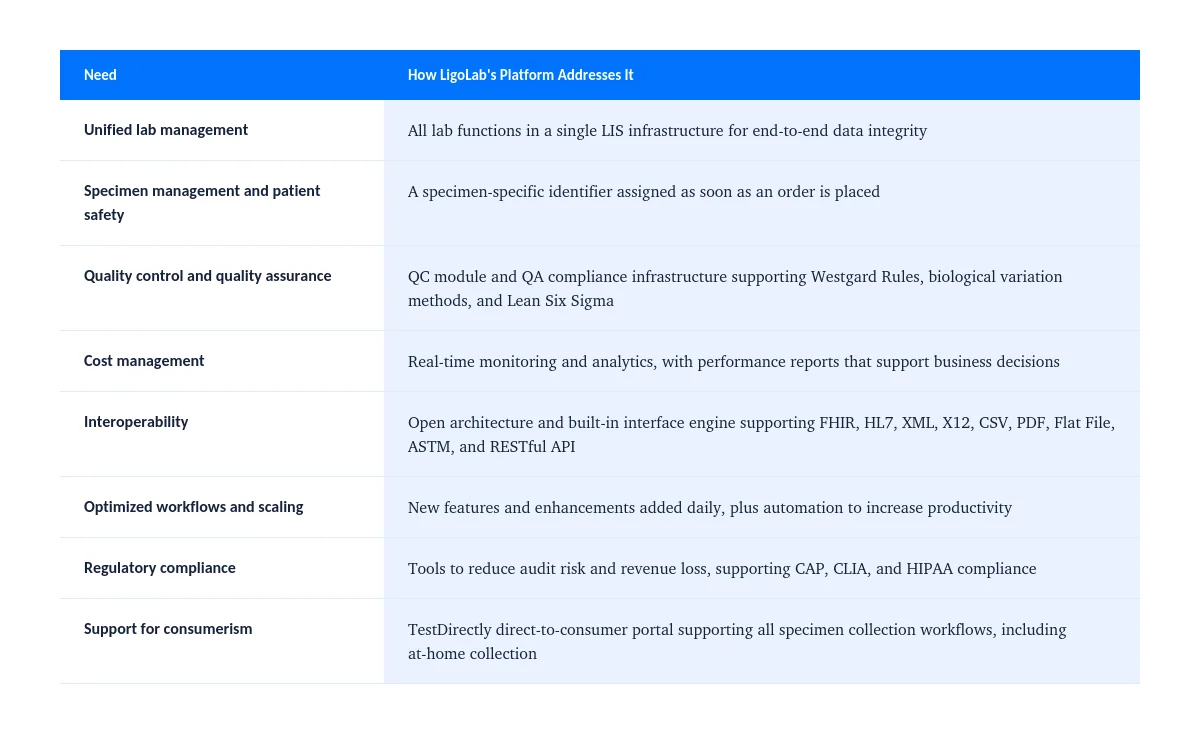
The platform unifies all lab functions within a single LIS software infrastructure and management system, ensuring end-to-end data integrity and seamless operations.
How Does Specimen Management Support Patient Safety?
An error-free lab sample management system is essential for flawless laboratory operations. LigoLab assigns a specimen-specific identifier as soon as an order is placed, ensuring an error-free sample-tracking workflow.
How Does the Platform Support Quality Control and Quality Assurance?
LigoLab's QC module and QA compliance infrastructure enable accurate testing, precise report distribution, and closely monitored operations. The platform supports various QC methodologies, including Westgard Rules, biological variation methods, and Lean Six Sigma.
How Does the Platform Help With Cost Management?
Cost control has become essential for molecular laboratories. LigoLab's LIS medical software provides real-time monitoring and analytics, enabling users to generate performance reports that deliver actionable insights to support more informed business decisions.
What Interoperability Does the Platform Offer?
LigoLab features an open lab organization software architecture with a built-in interface engine that provides maximum interoperability, enabling the lab information system platform to connect seamlessly with most analyzers, EHRs, and third-party plug-ins. This includes the internal LIS system and lab revenue cycle management networking, as well as connections to external bodies such as lab billing services, the Tumor Registry, and state reporting agencies.
The interface engine supports all standard interchange protocols, including FHIR, HL7, XML, X12, CSV, PDF, Flat File, ASTM, and RESTful API.
Discover More: LigoLab Delivers the LIS System Interoperability Needed to Transform Medical Laboratories into Thriving Businesses
How Does the Platform Optimize Workflows and Business Scaling?
LigoLab constantly evolves, adding new features and enhancements to its lab information system platform daily. With domain expertise, best LIS practices, and customer feedback, LigoLab helps customers automate processes, boost productivity, and scale quickly.
Discover More: Leveraging LigoLab for Optimal Return on Investment - An LIS System Guide for Lab Directors
How Does the Platform Make Regulatory Compliance Easier?
Without a flexible LIS system, compliance is challenging and labor-intensive. LigoLab offers specialized tools that reduce audit risk and revenue loss, helping users comply with CAP, CLIA, and HIPAA.
How Does the Platform Support Consumerism?
With LigoLab, medical laboratories can interact with patients while expanding laboratory services. The TestDirectly direct-to-consumer lab testing portal makes this possible by replacing paper forms and manual processes with a simplified digital lab workflow that starts with patient self-registration and eliminates the potential for human error, order-entry bottlenecks, reporting delays, and patient and provider frustration.
The cloud-based TestDirectly portal supports all forms of direct-to-consumer lab testing, including sexually transmitted infections, urinary tract infections, allergy testing, and genetic screening, as well as all specimen collection workflows, including at-home collections.
Discover More: Comparing LigoLab Informatics Platform with Legacy Laboratory Information System Software
Is LigoLab the Right Fit for Every Molecular Lab?
Not necessarily, as molecular laboratories have diverse operational needs, testing specialties, and technology requirements. Laboratories operating within larger health systems may prioritize seamless integration with existing electronic health records (EHRs), centralized patient data, and unified IT management. Meanwhile, laboratories specializing in complex sequencing or genetic variant interpretation should carefully evaluate how well a molecular LIS integrates with their existing bioinformatics platforms and diagnostic interpretation tools to ensure efficient workflows and reliable data exchange.
For molecular labs that need strong specimen traceability, QC, interoperability, and integrated billing in one platform, though, the capabilities described here are the right questions to hold every vendor to.
Continue Your Research
- Best LIS for Molecular Labs: What is the Best LIS for Molecular Testing Labs?
- Molecular Accessioning: How Molecular Test Orders are Accessioned with LigoLab's LIS System
- New Revenue Sources: Introducing a New Revenue Source for Labs
- Interoperability: LigoLab Delivers the LIS System Interoperability Needed to Transform Medical Laboratories into Thriving Businesses
- Billing Case Study: Leveraging LIS & RCM Integration to Improve the Laboratory Billing Process
Ready to Discover LigoLab's Scalable LIS Software Solutions?
Learn more about LigoLab's scalable laboratory information system software and the LIS company behind it by requesting a demo or scheduling a quick consultation with an experienced product specialist.
Don’t Wait: Connect with a LigoLab Specialist!
Frequently Asked Questions About Molecular LIS Software and LigoLab's All-in-One Medical LIS & Lab Billing Platform
What is a molecular LIS, and why do molecular testing labs need a specialized solution?
A molecular LIS solution is a laboratory information system software module specifically designed to support the complex workflows of molecular testing laboratories, including order management, specimen tracking, result reporting, and interoperability with advanced instruments and EHRs. As molecular testing has grown more complex and central to precision medicine, generic LIS platforms can no longer meet these labs' specialized demands.
What role are molecular labs playing in precision medicine?
Molecular labs are becoming vital interpreters of data-rich biospecimens, helping clinicians understand clinical pathways and select appropriate drug therapies and specialized therapeutics. As diagnostic tests grow more complex, molecular LIS software and clinical/pathology reporting software play a critical role in helping healthcare providers comprehend and act on specific results.
What interoperability capabilities does LigoLab's molecular LIS offer?
LigoLab features an open architecture with a built-in interface engine that connects to most analyzers, EHRs, and third-party systems. It supports standard interchange protocols, including FHIR, HL7, XML, X12, CSV, PDF, Flat File, ASTM, and RESTful API, plus external connections to lab billing services, the Tumor Registry, and state reporting agencies.
What quality control methodologies does LigoLab's platform support?
LigoLab's QC module supports multiple quality control methodologies, including Westgard Rules, biological variation methods, and Lean Six Sigma, enabling accurate testing, precise report distribution, and closely monitored operations that meet accreditation standards.
What results did Avero Diagnostics achieve after partnering with LigoLab?
Within months of adopting LigoLab's fully integrated medical LIS and lab billing platform, Avero Diagnostics reported greater efficiency, improved accuracy, and a 35 percent increase in net collections, gains it has sustained ever since.
Is LigoLab the right fit for every molecular lab?
Not always. Labs inside health systems standardized on an enterprise EHR may weigh a single patient record heavily, and labs with complex sequencing or variant-interpretation workflows should ask how any LIS connects to bioinformatics tools. Request named references and a demo of your own instrument and EHR interfaces.