Blog
Mastering Lab Operations: A Guide to Clinical Laboratory Management Solutions

October 7, 2026

Executive Summary: Modern clinical laboratory management centers on a unified laboratory information system (LIS) and lab revenue cycle management (RCM) platform that automates the seven-step revenue cycle, from preregistration through patient collections, while also managing specimen data, reducing denials, and controlling costs. Integrated platforms outperform fragmented LIS-plus-standalone-billing setups by synchronizing clinical and financial workflows from case creation.
Healthcare organizations increasingly rely on advanced clinical laboratory management solutions to enhance efficiency, accuracy, and financial performance. At the center of these solutions is the modern laboratory information system (LIS), a powerful informatics platform designed to streamline laboratory workflow management, support large volumes of diagnostic data, and optimize laboratory billing operations.
Modern LIS software platforms let laboratories automate key steps across the diagnostic process, from specimen accessioning and testing to result reporting and reimbursement. By linking clinical lab workflow with laboratory billing, advanced LIS systems reduce errors, accelerate turnaround times, and help laboratories operate more efficiently.
Even more valuable are integrated medical LIS and laboratory revenue cycle management (RCM) solutions that unify laboratory workflow management and billing within a single unified platform. This integration lets laboratories manage complex billing processes while maintaining accurate clinical data throughout the entire case lifecycle.
Discover More: Best Pathology Lab Reporting Software - Buyer’s Guide and Checklist
What Are the Key Benefits of Integrated Medical LIS and Laboratory Billing Solutions?
Modern laboratory information systems with integrated lab revenue cycle management provide a comprehensive framework for managing both clinical and financial workflows. A well-designed laboratory billing system leverages each step of the RCM cycle to optimize accuracy and efficiency.
What Are the Key Components of the Laboratory Billing Process?
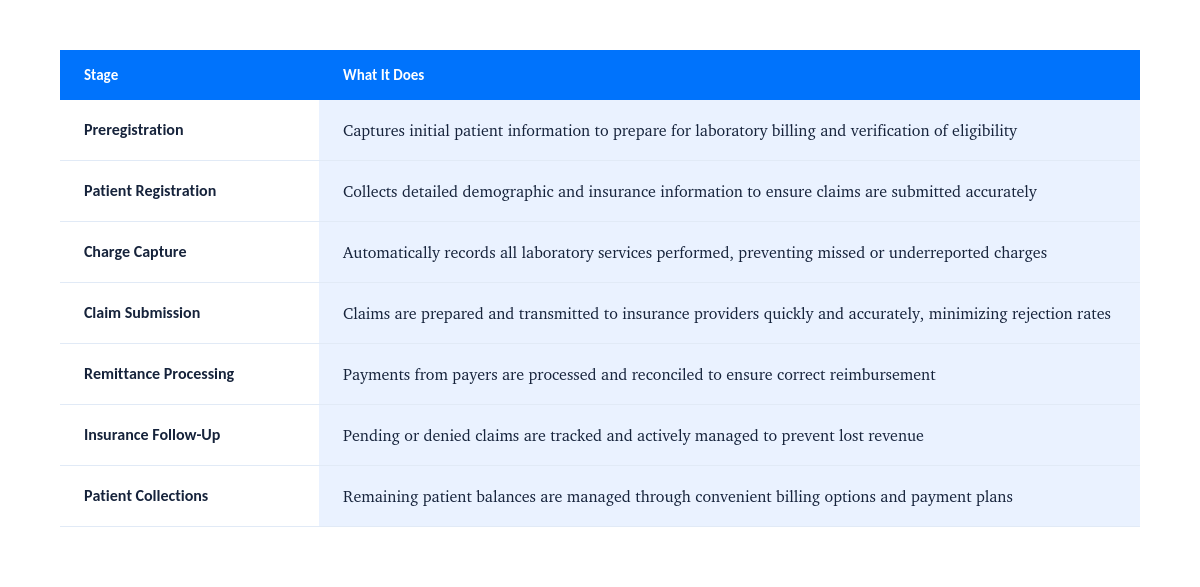
By unifying these processes within the LIS lab workflow, testing organizations can significantly improve billing accuracy and laboratory profitability.
Get Insight: LigoLab’s Professional Tier - A Powerful Laboratory Information System Solution for Growing Laboratories
How Do Integrated Systems Reduce Laboratory Billing Denials?
Denied claims are one of the most costly challenges in laboratory billing. They consume staff resources, delay payments, and reduce overall revenue.
Advanced medical LIS software with integrated laboratory billing solutions helps reduce claim denials through several mechanisms:
- Improved Data Accuracy: Capturing accurate patient and insurance information at order entry reduces billing errors later in the process.
- Automated Insurance Verification: Automatically verifying insurance eligibility before services are rendered.
- Real-Time Error Detection: Identifying potential issues before claim submission, enabling proactive corrections that reduce denials and improve clean claim rates.
By identifying and resolving problems earlier in the workflow, laboratories can dramatically increase their first-pass claim acceptance rate.
Discover More: Why Integrated LIS System and Lab RCM Software is a Catalyst for Growth
.webp)
How Do Integrated Systems Optimize Laboratory Cost Management?
Operational inefficiencies can drive up laboratory costs and reduce an organization's medical laboratory profit. Modern LIS software with integrated RCM tools helps control costs through automation and better operational visibility.
- Reduced Errors: Automated labs create workflows that help prevent common mistakes such as specimen misidentification, incorrect coding, and missing documentation.
- Improved Resource Utilization: Automation reduces repetitive manual tasks, enabling laboratory staff to focus on higher-value work.
- Data-Driven Insights: Modern LIS systems include reporting dashboards and analytics tools that help laboratory leaders identify inefficiencies, monitor performance metrics, and make better operational decisions.
Discover More: Maximizing Your Lab’s Profitability - The Case for In-House Lab Billing
What Common Clinical Laboratory Management Challenges Do Modern LIS Systems Solve?
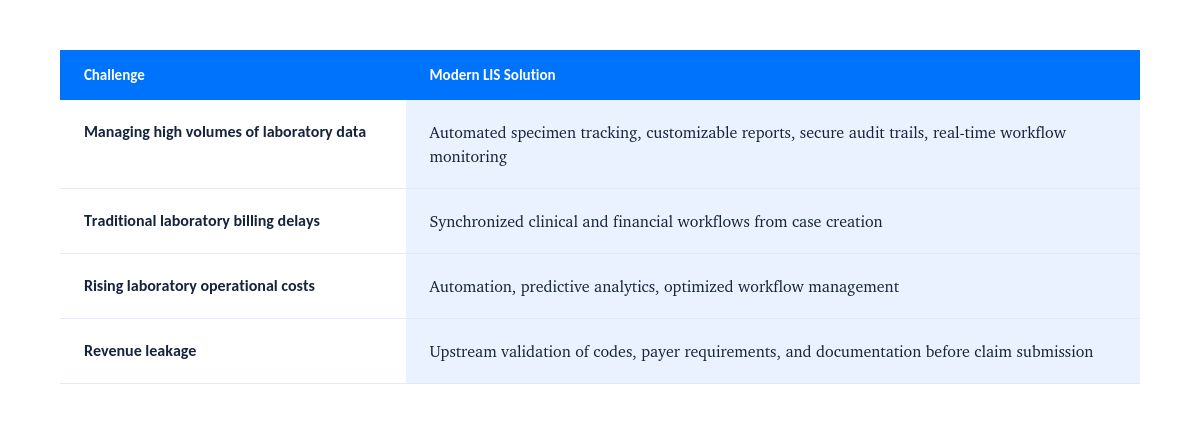
Modern laboratories face several operational and financial challenges that require advanced software solutions.
Challenges and Solutions at a Glance
How Do Modern Laboratory Information Systems Manage High Volumes of Laboratory Data?
Challenge: Clinical laboratories handle massive amounts of patient and specimen data that staff must process accurately and quickly.
Solution: The best laboratory information system software can manage high volumes of diagnostic data while maintaining strict data integrity. Modern LIS medical platforms also offer automated specimen tracking, customizable pathology report templates, secure audit trails, and real-time workflow monitoring. These features ensure diagnostic information remains accurate while supporting efficient laboratory operations.
Get Insight: How to Turn Your Mid-Sized Medical Laboratory into a Thriving Large-Scale Operation
How Do Modern LIS Systems Eliminate Traditional Laboratory Billing Delays?
Challenge: Historically, laboratories completed diagnostic workflows in a lab information system and then transferred information to a separate laboratory billing system. This fragmented approach often caused delays and claim errors.
Solution: Modern integrated healthcare LIS and laboratory billing platforms synchronize clinical and financial workflows from the moment a case is created. This unified architecture keeps patient data consistent across laboratory software systems, generates claims using accurate test information, and reduces billing errors and claim denials.
Case Study: The Connected Laboratory - A New Approach to Laboratory Billing Services
How Do Modern LIS Systems Help Control Rising Laboratory Operational Costs?
Challenge: Clinical laboratories face increasing operational expenses, including LIS staffing shortages, equipment maintenance, and outdated pathology software infrastructure.
Solution: Modern LIS software helps reduce these costs through automation, predictive analytics, and optimized clinical workflow management. For example, advanced LIS systems can forecast staffing needs, schedule preventive equipment maintenance, identify workflow bottlenecks, and improve laboratory throughput.
Discover More: How LigoLab Helps Medical Labs Combat Staffing Shortages
How Do Modern LIS Systems Prevent Revenue Leakage?
Challenge: Without automation, laboratories risk losing revenue due to delayed billing, incorrect coding, or missed charges.
Solution: Advanced laboratory billing solutions and RCM tools help identify billing errors upstream and before claims are submitted. Automated laboratory billing systems can validate CPT and ICD codes, verify payer requirements, flag missing documentation, and submit claims promptly. These capabilities help laboratories maximize reimbursement and reduce revenue leakage.
On-Demand Webinar: Unifying Technical and Financial Operations to Minimize Denials and Prevent Revenue Leakage

Why Are Modern Laboratory Billing Solutions Essential for Financial Stability?
Modern laboratory billing solutions form the financial backbone of advanced diagnostic laboratories. When integrated with LIS system software, they improve transparency, efficiency, and compliance.
- Faster Claims Submission: Automated lab billing tools submit claims quickly and accurately, accelerating reimbursement.
- Proactive Claim Management: Advanced systems track denied claims and automatically trigger follow-up actions.
- Accurate Claims Processing: Integrated systems cross-reference billing data with clinical workflows to ensure precise claims submission.
- Real-Time Insurance Verification: Eligibility verification tools ensure claims are submitted with accurate payer information.
- Transparent Billing Processes: Modern lab billing platforms support detailed charge documentation, improving compliance and patient trust.
Industry Insights: Roundtable Discussion - Laboratory Billing Solutions and the Lab RCM Process
Why Are Modern Laboratory Billing Solutions Essential for Financial Stability?
Modern laboratory billing solutions form the financial backbone of advanced diagnostic laboratories. When integrated with LIS system software, they improve transparency, efficiency, and compliance.
- Faster Claims Submission: Automated lab billing tools submit claims quickly and accurately, accelerating reimbursement.
- Proactive Claim Management: Advanced systems track denied claims and automatically trigger follow-up actions.
- Accurate Claims Processing: Integrated systems cross-reference billing data with clinical workflows to ensure precise claims submission.
- Real-Time Insurance Verification: Eligibility verification tools ensure claims are submitted with accurate payer information.
- Transparent Billing Processes: Modern lab billing platforms support detailed charge documentation, improving compliance and patient trust.

Is a Fully Integrated Platform Necessary for Every One of These Challenges?
Not every laboratory challenge requires a LIS and RCM platform. Some problems are narrow enough that a specialized solution may deliver greater value. For example, a laboratory primarily struggling with equipment maintenance scheduling may benefit more from a dedicated maintenance management tool than from a broader informatics overhaul focused on clinical and financial workflows.
Similarly, a laboratory focused on managing high data volumes, specimen tracking, audit trails, and report customization may be well served by a standalone LIS if billing and revenue cycle performance are not significant concerns. Laboratories with an effective in-house or outsourced billing operation also do not necessarily need to replace it when modernizing their LIS.
The case for a unified medical LIS and lab RCM platform becomes stronger when challenges overlap. Laboratories facing growing data volumes, billing delays, rising operational costs, workflow inefficiencies, and revenue leakage can benefit from addressing clinical, operational, and financial processes in a single integrated environment rather than adding and maintaining multiple point solutions.
Industry Insights: What Labs Get Wrong About Laboratory Billing - How High-Performing Labs Prevent Denials Before They Happen
What Should Labs Look for in Modern LIS Software for the Future?
Today's laboratories require flexible, scalable technology. Modern LIS systems provide several key advantages:
- Scalability: Cloud-based LIS systems help laboratories expand services and handle increasing test volumes.
- Customization: Configurable workflows let laboratories adapt the LIS platform to their specific diagnostic and billing needs.
- Integration: Advanced interface engines connect LIS systems with instruments, EHR systems, clearinghouses, and third-party applications.
These capabilities help laboratories stay efficient, adaptable, and competitive in an increasingly complex LIS healthcare environment.
Get Insight: The Four Most Important Things to Consider When Modernizing a Laboratory
Organizations ready to modernize their operations should explore comprehensive solutions like the LigoLab Informatics Platform, which combines a powerful medical LIS system with integrated laboratory billing solutions and innovative revenue cycle management tools.
Continue Your Research
- Buyer's Guide: Best Pathology Lab Reporting Software - Buyer’s Guide and Checklist
- Case Study: The Connected Laboratory - A New Approach to Laboratory Billing Services
- Modernization Guide: The Four Most Important Things to Consider When Modernizing a Laboratory
- Case Study: Documenting the Avero Diagnostics Move From a Legacy Lab RCM System to LigoLab’s All-in-One Lab Informatics Platform
Ready to Modernize Your Laboratory with Integration and Automation?
Schedule a demonstration with a LigoLab product specialist and get your questions answered.
Act Now: Speak with a LigoLab Product Specialist!
Frequently Asked Questions About LIS Systems, Laboratory Billing, and Automated Workflows
What is a laboratory information system (LIS)?
A laboratory information system (LIS) is specialized healthcare software that manages laboratory operations, including specimen tracking, test processing, results reporting, and laboratory billing. Modern LIS systems automate workflows, connect laboratory instruments and healthcare systems, and centralize clinical and financial data.
What is laboratory revenue cycle management (RCM)?
Laboratory revenue cycle management (RCM) refers to the financial processes that ensure laboratories are reimbursed for the diagnostic services they provide. This process includes patient registration, insurance verification, charge capture, claim submission, payment posting, denial management, and patient billing.
Why is laboratory billing so complex?
Laboratory billing is inherently complex. Organizations must navigate multiple payers, diagnostic codes, regulatory requirements, and constantly evolving insurance rules. Accurate application of CPT codes, ICD-10 diagnoses, and payer-specific policies is essential, as even minor data errors can result in claim denials, delayed reimbursement, and increased compliance risk.
How does integrating LIS systems with laboratory billing improve efficiency?
When LIS systems integrate with advanced laboratory billing software, clinical and financial workflows operate within a single platform. Diagnostic data automatically flows into billing processes, reducing manual data entry and minimizing discrepancies between clinical records and financial claims.
What features should laboratories look for in a modern LIS system?
Modern LIS systems should include automated specimen tracking, configurable workflow rules, integrated laboratory billing tools, real-time reporting dashboards, interoperability with electronic health record systems, and secure audit trails. Advanced solutions may also support digital pathology and AI tools.
Can an LIS system help laboratories reduce operational costs?
Yes. Modern LIS platforms help laboratories reduce operational costs by automating manual processes, improving resource utilization, and reducing billing errors. Advanced reporting tools also let laboratory leaders analyze performance data and identify costly inefficiencies.
How do LIS systems support laboratory scalability and growth?
Modern LIS systems are designed to scale with laboratory operations, supporting increasing test volumes, additional diagnostic services, and multi-location laboratory networks. Automation and configurable workflows enable laboratories to expand services without adding significant administrative complexity.
.jpg)