Blog
The Best LIS Systems Are Comprehensive and Laboratory-Specific

October 22, 2026

Executive Summary: The best laboratory information systems are dedicated, laboratory-specific platforms that cover the full lab lifecycle, from order entry to billing, rather than lab modules embedded in a broader electronic health record (EHR) system. They combine end-to-end workflow coverage, configuration without heavy coding, integrated lab revenue cycle management (RCM), and scalability; a CAP-commissioned comparison reported that dedicated LIS systems outperform EHR-embedded lab modules.
Independent clinical laboratories and anatomic pathology groups face mounting operational pressure. Rising test volumes, staffing shortages, evolving reimbursement models, and growing regulatory complexity demand more than basic diagnostic lab software. To compete effectively and support long-term growth, laboratories need comprehensive, flexible laboratory information system (LIS) software built for the unique demands of medical laboratory operations, rather than retrofitted modules within broader healthcare information systems or generic data management platforms.
The best LIS software is robust, adaptable, and highly configurable. It seamlessly supports clinical and laboratory revenue cycle management (RCM) workflows, accommodates specialized testing environments, and evolves alongside advances in clinical and pathology lab management and diagnostic technology.
Industry Insights: Best LIS Systems - Top Laboratory Information Systems Compared for Clinical, Pathology, and Outreach Labs
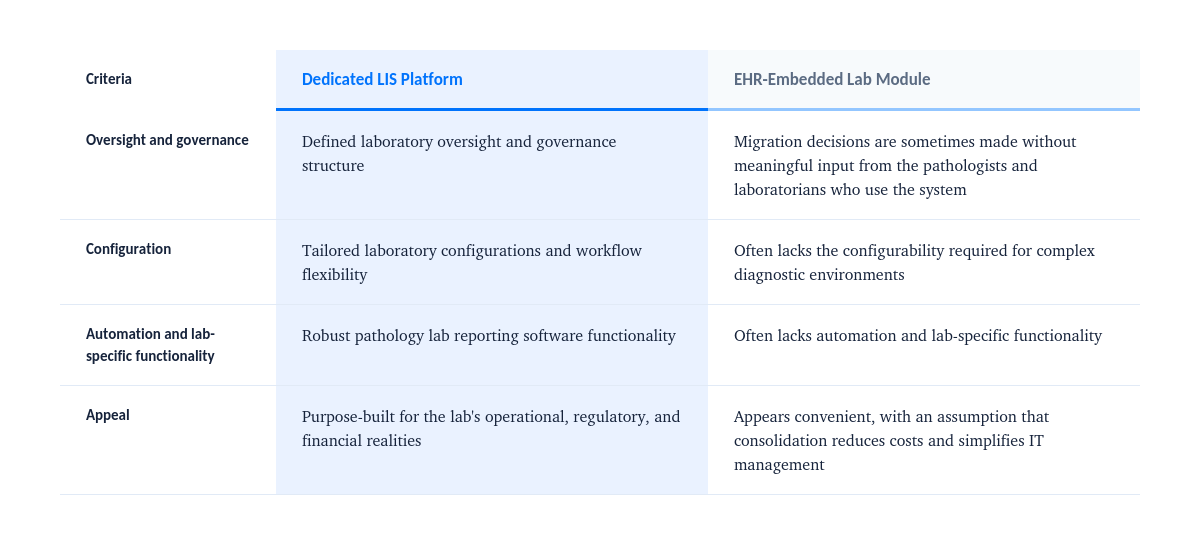
How Does a Dedicated Lab Information System Compare With an EHR-Embedded Lab Module at a Glance?
Why Do Modern Laboratories Need Dedicated LIS Systems?
Today's medical LIS system must do more than track specimens and report results. It must manage the entire laboratory lifecycle, from order entry and specimen accessioning to reporting, compliance, analytics, and laboratory billing.
A modern medical laboratory information system should:
- Support end-to-end laboratory workflow management
- Offer deep configurability for pathology, clinical, molecular, and specialty labs
- Integrate seamlessly with instruments, EHRs, laboratory billing systems, and third-party partners
- Support automation that reduces manual errors and turnaround times
- Deliver real-time operational and financial visibility
Equally important, laboratories need support and strategic guidance from laboratory information system companies that understand the real-world complexity of clinical and pathology operations. Generic healthcare IT vendors often lack the domain expertise required to support nuanced lab workflows.
Discover More: What You Need to Know Before Contracting with a Laboratory Information System (LIS) Company
What Did the Research Show About Dedicated LIS Labs vs. EHR Lab Modules?
Several years ago, the College of American Pathologists (CAP) commissioned respected pathologists from across the United States to compare two laboratory information system software models:
- A dedicated, end-to-end LIS lab platform
- A laboratory module embedded within a larger enterprise electronic health record (EHR) system
The physicians, who were not compensated for their findings, evaluated which model best supported laboratory performance and long-term success.
Their conclusion was clear: dedicated LIS systems consistently outperformed EHR-embedded lab modules.
What Were the Key Advantages of a Dedicated Laboratory Information System?
The CAP study highlighted several benefits of dedicated LIS medical software:
- Defined laboratory oversight and governance structure
- Tailored laboratory configurations and workflow flexibility
- Robust pathology lab reporting software functionality
- Direct access to specialized LIS vendors
- Full support for laboratory billing and lab revenue cycle management
This research reinforced what many lab leaders already understood: laboratories operate as highly specialized clinical businesses. They require laboratory information systems designed specifically to support operational, regulatory, and financial realities.
White Paper: Vendor to Partner - How Aligning with Your LIS Provider Can Transform Your Lab

Should Labs Defend the Dedicated LIS System in an Era of EHR Consolidation?
Hospitals and health systems often pressure laboratories to abandon dedicated LIS systems for bundled EHR modules. The assumption is that consolidation reduces costs and simplifies IT management.
However, the CAP study challenged this assumption, revealing that decisions to adopt EHR-based laboratory modules are sometimes made without essential input from the pathologists and laboratory professionals who depend on these systems for their daily workflows.
While EHR-integrated solutions may offer convenience, they often fall short in providing the flexibility, automation, and specialized functionality necessary to manage the complex workflows and evolving operational demands of modern diagnostic laboratories.
In today's healthcare landscape, where diagnostic accuracy, turnaround time, and financial performance are tightly connected to quality outcomes, medical laboratories cannot afford limitations in diagnostic lab software.
Pathologists are increasingly recognized as critical contributors to patient care. With the rise of personalized medicine, molecular diagnostics, and high-volume outreach programs, laboratory information systems must evolve to support these areas.
Get Insight: Laboratory Information Systems vs. Electronic Health Record Systems - Which is the Best Choice for My Hospital Lab?
What Makes the Best Laboratory Information System?
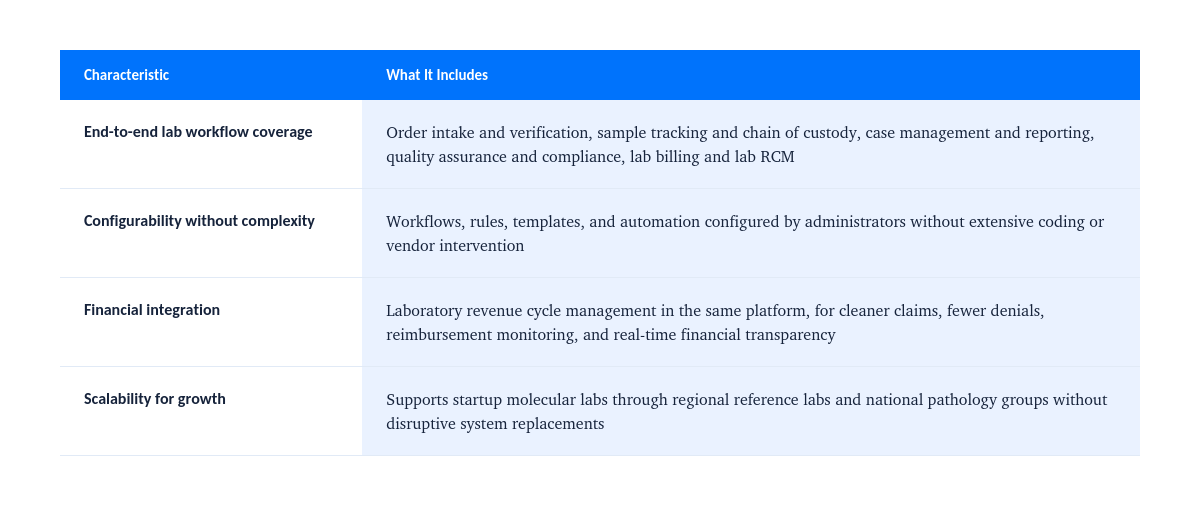
The best LIS systems share several defining characteristics.
1. Does the LIS System Cover Lab Workflow End-to-End?
Comprehensive LIS software manages the complete laboratory lifecycle, including:
- Order intake and verification
- Sample tracking and chain-of-custody management
- Case management and reporting
- Quality assurance and compliance
- Laboratory billing and lab revenue cycle management
Fragmented laboratory software systems create operational friction. A unified informatics platform eliminates data silos and reduces reliance on manual workarounds.
2. Can It Be Configured Without Added Complexity?
No two laboratories operate the same way. The best medical laboratory solutions let administrators configure workflows, rules, templates, and automation without extensive coding or vendor intervention.
Flexibility ensures the LIS system can adapt as testing menus expand, partnerships grow, and regulatory requirements evolve.
3. Is Laboratory Revenue Cycle Management Integrated?
Operational performance alone does not sustain a laboratory. The best laboratory information systems fully integrate laboratory revenue cycle management into the same platform.
By unifying technical and financial data, labs can:
- Improve clean claim submission rates
- Reduce denials
- Monitor reimbursement trends
- Gain real-time financial transparency
4. Will It Scale With Your Growth?
From startup molecular labs to regional reference laboratories and national pathology groups, scalable laboratory information system software supports every stage of growth without requiring disruptive system replacements.
On-Demand Webinar: From Manual to Magical - Automation Strategies for Multi-Facility AP & Clinical Labs

Is a Dedicated Laboratory Information System Always the Better Choice Than an EHR Lab Module?
Not always, and it's worth being direct about that. The CAP comparison reflects what the pathologists judged best for laboratory performance. An EHR-embedded lab module can still fit some hospital-based labs, particularly those that mainly serve their own health system, run straightforward workflows, have no meaningful outreach or outside billing, and place the most weight on a single clinical context, unified patient records, and consolidated IT governance. In that situation, convenience and enterprise integration are real benefits, not just assumptions.
A dedicated LIS lab platform makes the strongest case for complex labs: specialty testing, high-volume outreach, molecular or anatomic pathology workflows, and their own lab billing. The study highlights the risk of a consolidation decision made without meaningful input from pathologists and laboratorians. If you're weighing this choice, involve them early, test the EHR module against your real workflows and billing needs, and ask each vendor how it handles interfaces, support, and configuration changes.
How Does LigoLab Redefine Modern LIS Systems?
Since 2006, LigoLab has helped independent clinical laboratories and pathology groups modernize and scale with confidence.
Pathologists and experienced laboratorians built the all-in-one LigoLab Medical LIS & Lab RCM Informatics Platform to optimize laboratory workflow management, improve operational efficiency, and ensure lab leaders maintain complete control over clinical and financial processes.
Unlike legacy laboratory information systems that rely on rigid architecture and fragmented modules, LigoLab's unified informatics platform integrates:
- Anatomic pathology
- Clinical laboratory operations
- Molecular diagnostics
- Microbiology and specialty testing
- Laboratory billing and lab revenue cycle management
- Direct-to-consumer lab testing workflows
This end-to-end integration eliminates silos, thereby enabling laboratories to operate more efficiently across all departments and locations.
Get Insight: A Best Practices Guide for Large-Scale Laboratory Information System Implementations

How Does LigoLab's Tiered Pricing Fit Every Growth Stage?
One of LigoLab's differentiators is its flexible, tiered pricing LIS model. Rather than imposing large upfront licensing fees or one-size-fits-all medical laboratory solutions, LigoLab aligns platform functionality with each laboratory's operational complexity.
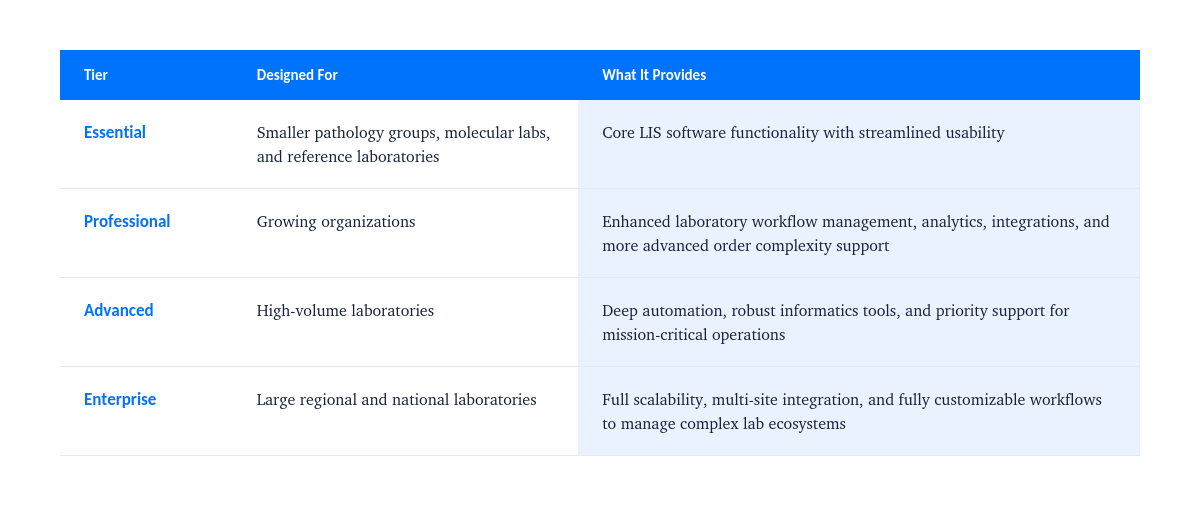
This structured roadmap supports laboratory scalability without replacing the LIS system or disrupting operations.
Discover More: LigoLab Informatics Platform - Uniquely Designed to Deliver Maximum Value
What Makes LigoLab a True Laboratory Growth Platform?
The LigoLab platform goes beyond traditional laboratory information system software. It’s equipped with all supporting modules required to drive business growth, reduce labor costs, increase revenue, and enhance client service.
Key benefits include:
- Advanced automation that reduces manual entry
- Real-time dashboards and business intelligence
- Full interoperability with external healthcare systems
- 24/7 responsive customer support
- Collaborative partnership focused on long-term success
Hundreds of medical laboratories nationwide trust LigoLab to modernize operations and strengthen competitive positioning.

How Does Reimagining LIS Software Support the Future of Healthcare?
Modern laboratories need an intelligent, integrated laboratory information system that aligns operational excellence with financial integrity.
LigoLab's next-generation LIS system combines automation, configurability, and interoperability into a single, powerful informatics platform.
Unlike legacy clinical/pathology LIS systems burdened by disconnected workflows and outdated infrastructure, LigoLab empowers laboratories to:
- Improve turnaround times
- Reduce operational risk
- Enhance lab billing accuracy
- Scale strategically
- Deliver better patient outcomes
Industry Insights: The Hidden Challenge of LIS System Adoption - Why Most Labs Struggle, and How the Right Vendor Can Change Everything
Continue Your Research
- Platform Comparison: Best LIS Systems - Top Laboratory Information Systems Compared for Clinical, Pathology, and Outreach Labs
- LIS vs. EHR: Laboratory Information Systems vs. Electronic Health Record Systems - Which is the Best Choice for My Hospital Lab?
- Pricing: LigoLab Informatics Platform - Uniquely Designed to Deliver Maximum Value
- Vendor Partnership: Vendor to Partner - How Aligning with Your LIS Provider Can Transform Your Lab
Ready to Modernize Your Laboratory?
If your business is evaluating laboratory information systems and looking for a comprehensive, scalable, and laboratory-specific solution, it's time to explore what's possible with LigoLab. Connect with a LigoLab product specialist today to schedule a personalized demo, and discover how our all-in-one LIS software and lab revenue cycle management platform can be tailored to your lab's unique workflows, goals, and growth strategy.
Act Now: Start Your Transformation Today!
Frequently Asked Questions About Dedicated and Laboratory-Specific LIS Systems
What is a dedicated laboratory information system, and how is it different from an EHR lab module?
A dedicated LIS is an end-to-end laboratory information system purpose-built for the medical lab, covering order entry, specimen tracking, reporting, compliance, analytics, and lab billing. An EHR lab module is a laboratory component embedded in a larger enterprise electronic health record system, which often offers less configurability, automation, and lab-specific functionality.
What did the CAP-commissioned study conclude about dedicated LIS systems?
Several years ago, the College of American Pathologists commissioned pathologists from across the United States to compare a dedicated, end-to-end medical LIS platform with a lab module embedded in an enterprise EHR. The physicians, who were not compensated for their findings, concluded that dedicated LIS systems consistently outperformed EHR-embedded lab modules.
What makes the best laboratory information system software?
The best LIS systems share four characteristics: end-to-end lab workflow coverage; configurability without extensive coding or vendor intervention; financial integration with laboratory revenue cycle management in the same platform; and scalability that supports growth without disruptive system replacements.
Why does integrated lab revenue cycle management matter in an LIS?
Integrating lab RCM into the same platform unifies technical and financial data, improves clean claim submission rates, reduces denials, helps monitor reimbursement trends, and provides real-time financial transparency.
How does LigoLab's tiered pricing work?
LigoLab offers four tiers, Essential, Professional, Advanced, and Enterprise, that align platform functionality with a lab's operational complexity rather than imposing large upfront licensing fees. Labs can move up the tiers as they grow without replacing their LIS system.
Is a dedicated LIS always better than an EHR lab module?
Not always. Hospital-based labs that mainly serve their own health system, run straightforward workflows, and prioritize a single clinical context and consolidated IT governance may find an EHR module a reasonable fit. Dedicated LIS platforms make the strongest case for labs with specialty testing, high-volume outreach, and their own billing.