Blog
LIS Systems - Learn the Basics and Find Out How the Best Laboratory Information Systems Efficiently Remove Barriers and Maximize Growth

September 29, 2026

To operate efficiently and remain profitable, medical laboratories must rely on modern diagnostic lab software that automates workflows, enhances accuracy, strengthens laboratory revenue cycle management (RCM), and enhances interoperability.
This guide explains the basics of laboratory information system (LIS) software, the difference between an LIS lab platform and a laboratory information management system (LIMS) application, and how the best laboratory information system software eliminates operational bottlenecks while driving long-term growth.
Industry Insights: Best LIS Systems - Top Laboratory Information Systems Compared for Clinical, Pathology, and Outreach Labs
What Is LIS in Healthcare?
A laboratory information system is specialized healthcare LIS software designed to manage operations in clinical and pathology settings.
An LIS system is purpose-built to handle:
- Patient data management
- Sample tracking and chain of custody
- Laboratory workflow management automation
- Result reporting and distribution
- Regulatory compliance
- Laboratory revenue cycle management and lab billing
Modern examples of laboratory information systems have become the digital backbone of hospitals, reference labs, molecular diagnostics labs, and anatomic pathology groups.
A well-designed lab information system simplifies daily operations by recording and updating patient demographics, managing orders and accessioning, monitoring specimen processing, generating customized lab reports, and delivering results to providers and patients.
Without a reliable LIS model, medical laboratories struggle with inefficiency, data silos, and costly billing errors.
Discover More: Boosting Operational Efficiency - How LigoLab Transforms Lab Workflow

Why Are Laboratory Information Systems So Important?
Every clinical and pathology laboratory strives to improve productivity, minimize errors, and strengthen financial performance. Yet many are still held back by outdated legacy LIS systems that limit efficiency and scalability.
Common problems with older LIS systems include rigid workflows, poor interoperability, manual data entry, disconnected laboratory billing software, limited automation, and high support costs. These limitations create operational bottlenecks that restrict growth.
Modern medical LIS platforms eliminate these barriers by integrating laboratory workflow management, sample tracking, reporting, compliance tools, and laboratory revenue cycle management into one lab organization software solution.
When technical and financial operations share the same database and infrastructure, laboratories gain greater visibility, improved efficiency, stronger compliance, higher collection rates, and scalability without added staffing.
Get Insight: Future of LIS Systems and Personalized Medicine

What Is the Difference Between LIMS and LIS?
Many confuse laboratory information management system software (LIMS) with LIS system software. While they sound similar, they serve very different purposes.
LIS vs. LIMS at a Glance
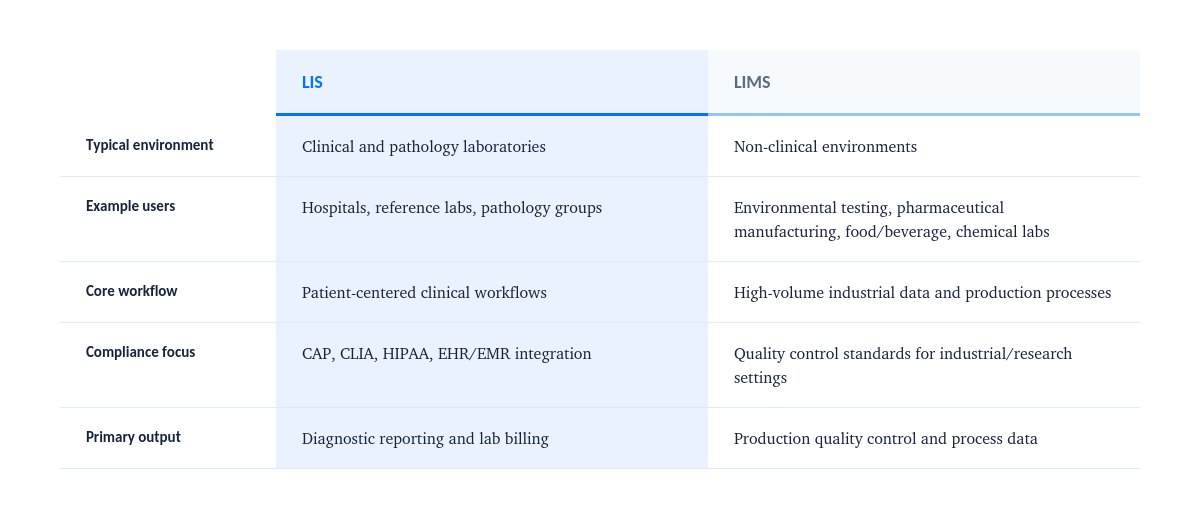
A laboratory information system supports patient-centered workflows, laboratory billing, CAP, CLIA, and HIPAA compliance, EHR integration, and accurate diagnostic reporting.
The best laboratory information system software is configurable and can expand as laboratory services grow.
Discover More: Differences Between Laboratory Information Management Systems (Lab LIMS) and Laboratory Information Systems (LIS Systems)
What Key Features Do Modern Medical LIS Platforms Include?
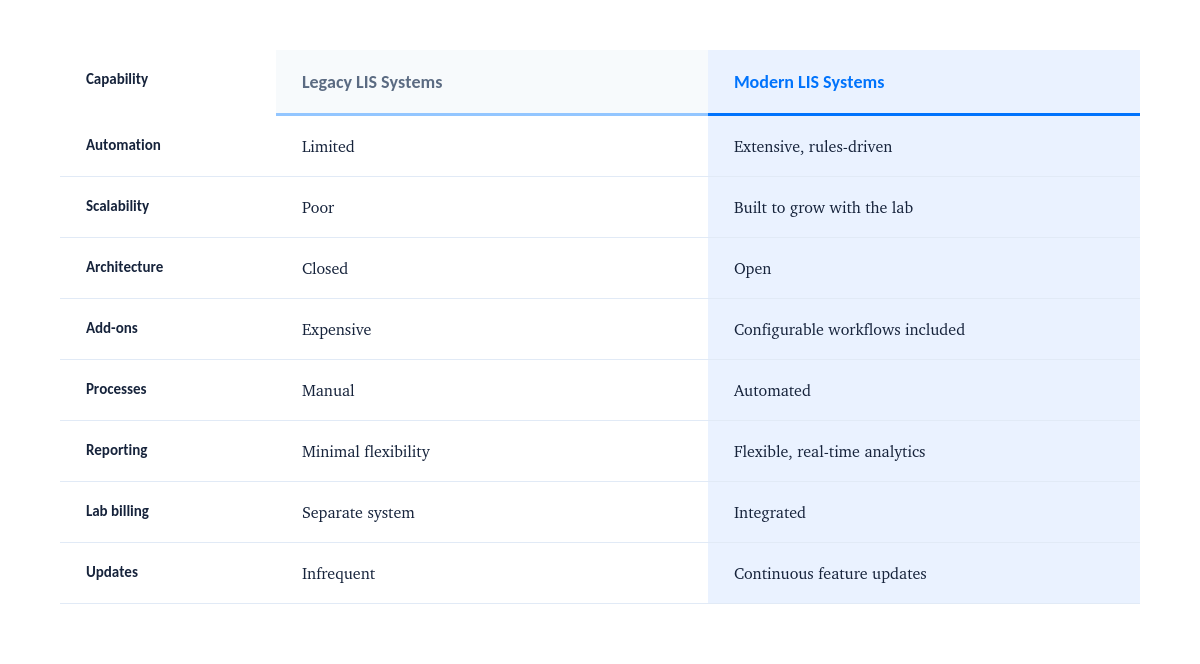
Modern laboratory information systems outperform legacy medical LIS in several critical areas:
- Unified Operations: All departments operate within one comprehensive LIS system, eliminating data silos.
- Workflow Automation: Rules and automation engines reduce manual processes and minimize human error.
- Advanced Interoperability: Seamless integration with EHR systems, laboratory instruments, laboratory billing services, state registries, APIs, and third-party applications.
- Specimen Traceability: Robust chain-of-custody sample tracking with unique barcodes and timestamps.
- Custom Reporting: Fully customizable lab reports with automated distribution options.
- Real-Time Business Intelligence: Dashboards and analytics provide visibility into turnaround times, denial rates, staff productivity, and workflow bottlenecks.
- Integrated Lab Revenue Cycle Management: When medical LIS and lab RCM modules operate on the same informatics platform, laboratories can verify insurance and eligibility at order entry, automatically scrub claims, reduce denials, accelerate reimbursement, and improve cash flow.
Integrated medical LIS + lab RCM systems drive business growth.

How Do Modern LIS Systems Maximize Efficiency?
Upgrading to modern clinical laboratory management/pathology lab management software, such as LigoLab's all-in-one LIS system with advanced laboratory billing solutions embedded in the platform, can dramatically improve operational performance.
- Automation Removes Bottlenecks: Modern LIS medical platforms use rules and automation engines to trigger workflows automatically, route cases intelligently, reduce repetitive data entry, and alert users to compliance issues. This reduces administrative burden and allows staff to focus on diagnostics.
- Improved Turnaround Times: Automated sample tracking and real-time workflow visibility shorten processing times and improve client satisfaction.
- Reduced Errors: Built-in verification checkpoints and barcode tracking minimize the chance of lost or mislabeled specimens.
- Scalable Architecture: Modern LIS systems grow with your lab, handling increased volume, new departments, and additional data tracking without requiring a complete LIS replacement.
On-Demand Webinar: Leverage LIS System Rules, Automation, and Data Analytics to Increase Efficiency and Cut Costs
How Does Integrated Laboratory Billing Improve Operational and Financial Performance?
One of the biggest advantages of modern LIS software platforms is embedded laboratory revenue cycle management.
Traditionally, organizations have relied on separate laboratory billing systems, creating delays and errors as the LIS and RCM platforms interact. Integrated medical LIS + lab RCM systems enable billing workflows to begin at order inception.
Key capabilities include:
- Real-time insurance discovery
- Eligibility verification
- Address validation
- Automated CPT and ICD coding
- Claim scrubbing
- Denial management tools
- Detailed KPI reporting
This integrated approach reduces rejections, improves collections, and increases profitability.
Case Study: Leveraging LIS System & Lab RCM Integration to Improve the Laboratory Billing Process

How Do Modern LIS Systems Handle Sample Tracking and Chain of Custody?
Accurate sample tracking is foundational to laboratory success.
Modern LIS systems assign unique identifiers to every specimen and document. Advanced sample tracking features include:
- Barcode integration
- Timestamp logging
- Duplicate patient detection
- Instrument start and stop tracking
- Workflow visibility for every processing stage
This dramatically reduces risk and improves compliance.
Get Insight: How Laboratory Information System Software Helps Medical Labs Offer Flawless Service
What Reporting and Distribution Options Do Modern LIS Systems Offer?
Modern clinical and pathology LIS systems feature advanced reporting engines that customize report formats, incorporate images and diagrams, use CAP cancer protocol templates, automate distribution rules, and support multiple report delivery methods.
Report delivery options include:
- Provider portals
- Secure email
- Fax
- APIs
- PDF drops
- SMS notifications
- Remote printing
Customization enhances customer satisfaction and strengthens referral relationships.
Industry Insights: How Modern LIS Systems Empower Labs Through Configurable Reporting, Seamless Integration, and True Partnership
Why Does LIS Lab Interoperability Matter for Growth?
Interoperability is essential in modern healthcare.
The best LIS software platforms include built-in interface engines that support HL7, FHIR, APIs, X12, XML, ASTM, CSV, and PDF.
Modern LIS systems connect to all instrument types, all major EHR systems, clearinghouses, tumor registries, and state reporting agencies.
Without interoperability, laboratories cannot scale efficiently.
Discover More: The Four Most Important Things to Consider When Modernizing a Laboratory
Can a Modern LIS System Support Direct-to-Consumer Lab Testing?
The best laboratory information system software supports direct-to-consumer lab testing models and opens new revenue streams.
DTC functionality enables online patient registration, appointment scheduling, automated notifications, insurance discovery, and real-time results delivery. This expands laboratory reach beyond traditional referral models.
Discover More: Highlighting the Versatility of the TestDirectly Direct-to-Consumer Lab Testing Portal
How Do Modern LIS Systems Handle Security and Compliance?
Data protection is non-negotiable.
Advanced lab information system security features include automatic log-off, role-based access control, searchable audit trails, and encrypted communications.
Compliance tools support CAP, CLIA, HIPAA, and state reporting requirements. Built-in compliance workflows reduce risk and prevent revenue loss.
Get Insight: A Detailed Look at How Modern Laboratory Information Systems Fully Support Quality Control
Is Switching LIS Systems Always Worth the Disruption?
Not necessarily, and it's fair to be honest here. Many lab directors hesitate to switch laboratory information system companies because they anticipate disruption, and that hesitation is sometimes well-founded. A small, single-discipline, low-volume lab that has no near-term plans to grow test volume, add specialties, or expand into direct-to-consumer lab testing may not see enough ROI to justify a full platform migration right now. Similarly, a lab that's part of a hospital system already running an adequate enterprise EHR-based LIS may not need to switch unless that system is genuinely creating bottlenecks.
It’s also important to know where a medical LIS isn’t the right fit. Non-clinical environments, such as environmental testing, pharmaceutical manufacturing, food and beverage testing, and chemical laboratories, are typically better served by a dedicated LIMS designed to manage industrial data, quality control, sample tracking, and production workflows.
For labs that are hitting the "artificial growth ceiling" outdated LIS systems create, rigid workflows, poor interoperability, disconnected lab billing, and manual processes limiting expansion- the disruption of switching is generally worth it, since modern LIS systems enable increased sample volume without additional FTEs and directly translate into measurable ROI.

What Does LigoLab's Four-Phase Laboratory Information System Implementation Process Look Like?
A laboratory information system implementation requires structured planning and execution to succeed. LigoLab's proven four-phase process includes:
- Discovery: Comprehensive lab workflow analysis and LIS system planning.
- Configuration: Baseline setup, interface builds, and historical data migration.
- Testing & Validation: Parallel processing and workflow gap analysis.
- Go-Live: Structured launch with active support and optimization.
A disciplined implementation process ensures minimal disruption.
Discover More: LigoLab’s LIS System Implementation Support at Every Stage
How Do Modern LIS Systems Outperform Legacy Software?
Legacy vs. Modern LIS Systems at a Glance
Industry Insights: From System of Record to System of Action - The Next Evolution of Laboratory Information Systems

How Can Labs Future-Proof Their Operations?
Healthcare is evolving rapidly. Laboratories must adopt LIS systems that anticipate and are adaptable to change.
Future-ready healthcare LIS platforms support molecular diagnostics, digital pathology integration, AI-driven automation, direct-to-consumer lab testing workflows, advanced analytics, and regulatory adaptability.
Labs that invest in modern medical laboratory information system software position themselves for sustainable growth.
Get Insight: The latest Digital Pathology Solutions - The Future is Here
The Bottom Line: Invest in a Modern Laboratory Information System
A modern laboratory information system is infrastructure for operational excellence. The best laboratory information systems remove workflow barriers, eliminate lab billing silos, improve sample tracking, strengthen compliance, enhance interoperability, increase profitability, and enable scalable growth.
In today's competitive healthcare landscape, laboratories cannot afford inefficiency or outdated technology.
Continue Your Research
- Platform Comparison: Best LIS Systems - Top Laboratory Information Systems Compared for Clinical, Pathology, and Outreach Labs
- Glossary/Comparison: Differences Between Laboratory Information Management Systems (Lab LIMS) and Laboratory Information Systems (LIS Systems)
- Case Study: Documenting the Avero Diagnostics Move From a Legacy Lab RCM System to LigoLab's All-in-One Lab Informatics Platform
- Implementation Guide: LigoLab's LIS System Implementation Support at Every Stage
Maximize Efficiency and Revenue with an All-in-One Medical LIS & Lab RCM Platform
By investing in LigoLab's comprehensive, fully integrated LIS system with advanced laboratory billing solutions embedded into the software, clinical and pathology laboratories can streamline operations, safeguard revenue, and scale with confidence in an increasingly competitive healthcare environment.
Act Now: Speak with a LigoLab Product Specialist to Learn More!
Frequently Asked Questions About LIS Systems
What is LIS in healthcare?
A laboratory information system (LIS) is specialized software that manages laboratory operations in clinical and pathology settings, covering patient data management, sample tracking, workflow automation, reporting, compliance, and lab billing.
What is the main difference between LIS and LIMS?
An LIS supports patient-centered clinical and pathology laboratories; a LIMS supports sample-centric, non-clinical environments such as pharmaceutical manufacturing, environmental testing, and food and beverage testing.
Should every lab switch from a legacy LIS to a modern platform?
Not necessarily. Small, single-discipline, low-volume labs with no near-term growth plans, or labs already running an adequate enterprise EHR-based system, may see less immediate ROI. Labs actively hitting growth bottlenecks from rigid, disconnected legacy LIS systems generally see the strongest returns from switching.
What key features separate modern LIS software platforms from legacy LIS systems?
Modern platforms offer unified operations, workflow automation, advanced interoperability, specimen traceability, custom reporting, real-time business intelligence, and integrated lab revenue cycle management, areas where legacy systems are typically limited or absent.
How does integrated lab billing improve a lab's financial performance?
By starting revenue cycle management at order inception with real-time insurance discovery, eligibility verification, and automated coding, integrated LIS + lab RCM platforms reduce claim rejections, improve collections, and increase overall profitability.
What does a typical LIS implementation process look like?
LigoLab's four-phase approach includes Discovery (workflow analysis and planning), Configuration (setup, interfaces, and data migration), Testing & Validation (parallel processing and gap analysis), and Go-Live (structured launch with active support).