Blog
How Pathology Specimen Tracking System Software is Reducing Lab Errors & Enhancing Patient Safety

September 15, 2026

A pathology specimen tracking system is a featured component of a laboratory information system (LIS) that assigns unique identifiers to samples, monitors their movement through every testing stage, and links that data to patient records.
This matters because specimen mislabeling remains a leading, preventable cause of misdiagnosis, and even a small per-test error rate translates into significant patient harm.
Case Study: A Conversation With LIS System Administrator Kristie Becerra
Why Do Lab Test Errors Matter So Much?
Laboratory tests are pivotal in medical decision-making, but their accuracy hinges on error-free sample tracking and handling via a robust pathology specimen tracking system (also known as a lab sample management system).
The Centers for Disease Control and Prevention (CDC) estimates that 14 billion lab tests are ordered annually, underscoring the magnitude of lab-based testing and the growing importance of advanced diagnostic lab software. Research suggests that inaccuracies, including lab errors, rank alarmingly high among causes of patient harm.
Discover More: Top 10 Medical Laboratory Mistakes and How to Prevent Them from Happening in Your Lab
The Dire Consequences of Specimen Mislabeling and Misdiagnosis
Specimen mislabeling is a common yet preventable cause of diagnostic errors. A seemingly minor labeling mistake can lead to incorrect diagnoses, delayed treatments, or inappropriate medical interventions.
In extreme cases, these errors can contribute to patient mortality. Studies estimate that medical errors are the third leading cause of death in the U.S.
The ripple effect of these errors extends beyond the individual patient, affecting families and the broader healthcare system through increased medical costs and loss of trust in medical institutions.
This highlights the necessity for pathology lab reporting software with impeccable specimen management to ensure patient safety and uphold the integrity of medical diagnoses.
Get Insight: Best Pathology Lab Reporting Software - Buyer's Guide and Checklist

What Is Pathology Specimen Tracking System Software?
Pathology specimen tracking system software is an innovative diagnostic technology designed to streamline a specimen's journey from collection to diagnosis.
Every medical LIS lab platform includes a pathology specimen tracking system. However, only the best laboratory information system software solutions truly elevate organizational performance by delivering the accuracy, visibility, and operational efficiency needed to optimize every stage of pathology lab management.
Here's a breakdown of core laboratory information system functions for modern lab tracking system solutions:
- Labeling and Identification: The pathology specimen tracking system assigns a unique identifier to every sample, ensuring precise documentation from the moment of accessioning.
- Tracking Movement: It enables visibility into each specimen's progression across all testing stages, departments, and workflows.
- Data Integration: The system seamlessly connects specimen information with patient records, preserving data integrity and supporting accurate reporting.
- Error Reduction: By automating tracking and verification, it significantly reduces the risk of mislabeling, misplaced samples, and specimen mix-ups.
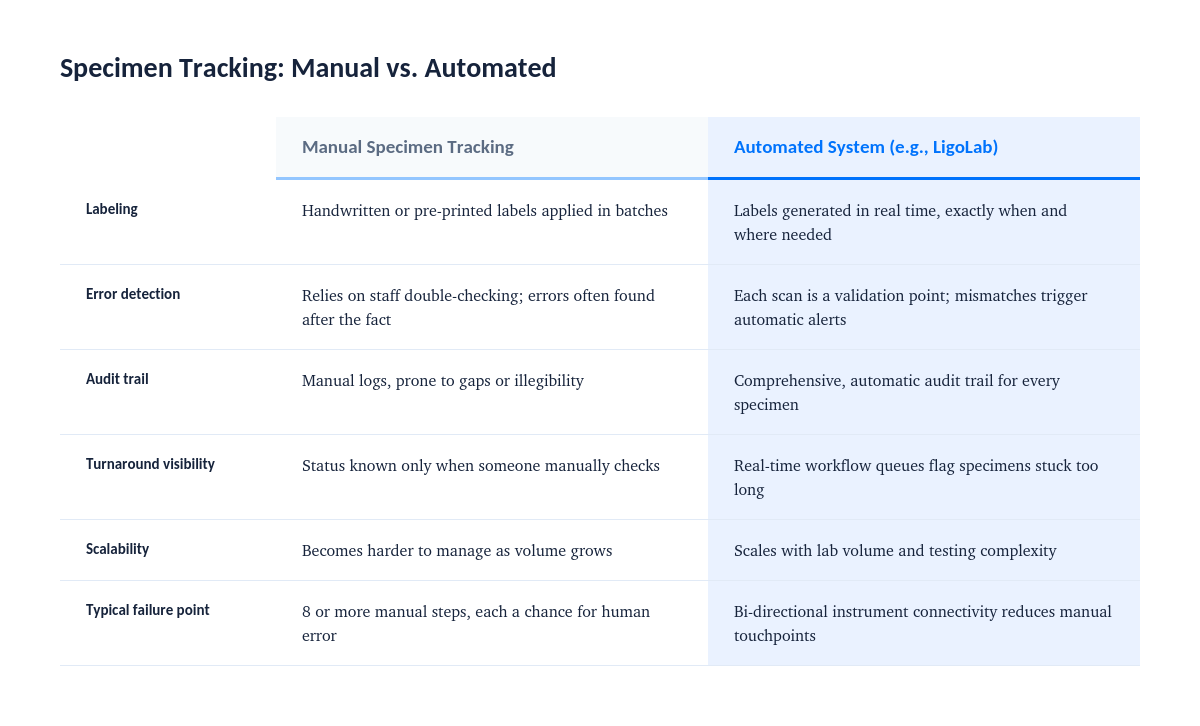
How Does Manual Sample Tracking Compare to an Automated System?
Discover More: What You Need to Know Before Contracting with a Laboratory Information System (LIS) Company
Is Manual Sample Tracking Ever Still Adequate?
A very small, low-volume setting, such as a physician-office lab processing only a handful of specimens a day, may keep manual error rates low for a while through meticulous logging and strict SOPs. In that narrow scenario, the near-term case for a full LIS lab investment is weaker on cost grounds alone.
That said, the margin for error shrinks quickly as volume, staff turnover, or specimen complexity increase. As Suren Avunjian, LigoLab CEO, put it:
"It's easy to try and blame mistakes on overburdened technicians or subpar pathology lab management. Most laboratories operate with great care, going to extreme lengths to check details repeatedly. But there can be eight or more separate steps in the testing process, and when you do each step manually, especially in high-throughput labs, human errors are unfortunately inevitable."
Given the CDC estimation, even a low per-lab error rate adds up to a meaningful patient-safety risk system-wide, which is why most labs above a very small scale are better served by automated sample tracking.
Discover More: Automation in Pathology Lab Management Using Advanced LIS System Software
How Does LigoLab's Platform Improve Sample Tracking Accuracy?
"With LigoLab's all-in-one medical LIS and lab billing informatics platform, lab directors and managers know who touched the specimen and where staff moved it,” said Avunjian. “We built LigoLab to model the real world as closely as possible, with a pathology specimen tracking system solution deeply embedded within the LIS software. It remains aware of the parent-child relationships as specimen derivatives, and aliquots are produced throughout the clinical lab workflow."
LigoLab's comprehensive informatics platform represents a major advancement in pathology specimen tracking system technology:
- Real-Time Tracking: Offers instant updates on specimen status, reducing errors.
- Comprehensive Audit Trails: Creates detailed records for every specimen.
- Intuitive Pathology Lab Management: Streamlines lab operations for greater efficiency.
- Scalable Solutions: Easily adapts to labs of different sizes and specialties.
- Advanced Features: Supports barcoding and radio frequency identification (RFID) for enhanced accuracy.
"Because the LigoLab platform is built with real-time lab workflow queues, technicians can quickly identify any specimen that has remained in a queue where it should not be,” Avunjian continued. “Additionally, each specimen turnaround time is tracked, and the LIS system automatically changes the color of the case to bring attention to the tech when there's potential for error."

What Happened When ECPC Switched to LigoLab's Sample Tracking System?
Before implementing LigoLab's modern anatomic pathology software solution, Eastern Connecticut Pathology Consultants’ manual sample tracking posed risks that affected diagnostic accuracy and efficiency.
By transitioning to LigoLab's advanced informatics platform and modern pathology lab report software with an automated lab sample management system, ECPC addressed these challenges, improving operational efficiency and reducing the likelihood of diagnostic errors.
This shift improved service quality and facilitated expansion into new markets and services, showing how modernizing laboratory information system software and sample tracking can significantly reduce risks.
- The Challenge: Before partnering with LigoLab, ECPC relied on a legacy LIS and outdated sample tracking that limited scalability, reduced operational visibility, and hindered growth.
- The Solution: By implementing LigoLab's modern medical LIS software, ECPC streamlined laboratory workflow management, enhanced productivity, and created the operational flexibility needed to scale efficiently.
- The Results: The transformation led to a 31% increase in test volume, driven by fewer specimen-tracking errors, faster turnaround times, and stronger compliance and risk management.
What Innovative Features Set LigoLab's Platform Apart?
LigoLab's comprehensive informatics platform brings several innovative features to the forefront of sample tracking, reimagining how laboratories operate:
- End-to-End Functionality: Offers bi-directional lab interface system connectivity with instruments, efficient routing, and automated sample tracking with a comprehensive audit trail.
- Advanced Workflow Features: Includes quick order entry, barcoded specimens with unique IDs, customizable labels, electronic histology workflow, and support for voice transcription (pathology dictation software).
- Scalability and Flexibility: Designed as a complete, flexible laboratory information system software platform, built for ease of use and increased productivity, enabling labs to scale operations quickly and effectively.
“LigoLab generates specimen labels in real time, exactly when and where they’re needed. Combined with barcoding and comprehensive sample tracking, this enables labs to verify specimen identity throughout the entire workflow, automatically flag and document potential mix-ups, and maintain detailed traceability as testing progresses,” noted Avunjian. “As laboratory volume and complexity grow, this level of tracking helps improve accuracy, reduce errors, and support greater scalability.”
Get Insight: Manage Complex Processes and Streamline Operations with LigoLab's Clinical Laboratory Solutions
What's Next for Sample Tracking Technology?
The sample tracking technology landscape is continuously evolving, with innovations promising further advances in laboratory practices. As we look ahead, several emerging technologies stand out for their potential to enhance sample tracking and reduce diagnostic errors.
- Artificial Intelligence (AI) and Machine Learning: Artificial intelligence and machine learning algorithms are poised to play a pivotal role in sample tracking. By analyzing vast amounts of data, these technologies can predict potential errors before they occur, streamline decision-making processes, and automate routine tasks, reducing human error and increasing efficiency.
- Blockchain for Enhanced Security and Traceability: Blockchain technology can provide a secure, unalterable record of specimen data, helping maintain data integrity so every step of the specimen's journey is accurately recorded and easily verifiable.
- Internet of Things (IoT) Integration: Integrating IoT with a modern pathology specimen tracking system enables real-time specimen monitoring. Sensors and smart devices can track specimen condition and location, providing alerts for any deviations from predefined conditions.
- Advanced Robotics in Specimen Handling: Robotics can automate specimen handling, reducing contamination and human error while speeding processing for faster turnaround times.
- Cloud Data Management: The shift toward cloud-based pathology lab reporting software enables more scalable, flexible, and accessible information systems and data management, ensuring critical specimen details are available to healthcare professionals whenever needed.
- 3D Printing: 3D printing lets laboratories design and produce specialized tools tailored to their unique requirements, improving precision and reducing handling errors.
By improving the accuracy, security, and efficiency of sample tracking, these emerging technologies herald a new era in diagnostic medicine.
Get Insight: How AI Can Propel Medical Laboratories into a New Era of Growth
Final Thoughts on Sample Tracking Software
As we conclude our exploration into sample tracking and advanced LIS laboratory information system software, it's clear that the stakes in medical diagnostics have never been higher. In an environment where a single error can have life-altering consequences, impeccable accuracy and efficiency are paramount.
From dramatically reducing lab errors to enhancing patient safety, LigoLab's comprehensive medical LIS lab solutions are more than just diagnostic and tracking tools; they are vital allies in the relentless pursuit of pathology lab software excellence.
The platform's innovative features, including real-time sample tracking, comprehensive audit trails, and advanced barcode and RFID support, have set a new industry benchmark, ensuring every specimen's journey from collection to diagnosis is monitored with the utmost precision.
The shift from manual workflows to automated labs powered by advanced LIS software solutions marks a defining change in operations, signaling a future where diagnostic errors are minimized, operational precision is elevated, and patient care improves meaningfully.
Continue Your Research
- Buyer's Guide: Best Pathology Lab Reporting Software - Buyer's Guide and Checklist
- Case Study: A Scaling Success Story - How ECPC Tripled Productivity & Boosted Net Collections by 35% with LigoLab Informatics Platform
- Vendor Evaluation: What You Need to Know Before Contracting with a Laboratory Information System (LIS) Company
- Emerging Technology: How AI Can Propel Medical Laboratories into a New Era of Growth
Step Into the Future of Safer, Smarter Diagnostics
Join us in advancing toward a more efficient, accurate, and resilient world of laboratory medicine. Discover how LigoLab's innovative LIS lab solutions and modern sample tracking technology can transform your operations, protect patient health, and raise the standard of diagnostic performance.
Act Now: Contact a LigoLab Product Specialist!
Frequently Asked Questions About Pathology Specimen Tracking System Software
What is a pathology specimen tracking system?
It's a featured component of a modern laboratory information system that assigns unique identifiers to samples, tracks their movement through every testing stage, and integrates that data with patient records to prevent mislabeling and misplacement.
How common are specimen mislabeling errors?
Exact rates vary by lab, but because the CDC estimates 14 billion lab tests are ordered annually in the U.S., even a small per-test error rate translates into many preventable mistakes across the healthcare system.
Is manual sample tracking ever still acceptable?
Very low-volume settings, like a small physician-office lab, may manage manual sample tracking adequately in the near term with strict logging practices. However, error risk grows quickly as volume, staff turnover, or specimen complexity increase.
What features should an automated pathology specimen tracking system include?
Look for real-time tracking with unique specimen identifiers, comprehensive audit trails, barcoding or RFID support, bi-directional instrument connectivity, and workflow queues that flag specimens stuck too long in any single stage.
Did switching to an automated system produce measurable results for any real labs?
Yes. After Eastern Connecticut Pathology Consultants (ECPC) moved from a legacy, manual-heavy system to LigoLab's platform, the lab saw a 31% increase in test volume, driven by fewer tracking errors, faster turnaround times, and stronger compliance.
What emerging technologies could further improve specimen tracking?
AI and machine learning for predictive error detection, blockchain for tamper-proof specimen records, IoT sensors for real-time condition monitoring, robotics for automated handling, and cloud-based data management are all expected to shape the next generation of tracking systems.
.jpg)