Blog
Stability and Performance: The Two Most Important Aspects of a Modern Laboratory Operation

November 2, 2026

Executive Summary: Stability and performance matter because unplanned laboratory information system (LIS) downtime is costly: experts estimate up to $100,000 per hour for a medium- to large-sized lab. LigoLab guarantees 99.9 percent uptime and credits customers for unplanned downtime it causes. Labs should also look for scalable architecture, proactive support, advanced security, and continuous innovation, and prepare internal contingency plans.
A laboratory information system (LIS) is like an alarm clock; if it's not reliable, it's probably time to replace it.
That statement may seem extreme until you consider the significant consequences of unplanned downtime for a clinical laboratory or pathology practice. In this post, we'll discuss the consequences and examine how medical labs can prevent downtime from severely affecting customer relationships and patient outcomes by partnering with advanced laboratory information system vendors with well-earned reputations for prioritizing stability and performance.
Discover More: Laboratory Information Systems Are Not Commodities!
What Is Laboratory Downtime?
Laboratory downtime is any period when an instrument or system doesn’t function properly or becomes unavailable to the user. It falls into two categories: planned and unplanned.
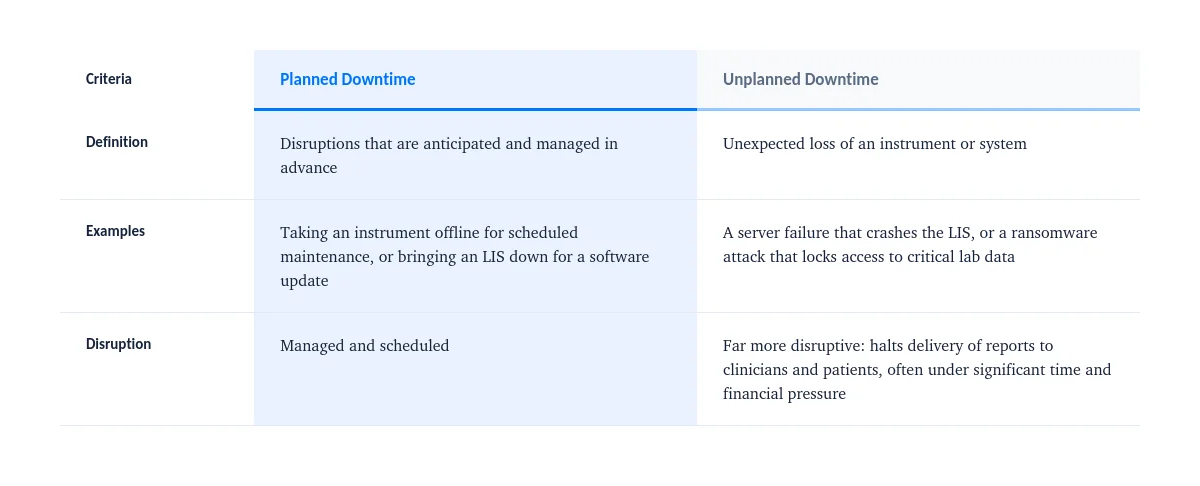
What Is Planned Downtime?
Examples of planned downtime include temporarily taking laboratory instruments offline for scheduled maintenance or suspending laboratory information system operations to perform LIS software updates. These disruptions are anticipated, scheduled, and managed in advance to minimize their impact on laboratory workflows.
What Is Unplanned Downtime?
Unplanned downtime is far more disruptive. For instance, a server failure can cause a laboratory information system to crash unexpectedly, halting report delivery to clinicians and patients. Similarly, a ransomware attack can bring operations to a standstill by locking access to critical lab data until the issue is resolved, often under significant time and financial pressure.
Discover More: Protect Your Lab with Enhanced Cybersecurity Measures

How Costly Is Unplanned Downtime?
Studies show that unplanned downtime is costly. While exact figures vary by the scale and scope of operations, experts estimate that unplanned downtime can cost a medium- to large-sized medical lab up to $100,000 per hour.
What Does a Real-World Downtime Cost Example Look Like?
Consider this scenario. A small lab, Lab X, typically processes 1,000 samples every 24 hours at an average of $100 per case, generating a hypothetical daily revenue of $100,000. The lab experiences eight hours of unplanned downtime.
To calculate the financial impact, divide the daily revenue of $100,000 by 24 hours to determine an hourly revenue of approximately $4,167. Multiply that figure by eight hours of downtime, and the potential revenue loss totals $33,333, equivalent to roughly 33% of a full day’s revenue.
Add another $5,000 to $10,000 in related operational expenses, such as labor, repairs, and maintenance, and those eight hours have cost the lab nearly $40,000. That figure doesn't even account for the indirect impacts of reputational damage, declining staff morale, and potential customer loss (see breakdown below).
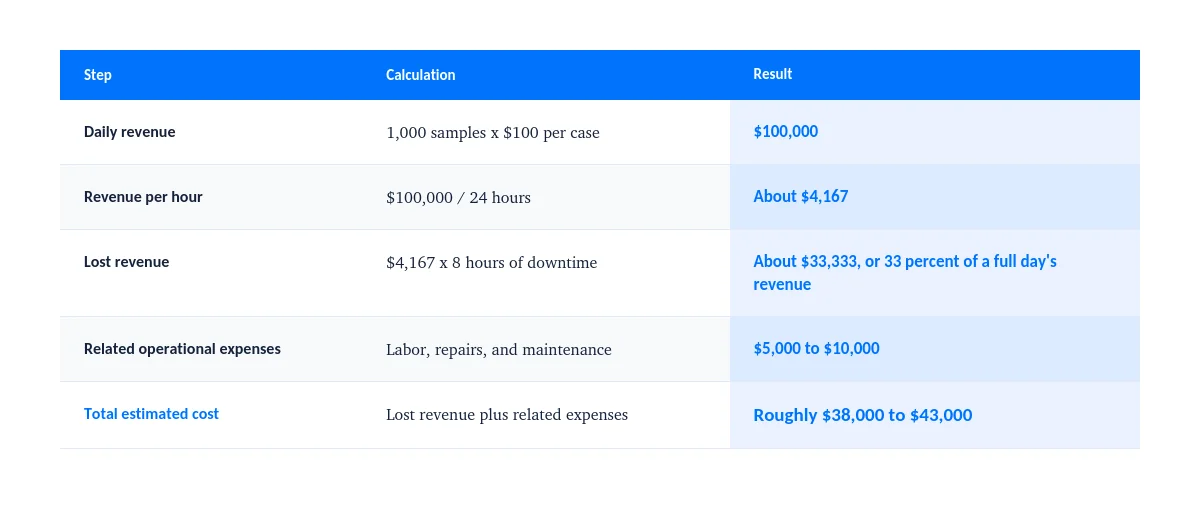
Editor’s Note: The above infographic doesn't account for the indirect impacts of reputational damage, declining staff morale, and potential customer loss.
Industry Insights: Choosing a Vendor - Guidance for Your LIS System Upgrade
How Can the Best Laboratory Information System Companies Help Prevent Unplanned Downtime?
Proactive measures to prevent downtime are essential to sustain long-term productivity and profitability because even the most successful labs operate on tight margins and rely heavily on their reputations.
A strong starting point is implementing a modern laboratory information system from LIS software vendors who understand the critical nature of lab work and the need for reliable laboratory workflow management applications.
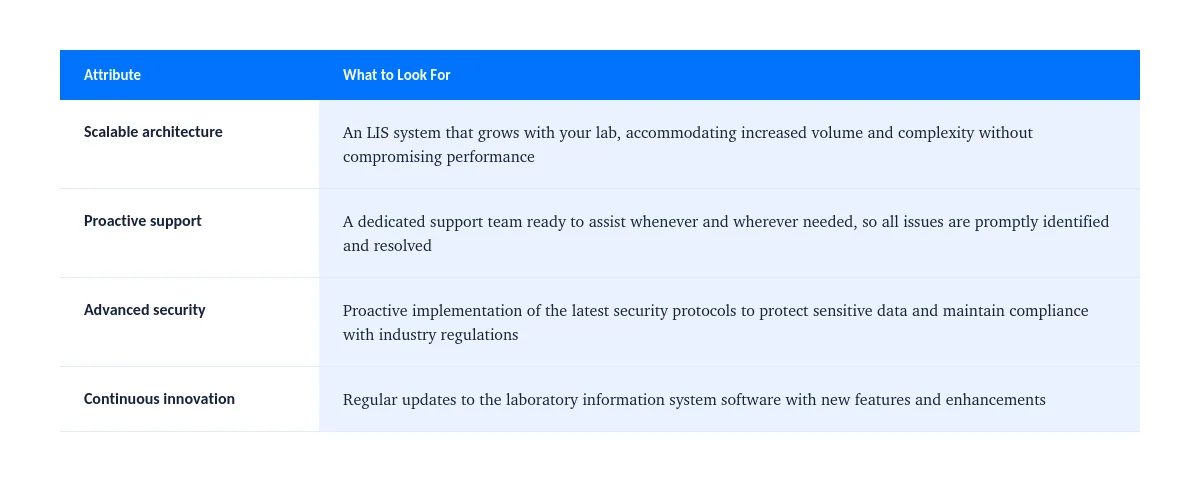
What Four Attributes Should You Look for in an LIS Software Vendor?
Get Insight: It’s Time for Medical Labs to Embrace the Potential of Laboratory Informatics

What Is LigoLab's 99.9% Uptime Guarantee?
For advanced lab information system technology and clinical and pathology lab management best practices that directly impact profitability, LigoLab has distinguished itself in the competitive information systems and data management market through its unwavering commitment to excellence, including an uptime guarantee that other LIS vendors are unwilling to offer.
How do Architecture and Accountability back the Guarantee?
"We proudly guarantee 99.9 percent uptime for the all-in-one LigoLab Informatics Platform," said LigoLab CEO Suren Avunjian. "This means your lab can rely on our LIS software with an embedded laboratory billing module to be operational and accessible virtually all the time, ensuring that your critical lab workflow is never compromised. We understand that even minor downtime can have significant consequences, and we take every measure to prevent it."
The LigoLab platform is purpose-built to meet the full spectrum of demands faced by today's modern laboratories, from high-volume specimen processing to intricate data management. Its scalable and resilient architecture ensures peak performance even during the most intense workloads, with built-in advanced monitoring tools that detect and address potential issues before they disrupt operations.
What Credits Apply for Any Unplanned Disruption?
"We commit to providing a reliable and stable platform," continued Avunjian. "In the rare event of unplanned downtime, we credit our customers for the time we impact them. This guarantee underscores our alignment with the organizations we serve, our confidence in the reliability and stability of our LIS software platform, and our dedication to customer satisfaction."
LigoLab continuously invests in cutting-edge clinical and anatomic pathology software technology and infrastructure, with rigorous development, testing, and quality assurance processes to ensure the platform meets the highest industry standards.
Case Study: From Launch to Lift-Off - Highlighting Goldfinch Laboratory’s Formula for Rapid Growth
What More Can Labs Do to Prevent Unplanned Downtime?
In addition to partnering with experienced laboratory information system companies, the best lab operators help themselves by prioritizing the following:
- Maintenance and calibration of all lab instruments.
- Deployment of redundant systems and backup servers.
- Real-time monitoring of critical systems.
- Security protocols with regular audits to prevent cyberattacks and data breaches.
- Development and enforcement of Standard Operating Procedures (SOPs) with contingency plans for unplanned downtime.
- Regularly scheduled emergency drills.
- Stable power supply and climate control.
- Clear communication channels for issue reporting.
- Strict quality control measures.
Discover More: Beyond Risk - How LigoLab Fortifies Modern Clinical Laboratory Management

Why Are Stability and Performance Critical to Laboratory Operations?
Stability and performance are paramount in modern laboratory operations, where patient outcomes and profitability are top objectives. Without these, a medical lab can’t operate smoothly or efficiently, directly affecting the vital services it provides.
"In laboratory environments, turnaround time is not just a metric; it's a critical component that directly impacts reputation, customer satisfaction, and patient outcomes," said Avunjian. "Rapid and accurate test results are essential for timely medical decisions. Any delay can have significant consequences, from impeding treatment plans to affecting patient recovery."
LigoLab's uptime guarantee has been a game-changer for organizations that require the highest levels of reliability and dependability, reinforcing trust among healthcare providers, patients, and stakeholders alike.
White Paper: What To Do When Your Laboratory Information System Is Sunsetting
What Is the LigoLab Advantage?
Choosing LigoLab means partnering with an LIS company committed to your laboratory’s long-term success. Its comprehensive, highly configurable laboratory information system streamlines workflows, improves accuracy, increases operational efficiency, and optimizes overall laboratory performance.
Discover More: Navigating the Future of Pathology - The LigoLab Advantage
Does an Uptime Guarantee Alone Make an LIS System the Right Choice?
Not by itself, and it's worth being direct about that. A guarantee is only as useful as its terms. Mathematically, 99.9 percent availability over a year allows roughly 8.8 hours of downtime, which is about the eight-hour outage in the Lab X example above, so ask how uptime is measured, over what period, and what is excluded. Also ask what the remedy is: a credit for the time impacted may be much smaller than the revenue and operational cost of an outage.
Some downtime also starts on the lab's side, such as instrument failures, power or network problems, or a ransomware attack on local systems, which is why the internal measures above still matter. The $100,000-per-hour figure is an expert estimate, so calculate your own cost using your volume and revenue per case, as the Lab X example does. Request each LIS vendor's uptime commitment in writing, including hosted and cloud vendors, and compare terms rather than assuming.
Finally, stability is one criterion among several. Workflow fit, lab billing integration, interoperability, and support all belong in the evaluation, and references from labs with similar volume will tell you more than any single guarantee.
Continue Your Research
- Vendor Evaluation: Laboratory Information Systems Are Not Commodities!
- Cybersecurity: Protect Your Lab with Enhanced Cybersecurity Measures
- Risk Management: Beyond Risk - How LigoLab Fortifies Modern Clinical Laboratory Management
- Data Security and Compliance: How LigoLab Safeguards Data Privacy, Security, and Compliance in Today's Digital Lab Environment
- Reducing Lab Risk: Reducing Risk in the Modern Laboratory - A Comprehensive Approach
Ready to Experience Unmatched Laboratory Information System Stability?
See for yourself how the all-in-one LigoLab Informatics Platform with embedded laboratory billing solutions can support your business with unprecedented uptime and performance. Connect with a specialist today.
Act Now: Contact a LigoLab Product Specialist!
Frequently Asked Questions About Laboratory Downtime and Laboratory Information System Stability
What is the difference between planned and unplanned downtime?
Planned downtime is scheduled and managed in advance, such as taking an instrument offline for maintenance or bringing a lab information system down for a LIS software update. Unplanned downtime is unexpected and far more disruptive, caused by events such as server failures, system crashes, or ransomware attacks.
How much can unplanned downtime cost a medical laboratory?
Experts estimate that unplanned downtime can cost a medium- to large-sized lab up to $100,000 per hour. In a smaller-lab example, 1,000 samples a day at $100 per case could lose about $33,333 in revenue from eight hours of downtime, and roughly $38,000 to $43,000 once you add labor, repairs, and maintenance.
What is LigoLab's uptime guarantee?
LigoLab guarantees 99.9 percent uptime for its informatics platform, meaning the all-in-one LIS system is operational and accessible virtually all the time. In the rare event of unplanned downtime, LigoLab credits customers for the time it impacts them. LigoLab states that it is the only LIS company offering an uptime guarantee, so labs should compare each vendor's terms in writing.
What steps can labs take internally to reduce unplanned downtime?
Beyond choosing a reliable LIS vendor, labs can schedule instrument maintenance and calibration, deploy redundant systems and backup servers, monitor critical systems in real time, run regular security audits, document SOPs with downtime contingency plans, hold emergency drills, and maintain stable power and climate control.
How does downtime affect patient outcomes?
Delays in delivering diagnostic results to clinicians can disrupt timely treatment decisions and negatively affect patient outcomes. In time-sensitive cases, even a few hours of delayed reporting can negatively affect patient care and recovery.
Does an uptime guarantee alone make an LIS system the right choice?
Not by itself. Ask how uptime is measured, what is excluded, and what remedy applies, remembering that 99.9 percent availability still allows roughly 8.8 hours of downtime a year. Evaluate workflow fit, lab billing integration, support, and references alongside any guarantee.