Industry Insights
ECPC’s Strategic Leap into Digital Pathology - A Connected Vision for the Future

August 11, 2026
When Eastern Connecticut Pathology Consultants (ECPC) decided to enter the world of digital pathology, they did so with a clear mission: modernize lab workflow management, strengthen collaboration across sites, and position the practice for an AI-driven future.
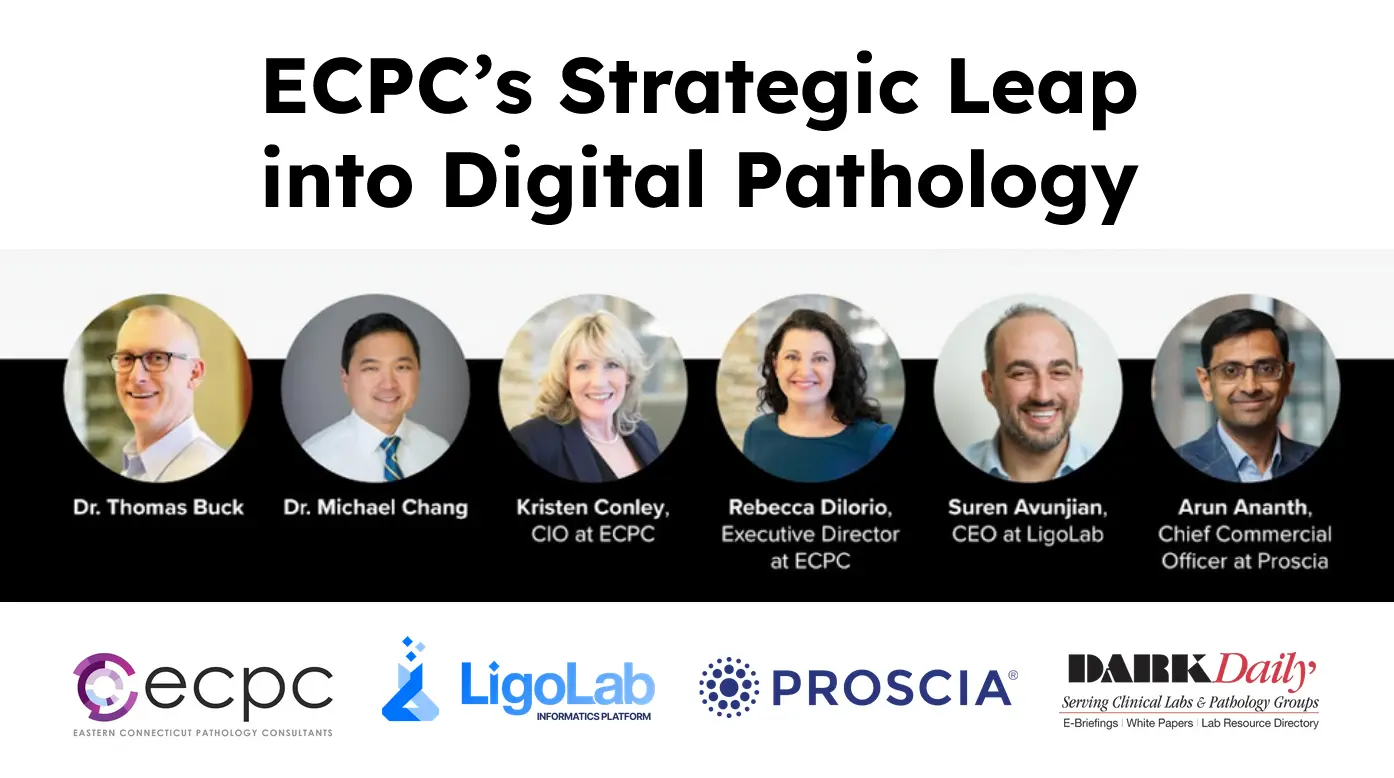
That mission came to life during the "ECPC's Strategic Leap into Digital Pathology" webinar, hosted by Dark Daily and sponsored by LigoLab and Proscia. The session brought together ECPC's Dr. Thomas Buck, Dr. Michael Chang, Kristen Conley (CIO), and Rebecca Dilorio (Executive Director), along with Suren Avunjian (CEO, LigoLab) and Arun Ananth (Chief Commercial Officer, Proscia).
Together, they shared an impactful story of innovation, partnership, and perseverance, offering a clear roadmap for other pathology groups to follow.
Editor’s Note: What follows is a summary of the Dark Daily-hosted webinar that aired live on October 30, 2025. An on-demand version of the webinar is linked below.
On-Demand Webinar: ECPC’s Strategic Leap into Digital Pathology
A Growing Practice Ready for Change
Founded in 1993, ECPC has grown from a three-pathologist team serving a single hospital into a regional network of 25 board-certified pathologists covering five hospitals and six independent laboratories across Connecticut and southern Massachusetts.
Over the years, ECPC built a reputation for subspecialty excellence across GI, GU, breast, dermatopathology, cytopathology, and hematopathology. But as the group expanded, logistical challenges followed.
"Moving glass slides between sites was expensive and time-consuming," said Dr. Buck. "We needed a smarter, faster, and more collaborative way to work."
The solution: a unified digital pathology ecosystem powered by Proscia’s Concentriq image management system, and tightly integrated with LigoLab’s all-in-one Medical LIS & lab RCM Informatics Platform.
Industry Insights: The Modern Laboratory Blueprint - Aligning People, Processes, and Technology for Long-Term Success
Revisiting a Decade-Old Vision
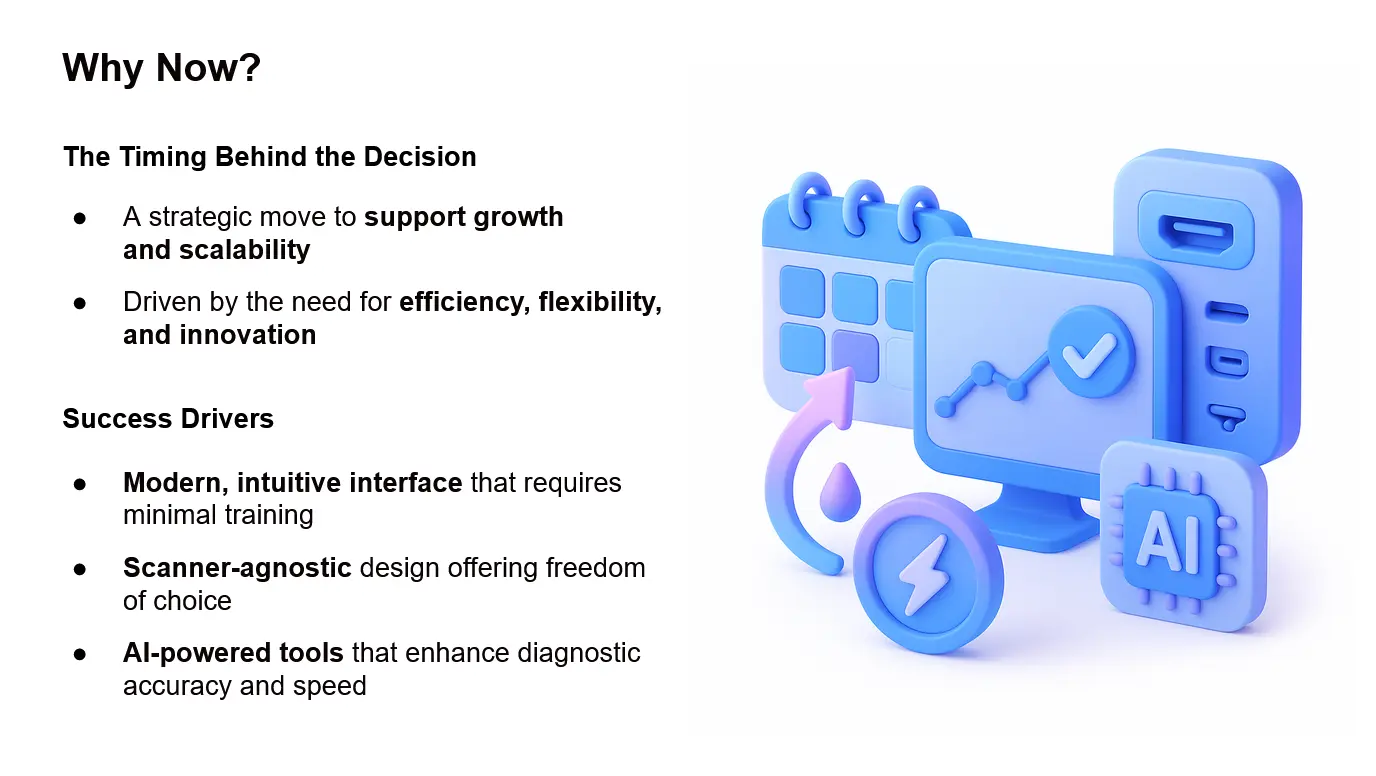
ECPC first explored the benefits of digital pathology a decade ago, but the technology and infrastructure weren’t yet mature enough to support widespread adoption. Scanners were slower, cloud computing was in its infancy, and system integration capabilities were limited.
Fast-forward to today, and both the technology and the need for digital pathology solutions have advanced significantly. With Proscia, LigoLab, and a cloud-first IT strategy in place, ECPC revisited digital pathology and never looked back.
"We started scanning for primary diagnosis about six months ago," said Dilorio. "Half of our pathologists are validated or in the process, and our digital footprint is expanding rapidly."
Discover More: Digital Pathology Workflow - The Future is Here
Building a Cloud-Native Foundation
When Conley joined ECPC in 2019, the practice had no owned applications or infrastructure. Her first task was to establish an IT foundation built for scale.
Operating from a hospital campus without on-premises servers, Conley implemented a fully cloud-based ecosystem with LigoLab's hosted laboratory information system (LIS) software platform serving as the ecosystem’s foundation.
"LigoLab stood out immediately," she said. "They provided the infrastructure, the backup, the security, and the scalability we needed from day one. It was a no-brainer."
This cloud foundation became the launchpad for ECPC's digital pathology workflow initiative.
When the group decided to implement Proscia's Concentriq, they needed local bandwidth for scanner-to-server communication. Conley secured a dedicated 1-gigabit line, new workstations, and a private data closet to ensure lightning-fast performance.
The partnership with LigoLab and Proscia created a fully integrated real-time architecture that connects every step, from accessioning and grossing to scanning and diagnosis.
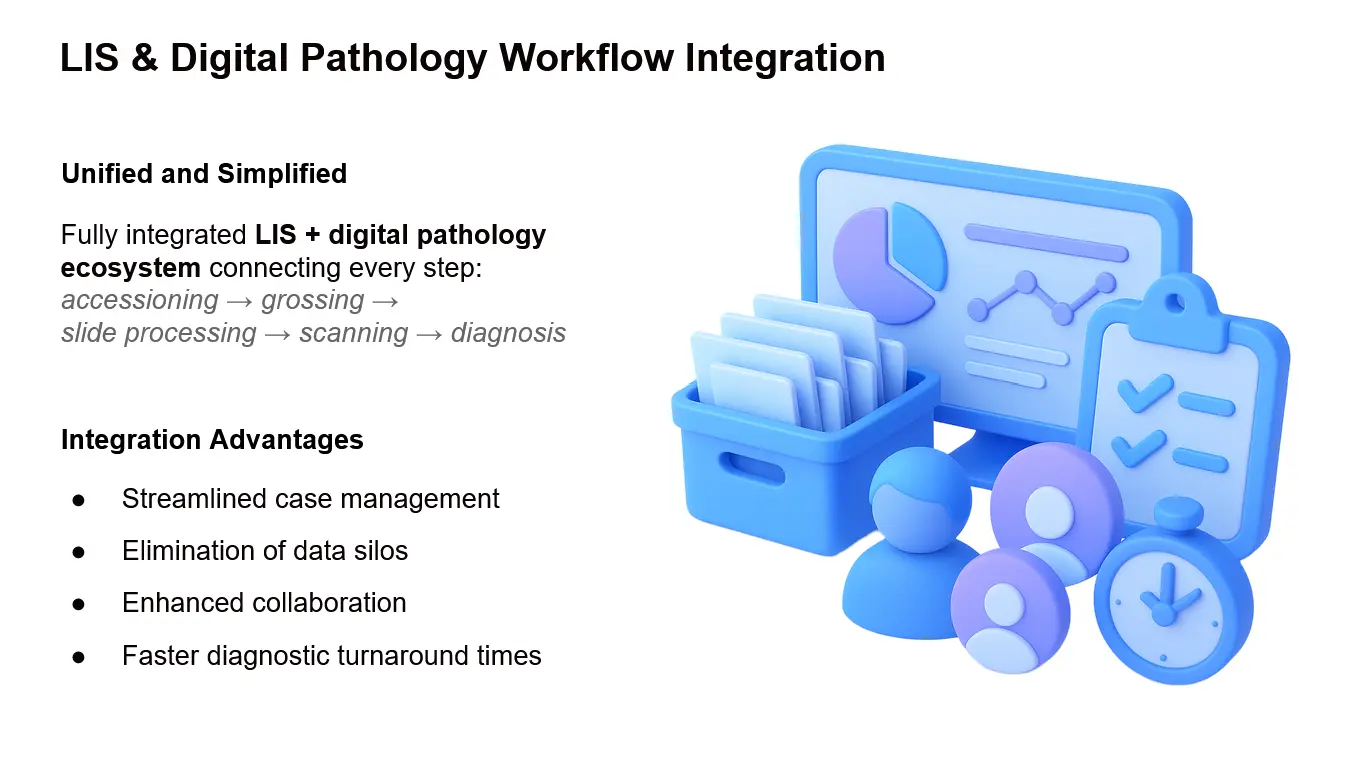
A Seamless, Fully Integrated Digital Pathology Workflow
Integration was non-negotiable. ECPC wanted bidirectional, contextual communication between LigoLab's advanced laboratory information system software and Proscia's image management platform.
"Every case, image, and report stays linked automatically," explained Avunjian. "When laboratory software systems communicate directly, data moves freely and securely, and the lab operates like an intelligent organism."
How the Integration Works
- Accessioning in LigoLab triggers a placeholder in Concentriq, preparing the system for incoming images.
- As slides are scanned, the images are automatically returned to LigoLab’s lab information system module.
- Pathologists launch directly into the digital viewer with a single click, eliminating the need for searching and extra sign-ins.
- Captured images and annotations are displayed immediately in the LigoLab report preview window.
"It's fully contextual," continued Avunjian. "The pathologist opens a case in LigoLab, and the LIS system launches the correct slide set in Concentriq, tied directly to that specimen. The integration works both ways."
This connected environment eliminates manual case matching and enables seamless, integrated workflows across the diagnostic process. It also establishes a strong foundation for AI-driven diagnostics by ensuring that data remains structured, traceable, and centralized within a unified environment.
Discover More: Best Practices for Preparing Medical Labs for AI Integration in Technical and Financial Operations
Future-Proofing for AI and Continuous Growth
"Digital pathology isn't just about replacing the microscope with a monitor," said Ananth. "It's about building a foundation for intelligent automation and AI."
He noted that interoperability, scalability, and user experience are critical design pillars for any successful digital transformation.
"The pathologist's workflow must be intuitive," said Ananth. "We're not just digitizing slides; we're empowering faster, more confident diagnosis and continuous improvement."
With Proscia’s Concentriq platform, ECPC can incorporate AI algorithms for image quantification, biomarker analysis, and automated case triage, with structured data flowing seamlessly back into LigoLab’s advanced LIS software. This creates a continuous feedback loop between the laboratory’s diagnostic and operational workflows, helping improve efficiency, visibility, and decision-making.
"This architecture is AI-ready," said Avunjian. "We're laying the groundwork for algorithms to work natively within the LIS system and become part of everyday diagnostic lab workflow."
Industry Insights: AI-Native Is Not the Same as AI-Ready
Overcoming Challenges and Learning Along the Way
Like any transformation, ECPC's digital journey had its hurdles. Early infrastructure challenges, scanner performance issues, and pathology lab software optimizations required close collaboration across all partners.
However, thanks to open communication and agile support from both LigoLab and Proscia, the teams resolved all issues quickly.
"They never left us hanging," said Conley. "Every challenge led to a better, more stable solution."
Operationally, ECPC also learned the importance of dedicated scanning teams and consistent quality control. Histology staff were trained to ensure slides were clean, centered, and optimized for scanning.
"We realized that quality control is as critical digitally as it is under the microscope," said Dilorio. "Dedicated resources and strong communication made all the difference."
Discover More: A Detailed Look at How Modern Laboratory Information Systems Fully Support Quality Control
A Pathologist’s Perspective: From Skeptic to Advocate
For Dr. Chang, the transition from microscope to monitor was both exciting and intimidating.
"I've spent years in front of a microscope," he said. "So naturally, I was skeptical. But after a short learning curve - maybe two weeks - I found the software intuitive and efficient."
Dr. Chang now signs out cases digitally and appreciates features like voice navigation, high-resolution image capture, and streamlined peer review.
"What used to take days now takes minutes," he said. "I can share a case instantly through Microsoft Teams, and within 10–15 minutes, I have feedback from three or four colleagues."
This rapid collaboration, powered by the LigoLab–Proscia integration, enhances diagnostic confidence, accelerates turnaround times, and directly improves patient care.
Discover More: Optimizing Lab Operations - Tackling Labor Shortages with Modern Laboratory Information Systems
The ROI and the Bigger Picture
While digital pathology solutions require a sizable upfront investment, the long-term gains are substantial. ECPC anticipates major savings on courier costs, estimated at over $200,000 per year, and improved operational efficiency across the board.
Dr. Buck emphasized that ROI goes beyond dollars.
"It's about staying relevant," he said. "Our clients are asking for AI and digital tools. We're building a practice that's ready for what's next."
The ECPC team expects to be a fully digital practice within a year, supported by continuous innovation from LigoLab and Proscia.
Discover More: Don’t Upgrade the Past - Invest in the Future with LigoLab’s Proven Strategies for Zero Downtime and Maximum ROI
Lessons for Laboratories Everywhere
When asked what advice they'd offer to labs just beginning their digital pathology workflow transformation, Avunjian and Ananth agreed on three key points:
- Start with workflow, not technology. Map how your lab really operates and identify bottlenecks before evaluating systems.
- Prioritize interoperability and scalability. Select platforms that communicate seamlessly and adapt as your lab grows.
- Treat implementation as a partnership, not a purchase. Choose lab vendors that build with you, not just for you.
Conley added that leadership and internal champions are essential.
“You need people who will hold the vision when challenges arise," she said.
White Paper: Vendor to Partner - How Aligning with Your LIS Provider Can Transform Your Lab
A Connected Future for Pathology
ECPC’s digital transformation demonstrates what’s possible when pathology, informatics, and AI are seamlessly integrated within a unified environment.
By pairing LigoLab's all-in-one LIS & RCM platform with Proscia's Concentriq image management system, ECPC built a connected, interoperable environment that supports faster diagnoses, richer data, and a stronger foundation for future innovation.
"This is what interoperability looks like in action," said Avunjian. "Advanced pathology lab software connecting people, data, and purpose."
For ECPC, the future of pathology goes beyond digital. It's connected, intelligent, and built for continuous evolution.
White Paper: Comparing LigoLab’s All-in-One Informatics Platform with Legacy Laboratory Information System Software
Ready to Build Your Own Connected Digital Pathology Workflow?
ECPC's journey shows what's possible when laboratory informatics and digital pathology imaging work together as one unified system. If your lab is ready to modernize operations, unify data, and prepare for AI-driven diagnostics, LigoLab can help.
Step into the Future: Speak with a LigoLab Product Specialist!
Frequently Asked Questions About ECPC's Digital Pathology Transformation
What technology did ECPC use for its digital pathology transformation?
ECPC paired Proscia's Concentriq image management system with LigoLab’s all-in-one Medical LIS & Lab RCM Informatics Platform, running on a cloud-based infrastructure hosted on Microsoft Azure.
How does the LigoLab-Proscia integration work?
Accessioning in LigoLab automatically creates a corresponding case in Concentriq. Once slides are scanned, the digital images are linked back to the laboratory information system, allowing pathologists to launch the digital viewer directly from LigoLab with a single click. Images and annotations are then seamlessly incorporated into the LigoLab report preview window.
Why did ECPC's first attempt at digital pathology, a decade ago, not succeed?
A decade ago, scanning technology and cloud infrastructure lacked the maturity needed to support a fully digital pathology workflow. Today, significant advances in scanner performance, cloud computing, and system integration have created the technology foundation that made ECPC’s successful transition to digital pathology possible.
What ROI can labs expect from digital pathology?
ECPC anticipates savings of over $200,000 per year on courier costs alone, along with improved operational efficiency. Beyond direct savings, leadership emphasized that digital pathology also helps practices stay competitive as clients increasingly request AI and digital tools.
How long did it take pathologists to adapt to digital sign-out?
According to Dr. Michael Chang, the learning curve was roughly two weeks before the digital workflow felt intuitive and efficient.
What advice do LigoLab and Proscia give labs starting their own digital transformation?
Start with workflow, not technology, by mapping current processes and bottlenecks first. Prioritize interoperability and scalability when choosing platforms. And treat implementation as a partnership with your vendors, not just a purchase.
How does this integration prepare labs for AI-driven diagnostics?
Because case data, images, and reports are already structured, linked, and centralized between LigoLab and Concentriq, the architecture is positioned to support AI algorithms for image quantification, biomarker analysis, and automated triage as they mature.