Industry Insights
Best LIS Systems in 2026: Top Laboratory Information Systems Compared for Clinical, Pathology, and Outreach Labs

September 9, 2026

What is an LIS System?
A laboratory information system (LIS) is software that manages the end-to-end lifecycle of laboratory diagnostics, from order intake and specimen tracking to testing workflows, result reporting, quality control, compliance, and increasingly, laboratory billing and operational analytics.
Modern medical LIS software platforms extend beyond basic data management. They function as LIS systems of Action, coordinating people, instruments, workflows, and financial processes in real time to improve efficiency, reduce errors, and support scalable laboratory operations.
Why the Definition of the "Best LIS System" Has Changed, and What Modern Laboratories Now Require
Modern laboratories rarely fail because of a single catastrophic breakdown. Instead, inefficiency accumulates quietly through dozens of small handoffs: incomplete order data, manual worksheets, faxed add-ons, misplaced specimens, interface queues or worksheets without clear ownership, lab billing edits discovered too late, or pathology cases delayed because images, metadata, and financial information live in separate systems.
These operational gaps compound at scale, slowing turnaround times, frustrating providers, straining staff, and quietly eroding margins. Over time, they impose an artificial ceiling on a laboratory's growth.
As a result, the definition of the "best LIS system" has fundamentally changed.
Today, laboratories no longer evaluate LIS software solely on its accessioning and result-reporting capabilities. The most effective laboratory information systems coordinate the entire diagnostic and financial lifecycle, connecting technical workflows, outreach operations, and laboratory revenue cycle management (RCM) processes into a single operating environment.
The platforms that stand out are those that:
- Orchestrate end-to-end laboratory workflow management across departments and locations.
- Support clinical, anatomic pathology, molecular, and specialty diagnostics without fragmentation.
- Apply configurable rules and automation to reduce manual intervention.
- Unify operational and financial data to manage throughput and cash flow together.
- Prevent revenue leakage by enforcing lab billing readiness upstream.
- Integrate seamlessly with instruments, EHRs, and reference laboratories.
- Scale without relying on bolt-on modules that create new silos.
This guide brings a market-based comparison of the leading laboratory information systems in use today, examining where each platform excels, where trade-offs exist, and why unified, all-in-one lab organization software architectures are increasingly replacing modular LIS models.
Discover More: Four Game-Changing Business Strategies to Improve Laboratory Processes
How to Evaluate LIS Medical Platforms Beyond Basic Demos and Core Functionality
Labs evaluating LIS medical platforms often request side-by-side demos of workflow automation, exception handling, and laboratory billing readiness. While most modern LIS systems can handle core functions like accessioning, result reporting, and basic interfaces, the real differentiators emerge under pressure.
Laboratories should evaluate the system’s depth, how much autonomy internal teams have to configure and evolve workflows, and how effectively the platform manages real-world exceptions rather than only ideal, linear workflows.
Act Now: Contact LigoLab to Schedule a Personalized Demo
A Summary Comparison of Today’s Leading LIS Systems
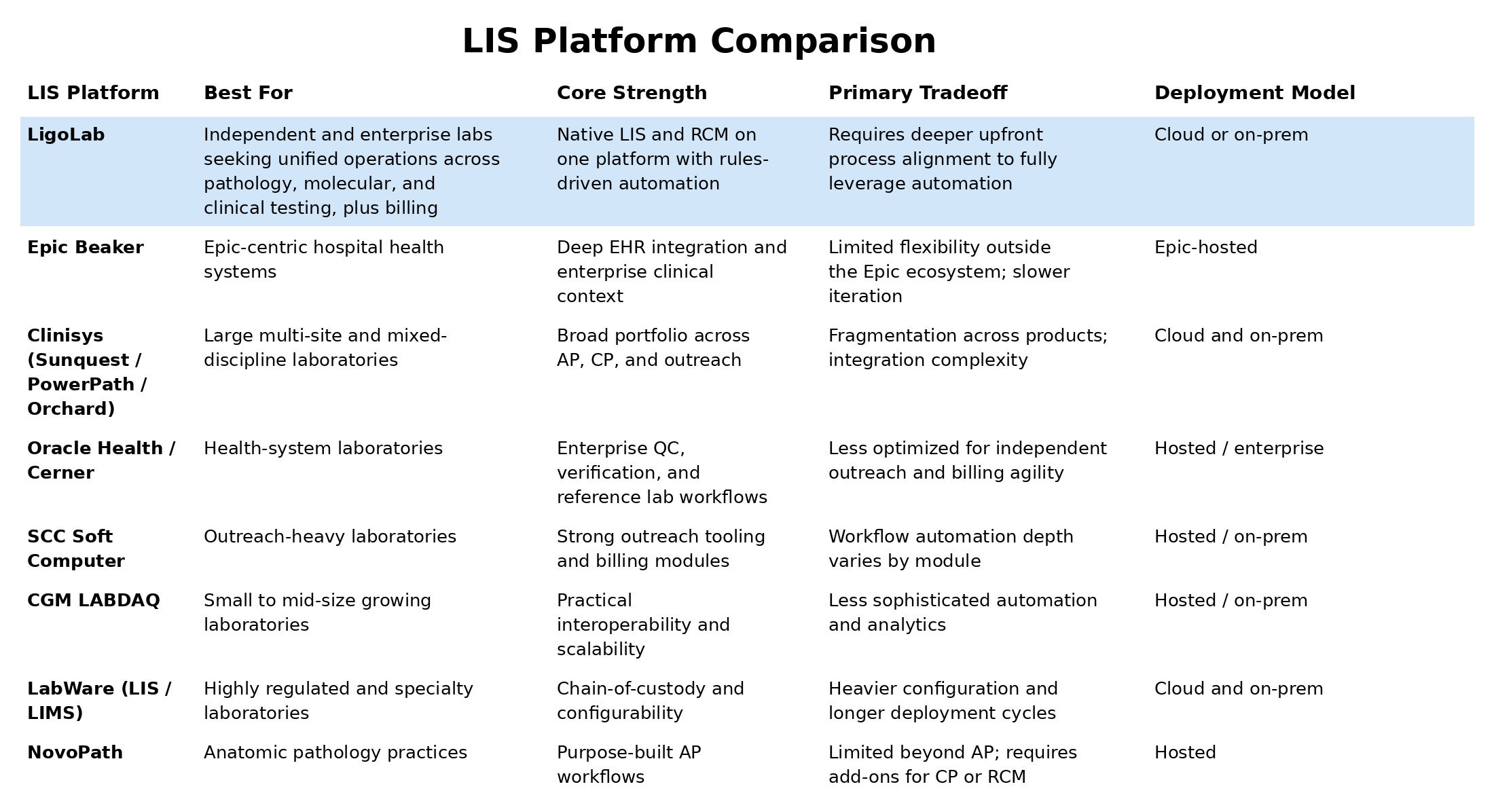
Let’s start with an overview of the top LIS systems currently in widespread use, highlighting core strengths and primary tradeoffs.
What Most LIS Systems Get Right (and Where the Differences Begin)
Across clinical laboratories, pathology practices, and multi-site diagnostic organizations, the most successful LIS system implementations consistently share a common set of capabilities.
The best LIS systems today are characterized by:
- Rules-based workflow automation that governs routing, autoverification, exception handling, and task prioritization rather than relying on manual decision-making.
- True specimen-to-result traceability, including complete audit trails, chain-of-custody visibility, and real-time status transparency.
- High-throughput instrument and middleware connectivity with resilient, bidirectional interfaces and managed queues.
- Configurable worklists and dashboards that surface bottlenecks by role, department, and priority.
- Outreach and interoperability infrastructure supporting EHR integration, portals, ordering control, and multi-site operations.
- Built-in quality and compliance controls aligned with regulatory and accreditation requirements.
- Laboratory revenue cycle management intelligence that's embedded upstream, ensuring demographic accuracy, coding readiness, and claim viability before results are finalized.
While many LIS software platforms excel in individual domains, such as hospital integration or anatomic pathology LIS workflows, only a small percentage unify operational workflows, outreach, and revenue cycle processes within a single, cohesive informatics platform.
Discover More: Can Your Laboratory Information System Support the Latest LIS System Technology?
Top Laboratory Information Systems: Strengths, Trade-offs, and the Rise of All-in-One Architectures
The analysis below examines the leading LIS systems on the market; what they do exceptionally well, where trade-offs exist, and why all-in-one architectures, particularly those that unify LIS and RCM workflows, are emerging as the defining competitive advantage for modern laboratories.
1) LigoLab’s All-in-One LIS & RCM Informatics Platform
Best-in-class for laboratories seeking a unified lab organization software architecture: LigoLab’s differentiator is a native, unified LIS + RCM architecture. LigoLab unifies LIS and laboratory revenue cycle management on a single platform, connecting technical operations directly with billing workflows to prevent errors upstream rather than correcting them later. The platform supports multi-facility pathology groups processing millions of accessions annually.
On-Demand Webinar: From Manual to Magical - Automation Strategies for Multi-Facility AP & Clinical Labs
Advanced Functions
- Cloud-ready deployment and flexibility: LigoLab supports cloud-based deployment and traditional on-premises server installations, providing laboratories the flexibility to choose the environment that best fits their infrastructure, security requirements, and operational goals.
- Support for diverse diagnostic disciplines: Rather than forcing laboratories to manage separate LIS lab instances or stitched-together modules, LigoLab enables clinical, anatomic pathology, and molecular diagnostics workflows to coexist and scale on a single, highly configurable informatics platform.
- Rules-driven automation across the entire lab workflow: A sophisticated automation engine triggers multi-step actions, applies prioritization logic, routes, and handles exceptions across departments. By automating full workflows, not just individual tasks, the platform reduces manual touchpoints per specimen and enables laboratories to scale volume without adding headcount.
- End-to-end specimen and case lifecycle control: Shared workflow queues, real-time status visibility, and complete audit trails ensure every specimen, case, and financial event is managed within a single system of record (one source of truth). This unified control LIS model eliminates departmental friction while improving turnaround times, accountability, and operational consistency.
- Integrated lab RCM automation: Built-in demographic review, eligibility verification, insurance discovery, intelligent workflow queues, and automated CPT/ICD coding proactively reduce denials and rework. Revenue protection is embedded directly into LIS system workflows, accelerating cash flow and improving lab billing accuracy.
- Unified operational and financial intelligence: Real-time dashboards connect throughput, turnaround time, staffing efficiency, and revenue performance in one view. This unified intelligence enables laboratory leaders to manage operations and margins together, rather than relying on disconnected reports or retrospective analysis.
Bottlenecks it Eliminates
- Manual exception management across departments: Rules-driven workflows and shared queues proactively identify missing demographics, coverage issues, and medical-necessity gaps, preventing exceptions from creating downstream delays and billing issues.
- "Billing after the fact" revenue delays: By embedding demographic review, eligibility checks, insurance discovery, and coding logic directly into LIS system workflows, cases remain billing-ready at every stage of processing, reducing delays and denial risk.
- Departmental silos and handoff friction: Accessioning, technical benches, client services, and laboratory billing departments all operate within a single lab database software system, utilizing shared rules, queues, and real-time visibility to streamline handoffs and improve turnaround times.
- Scaling constraints as volume grows: Automation reduces human touchpoints per specimen while supporting multi-facility operations. Shared, real-time workflow queues provide all teams with full visibility into specimen status, workload, and downstream dependencies across all testing disciplines, enabling laboratories to increase test volume and complexity without a proportional increase in staffing.
Bottom line: Unlike traditional laboratory information systems that rely on disconnected modules or third-party laboratory billing solutions, LigoLab's comprehensive and flexible informatics platform unifies clinical operations, outreach, automation, and lab revenue cycle management into a single, rules-driven application, eliminating silos, reducing errors upstream, and enabling laboratories to scale efficiently without rebuilding their technology stack.
2) Epic Beaker LIS
Why it's considered top-tier: Beaker is commonly selected by health systems standardized on Epic that prioritize seamless integration with their enterprise electronic health record (EHR). Its key strength is providing comprehensive clinical context and a unified patient record across the organization.
Advanced Functions
- Delivers a single, enterprise-wide clinical context when Epic functions as the core EHR, minimizing system switching and improving clinical data access for both anatomic and clinical pathology workflows.
- Provides modular anatomic pathology and clinical pathology components, enabling alignment with standardized, enterprise-wide clinical workflows.
Bottlenecks it Eliminates
- Delays in clinical data access for pathologists and laboratory teams working within an Epic-centric environment.
- Fragmented ordering and results distribution by consolidating workflows within a single, enterprise-wide EHR hub.
Tradeoff to watch: Beaker tends to shine most when your enterprise is already committed to Epic. For independent labs or multi-EHR outreach businesses, best-of-breed connectivity and specialized lab billing automation can be deciding factors.
Constraint: Customization and the pace of ongoing enhancements may be constrained by enterprise governance requirements and Epic’s release cycles.
3) Clinisys LIS (Sunquest, PowerPath, Orchard)
Why it's considered enterprise-grade: Clinisys has one of the broadest portfolios in laboratory informatics, spanning clinical pathology, anatomic pathology diagnostics, outreach/networking, and cloud-based modernization initiatives. Clinisys positions its cloud offerings around scalability, analytics, and reduced data silos.
Advanced Functions
- Orchard Enterprise delivers rule sequencing, autoverification, analytics, KPI tracking, and workflow optimization designed to improve operational efficiency.
- PowerPath (Sunquest PowerPath) is an anatomic pathology–focused LIS system with greater diagnostic flexibility and workflow depth than typical EHR-based pathology modules.
- Atlas outreach and multi-lab networking capabilities harmonize data across multiple LIS system environments, streamline order processing and results delivery, and enable test routing across distributed laboratory networks.
- Ongoing platform enhancements emphasize new functionality, modernization initiatives, and expanded support tooling across the portfolio.
Bottlenecks it Eliminates
- Multi-site operational complexity and "siloed LIS islands" through networking and data harmonization capabilities.
- Manual review workload by applying rule sequencing and autoverification to reduce repetitive human intervention.
- Operational friction for outreach, particularly around ordering, catalog synchronization, and results delivery, across heterogeneous laboratory environments.
Constraint: Portfolio breadth can introduce operational complexity, requiring integration and coordination across multiple products.
4) Oracle Health / Cerner PathNet LIS
Why it's considered top-tier: Oracle Health positions its laboratory offerings around workflow streamlining, verification, reference-lab integration, QC, and billable events, often in health-system contexts.
Advanced Functions
- Configurable verification workflows with site-specific reference ranges and built-in turnaround-time monitoring.
- Integrated quality control processes, secondary result review, and seamless connectivity with reference laboratories.
- Embedded capture of billable events within clinical lab workflows to support accurate and complete revenue recognition.
Bottlenecks it Eliminates
- Variability in result-verification processes and inconsistent quality control enforcement.
- Operational friction in coordinating reference laboratory workflows across complex enterprise environments.
Constraint: Best suited for health-system environments; independent outreach and rapid lab-billing innovation may be more constrained.
5) SCC Soft Computer LIS
Why it's considered top-tier: SCC emphasizes a comprehensive LIS ecosystem with outreach and RCM capabilities, including web-based reporting and dedicated lab billing/accounts receivable tooling.
Advanced Functions
- Comprehensive outreach suite that includes web-based ordering and results delivery, along with integrated lab billing and accounts receivable modules designed to support profitable outreach programs.
- Lab revenue cycle management solutions focused on streamlining billing workflows, improving collections efficiency, and strengthening overall financial performance.
- Specialized, integrated add-on capabilities, such as biobank management tools, are embedded directly within the medical LIS environment.
Bottlenecks it Eliminates
- Customer service overload related to outreach, including excessive status inquiries and manual result chasing.
- Fragmented billing and collections workflows are streamlined through a centralized, structured approach to accounts receivable and billing operations.
Constraint: Advanced automation and cross-department orchestration may require additional configuration or external tools.
6) CGM LABDAQ LIS
Why it's considered top-tier: CGM LABDAQ is commonly chosen by laboratories that need a practical, scalable LIS system with robust connectivity to EHRs, practice management systems, and reference labs.
Advanced Functions
- Robust connectivity and interoperability, including interfaces for orders, demographics, results, laboratory billing data, and seamless reference laboratory integration.
- A scalable architecture that supports laboratory growth by seamlessly accommodating additional users, sites, interfaces, and modules as needs evolve.
Bottlenecks it Eliminates
- Manual exchange of orders and results with external providers and reference laboratories through automated, bidirectional interfaces.
- Eliminates entry-level or “starter” LIS limitations with a scalable approach that enables laboratories to expand functionality and connectivity as needs evolve.
Constraint: Designed for scalability, but lacks the depth of rules-driven automation found in enterprise-grade platforms.
7) LabWare LIS and LIMS Platforms
Why it's considered top-tier: While often categorized as laboratory information management system (LIMS) software, LabWare positions its solutions for high configurability, chain-of-custody rigor, and automation in regulated environments; its Clinical Health releases also highlight HL7 integration, dashboards, and lab billing capabilities.
Advanced Functions
- Comprehensive chain-of-custody management combined with work assignment and inventory/storage location tracking supports highly regulated laboratory environments.
- Clinical Health–focused capabilities emphasizing system integration and operational automation across laboratory workflows.
Bottlenecks it Eliminates
- Compliance-intensive tracking gaps in environments that require detailed specimen governance and traceability.
- Manual coordination of complex testing protocols across personnel, instruments, and laboratory sites.
Constraint: High configurability comes with longer implementation timelines and greater reliance on specialized resources.
8) NovoPath LIS for Anatomic Pathology
Why it's considered top-tier: NovoPath is purpose-built for anatomic pathology LIS processes and is widely recognized for streamlining workflows, automation, and detailed diagnostic reporting.
Advanced Functions
- AP–centric workflow automation and reporting designed to support the full pathology lifecycle, from accessioning through final diagnosis.
Bottlenecks it Eliminates
- Manual anatomic pathology handoffs, from grossing and histology to sign-out and reporting, by replacing fragmented steps with a more cohesive, AP workflow design.
Constraint: Designed for anatomic pathology, with limited native support for clinical diagnostics or revenue cycle workflows.
Discover More: Why “The Safe Move” to a New Version of Legacy LIS Software Is the Wrong Move for Medical Labs

Laboratory Bottlenecks Eliminated by the Best LIS Systems
Across these leaders, the "big wins" map to a few recurring bottleneck categories:
1. Accessioning and Pre-Analytic Chaos
Modern solution: Structured order intake, rules-based validation, automation to catch missing fields, and tight traceability.
Best-in-class impact: Fewer recollects, fewer call-backs, fewer lost specimens.
2. Bench Throughput and Result Verification Delays
Modern solution: Autoverification logic, exception-based work queues, instrument connectivity, and real-time operational dashboards.
Best-in-class impact: Higher volume per FTE, fewer manual reviews, faster TAT.
3. Outreach Growth Bottlenecks
Modern solution: Ordering/catalog governance, client portals, multi-site routing, and interoperability layers that reduce friction between disparate systems.
Best-in-class impact: Fewer missing orders, cleaner interface connectivity, happier providers, scalable outreach.
4. Revenue Leakage and Denial Churn
Modern solution: Front-end insurance/eligibility controls, coding support, claim workflow automation, and auditable work queues.
Best-in-class impact: Fewer rejections, fewer denials, faster cash, less manual billing rework.
Most LIS systems can help labs move specimens faster and more accurately, but far fewer can systematically prevent laboratory billing errors by design, since billing is external or downstream. An advanced LIS software platform with a unified LIS + RCM architecture directly targets this industry-wide weak point.
Why All-in-One LIS Systems Are Replacing Modular LIS Models
Historically, laboratories adopted modular technology stacks: one system for accessioning, another for pathology, a separate outreach portal, and an external laboratory billing software platform downstream. While this approach offered short-term flexibility, it introduced long-term operational risk.
As test complexity, payer requirements, and outreach volume increase, fragmented systems create:
- Data latency between operational and financial workflows
- Manual reconciliation across departments
- Ambiguity around ownership of exceptions
- Higher integration maintenance costs
- Delayed visibility into revenue risk
All-in-one LIS software platforms address these issues by treating the laboratory as a single operating environment rather than a collection of disconnected tools.
By unifying technical, outreach, and revenue cycle operations on a single LIS software infrastructure, these platforms create shared rules, queues, and data models that prevent errors upstream, strengthen accountability, and improve operational and financial performance.
For laboratories planning to grow over the next three to five years, this unified architecture is increasingly becoming a necessity rather than a differentiator.
On-Demand Webinar: From Systems of Record to Systems of Action
How to Choose the Best Lab Information System for Your Business
The most revealing LIS system evaluations don’t focus on feature checklists. They focus on how a system performs under real operational pressure.
Most modern LIS software platforms can support foundational functions such as accessioning, specimen tracking, result reporting, and basic interfaces. These capabilities are now table stakes. The true differences emerge when laboratories encounter variability: missing or incomplete orders, complex payer requirements, multi-site coordination, shifting priorities, and downstream revenue risk.
When evaluating a laboratory information system, organizations should ask LIS vendors to demonstrate how their systems handle real-world scenarios, including:
- Preventing missing or invalid order data from becoming laboratory billing problems
- Capturing, routing, and resolving exceptions such as missing specimens or operational failures
- Managing cross-department handoffs without manual coordination or workarounds
- Responding to provider status inquiries without internal escalation
- Identifying revenue risk before claims are submitted
- Distributing cases dynamically using rules and automation rather than static, generic workflows
Equally important is who controls change. Laboratories should assess the autonomy internal teams have to configure rules, evolve workflows, and adjust case distribution as conditions change, without relying on vendor intervention or professional services.
While many LIS medical platforms can function as systems of record, laboratories focused on scale, automation, and margin protection increasingly require systems of action. A unified LIS and lab revenue cycle management platform, built on a single lab database software infrastructure, provides the visibility, control, and resilience needed to operate efficiently as volume and complexity grow.
White Paper: What To Do When Your Laboratory Information System Is Sunsetting
LIS Software Demo Checklist: Questions Every Laboratory Should Ask
The most effective laboratory information system demos move beyond feature walkthroughs and focus on how the LIS lab solution behaves under real operational pressure. Use the questions below to evaluate depth, flexibility, and long-term fit.
1. Workflow Depth and Automation
- How are workflows configured, and can internal teams create, modify, and deploy rules without relying on the LIS company?
- Demonstrate a multi-step workflow that spans accessioning, testing, review, and lab billing readiness. How are dependencies enforced?
- How does the LIS system handle non-linear workflows when steps occur out of sequence?
2. Exception Handling (Not the Happy Path)
- Demonstrate what happens when an order is missing demographics, insurance, or required clinical information.
- Show how exceptions are identified, prioritized, and routed. Are they visible in role-specific queues or buried in generic task lists?
- How does the LIS system prevent exceptions from cascading downstream into delays or billing issues?
3. Case Distribution and Workload Management
- Show how cases are distributed across benches, staff, or sites. Is the distribution static or rules-driven?
- Can routing account for priority, turnaround time, skill set, or capacity?
- How does the LIS system rebalance work when volume spikes or staff availability changes?
4. Autonomy and Change Management
- Who controls workflow changes: the lab or the vendor?
- How long does it take to implement a new rule, report change, workflow, or routing change?
- Can changes be tested safely before going live?
5. Cross-Department and Multi-Site Visibility
- Demonstrate end-to-end visibility of a specimen or case across departments.
- How are handoffs managed without emails, spreadsheets, or manual follow-ups?
- Can leadership see operational and financial status in real time across sites?
6. Revenue Protection and Lab Billing Readiness
- Show how the LIS system validates lab billing readiness before finalizing results.
- How does the LIS system enforce payer rules, eligibility requirements, and coding dependencies before they create downstream issues?
- Can the system proactively identify and address revenue risks before claim submission?
7. Provider and Client Experience
- Demonstrate how staff respond to provider status inquiries. Is information immediately visible?
- How are outreach orders, add-ons, and corrections handled without disrupting workflow?
- What tools reduce inbound calls rather than shifting the burden to staff?
8. Scalability and Future Readiness
- What happens when test volume doubles or new disciplines are added?
- Can the same workflows scale across multiple facilities without duplication?
- How does the platform avoid adding bolt-on modules as complexity increases?
Final Question to Ask Every Vendor
If our workflows, payer mix, or volume change significantly over the next two years, how much of that adaptation can we manage ourselves versus needing vendor services?
The best laboratory information system software will demonstrate not only that it can process specimens, but that it can adapt, prevent exceptions, and support growth without increasing operational friction.
Discover More: Questions All Pathology Labs Should Ask When Evaluating LIS Software and Support
Evaluate LigoLab Against Other Top-Tier LIS Systems
To see how this approach compares in practice, contact a LigoLab product specialist to schedule a personalized demonstration and learn how LigoLab stacks up against other top-tier LIS systems across workflow automation, laboratory revenue cycle management performance, and enterprise-scale pathology and clinical laboratory management.
Act Now: Contact a LigoLab Product Specialist Today!
Frequently Asked Questions About Choosing the Best LIS System
What makes an LIS system stand out now compared to previous years?
The best systems now coordinate the entire diagnostic and financial lifecycle, unifying technical workflows, outreach operations, and lab revenue cycle management into a single operating environment rather than just handling accessioning and result reporting.
Which LIS system is best for labs seeking unified LIS and RCM architecture?
LigoLab is highlighted as best-in-class for this use case, with LIS and lab revenue cycle management modules operating on one unified informatics platform that prevents billing errors upstream rather than fixing them after the fact.
Which LIS system is best for health systems standardized on Epic?
Epic Beaker is most often chosen by health systems already using Epic as their core EHR, offering rich clinical context and unified patient records. However, customization speed can be limited by Epic's enterprise governance and release cycles.
What are the most common laboratory bottlenecks that top LIS systems address?
The four recurring categories are: accessioning and pre-analytic chaos; bench throughput and result verification delays; outreach growth bottlenecks; and revenue leakage and denial churn.
Why are all-in-one medical LIS platforms replacing modular LIS models?
Modular stacks create data latency between operational and financial workflows, manual reconciliation across departments, and delayed visibility into revenue risk. All-in-one platforms treat the lab as a single operating environment, preventing upstream errors and improving efficiency and financial performance.
What questions should labs ask during an LIS demo?
Key areas to probe include workflow configuration autonomy, exception handling for incomplete orders, case distribution logic, change management speed, cross-department visibility, revenue protection before claims are submitted, provider experience tools, and scalability as volume grows.
Who should control workflow changes in an LIS, the lab or the vendor?
Laboratories should assess the autonomy their internal teams have to configure rules and evolve workflows without relying on vendor intervention, since systems that require constant vendor involvement can slow adaptation as needs change.