Industry Insights
A New Year, A New Foundation: Why Now is the Perfect Time to Modernize Your Laboratory Information System

October 23, 2026

Executive Summary: A new year is a natural point to modernize your laboratory information system (LIS) because a basic system that only tracks samples and reports results no longer meets lab needs. Modern platforms unify departments around a single source of truth, automate workflows to offset staffing shortages, and provide real-time visibility.
At the start of every new year, laboratory leaders pause to assess where they stand and where they need to go. Budgets reset, strategic plans refresh, and long-standing challenges resurface with renewed urgency. For clinical laboratories and pathology practices, few decisions are more consequential than modernizing core operations through an advanced laboratory information system (LIS).
Today, a laboratory information system is no longer just a technical utility. It is the digital backbone of pathology and clinical laboratory management. The new year offers a natural inflection point to rethink whether your current LIS software enables growth or quietly holds your organization back.
This article explores why now is the right time to invest in a modern medical LIS, how LIS systems are changing, and what lab leaders should prioritize when evaluating their next-generation lab information system platform.
Discover More: Keys to Providing Premier Pathology Client Services - How Advanced Laboratory Information Systems Set the Standard
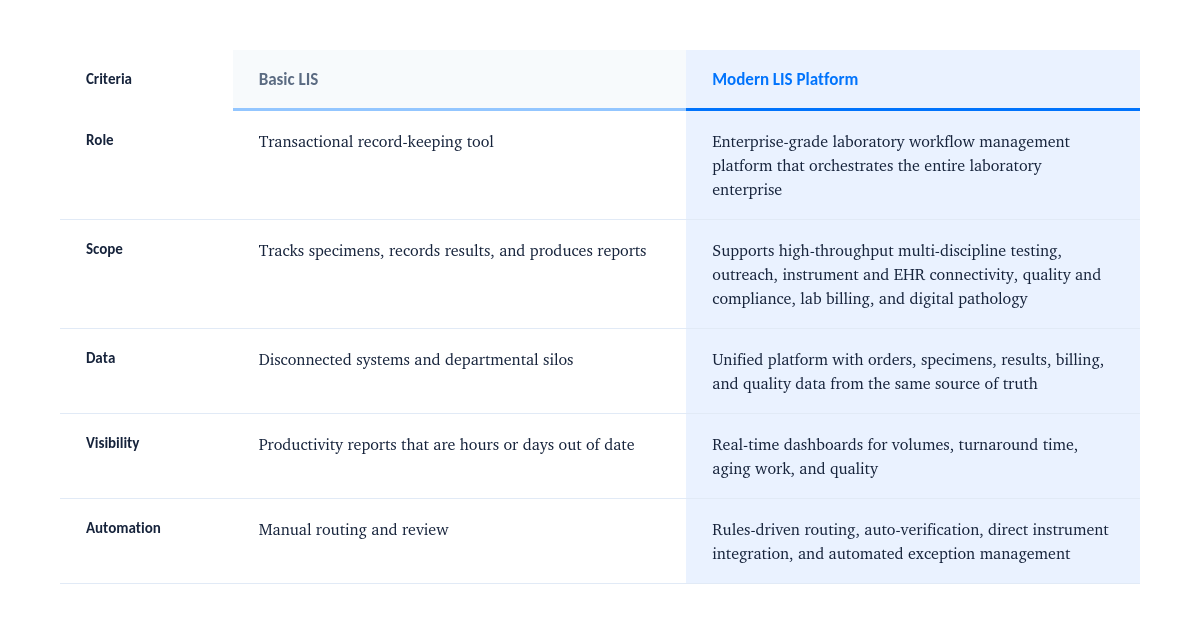
How Does a Modern LIS System Compare With a Basic LIS at a Glance?
How Is the Role of the Laboratory Information System Changing?
For decades, laboratory information systems were designed primarily to track specimens, capture test results, and generate reports. While these early medical LIS platforms played a vital role in laboratory operations, they were made for a simpler environment with lower testing volumes, fewer system integrations, and less demanding regulatory requirements.
Today's clinical and pathology labs operate in a far more complex environment. Laboratories now manage:
- High-throughput testing across multiple disciplines
- Outreach programs and cross-department processes
- Instrument and electronic health record connectivity
- Quality management and compliance reporting
- Laboratory billing and payer interactions
- Digital pathology solutions and image management
A traditional lab information system that only tracks samples and reports results is no longer enough. Modern labs need a modern digital informatics platform that connects all departments, manages workflows, and provides a complete, real-time view of operations.
This shift isn’t theoretical. It reflects a clear direction for LIS systems across the industry: from transactional record-keeping tools to enterprise-grade laboratory workflow management platforms that orchestrate the entire laboratory enterprise.

Why Does Unifying Departments Eliminate Silos?
One of the most important trends in modern lab workflow is the move toward unification.
Modern labs do much more than testing. They manage sample collection, accessioning, logistics, inventory, supplies, lab billing, quality assurance, compliance, client services, and reporting. When these functions operate on disconnected laboratory software systems, silos form quickly.
Silos create real operational risk:
- Duplicate data entry across departments
- Inconsistent patient and order information
- Delayed communication between technical and administrative teams
- Increased error rates and rework
- Limited visibility for managers
A unified laboratory information system brings these functions together on a single platform. Orders, specimens, results, billing events, and quality data all come from the same source of truth.
This unification improves efficiency and changes how teams collaborate. When everyone works from the same information, miscommunication drops, accountability improves, and managers gain confidence that decisions are based on accurate data.
For labs entering a new year with growth plans, outreach expansion, or new service lines, unification is often the foundation that makes those strategies achievable.
How Does Laboratory Workflow Management Become a Strategic Advantage?
In many labs, the biggest constraint isn't instrumentation; it's lab workflow.
Older LIS systems often struggle to manage complex outreach programs, cross-department processes, and multi-site operations. Specimens may move efficiently through one department but stall in another. Managers may sense delays but lack precise data on where bottlenecks occur.
Modern laboratory information system software changes this dynamic.
For example, an anatomic pathology LIS software uses automation and rules-driven routing to:
- Prioritize urgent or time-sensitive work
- Balance workloads across staff and shifts
- Monitor queue lengths and turnaround time
- Detect exceptions before they become failures
Real-time dashboards provide visibility into specimen locations, staff workloads, and potential workflow bottlenecks, enabling laboratory managers to make proactive adjustments before delays affect performance.
With greater operational visibility and control, laboratories can manage increasing test volumes without a corresponding rise in staffing costs, a critical advantage amid persistent workforce shortages.
Industry Insights: Process Improvement and Advanced Technology to Help Relieve Laboratory Staffing Burden
Why Do Visibility, Transparency, and a Single Source of Truth Matter?
In the past, many labs relied on productivity reports that lagged by hours or days. By the time problems were visible, they had already affected turnaround time, client satisfaction, or revenue.
Modern laboratory information systems support real-time visibility. With live dashboards, laboratory leaders can:
- Track order volumes by hour, day, or location
- Monitor turnaround time by test, department, or client
- Identify aging work-in-process
- Detect quality issues early
- Audit every action taken on every case
Automatic audit trails protect against errors and support compliance with CLIA, CAP, and payer requirements. More importantly, analytics turn raw data into actionable insight.
Instead of asking, "What happened last month?" lab leaders can ask, "What is happening right now, and what should we change today?"
This shift from retrospective reporting to operational intelligence defines next-generation LIS medical solutions.
On-Demand Webinar: Leverage LIS System Rules, Automation, and Data Analytics to Increase Efficiency and Cut Costs
How Do LIS System Automation and Digital Labor Help With Staffing Shortages?
Staffing shortages are not a temporary disruption. They are a structural reality facing laboratories nationwide.
In this environment, LIS automation is essential for any future growth. Advanced LIS software now supports digital labor across the laboratory:
- Direct instrument integration eliminates manual transcription
- Auto-verification reduces routine result review
- Rules-driven routing minimizes manual specimen handling
- AI-assisted scheduling improves staff and equipment utilization
- Automated exception management flags problems in real time
Automation does not replace expertise. It protects it.
By removing low-value manual tasks, a modern medical laboratory information system allows technologists, pathologists, and supervisors to focus on work that truly requires judgment and experience. This not only improves productivity but also reduces burnout and improves retention.
As laboratories face persistent staffing shortages in the new year, automation will play an increasingly vital role in helping them expand capacity, maintain operational efficiency, and meet growing testing demands.
Industry Insights: Why the Future of the Laboratory Information System Must Be Active, Intelligent, and Integrated
What Is the Return on Investment of Modern LIS Software?
Investing in a new laboratory information system is a major decision. But it’s also one of the few investments that touches every dimension of laboratory performance.
The best LIS software platforms deliver ROI through:
- Reduced labor costs through automation
- Shorter turnaround times
- Lower error and rework rates
- Improved compliance and audit readiness
- Faster onboarding of new clients and services
- Better payer performance and fewer denials
These benefits compound over time. As volumes grow, the efficiency gains multiply. As you add new services, the platform adapts without major reengineering.
Importantly, ROI isn't only financial. Faster, more reliable results improve patient care. Better visibility improves leadership confidence. Stronger systems improve staff satisfaction.
As laboratories enter the new year, many will discover that the long-term costs of maintaining outdated systems far outweigh the investment required to modernize.
Discover More: Four Game-Changing Business Strategies to Improve Laboratory Processes

What Should You Look for When Evaluating LIS Systems?
As lab leaders review options this year, the choice is not simply between laboratory information system vendors. It's a choice between philosophies for how the lab will operate over the next decade. When evaluating LIS systems, consider the following questions:
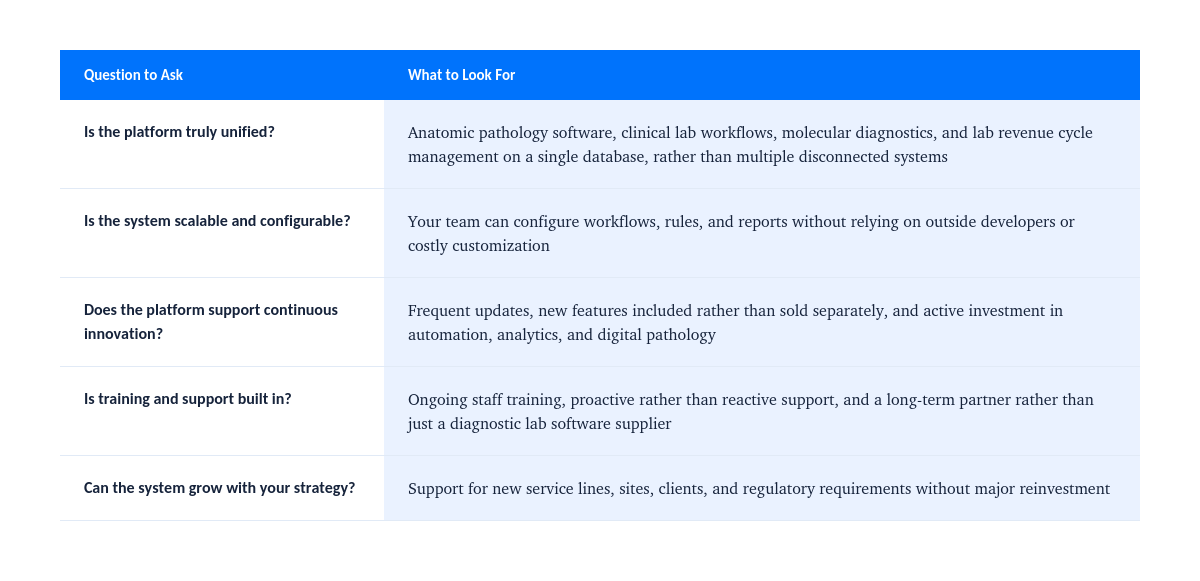
The best LIS software is not the one with the longest feature list. It’s the one that aligns with your operational strategy and evolves as your lab evolves.
White Paper: How Aligning with Your LIS System Provider Can Transform Your Lab
How Do You Choose a Partner for Long-Term Success?
Technology alone doesn’t modernize a laboratory. Partnership does.
The most successful laboratory information system implementations are built on collaboration between the lab and a vendor who understands laboratory operations, implementation realities, and long-term growth.
Choose a partner who:
- Understands both clinical and financial workflows
- Provides structured implementation and change management
- Offers continuous training and support
- Invests in product development year after year
- Helps you adapt to regulatory and market change
In a rapidly evolving industry, your LIS lab partner becomes part of your leadership team.
White Paper: Best Practices Guide - Managing LIS System Timelines for Vendor Research and Implementation
Is the New Year Always the Right Time to Switch LIS Systems?
A new year is a natural planning point, with budgets reset and strategy refreshed. Still, the right moment depends on your own circumstances: your current contract and support timeline, staff bandwidth, peak testing periods, and budget. Implementation takes real internal time, so launching one when your team is stretched thin can create its own risks.
It also depends on whether your current laboratory information system is actually the problem. If your existing system already integrates workflows, provides real-time operational visibility, and is backed by a vendor capable of supporting your growth, a replacement may not be necessary. In that case, targeted improvements may be the better use of the year. The line that the cost of not modernizing is higher than the cost of moving forward is also a generalization, so estimate your own baseline: turnaround times, error and rework rates, denial rates, and staffing costs.
For laboratories struggling with disconnected systems, manual workarounds, limited real-time visibility, and scalability challenges, the new year presents an ideal opportunity to evaluate modern LIS solutions. Starting early gives ample time for thorough vendor evaluations, informed decision-making, and a carefully planned, well-resourced implementation.
Why Is a New Year a Strategic Opportunity to Modernize?
The start of a new year is a strategic opportunity.
As laboratory leaders reflect on last year's challenges and this year's goals, the question is no longer whether to modernize, but how soon.
A modern laboratory information system provides the foundation for intelligent workflow management, operational efficiency, and sustainable growth.
In the year ahead, laboratories that prioritize modernization and invest in advanced LIS medical platforms will be better positioned to overcome emerging challenges, adapt to changing industry demands, and achieve long-term success.
Choose a system and a partner that help you connect your lab, adapt to change, and succeed for the long term.
Industry Insights: Best LIS Systems - Top Laboratory Information Systems Compared for Clinical, Pathology, and Outreach Labs
What Defines Your Lab's Next Decade?
The start of a new year presents an opportunity to turn strategic priorities into meaningful action. For laboratory leaders, investing in a modern laboratory information system is among the most consequential decisions they can make to improve clinical quality, strengthen operational efficiency, and support long-term financial sustainability.
If your current LIS software restricts visibility, relies on manual workarounds, or struggles to support increasing test volumes and future growth, now is the time to evaluate a more advanced solution.
About the Author
Suren Avunjian is the Co-Founder and Chief Executive Officer of LigoLab, a leading developer of enterprise laboratory information systems and fully integrated laboratory revenue cycle management software. With more than two decades of experience in healthcare technology and laboratory informatics, he leads LigoLab's vision of a unified, automation-driven informatics platform that seamlessly connects clinical, pathology, molecular, and financial workflows on a single, comprehensive system. Under his leadership, LigoLab has become a trusted partner to hundreds of laboratories nationwide, recognized for continuous innovation, deep industry expertise, and an unwavering commitment to operational excellence and customer success.
Continue Your Research
- Platform Comparison: Best LIS Systems in 2026 - Top Laboratory Information Systems Compared for Clinical, Pathology, and Outreach Labs
- Implementation Timeline: Best Practices Guide - Managing LIS System Timelines for Vendor Research and Implementation
- Client Services: Keys to Providing Premier Pathology Client Services - How Advanced Laboratory Information Systems Set the Standard
- Adoption Challenges: The Hidden Challenge of LIS Adoption: Why Most Labs Struggle, and How the Right Vendor Can Change Everything
- Overcoming Hesitation: Is the Fear of Failing a Problem at Your Laboratory?
Ready to Take the Next Step?
Evaluate your current LIS systems, define your operational priorities for the year ahead, and engage with a trusted partner to modernize with confidence. The best LIS system will not only support your lab but also position you to lead for the next decade.
Act Now: Speak with a LigoLab Product Specialist!
Frequently Asked Questions About Modernizing Your Laboratory Information System
Why is a new year a good time to modernize a lab information system?
A new year is a natural inflection point when budgets reset, strategic plans refresh, and long-standing challenges resurface. It’s a good time to assess whether your current LIS software enables growth or quietly holds your organization back, and to start a careful evaluation.
How has the role of the laboratory information system changed?
Early laboratory information systems (LIS) were designed primarily to track specimens, capture test results, and generate reports. Today’s laboratories face far more complex demands, including high-volume, multidisciplinary testing, outreach services, instrument and EHR integration, regulatory compliance, laboratory billing, and digital pathology. As a result, modern LIS software has evolved beyond basic recordkeeping into an enterprise-grade platform that connects, automates, and optimizes laboratory workflows across the entire operation.
How does a unified LIS eliminate silos?
A unified LIS system brings orders, specimens, results, billing events, and quality data onto a single platform with one source of truth. That reduces duplicate data entry, inconsistent order information, delayed communication, and rework, while giving managers more reliable data.
How does LIS automation help with staffing shortages?
Automation such as direct instrument integration, auto-verification, rules-driven routing, AI-assisted scheduling, and automated exception management removes low-value manual tasks. That lets labs handle higher volumes without proportionally increasing headcount and lets staff focus on work that requires judgment.
What should labs look for when evaluating LIS systems?
Ask whether the platform is truly unified on a single database, scalable and configurable without outside developers, backed by continuous innovation, supported by built-in training and proactive support, and able to grow with your strategy, including new service lines, sites, clients, and regulatory requirements.
Is the new year always the right time to switch LIS systems?
Not necessarily. The ideal timing depends on several factors, including your existing contract and vendor support commitments, staff availability, peak testing periods, and budget. If your current LIS meets your operational and growth requirements, replacing it may not be the right move. Start by establishing baseline performance metrics to determine whether modernization would deliver measurable value.