Industry Insights
The New Lab Reality: 2025’s Most Important Shifts in Management, Technology, and Regulation

October 20, 2026

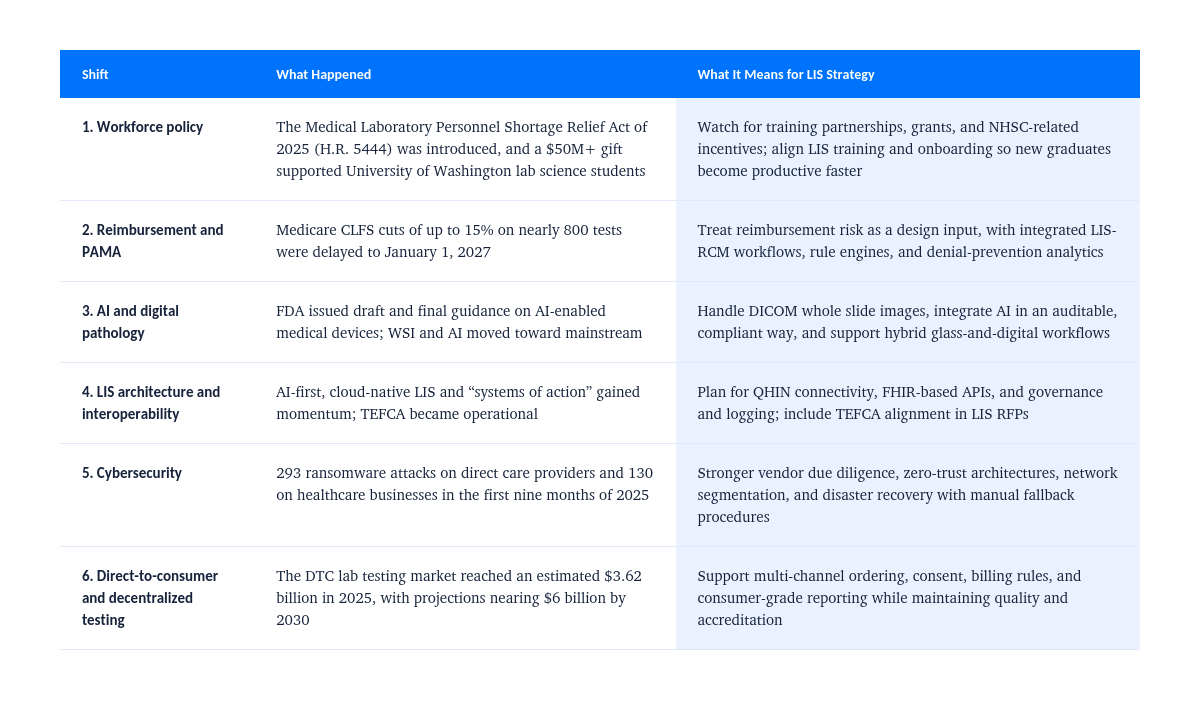
Executive Summary: Here’s a look back at 2025, where six shifts reshaped laboratory workflow management and LIS laboratory information system strategy: workforce shortages reached Washington, PAMA reimbursement pressure persisted, AI and digital pathology moved into production, LIS software platforms shifted toward systems of action, ransomware became a patient-safety issue, and direct-to-consumer testing went mainstream.
2025 was a pivotal and uncomfortable year for clinical laboratory management and laboratory information system (LIS) software. Workforce shortages, reimbursement pressure, AI and digital pathology, cybersecurity, and direct-to-consumer lab testing all moved from "future trend" to "immediate decision point" for lab leaders.
Here's a recap of the major stories and themes that shaped 2025.
What Were 2025's Six Biggest Shifts for Labs at a Glance?
1. The Workforce Crisis Finally Hit Washington's Radar
Clinical labs and pathology practices have been sounding the alarm about staffing shortages for years. In 2025, that message finally crystallized into meaningful national and local action.
Representatives Deborah Ross (D-NC) and Jen Kiggans (R-VA) introduced the Medical Laboratory Personnel Shortage Relief Act of 2025 in the U.S. House. The bipartisan bill would:
- Expand eligibility for the National Health Service Corps (NHSC) to include medical laboratory personnel.
- Create federal grants for accredited colleges and universities to train MLS and MLT students.
- Direct HHS to identify areas with critical lab workforce shortages and prioritize support there.
Read the Bill: H.R. 5444 - Medical Laboratory Personnel Shortage Relief Act of 2025
Advocacy groups and trade media such as Dark Daily highlighted the bill as a rare, targeted response to a profession where vacancy rates and retirements threaten basic access to diagnostic services.
At the same time, philanthropy stepped in. An anonymous donor gave the University of Washington over $50 million to cover tuition for senior-year clinical rotations for the school's medical laboratory science students for the next 50 years, allowing the program to expand its class size from 70 to 100 students over time.
Learn More: An anonymous $50M gift will cover some tuition for medical lab students at the University of Washington.
The defining workforce challenge of 2025 was the growing recognition that laboratory staffing shortages are no longer simply an internal hiring concern but a broader healthcare policy and funding priority. As a result, laboratories closely monitored emerging workforce development initiatives, training partnerships, grant opportunities, and National Health Service Corps (NHSC) incentives that could help strengthen recruitment, improve retention, and build a more sustainable laboratory workforce.
Industry Insights: Solving the Medical Laboratory Staffing Shortage with Advanced LIS Systems and Better Support
Editor’s Note: This story has been updated to reflect significant late-breaking legislative action affecting Medicare laboratory reimbursement.
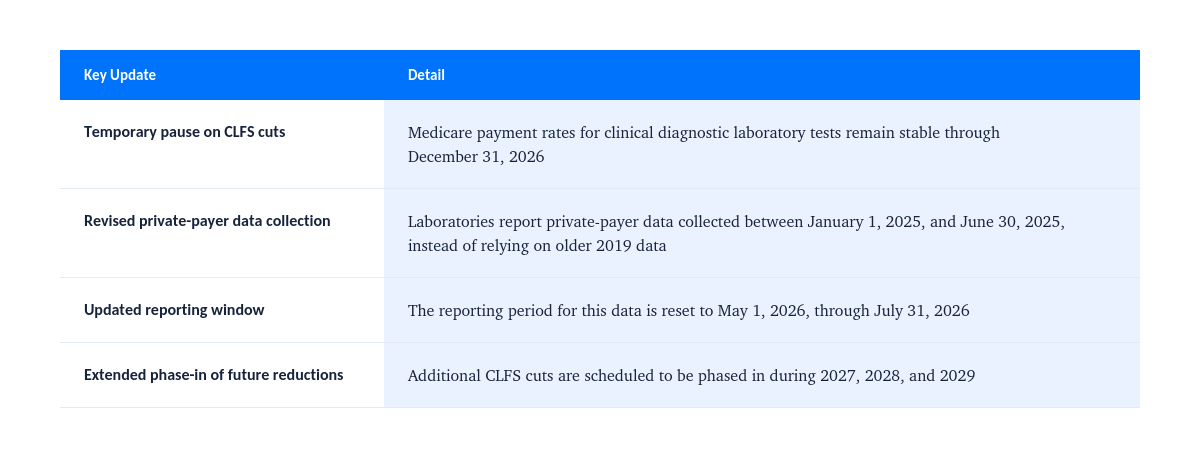
On February 3, 2026, President Trump signed the Consolidated Appropriations Act, 2026 (H.R. 7148) into law. The legislation delayed pending Medicare Clinical Laboratory Fee Schedule (CLFS) price cuts mandated under the Protecting Access to Medicare Act (PAMA), providing short-term financial relief to the clinical laboratory industry.
Under the new law, the next round of Medicare payment reductions, previously expected to take effect in early 2026 and affecting nearly 800 tests with reductions of up to 15 percent, was postponed until January 1, 2027.
2. PAMA and the Fight to "Stop Lab Cuts" Shaped 2025
Looking back, 2025 was defined by mounting concern over Medicare reimbursement pressure tied to PAMA implementation.
- The Centers for Medicare and Medicaid Services continued to update the CLFS through quarterly revisions based on private-payer data, keeping laboratories on constant alert for pricing volatility.
- Professional organizations, including the American Society for Clinical Pathology, warned that CMS was preparing to reduce reimbursement for roughly one-third of the CLFS, nearly 800 tests, by as much as 15 percent absent legislative relief.
- The proposed RESULTS Act emerged as a longer-term reform effort, aiming to cap annual payment reductions at 5 percent once fully implemented, with strong advocacy from the American Clinical Laboratory Association.
- Earlier reform initiatives, including the Saving Access to Laboratory Services Act, continued to influence policy discussions about how private-market data was collected and applied to CLFS pricing.
What Did This Mean for Laboratories?
Even with the 2026 delay, reimbursement uncertainty remained a structural reality. For laboratory leaders, LIS system administrators, and laboratory revenue cycle management teams, the takeaway was clear: pricing volatility wasn’t disappearing; it was merely deferred.
In response, many laboratories doubled down on:
- Stronger test utilization management strategies.
- Tightly integrated laboratory information system and lab revenue cycle management workflows to reduce denials and write-offs.
- Advanced analytics to model the financial impact of future CLFS reductions on specific test menus and service lines.
3. AI and Digital Pathology Moved From Pilot to Production
If 2023-2024 were about early adoption, 2025 was the year AI-enabled digital pathology started to look mainstream. Several storylines stood out:
- The U.S. Food and Drug Administration (FDA) issued both draft and final guidance on AI-enabled medical devices, covering lifecycle expectations and post-market oversight. It also granted Breakthrough Device designation to technologies that offer more effective treatment or diagnosis for life-threatening or irreversibly debilitating conditions.
- Academic reviews emphasized how whole slide imaging (WSI) and AI were reshaping pathology through remote collaboration, algorithmic decision support, and more standardized interpretations.
- Reports on the first AI-based tools cleared to support cancer pathology reinforced that regulators were increasingly comfortable with algorithmic assistance when evidence is strong and workflows are well-defined.
For LIS system buyers, digital pathology was no longer just about image storage. Modern LIS and pathology platforms now needed to:
- Handle DICOM-based whole slide images and image-linked metadata.
- Integrate with AI algorithms in an auditable, compliant way.
- Support hybrid workflows with pathologists fluidly operating between glass slides and digital cases.
In short, the advanced LIS system was becoming the orchestration layer for human-plus-AI pathology.
Case Study: OnePath - Transforming Pathology Lab Management Through Digital Innovation

4. Laboratory Information Systems and Lab IT Shifted From Systems of Record to Systems of Action
On the laboratory information systems side, 2025 was defined less by single "headline products" and more by architectural shifts.
What Happened With AI-First and Cloud-Native LIS?
- Black Book Research's Global State of Healthcare Laboratory IT report highlighted how labs in Europe and North America were moving from compliance-driven modernization to AI-first architectures, cloud deployment, and advanced interoperability over the next decade.
- Market analysts estimated the global lab information system market at roughly $891 million in 2024, projected to grow to around $1.3 billion by 2032 at a 5-6 percent CAGR.
- Meanwhile, buyer guides ranking the best laboratory information system companies in 2025 underscored just how crowded and stratified the medical LIS software market had become, from large enterprise EHR-tethered solutions to specialized best-of-breed platforms.
Industry commentary increasingly described modern LIS system platforms as shifting from "systems of record" to "systems of action" - active hubs that trigger alerts, drive automation, and coordinate workflows across electronic health records, laboratory billing, outreach portals, digital pathology solutions, and more.
Industry Insights: From System of Record to System of Action - The Next Evolution of Laboratory Information Systems
How Did TEFCA Change Nationwide Interoperability?
On the policy side, TEFCA (Trusted Exchange Framework and Common Agreement) moved from concept to operational reality:
- TEFCA went live in late 2023; by 2025, multiple Qualified Health Information Networks (QHINs) were actively exchanging data nationwide.
- Implementation guides stressed that TEFCA offered "one on-ramp" instead of dozens of custom interfaces, but also raised the bar around consent, audit, identity management, and security.
Learn More: A Nationwide Network-of-Networks for Health Information Exchange
For clinical labs and pathology groups, this meant LIS system roadmaps now had to account for:
- QHIN connectivity and TEFCA-aligned workflows for result delivery, public health reporting, and individual access.
- More robust APIs and FHIR-based interfaces that let lab data move fluidly through national exchange networks.
- Governance and logging that can withstand increasing regulatory scrutiny around information blocking and patient access.
Discover More: LigoLab Delivers the LIS System Interoperability Needed to Transform Medical Laboratories into Thriving Businesses
5. Cybersecurity Became a Patient Safety Issue for Labs
Cybersecurity was one of the most sobering stories overall, and diagnostic labs were squarely in the crosshairs. Some key 2025 data points:
- In the first nine months of 2025, 293 ransomware attacks hit hospitals, clinics, and other direct care providers, plus another 130 attacks targeted healthcare businesses such as lab vendors, lab revenue cycle management companies, and tech providers. Attacks on healthcare businesses rose roughly 30 percent from the previous year.
- Pathology and lab organizations were hit directly: WPM Pathology Laboratory in Kansas and Pacific Biolabs in California both reported ransomware incidents involving network intrusion and alleged data theft.
Learn More: Ransomware Gangs Attack Clinical and Pathology Laboratories
These stories marked an inflection point: ransomware was now explicitly linked to patient harm and mortality.
For LIS lab management, cybersecurity had become a core operational competency, implying:
- More rigorous vendor due diligence and shared-responsibility models for cloud systems.
- Zero-trust architectures, network segmentation for analyzer connections, and stronger identity and access management.
- Comprehensive disaster recovery plans that assume temporary loss of LIS/RCM/EHR connectivity and define manual fallback procedures.
Discover More: LigoLab’s Enhanced Cybersecurity Solutions Give Customers Added Protection and Peace of Mind
6. Direct-to-Consumer Labs and Decentralized Testing Now Mainstream
Another big 2025 storyline: lab testing "escaped the four walls" even further. Several signals stood out:
- The direct-to-consumer lab testing market reached an estimated $3.62 billion in 2025, with projections nearing $6 billion by 2030.
- Analyses noted that by 2025, DTC lab testing had become "mainstream", with an ecosystem of startups, telehealth providers, and retail health players offering everything from wellness panels to chronic disease monitoring.
Discover More: Direct-to-Consumer Lab Testing - Market Analysis & Impact on Healthcare
This trend affected more than consumer-facing brands; it had direct implications for LIS system platforms and clinical/pathology lab management:
- Outreach labs needed LIS software platforms to support multi-channel ordering (providers, retail, telehealth, and direct consumer), each with different ordering, consent, and billing rules.
- Laboratory revenue cycle management systems had to handle more complex payer mixes and price transparency expectations.
- Labs had to maintain quality, accreditation, and medical supervision requirements even when orders originated from consumer apps rather than traditional clinics.
White Paper: How Labs Can Achieve Financial Stability During Turbulent Times

What Does It All Mean for Lab Leaders and LIS System Strategy in 2026?
Pulling these threads together, 2025's major stories pointed toward a few clear imperatives for laboratory workflow management and LIS system planning:
- Plan for structural workforce support, not just local hiring fixes. Watch for NHSC eligibility, grants, and academic partnerships that can stabilize recruiting pipelines. Align LIS software training and onboarding to get new graduates productive faster.
- Treat reimbursement risk as a design input, not an afterthought. With PAMA and impending CLFS cuts, financial resilience depends on data visibility. Integrated LIS-RCM workflows, robust rule engines, and denial-prevention analytics are no longer "nice to have."
- Assume AI and digital pathology will touch your workflows. Even if you're not fully digital yet, your next LIS or anatomic pathology software decision should anticipate DICOM imaging, AI integration, and remote collaboration features.
- Make interoperability and TEFCA alignment part of your LIS system RFP. As QHINs mature, labs that can plug into national networks will be better positioned for value-based care, public health reporting, and patient-centric services.
- Elevate cybersecurity to the same level as quality and safety. Ransomware attacks are no longer just an IT security concern; they pose a direct threat to patient safety and continuity of care. Laboratories must align their LIS technology roadmap with a comprehensive cybersecurity strategy that includes robust data protection, disaster recovery, and contingency plans to maintain critical diagnostic services during system outages.
- Prepare for multi-front lab outreach and direct-to-consumer lab testing partnerships. Whether you're running your own DTC brand, partnering with telehealth players, or serving retail clinics, your LIS system needs to support flexible ordering channels, identity management, and consumer-grade reporting experiences.
2025 didn't bring a single "moonshot" moment for lab informatics, but it did deliver something more consequential: convergence. Workforce policy, payment reform, AI, interoperability, cybersecurity, and consumerization all collided in ways that make LIS systems and lab IT strategy a board-level discussion. Laboratories that recognize these converging trends and invest in the right technologies and strategies in 2026 will have opportunities to move beyond operational challenges, drive innovation, and help shape the future of diagnostic care.
Do All Six Shifts Apply Equally to Every Lab?
The six imperatives apply unevenly. Digital pathology and AI matter most to anatomic pathology groups, DTC and multi-channel outreach matter mainly to labs pursuing consumer, telehealth, or retail partnerships, and TEFCA and QHIN connectivity matter most to labs exchanging data nationally or handling public health reporting. A lab with no plans in one of those areas can reasonably rank it lower.
Some items are also less settled than the headlines suggest. The workforce bill was introduced, not enacted, so treat related incentives as something to watch rather than count on. The CLFS delay is temporary, with additional cuts scheduled to phase in during 2027, 2028, and 2029, and further congressional changes are possible. Market-size and attack-count figures come from different analysts and reports and can vary, so confirm the numbers before using them in a budget or board presentation.
For many smaller labs, a practical order is reimbursement resilience and cybersecurity first, since they affect revenue and continuity immediately, followed by interoperability, and then digital pathology and consumer channels as strategy requires.
How Is LigoLab Shaping the Future of Laboratory Operations?
2025 was a landmark year for LigoLab, marked by breakthrough platform enhancements, major digital pathology partnerships, new AI-driven automation capabilities, and record customer growth across every diagnostic discipline.
In 2026 and beyond, LigoLab will continue raising the bar with even more powerful laboratory information system software solutions designed to help labs scale, stay competitive, and thrive in an increasingly complex healthcare landscape.
Continue Your Research
- Reimbursement Strategy: 6 Ways to Improve Revenue and Lower Costs to Offset Reimbursement Cuts
- AI in the Lab: Healthcare AI Has Crossed the Line From Experiment to Infrastructure
- Cybersecurity: LigoLab’s Enhanced Cybersecurity Solutions Give Customers Added Protection and Peace of Mind
- Direct-to-Consumer Testing: Direct-to-Consumer Lab Testing - Market Analysis & Impact on Healthcare
- LigoLab's Year in Review: LigoLab in 2025: A Year of Innovation, Acceleration, and Transformative Partnerships
Ready to See What the Next Generation of LIS & RCM Innovation Looks Like?
Connect with our team today to see how LigoLab can help your laboratory become more efficient, profitable, and future-ready.
Act Now: Speak with a Product Specialist Today!
Frequently Asked Questions About 2025's Lab Industry Shifts
What is the Medical Laboratory Personnel Shortage Relief Act of 2025?
Introduced in the U.S. House by Representatives Deborah Ross (D-NC) and Jen Kiggans (R-VA), the bipartisan bill would expand National Health Service Corps eligibility to include medical laboratory personnel, create federal grants for accredited colleges and universities to train MLS and MLT students, and direct HHS to identify and prioritize areas with critical lab workforce shortages.
Were the Medicare lab fee schedule cuts delayed?
Yes, temporarily. The Consolidated Appropriations Act, 2026 (H.R. 7148), signed on February 3, 2026, postponed CLFS cuts of up to 15 percent on nearly 800 tests until January 1, 2027, and scheduled additional cuts to phase in during 2027, 2028, and 2029.
What does an LIS need to support digital pathology and AI?
Modern LIS and pathology platforms need to handle DICOM-based whole slide images and image-linked metadata, integrate with AI algorithms in an auditable, compliant way, and support hybrid workflows in which pathologists move between glass slides and digital cases.
What is TEFCA, and why does it matter to labs?
TEFCA, the Trusted Exchange Framework and Common Agreement, went live in late 2023, and by 2025 multiple Qualified Health Information Networks (QHINs) were exchanging data nationwide. It offers "one on-ramp" instead of dozens of custom interfaces but raises the bar on consent, audit, identity management, and security. Hence, LIS roadmaps need QHIN connectivity, FHIR-based APIs, and strong governance and logging.
How serious was ransomware for labs in 2025?
In the first nine months of 2025, 293 ransomware attacks hit direct care providers and another 130 hit healthcare businesses such as lab vendors and revenue cycle companies. Attacks on healthcare businesses were up roughly 30 percent from the prior year. Pathology and lab organizations, including WPM Pathology Laboratory in Kansas and Pacific Biolabs in California, reported ransomware incidents.
Do all of these 2025 shifts apply to every lab?
Not equally. Digital pathology matters most to anatomic pathology groups, DTC and multi-channel outreach to labs pursuing consumer partnerships, and TEFCA to labs exchanging data nationally. Some items, such as the workforce bill and the CLFS delay, are also unsettled, so labs should prioritize based on their own situation and verify figures before budgeting.