Blog
LIS-EHR Integration Doesn't Have to Be Painful: How LigoLab and ModMed gGastro Simplify Connectivity for Independent Pathology Groups

June 25, 2026
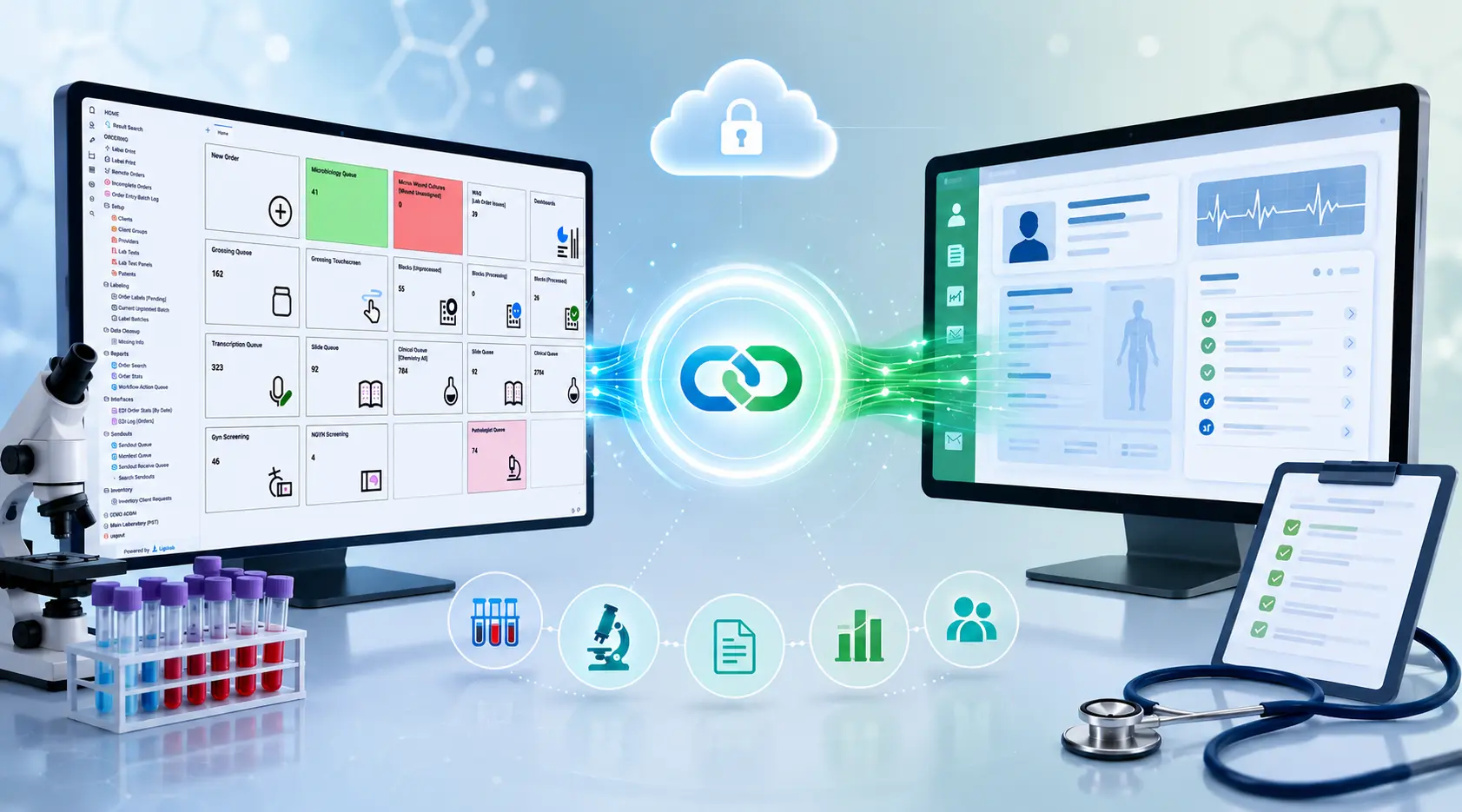
For many independent pathology groups, the phrase “LIS-EHR integration” often evokes memories of lengthy implementation projects, delayed timelines, endless coordination meetings, and frustrating interactions.
Laboratory leaders have come to expect integration projects to be difficult.
But what if they didn't have to be?
What if connecting your laboratory information system (LIS) to a physician practice's electronic health record (EHR) could be straightforward and predictable?
That's precisely the experience LigoLab delivers through its integration with ModMed's gGastro EHR solution.
While many leading laboratory information system vendors continue to rely on cumbersome integration models that require extensive coordination between multiple parties, LigoLab has developed a more streamlined approach that simplifies connectivity, accelerates implementation, and removes many of the obstacles that traditionally plague LIS-EHR projects.
For pathology groups focused on gastroenterology workflows, this means less time spent managing technology and more time dedicated to delivering exceptional diagnostic services.
Industry Insights: Best LIS Systems - Top Laboratory Information Systems Compared for Clinical, Pathology, and Outreach Labs
Why Traditional LIS-EHR Integrations Create Frustration
To appreciate the advantages of the LigoLab-ModMed gGastro integration, it's helpful to understand why interoperability projects have historically been a source of frustration for so many laboratories.
Historically, connecting a laboratory information system to an EHR often involves three separate organizations:
- The laboratory
- The LIS vendor
- The EHR vendor
Each party operates on a different schedule, follows a different process, and maintains different priorities.
As a result, implementation timelines frequently stretch from weeks into months.
Even seemingly simple projects can become complicated due to communication delays, technical reviews, workflow discussions, testing cycles, and approval processes.
Pathology groups often find themselves acting as project managers between vendors that may have very different levels of urgency.
Unfortunately, this complexity has become normalized throughout the industry.
"Many laboratories have been conditioned to believe that interface projects are naturally difficult," said Gor Kalantaryan, Chief Operating Officer at LigoLab. "In reality, much of that complexity comes from the way the integrations are organized. When you standardize connectivity and eliminate unnecessary layers, the entire experience becomes dramatically simpler."
Discover More: LigoLab Delivers the LIS System Interoperability Needed to Transform Medical Laboratories into Thriving Businesses
The LigoLab Difference: A Centralized Integration Model
The key differentiator behind the LigoLab-ModMed gGastro integration is LigoLab's centralized connectivity strategy.
Rather than building a new interface from scratch every time a laboratory wants to connect to ModMed gGastro, LigoLab maintains an established connection that laboratories can leverage immediately.
This centralized approach creates a true plug-and-play experience.
Instead of coordinating new interface development between multiple organizations, laboratories simply connect through an existing framework that has already been established and validated.
"We've already done the heavy lifting," Kalantaryan explained. "The connection already exists. Laboratories don't need us to build a brand-new integration every time. We simply connect them to the existing channel and work with them to configure the lab information system to support their workflow requirements."
This seemingly simple architectural decision delivers significant benefits.
The laboratory obtains its ModMed gGastro account information, LigoLab connects the organization through the established channel, and message routing begins flowing through the existing infrastructure.
No custom interface development.
No extensive coordination among multiple vendors.
No reinventing the wheel.

Interoperability by Design
The ModMed gGastro integration is just one example of LigoLab's broader approach to interoperability.
Today's laboratories require seamless connectivity between numerous other technologies, including:
- Laboratory instruments
- Digital pathology platforms
- Patient portals
- Laboratory billing systems
- Lab revenue cycle management solutions
- Clearinghouses
- Third-party healthcare applications
Unfortunately, legacy laboratory information systems often struggle to support these requirements.
At the center of the comprehensive and flexible LigoLab Informatics Platform is a custom-built interface engine designed to eliminate these barriers.
"If an electronic device can be interfaced, we can connect to it," said Kalantaryan. "Our interface engine supports every integration requirement, from EHRs and laboratory billing systems to instruments and beyond."
Unlike many LIS vendors that rely on disconnected middleware solutions or costly third-party integration tools, LigoLab provides a built-in interoperability framework that supports enterprise-wide connectivity across clinical, operational, and financial workflows.
By unifying workflows and data, this architecture enables laboratories to reduce manual effort, improve accuracy, shorten turnaround times, and boost efficiency.
Industry Insights: From System of Record to System of Action - The Next Evolution of Laboratory Information Systems
Support for Every Major Healthcare Data Format
Modern healthcare organizations operate within highly complex technology ecosystems.
One physician practice may utilize HL7 messaging.
Another may rely on FHIR.
A third may require API-based communication.
To accommodate these realities, LigoLab's interface engine supports:
- HL7
- FHIR
- XML
- X12
- CSV
- ASTM
- Flat File
- RESTful APIs
This vendor-agnostic architecture enables laboratories to connect with virtually any healthcare technology partner while maintaining complete flexibility for future growth and expansion.
"Our customers shouldn't have to redesign their operations around LIS software limitations," Kalantaryan said. "The technology should adapt to the laboratory, not the other way around."
Discover More: Is Your Laboratory Information System Able to Support the Latest LIS System Technology?
Eliminating the Three-Party Bottleneck
One of the most significant advantages of the ModMed gGastro integration is the elimination of the traditional three-party implementation model.
"We're integrating with our own platform," Kalantaryan said. "Our implementation teams already understand the system, the workflows, and the configuration requirements. That allows us to move significantly faster than organizations that have to coordinate across multiple vendors."
For pathology groups seeking to onboard new gastroenterology clients quickly, that speed can become a meaningful competitive advantage.
Discover More: Overcoming LIS Integration Challenges - How Advanced LIS Software Platforms Like LigoLab Simplify the Transition
Flexible Connectivity Meets Flexible Workflow Design
Connectivity alone is not enough.
Laboratories also require workflows that support their unique operational requirements.
This is where LigoLab's all-in-one lab organization software architecture provides another important advantage.
While the gGastro connection itself is highly standardized, the platform remains extraordinarily flexible from a workflow perspective.
Laboratories can configure:
- Workflow automation rules
- Routing logic
- Result delivery preferences
- Quality assurance processes
- User permissions
- Reporting structures
- Operational dashboards
As Kalantaryan explained during discussions about the gGastro integration, the interface itself may be plug-and-play, but the LIS system remains fully configurable to support the laboratory's preferred workflows.
This flexibility enables pathology groups to maintain their operational uniqueness while still benefiting from standardized interoperability.
Discover More: The Foundation of Digital Pathology - Flexible Laboratory Information Systems Built for Growth

Customer Choice Matters
Most laboratory information system companies tightly control interface development, often forcing customers into expensive service models.
LigoLab takes a different approach.
The company supports multiple levels of interface ownership and management.
Laboratories can choose to:
- Have LigoLab manage all interfaces
- Build and manage interfaces internally
- Adopt a hybrid management model
- Utilize external interface partners
"We can support virtually any level of interface customization," said Kalantaryan. "Some organizations want us to handle everything. Others want more control. Our goal is to provide the flexibility that best supports their business."
This philosophy gives laboratories greater control over their technology strategy while reducing vendor dependence.
Industry Insights: The Hidden Challenge of LIS System Adoption - Why Most Labs Struggle, and How the Right Vendor Can Change Everything
A Dedicated Interface Team Focused on Success
Technology alone doesn't guarantee successful interoperability.
Expert support remains essential.
That's why LigoLab maintains a dedicated interface team responsible for development, implementation, monitoring, optimization, and ongoing support.
Unlike lab vendors that treat interfaces as one-time projects, LigoLab continues supporting connections after go-live through monitoring, health checks, and proactive maintenance.
This customer-first approach enables laboratories to maximize uptime, maintain optimal performance, and prevent disruptions that often occur with unsupported integrations.
Discover More: Questions All Pathology Labs Should Ask When Evaluating LIS Software and Support
The Future of Laboratory Interoperability
Healthcare interoperability will become increasingly important as laboratories continue to pursue digital transformation initiatives.
Organizations that remain dependent on rigid, difficult-to-integrate legacy LIS systems will find themselves increasingly constrained.
Those leveraging modern platforms built around interoperability will be positioned to move faster, scale more effectively, and provide a better experience for clients and providers alike.
The seamless integration between LigoLab and ModMed gGastro demonstrates that LIS-EHR connectivity does not have to be difficult.
With the right architecture, the right team, and the right technology platform, integration becomes an accelerator rather than a barrier.
As Kalantaryan summarized, "When the infrastructure is already in place, and the teams understand both the technology and the workflows, integration stops being a challenge and starts becoming a competitive advantage."
Turn Connectivity Into a Competitive Advantage
Interested in learning more about LigoLab’s all-in-one informatics platform and its refreshing approach to LIS-EHR integrations?
Act Now: Speak with a LigoLab Product Specialist!
Frequently Asked Questions (FAQs) About ModMed’s gGastro and LigoLab’s Advanced Interface Engine
What is ModMed gGastro?
ModMed gGastro is a specialty-specific electronic health record (EHR) platform designed for gastroenterology practices. It helps providers manage clinical workflows, patient documentation, scheduling, and care delivery while supporting efficient communication with pathology laboratories.
How Does LigoLab Integrate With ModMed gGastro?
LigoLab utilizes a centralized integration architecture that enables laboratories to connect through an existing interface channel rather than a new custom integration for every implementation. This significantly reduces complexity, minimizes setup requirements, and accelerates deployment.
Why Is the LigoLab-ModMed gGastro Integration Faster Than Traditional LIS-EHR Integrations?
Traditional LIS-EHR integrations often require coordination among the laboratory, the LIS vendor, and the EHR vendor. LigoLab's centralized approach eliminates much of this complexity by leveraging an established connection to ModMed gGastro, enabling laboratories to be connected quickly without significant interface development or lengthy project timelines.
What Healthcare Data Formats Does LigoLab Support?
LigoLab's custom-built interface engine supports a wide range of healthcare data exchange standards and formats, including HL7, FHIR, XML, X12, CSV, PDF, ASTM, Flat File, and RESTful APIs. This flexibility enables seamless connectivity across diverse healthcare technology environments.
Can LigoLab Integrate With Laboratory Instruments and Laboratory Billing Systems?
Yes. LigoLab's interface engine supports connectivity with lab instruments, electronic health record systems, digital pathology platforms, patient portals, laboratory billing systems, lab revenue cycle management solutions, clearinghouses, and numerous third-party applications.
Does LigoLab Offer Interface Customization?
Absolutely. LigoLab supports multiple interface management models, including fully managed services, self-managed interfaces, hybrid approaches, and integrations supported by third-party vendors. This flexibility enables laboratories to choose the approach that best aligns with their technical resources and operational preferences.
How Does LigoLab Support Customers After an Interface Goes Live?
LigoLab's dedicated interface team provides ongoing support, monitoring, maintenance, and health checks to ensure interfaces continue to operate efficiently. The team proactively addresses issues, helps optimize performance, and remains available to support future integration needs.
Why Is Interoperability So Important for Independent Pathology Groups?
Interoperability enables laboratories to exchange information seamlessly with physician practices, healthcare organizations, instruments, and business systems. Strong interoperability reduces manual data entry, minimizes errors, improves turnaround times, enhances provider satisfaction, supports operational efficiency, and creates a foundation for sustainable growth.