Blog
Custom Laboratory Reporting Without IT - Inside LigoLab's Dynamic Reports Module

July 20, 2026
Every medical laboratory generates vast amounts of operational data each day. Every accession, specimen, diagnosis, laboratory billing event, quality issue, and user interaction creates valuable information. The challenge isn't collecting data, as modern laboratory information system software already does that exceptionally well.
The real challenge is turning that data into meaningful insights.
Unfortunately, many laboratories remain limited by static reports that were designed years ago or require IT departments, database administrators, or LIS software vendors to create new reports whenever operational needs change. As laboratories evolve, leadership often finds itself waiting days or even weeks for information that should be available immediately.
Modern laboratory workflow management demands something different.
It requires laboratories to ask new questions, measure new metrics, and respond quickly to changing operational conditions without depending on LIS lab developers or vendor support.
That's exactly why LigoLab developed the Dynamic Reports module.
Included within the Advanced Tier of the all-in-one LigoLab Informatics Platform, Dynamic Reports empower laboratory staff to build customized reports using their own laboratory information system data without programming, without submitting support tickets, and without waiting for LIS software updates.
As Allison Still, LIS Product Manager at LigoLab, explains in her Dynamic Reports overview video (linked below):
"Every lab tracks information differently, and pre-built reports can't cover every use case. The Dynamic Reports module gives customers direct access to the platform's data fields, so the exact report needed can be built and run on demand."
Rather than forcing organizations to adapt their reporting around lab information system limitations, Dynamic Reports adapt to the customer.
Case Study: Summit Pathology - Achieving Laboratory Profitability Amidst Operational Pressures
Why Reporting Matters in Modern Laboratory Workflow Management
Today's laboratory leaders monitor operational efficiency, lab revenue cycle management, quality assurance, regulatory compliance, staffing utilization, client service, turnaround times, digital pathology workflows, send-out testing, productivity, and financial performance, all while preparing their organizations for continued growth.
All of these responsibilities depend on timely and accurate information. Without it, laboratory managers are often forced to make decisions based on incomplete data rather than objective insights.
Fortunately, modern laboratory information systems have the power to transform operational data into actionable business intelligence that supports continuous improvement, and LigoLab's Dynamic Reports module exemplifies this by giving customers complete control over how their lab data is organized, filtered, grouped, and presented.
Discover More: Why Modern Labs Must Move Beyond Manual Workflows and Legacy LIS Systems
Laboratory Reporting Without IT Bottlenecks
Traditional reporting often follows a familiar pattern.
A laboratory manager needs access to information that isn't readily available through an existing report.
The request is submitted to IT or the LIS company.
Weeks later, after multiple revisions, the report may finally become available.
By then, the operational question has often changed.
LigoLab’s Dynamic Reports eliminate this bottleneck.
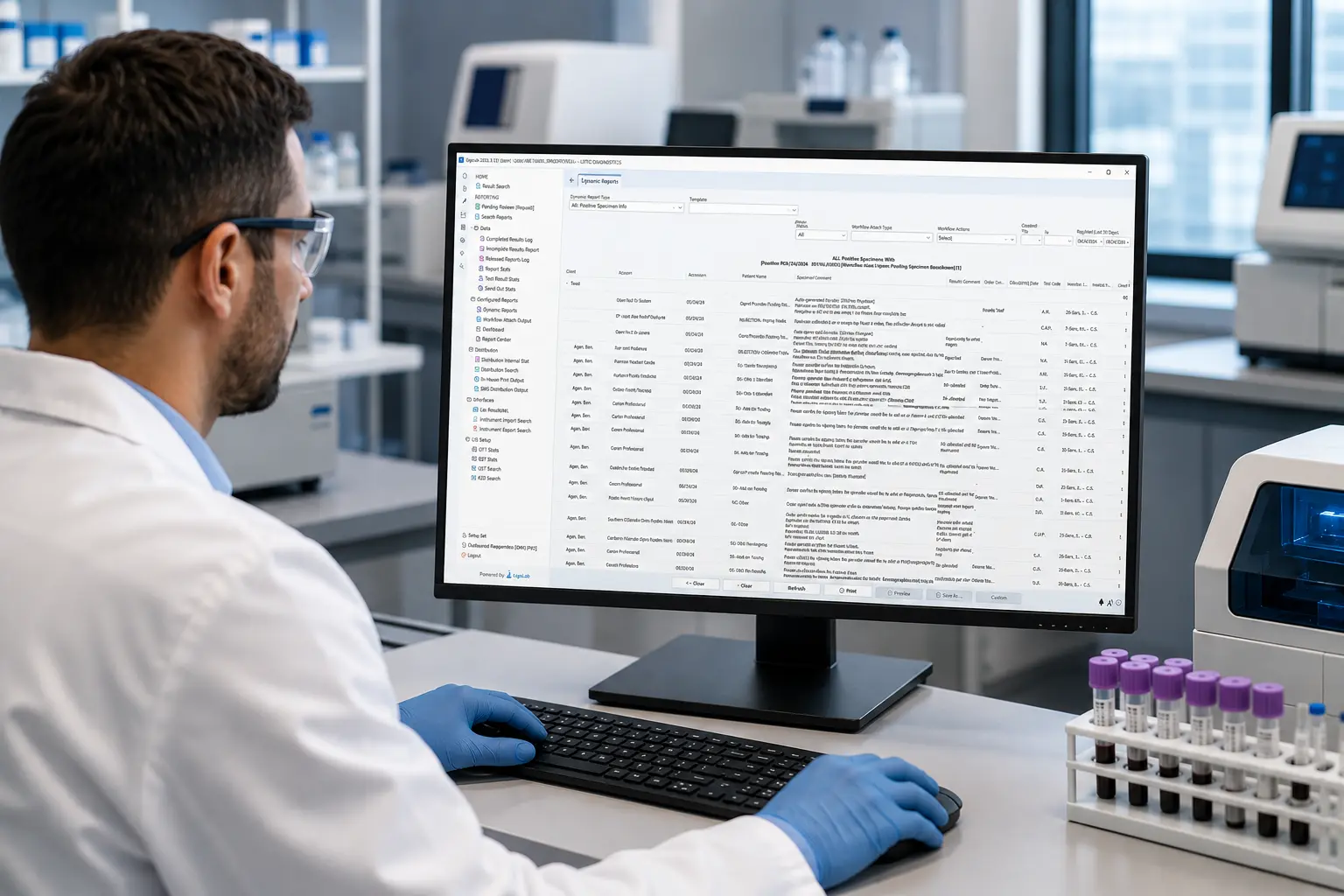
Users build reports directly within the LigoLab platform by selecting the specific data elements they need, arranging columns in any order, grouping information, applying filters, and generating results immediately.
No programming, database knowledge, or vendor involvement needed.
This self-service approach provides customers with the flexibility to create reports on demand, enabling leadership to answer operational questions without delay and make more informed decisions.
Discover More: Streamline Laboratory Workflow Management With Customized Lab Reports & Unmatched Client Support
Every Laboratory Measures Success Differently
It’s understood throughout the industry that no two laboratories operate exactly alike. Even laboratories within the same specialty frequently develop unique workflows, productivity goals, client reporting requirements, and quality initiatives.
This is why fixed reporting simply isn’t good enough.
As Allison notes in her overview video:
"LigoLab’s Dynamic Reports are built from your lab's own data fields, arranged in any order, with column widths and groupings configured per report."
Instead of forcing laboratories to conform to fixed reporting templates, LigoLab’s Dynamic Reports deliver a flexible reporting environment that continuously adapts to the way each customer operates.
Discover More: LigoLab - Comprehensive and Flexible LIS Software Solutions for Your Laboratory
Practical Applications Across the Laboratory
One of the greatest strengths of the Dynamic Reports module is its versatility.
Rather than serving a single department, the module supports virtually every operational area throughout the laboratory.
Laboratory Billing and Lab Revenue Cycle Management
Laboratory billing teams frequently need exports formatted according to the specific requirements of clearinghouses, RCM cycle partners, accounting systems, or internal financial analysis.
Standard reports rarely match these requirements exactly.
LigoLab solves this challenge by enabling lab billing personnel to assemble precisely the information they need.
For example, lab billing reports can include:
- Accession numbers
- Patient demographics
- Diagnoses
- Pathologists
- ICD codes
- CPT codes
- Collection dates
- Service dates
- Billing status
- Client information
Reports can then be filtered by date range, pathologist, client, facility, payer, or virtually any other available field before being exported in the preferred format.
Rather than manually manipulating spreadsheets after export, lab billing teams receive the information from the beginning.
White Paper: Vendor to Partner - How Aligning with Your LIS System Provider Can Transform Your Lab
Quality Management and Compliance
Quality management requires continuous monitoring.
Laboratories routinely investigate specimen deficiencies, documentation issues, workflow exceptions, client concerns, and corrective actions.
Ligolab’s Dynamic Reports solution makes these activities significantly easier to track.
One example highlighted by Allison (in the linked video above) follows specimen deficiencies from initial creation through final resolution.
The report captures:
- Problem type
- Responsible sales representative
- Client
- Patient
- Current status
- Creation time
- Resolution time
- Assigned users
- Complete handling history
Instead of searching through multiple screens, laboratory leadership gains immediate visibility into quality trends while maintaining documentation that supports accreditation, compliance, and continuous improvement initiatives.
Discover More: From Systems of Record to Systems of Action - LigoLab’s Intelligent Informatics Platform for Modern Laboratories
Staff Productivity and Workforce Optimization
Laboratories continue to face significant staffing shortages while simultaneously managing increasing testing volumes.
Understanding how work moves throughout the laboratory has never been more important.
Because Dynamic Reports are fully integrated into the LigoLab Informatics Platform, laboratory leadership gains immediate visibility into workforce productivity without the complexity and cost of additional reporting systems.
One productivity report demonstrated by Allison tracks:
- Accessioning start times
- Completion times
- Total accessioning duration
- Seconds per accession
- Work completed by each staff member
- Department totals
This level of operational insight enables laboratory managers to identify workflow bottlenecks, recognize top performers, optimize staffing levels, and improve overall laboratory workflow management.

Dynamic Reports Are Part of LigoLab's Advanced Tier
Dynamic Reports are one of several enterprise-level capabilities included in LigoLab's Advanced Tier, a comprehensive package designed for high-volume clinical laboratories, pathology groups, and multi-site diagnostic organizations managing complex laboratory workflows.
In addition to Dynamic Reports, the Advanced Tier includes:
- Multi-facility laboratory management
- Send-out testing automation
- Customer service management and case flagging
- Advanced rule engine workflow automation
- Real-time dashboards and KPI monitoring
- Peer review for pathology quality assurance
- Inventory and supply chain management
- Advanced interoperability
- Priority technical support
Together, these modules form a powerful LIS software solution that offers laboratories the visibility, automation, and intelligence to operate more proactively and efficiently.
Discover More: LigoLab Expands Advanced Tier with Integrated Peer Review for Pathology Quality Assurance
Dynamic Reports and Dashboards: Better Together
While Dynamic Reports empower users to build highly customized reports for detailed analysis, LigoLab's Dashboards module provides an at-a-glance operational command center.
Dashboards automatically update as new information enters the LIS system, enabling laboratory leadership to monitor key performance indicators such as:
- Turnaround times
- Case status
- Work queues
- Productivity metrics
- Error rates
- Financial performance
- Quality indicators
- Operational trends
Together, Dashboards and Dynamic Reports provide both macro- and micro-level visibility into laboratory operations.
Dashboards identify emerging trends in real time, while Dynamic Reports enable users to investigate the underlying data and answer specific operational questions.
The combination creates a powerful business intelligence environment that supports continuous operational improvement.
Discover More: Mastering Real-Time Analytics in the Clinical Laboratory - A Comprehensive Guide
A Flexible Laboratory Information System for Every Department
Although Dynamic Reports are often associated with management reporting, nearly every department benefits from the module.
Laboratory administrators gain operational visibility.
Lab billing teams receive customized financial exports.
Quality managers monitor compliance activities.
Customer service teams track case resolution.
Operations managers analyze staffing productivity.
Executive leadership measures organizational performance across multiple facilities.
Because reports are built using the laboratory's own data fields, each department can develop reporting tools that support its unique responsibilities without depending on IT resources or software customization.
Discover the Power of Dynamic Reports and the Advanced Tier
Schedule a personalized lab information system demonstration with a LigoLab product specialist to see how Dynamic Reports and the Advanced Tier can help your laboratory turn operational data into measurable results.
Take the First Step: Speak with a LigoLab Product Specialist
Frequently Asked Questions About LigoLab’s Laboratory Information System and Dynamic Reports Module
What is LigoLab's Dynamic Reports module?
Dynamic Reports is a business intelligence module within LigoLab's laboratory information system software, which enables laboratories to create fully customized reports using their own data fields without requiring IT assistance or vendor support.
How do Dynamic Reports improve laboratory workflow management?
Dynamic Reports provide immediate access to operational metrics, productivity data, quality indicators, billing information, and workflow trends, allowing laboratory leaders to make informed decisions and continuously improve laboratory operations.
Can laboratories customize Dynamic Reports?
Yes. Users can select data fields, arrange columns, group information, apply filters, create custom queries, and configure report layouts based on their organization's unique reporting requirements.
Who benefits from Dynamic Reports?
Dynamic Reports support laboratory administrators, lab billing teams, quality managers, customer service departments, operations managers, and executive leadership by providing customized reporting tailored to each department's needs.
Are Dynamic Reports included with every LigoLab laboratory information system?
Dynamic Reports is included as part of LigoLab's Advanced Tier, which provides enterprise-level laboratory workflow management, business intelligence, workflow automation, and operational analytics.
What other features are included in the Advanced Tier?
The Advanced Tier includes Dynamic Reports, Dashboards, Rule Engine automation, Peer Review, Multi-Facility Support, Send-Out Testing Management, Customer Service Management, Inventory Management, Advanced Interoperability, and Priority Support.
How do Dynamic Reports differ from standard laboratory reports?
Unlike static reports, Dynamic Reports empower laboratories to create new reports on demand using configurable fields, filters, groupings, and layouts, providing significantly greater flexibility and eliminating the required assistance from software developers or IT staff.
Why is business intelligence important in laboratory information system software?
Business intelligence enables laboratories to monitor operational performance, identify trends, improve workflow efficiency, strengthen quality management, optimize staffing, and make data-driven decisions that support clinical and financial success.