Blog
LigoLab Expands Advanced Tier with Integrated Peer Review for Pathology Quality Assurance

November 3, 2026

Executive Summary: LigoLab has added a Peer Review module to its Advanced Tier, enabling post-sign-out case evaluation inside the anatomic pathology LIS workflow. Pathologists can flag cases, assign reviewers by configurable rules, track discrepancies and resolutions, and keep an audit trail for accreditation. The Advanced Tier also includes multi-facility management, the Rule Engine, dashboards, and Priority Support.
LigoLab has added a powerful Peer Review feature to the Advanced Tier of its industry-leading laboratory information system (LIS) and lab revenue cycle management (RCM) platform. This enhancement strengthens the platform's comprehensive approach to pathology and clinical laboratory management, intelligent automation, and data-driven operations.
Already recognized as the tier where LigoLab distinguishes itself from competing laboratory information systems, the Advanced Tier now delivers even greater value for high-volume organizations, multi-site diagnostic networks, and pathology groups seeking advanced medical laboratory solutions.
With the addition of Peer Review, the Advanced Tier continues to evolve as a complete informatics solution for laboratories that demand operational precision, scalability, and regulatory readiness.
Industry Insights: Best LIS Systems - Top Laboratory Information Systems Compared for Clinical, Pathology, and Outreach Labs
What Does the Advanced Tier Include, and Who Is It Built For?
The Advanced Tier is built for high-volume, multi-site diagnostic laboratories. It includes all Professional Tier functionality and adds powerful enterprise-level lab information system capabilities for complex clinical environments.
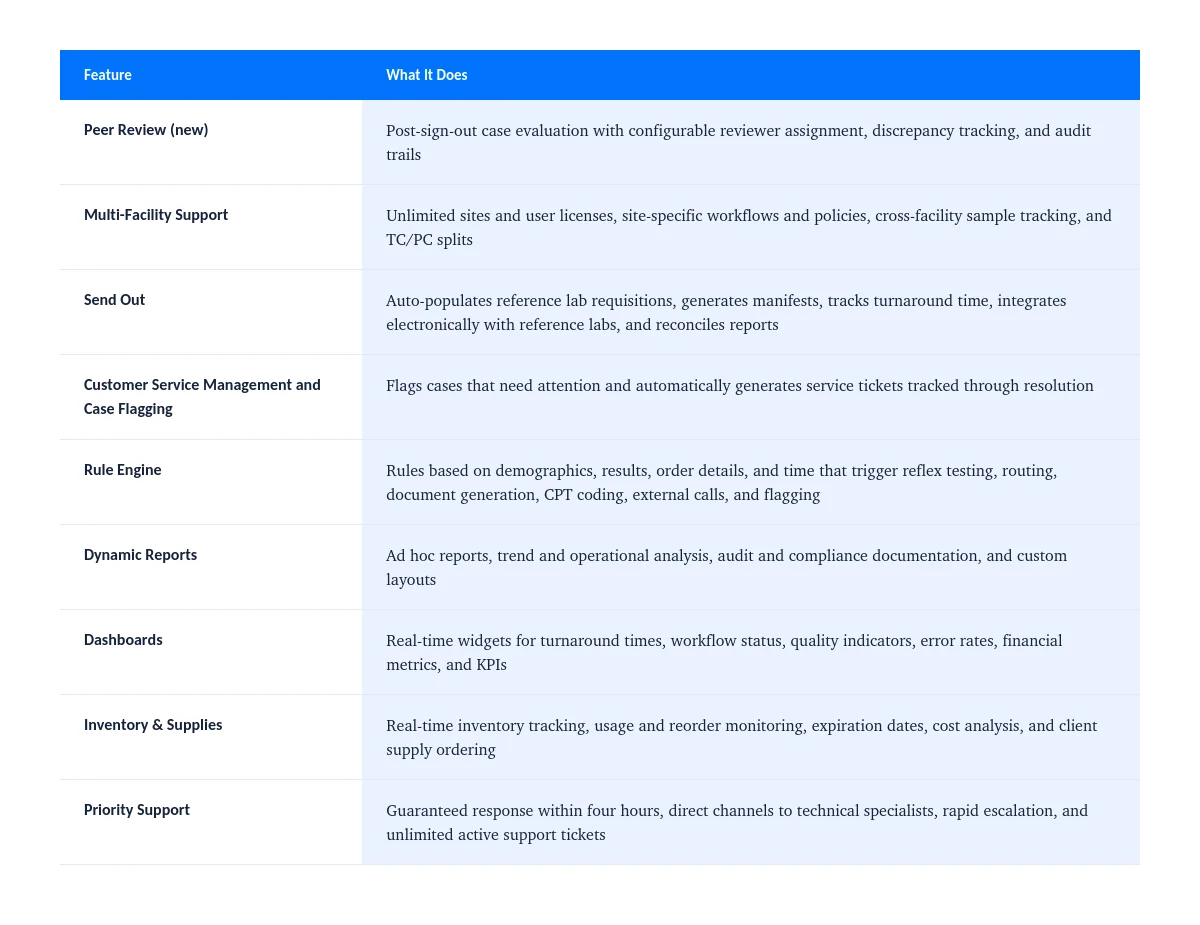
The Advanced Tier also adds advanced interoperability capabilities. Together, these modules transform the medical LIS into a true system of action, enabling LigoLab customers to operate more efficiently while improving overall performance.
Industry Insights: From LIS System of Record to LIS System of Action - The Next Evolution of Laboratory Information Systems
What Is the New Integrated Peer Review Feature for Pathology Quality Assurance?
The newest addition to the Advanced Tier is LigoLab's Peer Review module, designed to enhance diagnostic accuracy, collaboration, and regulatory compliance within LIS pathology workflows.
Unlike traditional internal consultations that occur before a case is finalized, LigoLab's peer review capability focuses on post-sign-out case evaluation, providing an additional layer of diagnostic quality assurance.
What Can Pathologists Do Within the Peer Review Workflow?
Within the anatomic pathology LIS workflow, pathologists can:
- Flag completed cases for peer review.
- Automatically assign reviewers based on configurable rules.
- Manually select peer reviewers when needed.
- Access full case context, including clinical records and diagnostic data.
- Track discrepancies, investigations, and resolutions.
- Maintain a complete audit trail for compliance and accreditation.
Peer review cases are organized into dedicated queues, enabling reviewers to process evaluations efficiently with minimal clicks.
How Does Peer Review Benefit Laboratories?
By integrating peer review into daily case management, laboratories can:
- Improve diagnostic consistency.
- Encourage collaboration among pathologists.
- Strengthen quality management programs.
- Maintain documentation for accreditation requirements.
- Support internal governance and compliance initiatives.
This feature reinforces LigoLab's commitment to helping laboratories maintain high standards of diagnostic excellence and operational transparency.
Discover More: How Modern LIS Software Helps Pathologists Sign Out Anatomic Pathology Cases Faster
How Does Multi-Facility Support Help Expanding Laboratory Networks?
Modern diagnostic laboratories frequently operate across multiple sites, regions, or time zones. The Multi-Facility Support module lets laboratories manage all locations within a single, unified LIS healthcare platform.
Each facility can maintain its own workflows, policies, and reporting structures while benefiting from centralized oversight and shared data visibility.
Key capabilities include:
- Unlimited sites and user licenses.
- Role-based user access and permissions.
- Site-specific workflows and policies.
- Cross-facility sample tracking.
- Transfer of tests between facilities.
- Shared reporting and operational visibility.
This functionality enables laboratories to expand partnerships, scale operations, and support Technical Component/Professional Component (TC/PC) splits between organizations.
White Paper: Comparing LigoLab Informatics Platform with Legacy Laboratory Information System Software
How Does Send-Out Testing Management Work With Reference Lab Integration?
Many laboratories rely on reference laboratories for specialized testing. LigoLab's Send Out module simplifies and automates the entire send-out workflow. The LIS system can:
- Automatically populate reference lab requisition forms.
- Generate manifests and track turnaround times.
- Integrate electronically with reference laboratories.
- Track specimen status from send-out through results return.
- Reconcile reports and attach external results to final case reports.
By automating these processes, the system reduces paperwork, eliminates manual errors, and maintains full visibility.
Industry Insights: The Competitive Edge in Laboratory Outreach - Enhancing Value Beyond Price
How Do Customer Service Management and Case Flagging Work?
The Customer Service Module (CSM) centralizes communication and issue tracking within the laboratory.
Through Case Flagging, the LIS system can identify cases that require attention, such as:
- Results requiring additional review.
- Testing delays.
- Data entry discrepancies.
- Client follow-up requests.
Flagged conditions automatically generate service tickets that are tracked through resolution.
LigoLab's Workflow Engine powers these actions, automatically routing tasks and triggering actions based on configurable rules and real-time data.
This structured approach enhances accountability, strengthens communication, and ensures that customer service issues are resolved quickly and consistently.
Discover More: Is Your Laboratory Information System and LIS Lab Vendor Holding Your Laboratory Hostage?

How Does LigoLab's Rule Engine Automate Complex Workflows?
The Rule Engine enables laboratories to automate complex operational workflows.
Rules can be created based on nearly any parameter within the laboratory information system, including:
- Patient demographics.
- Test results.
- Order details.
- Time-based conditions.
These rules can automatically trigger actions such as:
- Reflex testing.
- Workflow routing.
- Document generation.
- CPT coding.
- External system calls.
- Case flagging and notifications.
Because rules can be applied at any stage, from order entry to reporting, laboratories can create highly customized automation that matches their operational requirements.
Get Insight: Boosting Laboratory Revenue with Billing & Coding Automation
How Do Dynamic Reports and Dashboards Support Advanced Analytics?
The Advanced Tier also includes robust business intelligence LIS and RCM tools that permit laboratory leaders to monitor performance and make data-driven decisions.
What Can You Do With Dynamic Reports?
The Dynamic Reports module empowers laboratories to build custom reports using the platform's discrete data elements. Users can:
- Create ad-hoc reports on demand.
- Analyze trends and operational metrics.
- Generate audit and compliance documentation.
- Customize report layouts and filtering.
This flexibility unlocks operational data and turns it into actionable insights.
What Can You Track With Dashboards?
The Dashboards module provides a real-time operational command center. Through customizable widgets and visualizations, users can track:
- Turnaround times.
- Workflow status.
- Quality indicators.
- Error rates.
- Financial metrics.
- Key performance indicators.
Dashboards update automatically as data changes, enabling leadership teams to monitor operations and respond quickly to emerging trends.
Discover More: The New Era of Laboratory Informatics - From Manual Tasks to Sustained Success
How Does Inventory and Supply Chain Management Work?
Laboratories must manage supplies and operational costs carefully. The Inventory & Supplies module provides full control over supply chains. Capabilities include:
- Real-time inventory tracking.
- Monitoring supply usage and reorder levels.
- Expiration date tracking.
- Cost analysis and budgeting insights.
- Client supply ordering within the LIS.
This functionality helps laboratories reduce waste, control expenses, and optimize purchasing decisions.
Get Insight: Top 10 Medical Laboratory Mistakes and How to Prevent Them from Happening in Your Lab
What Does Priority Support Provide for Mission-Critical Operations?
Laboratories operating in high-volume environments require rapid technical support when issues arise. The Advanced Tier includes Priority Support, which provides:
- Guaranteed response times within four hours.
- Direct communication channels with technical specialists.
- Rapid issue escalation and resolution.
- Unlimited active support tickets.
This service helps laboratories maintain continuous operations and maximize platform utilization.
Discover More: Stability and Performance - The Two Most Important Aspects of a Modern Laboratory Operation

What Do the Other LigoLab Informatics Platform Tiers Offer?
While the Advanced Tier delivers powerful enterprise-level functionality for high-volume laboratories, the all-in-one LigoLab Informatics Platform offers a four-tier pricing structure that helps laboratories adopt the functionality that best fits their current needs while providing a clear path for future growth. Each tier builds on the previous one, enabling laboratories to scale operations without replacing their laboratory information system as their organization expands.

The Essential Tier provides a modern digital foundation for laboratories transitioning from manual workflows or legacy LIS systems while maintaining the flexibility to scale as operational needs grow.
The Professional Tier’s capabilities facilitate workflow efficiency, strengthen quality oversight, and integrate more seamlessly with external healthcare systems.
The Enterprise Tier delivers a fully integrated enterprise informatics ecosystem.
How Does a Tiered LIS Software Platform Grow With Your Laboratory?
The LigoLab tiered pricing model eliminates the traditional one-size-fits-all approach to laboratory information systems, which forces labs to purchase unnecessary functionality or migrate platforms as they grow.
Instead, laboratories can start with the tier that matches their current operational complexity and expand seamlessly as testing volumes, partnerships, and service offerings grow.
This flexible framework streamlines operations, enhances efficiency, and supports sustainable growth through a single, unified LIS medical solution with embedded laboratory revenue cycle management.
Are Peer Review and the Advanced Tier Right for Every Lab?
Not necessarily. The Peer Review module is a quality assurance feature, and its value depends on having enough pathologists to review one another's work and a program your lab and accrediting bodies actually expect. A small group with few pathologists, or a lab that already runs peer review through another process, may want to compare the workflow, reviewer assignment, and documentation before changing anything. The module also focuses on post-sign-out evaluation, so it complements rather than replaces consultations that happen before a case is finalized.
The same logic applies to the tier. The Advanced Tier is built for complexity, such as multiple sites, high volume, and demanding automation needs. Smaller or single-site labs may find Essential or Professional a better match, and Enterprise is designed for the largest regional and national organizations.
Continue Your Research
- Advanced Tier Deep Dive: LigoLab's Advanced Tier - The Ideal Fit for Expansive High-Volume Laboratories Seeking Top-Level Efficiency, Automation, and Insight
- Pricing and Tiers: LigoLab Informatics Platform - Uniquely Designed to Deliver Maximum Value
- Dedicated LIS Systems: The Best LIS Systems are Comprehensive and Laboratory-Specific
- Platform Comparison: Best LIS Systems - Top Laboratory Information Systems Compared for Clinical, Pathology, and Outreach Labs
- Pathologist Workflow: How Modern LIS Software Helps Pathologists Sign Out Anatomic Pathology Cases Faster
Interested in Learning How the LigoLab Advanced Tier Can Modernize Your Laboratory Operations?
Connect with a LigoLab product specialist today to schedule a personalized demonstration.
Don’t Wait: Speak with a LigoLab Product Specialist!
Frequently Asked Questions About LigoLab's Advanced Tier and Peer Review Feature
What is LigoLab's Advanced Tier?
LigoLab's Advanced Tier is a high-performance configuration of the LigoLab Informatics Platform designed for large, high-volume laboratories and multi-facility diagnostic organizations. It includes advanced automation, analytics, interoperability, inventory management, multi-facility support, customer service tools, and priority technical support. This tier helps laboratories streamline operations and make data-driven decisions.
What is the Peer Review feature in LigoLab's LIS system platform?
The Peer Review feature enables pathologists to submit completed cases for post-sign-out review by colleagues directly within the LIS pathology workflow. The system tracks reviews, discrepancies, investigations, and resolutions in a structured, auditable format that supports quality assurance programs, diagnostic accuracy, and regulatory compliance.
Why is peer review important in pathology laboratories?
Peer review plays a critical role in LIS pathology quality assurance by allowing other pathologists to evaluate diagnostic decisions. This process improves diagnostic consistency, identifies potential discrepancies, strengthens internal quality management programs, and provides documentation required for accreditation and compliance.
Which laboratories benefit most from the LigoLab Advanced Tier?
The Advanced Tier is ideal for high-volume clinical laboratories, pathology groups, and laboratory networks that operate multiple testing sites. It is especially beneficial for organizations that need advanced automation, enterprise analytics, quality assurance tools, and scalable infrastructure for growth.
What is the Rule Engine in the LigoLab platform?
The Rule Engine is an automation framework that creates automated labs with configurable rules based on patient data, test results, workflows, and operational conditions. These rules can trigger actions such as reflex testing, document generation, CPT coding, workflow routing, and case flagging, significantly reducing manual tasks and improving efficiency.
Is the Advanced Tier or Peer Review right for every lab?
Not always. Peer review depends on having enough pathologists to review one another's work, and smaller or single-site labs may be better matched to the Essential or Professional tiers.