Blog
PAMA Cuts Loom: What's at Stake for Clinical Labs and Pathology Groups in 2027?
October 13, 2026

Clinical laboratories and pathology groups are approaching a critical turning point. After years of legislative delays, substantial Medicare reimbursement reductions are scheduled to take effect on January 1, 2027, unless Congress intervenes.
The Centers for Medicare & Medicaid Services (CMS) has released preliminary 2027 Clinical Laboratory Fee Schedule (CLFS) rates (linked below) that point to lower reimbursement for over 1,000 laboratory test codes. These reductions, mandated under the Protecting Access to Medicare Act of 2014 (PAMA), threaten to intensify financial pressures across an industry already struggling with rising operating costs, staffing shortages, regulatory complexity, and shrinking margins.
The stakes extend beyond laboratory profitability. Reduced reimbursement could force clinical laboratories and pathology practices to scale back services, delay investments, limit access to specialized testing, or reconsider their ability to serve certain patient populations.
Industry organizations are urging Congress to pass the bipartisan Reforming and Enhancing Sustainable Updates to Laboratory Testing Services (RESULTS) Act or, at minimum, postpone the scheduled cuts.
But regardless of what happens in Washington, one thing is clear: Laboratory leaders cannot afford to build their financial future on the expectation of legislative relief.
Related Link: Preliminary Calendar Year (CY) 2027 Medicare Clinical Laboratory Fee Schedule Payment Rates
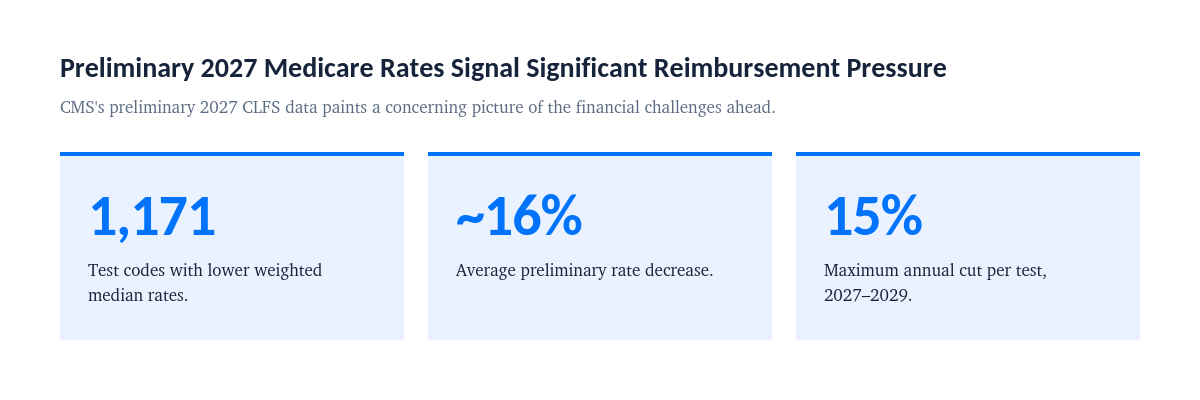
After analyzing private-payer payment data for 1,528 laboratory test codes, CMS found that 1,171 codes (approximately 77%) had calculated rates below their 2026 Medicare reimbursement levels. Meanwhile, 186 codes had higher rates, and 169 remained unchanged.
The findings suggest that more than three-quarters of the analyzed test codes could face Medicare reimbursement reductions beginning January 1, 2027, unless Congress intervenes.
CMS estimates that aligning Medicare reimbursement more closely with private-payer rates could save the federal government approximately $1 billion annually.
For medical laboratories, those savings represent potential revenue losses that must be absorbed, offset through greater efficiency, or passed along through operational changes.
Sources: CMS preliminary 2027 CLFS findings, as reported by CLP Magazine and Today's Clinical Lab.
What Happens if Congress Fails to Act?
The consequences of scheduled PAMA reductions will vary depending on laboratory size, testing mix, payer composition, and financial stability. However, several scenarios illustrate the potential impact.
1. Reduced Revenue and Shrinking Operating Margins
For a medical laboratory generating $5 million annually in Medicare revenue, a 10% average reimbursement reduction across its testing portfolio could result in approximately $500,000 in lost annual revenue, assuming testing volumes and test mix remain unchanged. For laboratories already operating on tight margins, a loss of this magnitude could significantly threaten profitability and long-term financial stability.
2. Increased Pressure on Staffing and Turnaround Times
Laboratory personnel are already managing growing workloads amid persistent workforce shortages. Additional financial pressure could lead organizations to freeze hiring, reduce overtime, postpone replacing departing employees, or consolidate positions.
These decisions could increase workloads, contribute to burnout, and threaten turnaround times.
3. Reduced Access to Testing Services
Independent and community laboratories may be especially vulnerable when they lack the financial reserves or testing volumes needed to absorb reimbursement reductions.
Some could discontinue low-margin tests, reduce collection locations, limit outreach services, or consolidate operations.
Patients in rural and underserved communities could face longer travel distances and delayed access to diagnostic testing.
4. Delayed Modernization and Equipment Investments
When reimbursement declines, technology investments often are among the first expenses reconsidered.
Laboratories may postpone instrument upgrades, automation initiatives, digital pathology adoption, or replacing laboratory information system (LIS) software.
Unfortunately, delaying modernization can compound financial difficulties by preserving inefficient workflows, increasing manual labor requirements, and limiting scalability.
Industry Insights: The Modern Laboratory Blueprint - Aligning People, Processes, and Technology for Long-Term Success
The RESULTS Act: A Potential Path Toward Sustainable Reimbursement
The bipartisan RESULTS Act, introduced as H.R. 5269 and S. 2761, seeks to address longstanding concerns about how Medicare determines laboratory reimbursement rates.
Rather than continuing to rely primarily on direct private-payer data submissions from thousands of laboratories, the legislation would generally use commercial paid-claims information obtained through an independent database.
Supporters argue this approach would provide a more representative picture of the laboratory marketplace while reducing administrative reporting burdens.
The legislation would also cancel scheduled payment reductions, freeze rates during implementation, and eventually limit annual reductions to 5%.
The College of American Pathologists (CAP), American Clinical Laboratory Association (ACLA), and other industry organizations have advocated for permanent reform.
Despite bipartisan support, passage is not guaranteed. Congress could approve the RESULTS Act, enact another temporary delay, or allow the scheduled reductions to proceed.
That uncertainty makes the remaining months of 2026 particularly important for laboratory advocacy and financial planning.
Discover More: Pathologists See Digital Pathology as a Workforce Solution, but Reimbursement Remains a Barrier
How Laboratory Professionals Can Advocate for Congressional Action
Laboratory executives, pathologists, medical technologists, and industry stakeholders can influence the debate before January 1.
Advocacy is particularly effective when it connects reimbursement policy to the real-world consequences for patients and healthcare providers.
Laboratory professionals can take several practical steps:
- Contact congressional representatives. Reach House and Senate offices, explain how the proposed reductions could affect local diagnostic services, and request support for the RESULTS Act or temporary payment relief.
- Share laboratory-specific financial projections. Quantify potential revenue losses, staffing consequences, and service reductions using actual testing volumes and Medicare reimbursement data.
- Participate in industry advocacy campaigns. Engage with organizations such as CAP, ACLA, and the American Hospital Association to amplify industry concerns.
- Mobilize healthcare partners. Encourage physicians, hospitals, and patient advocates to explain how reduced laboratory access could affect patient care.
The strongest argument goes beyond the need for adequate laboratory reimbursement. It emphasizes that financially sustainable diagnostic services are essential to ensuring timely diagnoses, effective treatment, and continued patient access to quality care.
Discover More: Why Laboratory Leaders Are Re‑Thinking Their LIS Strategy in 2026 - and Where LigoLab Fits
The Bigger Picture: PAMA Is Only One of Many Challenges Facing Laboratories
Even if Congress prevents the scheduled reductions, broader financial and operational challenges remain.
Laboratories must contend with escalating labor and supply costs, persistent staffing shortages, increasingly complex payer requirements, cybersecurity risks, and expanding expectations for interoperability and regulatory compliance.
At the same time, healthcare providers expect faster turnaround times, greater transparency, electronic ordering, and convenient access to results.
These pressures expose the limitations of legacy laboratory information systems, fragmented laboratory billing processes, and manual workflows.
The underlying challenge is no longer simply how much laboratories are reimbursed, but how efficiently they operate and how much revenue they successfully collect.
A temporary congressional reprieve may provide breathing room, but it won’t resolve inefficiencies that erode profitability every day.
Case Study: In-House vs. Outsourced Laboratory Billing – Navigating the Best Path Forward for Your Lab
How Advanced Medical LIS Technology Helps Protect Labs Against Reimbursement Pressure
Laboratories cannot control Medicare payment policies, but they can improve operational efficiency, financial visibility, and adaptability.
Modern laboratory information system software offers a practical way to address these challenges.
By automating accessioning, specimen tracking, quality control, result reporting, and other routine processes, advanced LIS platforms help laboratories increase productivity without proportionally increasing staffing requirements.
Equally important, integrated laboratory revenue cycle management (RCM) capabilities help protect revenue through accurate demographic capture, automated coding, payer-specific claim validation, denial management, and reimbursement analytics.
A unified LIS and RCM environment can help laboratories:
- Reduce operating costs by eliminating repetitive manual work and minimizing errors.
- Protect revenue by identifying laboratory billing problems before claims are submitted.
- Improve staff productivity through automated workflows and exception-based management.
- Strengthen compliance with comprehensive audit trails, quality controls, and reporting.
- Make informed financial decisions using real-time dashboards that reveal test profitability, payer performance, and reimbursement trends.
For example, a laboratory facing a 10% reimbursement reduction could use integrated analytics to identify underperforming payer contracts, costly manual processes, and avoidable claim denials. Automation and revenue optimization may offset some losses, although the results will depend on the laboratory's existing operations and opportunities for improvement.
Platforms such as LigoLab's unified LIS and RCM solution connect technical, operational, and financial workflows, giving laboratory leaders greater control over productivity and revenue performance.
Technology cannot eliminate reimbursement cuts, but it can help laboratories become more resilient when financial conditions deteriorate.
Industry Insights: Why LIS And RCM Integration Is A Laboratory Survival Imperative
Preparing for 2027: Don't Wait for Congress to Determine Your Future
Congress may pass the RESULTS Act, approve another delay, or allow the reductions to proceed. Regardless of the outcome, laboratories should begin preparing now.
That means modeling reimbursement scenarios, evaluating test-level profitability, reviewing staffing and operational costs, strengthening billing performance, and identifying opportunities for automation.
Most importantly, laboratory leaders should view technology modernization as a long-term investment in financial sustainability rather than a discretionary expense.
The laboratories best positioned for 2027 and beyond will combine industry advocacy with operational innovation, using advanced LIS technology, automation, and integrated lab RCM to protect margins, improve productivity, and maintain high-quality diagnostic services.
Frequently Asked Questions About PAMA and the 2027 Medicare Laboratory Payment Cuts
What is PAMA, and why does it affect laboratory reimbursement?
The Protecting Access to Medicare Act of 2014 (PAMA) established a methodology for setting Medicare laboratory reimbursement rates based on weighted median payments from private insurers. When these commercial payment rates fall below existing Medicare rates, laboratories may face reimbursement reductions.
How much could Medicare laboratory reimbursement decrease in 2027?
CMS preliminary data indicates that 1,171 test codes have weighted median private-payer rates below their 2026 Medicare rates. Under current law, payment reductions for individual tests are capped at 15% annually from 2027 through 2029. Actual reductions will depend on final rates and individual test codes.
What is the RESULTS Act?
The RESULTS Act is bipartisan legislation intended to reform Medicare laboratory payment calculations, improve the representativeness of commercial reimbursement data, reduce reporting burdens, and limit future payment reductions.
What happens if Congress does not act before January 1, 2027?
Scheduled PAMA reductions would take effect, potentially reducing revenue for affected laboratories. Depending on their financial position, laboratories could face staffing constraints, reduced services, delayed technology investments, or pressure to consolidate.
How can laboratory professionals help prevent the scheduled cuts?
Laboratory professionals can contact congressional representatives, share financial impact assessments, participate in industry advocacy initiatives, and encourage healthcare partners to communicate the importance of protecting access to diagnostic testing.
How can modern medical LIS and lab RCM software help laboratories manage declining reimbursement?
Advanced LIS and RCM platforms help laboratories automate workflows, reduce operating costs, improve billing accuracy, prevent avoidable denials, and gain greater visibility into financial performance. These capabilities can help organizations protect margins and remain competitive despite reimbursement uncertainty.