Blog
Image Management Systems and the LIS: Why Seamless Integration is Essential for Digital Pathology
April 1, 2026
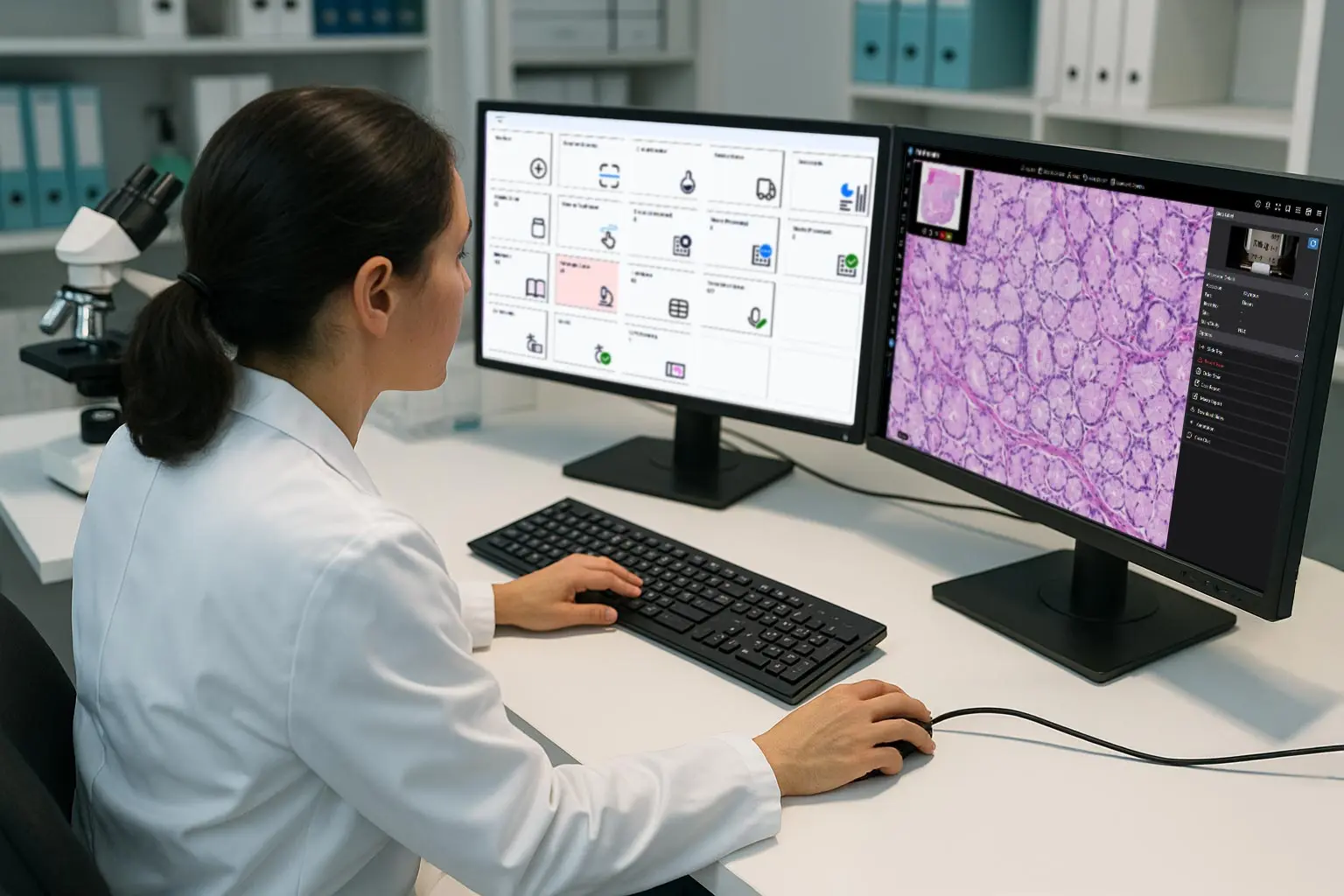
Digital pathology is no longer a future concept; it is rapidly becoming a clinical, operational, and strategic necessity for modern pathology groups. As laboratories adopt remote sign-out and AI-assisted diagnostics, a new class of technology has emerged as mission-critical: the digital pathology image management system (IMS).
Yet, not all digital pathology tools are created equal. Many labs begin their journey with simple image (slide) viewers, only to discover that true scalability, compliance, and efficiency require something far more robust and integrated.
This article addresses what digital pathology image management systems are, how they differ from basic image viewers, and why deep, contextual integration between an IMS and a modern laboratory information system (LIS) is foundational to successful digital pathology adoption. We’ll also examine the problems this integration solves and the strategic advantages it delivers to pathology groups on a path toward a fully digital, AI-enabled future.
Industry Insights: Digital Pathology Redefined - Uniting AI, Viewers, and a Robust LIS System for a Seamless Workflow
Image Viewers vs. Image Management Systems: What’s the Difference?
As digital pathology adoption accelerates, confusion often arises around terminology, particularly between image viewers and image management systems.
Image Viewers: Useful but Limited
A pathology image viewer is designed primarily for visualizing digitized slides, also known as whole slide images (WSIs). These tools typically allow users to zoom, pan, rotate, and annotate images. They are often used for:
- Basic case review
- Education and teaching
- Research and image exploration
Viewers may be web-based or desktop applications, and some are vendor-specific, while others support multiple file formats. Slide viewers can be effective and easy to deploy for low-volume or individual use cases.
However, their limitations quickly surface in clinical environments. Slide viewers generally lack workflow management, user governance, auditability, interoperability, and compliance controls. They are tools for looking at images, not for managing digital pathology at scale.
Industry Insights: Why the Future of the Laboratory Information System Must Be Active, Intelligent, and Integrated
What Is an Image Management System (IMS) in Digital Pathology?
A digital pathology image management system (IMS) goes far beyond viewing. It is an enterprise-grade platform designed to manage the entire lifecycle of digital pathology images across clinical, research, and educational workflows.
An IMS serves as the backbone of digital pathology operations, supporting everything from secure storage to AI integration and multi-institution collaboration.
Core Capabilities of a Modern Digital Pathology IMS
A robust IMS typically includes:
- Advanced Slide Viewing: High-performance visualization across multiple formats (SVS, NDPI, SCN, DICOM, BigTIFF, and more), synchronized multi-slide viewing, annotations, overlays, and fast rendering.
- Centralized Data Management: Secure, scalable image storage, on-premises, cloud, or hybrid, with governance controls and long-term data stewardship.
- Security and Compliance: HIPAA-grade protections, encryption, audit trails, role-based access, and regulatory readiness for clinical use.
- Workflow Integration: Case management, task tracking, and seamless interoperability with LIS, EHR, PACS, and other enterprise laboratory software systems.
- User Roles and Access Control: Granular permissions ensure that only authorized users access sensitive data, while maintaining accountability.
- Collaboration Tools: Support for remote consults, tumor boards, education, and peer review through shared environments.
- AI and Image Analysis Enablement: Integration with AI models for detection, quantification, and pattern recognition, embedded directly into diagnostic workflows.
- Regulatory Readiness - Many IMS platforms are designed to meet FDA, HIPAA, GDPR, IVDR, and other regulatory standards. Some, such as PathPresenter’s clinical viewer, are FDA 510(k) cleared for primary diagnosis when paired with approved scanners.
In short, an IMS provides a comprehensive infrastructure for digital pathology.
Discover More: Digital Pathology - The Future is Here
Why LIS-IMS Integration Is So Critical for Digital Pathology
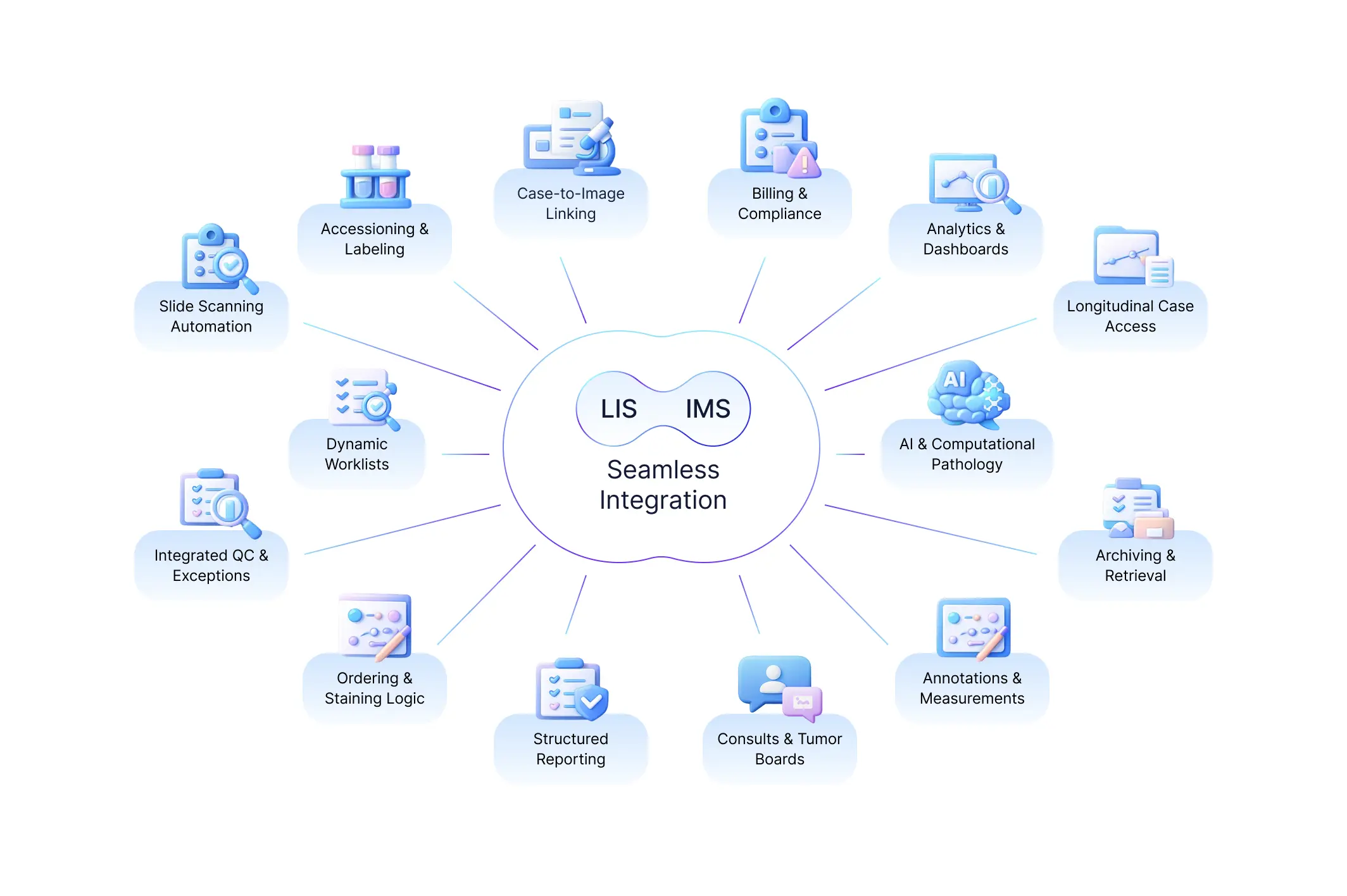
While a standalone IMS is powerful, its true value is unlocked only when it is deeply integrated with an advanced laboratory information system (LIS) software. Without that integration, labs risk recreating the very silos digital pathology was meant to eliminate.
The Risks of Disconnected LIS and IMS Platforms
When an IMS and LIS lab platform operate separately, pathology teams face:
- Manual case matching between systems
- Duplicate data entry
- Context switching that slows sign-out
- Increased error risk
- Fragmented audit trails
- Inefficient collaboration
In high-volume, regulated environments, these inefficiencies compound quickly, undermining both productivity and quality.
Discover More: Laboratory Problems and LIS System Solutions for Pathology Groups and Clinical Labs
From LIS System of Record to LIS System of Action
Historically, most laboratory information system platforms have served primarily as systems of record, repositories for patient data and reports. While essential, that model is no longer sufficient.
Why Traditional LIS Models Are No Longer Enough
Modern laboratories require LIS systems of action: platforms that interpret data in real time, automate workflows, and guide users proactively.
When an IMS is tightly integrated into a modern LIS system, digital pathology becomes part of a living operational fabric (not a disconnected add-on).
What Seamless LIS-IMS Integration Looks Like in Practice
In a truly integrated environment:
- The pathologist launches digital slides directly from the LIS system's case record
- Case metadata, patient context, and specimen details are preserved automatically
- Navigation between case data and images is frictionless
- Audit trails span both clinical data and image interactions
- AI tools operate within established diagnostic workflows
This represents a strategic transformation of laboratory workflows, much more than a mere convenience.
Discover More: The Four Most Important Things to Consider When Modernizing a Laboratory
Key Problems LIS-IMS Integration Solves for Pathology Groups
1. Eliminating Lab Workflow Friction
By embedding the IMS directly within the LIS system, pathologists avoid constant system switching. This reduces cognitive load, accelerates case review, and improves turnaround times.
2. Supporting Remote and Distributed Teams
Integrated IMS–LIS workflows enable secure remote sign-out, consults, and collaboration, all critical in an era of subspecialization and staffing shortages.
3. Improving Diagnostic Accuracy
Contextual integration ensures that pathologists review images alongside complete case data, reducing the risk of misinterpretation or missing information.
4. Strengthening Compliance and Traceability
Unified audit trails across LIS and IMS simplify CAP, CLIA, and HIPAA compliance while improving inspection readiness.
5. Preparing for AI at Scale
AI is most effective when embedded into real workflows. An integrated LIS–IMS environment allows labs to deploy, govern, and evolve AI responsibly, without disrupting operations.
Discover More: Best Practices for Preparing Medical Labs for AI Integration in Technical and Financial Operations
Digital Pathology at Scale: A Real-World LIS-IMS Integration Example
A clear illustration of LIS–IMS integration in practice is the strategic partnership between LigoLab and PathPresenter.
Through this collaboration, PathPresenter’s clinical viewer is seamlessly embedded within LigoLab’s enterprise laboratory information system platform. Pathologists can access, view, and interpret images directly from the LIS software, within a unified diagnostic environment.
This integration delivers:
- Context-aware slide viewing launched from the case record
- Reduced navigation friction and bottlenecks
- Faster turnaround times
- A foundation for AI-enabled workflows
Creating a Unified Digital Pathology Workflow
As LigoLab CEO Suren Avunjian has noted, the goal is to create an environment where pathologists move effortlessly from data to images, turning the LIS system into an active participant in diagnostic excellence.
From PathPresenter’s perspective, the integration underscores a shared focus on interoperability, scalability, and ROI, ensuring that investments in digital pathology solutions deliver tangible operational gains.
Industry News: LigoLab and PathPresenter Announce Strategic Partnership to Deliver Seamless Digital Pathology Workflows
The Role of LIS-IMS Integration in AI-Enabled Pathology
Digital pathology is no longer just about replacing glass slides; it is about redefining anatomic pathology software and how pathology work gets done.
When LIS and IMS platforms operate as one:
- Operations benefit from automation and visibility
- Finance benefits from tighter integration with laboratory revenue cycle management (lab billing) workflows
- Staff benefit from reduced manual effort and modern diagnostic lab software tools
- Patients benefit from faster, more reliable diagnoses
This alignment becomes even more critical as AI, advanced analytics, and remote diagnostics become standard expectations.
Discover More: How Advanced LIS Software Helps Pathologists Sign Out Anatomic Pathology Cases Faster
How to Evaluate an Image Management System for LIS Integration
For pathology groups evaluating digital pathology solutions, the key question is no longer “Do we need an IMS?” but rather:
“How well does this IMS integrate with our LIS, and how future-ready is that integration?”
The most successful labs prioritize:
- Vendor-agnostic, standards-based interoperability
- Contextual, embedded workflows
- Regulatory readiness for clinical use
- AI enablement without workflow disruption
- A shared vision between LIS and IMS providers
White Paper: What You Need to Know Before Contracting with a Laboratory Information System Company
Why LIS-IMS Integration Defines the Future of Digital Pathology
Digital pathology delivers its greatest value not through isolated tools, but through deeply integrated platforms that connect images, data, workflows, and intelligence.
Financial and Strategic Advantages
A modern image management system is essential, as is an LIS–IMS integration that transforms digital pathology from a promising technology into a scalable, compliant, and profitable reality.
As laboratories shift toward fully digital, AI-enabled operations, those that embrace unified systems of action will define the next era of pathology: faster, smarter, and more connected than ever before.