Blog
Turning Workflow Insight into Measurable Lab Performance: Webinar Recap

February 16, 2026

Clinical laboratories and pathology practices are under extraordinary pressure. Volumes continue to rise. Reimbursement remains unpredictable. Staffing shortages persist. And across the industry, fragmented lab workflow and underutilized LIS laboratory information system software quietly erode both efficiency and margin.
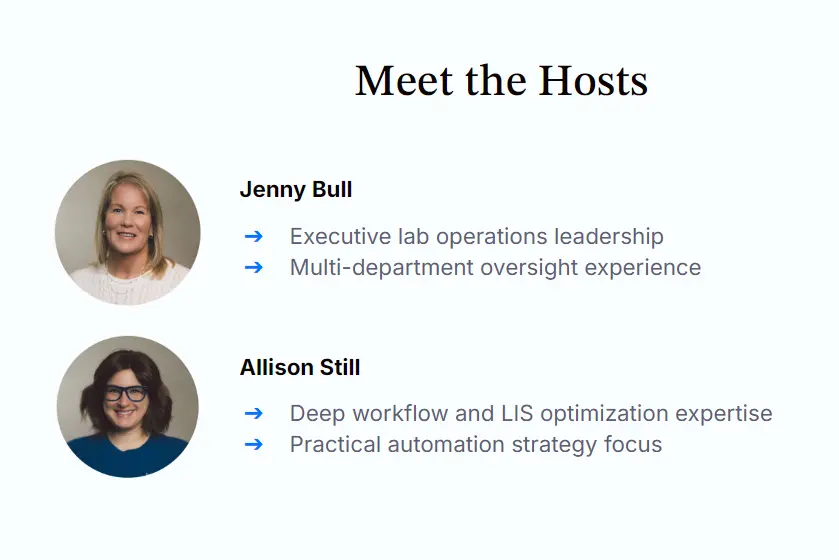
In LigoLab’s first webinar of the year, “Turning Workflow Insight into Measurable Lab Performance,” Success Director Jenny Bull and LIS Product Manager Allison Still delivered a candid, experience-driven discussion focused on how laboratory information system vendors should help medical labs move beyond assumptions and toward measurable ROI.
The message was clear: today’s laboratories don’t just need laboratory information system software. They need a truly advanced LIS system that drives optimized laboratory workflow, strengthens pathology/clinical laboratory management, and eliminates the hidden inefficiencies that stall growth.
Discover More: How Best Practices and Advanced Laboratory Information System Technology Help Ensure Lab Workflow Management
Today’s Laboratory Reality: Rising Pressure, Hidden Inefficiencies
The webinar opened with a familiar truth. No matter the specialty (clinical, pathology, molecular, or outreach), labs face the same core challenges:
- Increasing test volumes
- Ongoing reimbursement constraints
- Difficulty recruiting and retaining qualified staff
- Fragmented lab workflow
- Underutilized LIS system software
Many labs assume their workflows are “good enough.” But as Bull explained, assumptions are rarely backed by direct observation.
“The goal is really simple,” she said. “At the end of the day, we want to replace guesswork with direct observation and produce a structured opportunity report that identifies measurable improvements the lab, its customers, and staff can benefit from.”
For laboratory leaders evaluating LIS vendors or seeking the best LIS for their long-term growth, that mindset shift is critical.
Industry Insights: Best LIS Systems in 2026 - Top Laboratory Information Systems Compared for Clinical, Pathology, and Outreach Labs
What an On-Site Assessment Really is (And What it’s Not)
Bull grounded the audience in what an on-site assessment truly entails.
It is not a sales pitch.
It is not a theoretical review.
It is not a remote screen-share consultation.
Instead, it is a structured, in-person operational deep dive into how a laboratory truly functions day to day.
During these engagements, Bull and Still:
- Observe real workflows, not just intended processes
- Follow the full specimen lifecycle from accessioning to laboratory billing
- Identify inefficiencies, bottlenecks, and hidden rework loops
- Evaluate the usage of the LIS system software
- Engage staff across departments
“We observe real workflows, not just how processes are intended to work, but how they actually happen in practice,” Stilll emphasized.
This approach sets high-performing laboratory information system companies apart from transactional LIS vendors who focus only on feature demonstrations.
Discover More: How Does the Cost of Different Laboratory Information Systems Compare?
What They Commonly Discover in Labs
When asked what they most frequently uncover, Still didn’t hesitate.
“Spreadsheets. Whiteboards. Manual work logs. Duplicate data entry. Systems layered on top of each other,” she said. “Sometimes labs can do processes in the LIS lab solution that they’re doing manually because they don’t even know what they have.”
Across laboratories, regardless of the LIS company, common themes emerge:
- Excel files tracking issues that the LIS system could handle
- Manual send-out processes
- Shadow systems built on top of legacy LIS software platforms
- Duplicate transcription work
- Underutilized automation
Bull added another critical insight:
“Sometimes it’s just one little click of a button that allows visibility to a screen you didn’t even know was there.”
These small inefficiencies compound across thousands of cases, quietly draining time, morale, and revenue.
On-Demand Webinar: From Manual to Magical - Automation Strategies for Multi-Facility AP & Clinical Labs
.webp)
From Insight to Impact: The Opportunity Report
Observation alone is not enough. The true value comes from translating findings into a structured opportunity report.
This report is not marketing collateral. It is a business case document.
For labs evaluating new LIS lab solutions, the report:
- Documents current workflow realities
- Highlights integration and infrastructure considerations
- Identifies areas where automation could replace manual work
- Quantifies potential efficiency and financial improvements
For existing customers, the report focuses on:
- Configuration optimization
- Underutilized features in current LIS software
- Version upgrades and enhancements
- Laboratory workflow management improvements
That distinction matters for labs comparing laboratory information system vendors. True partnership means transparency, even when the vendor doesn’t yet have the perfect solution.
Get Insight: Comparing the LigoLab Informatics Platform with Legacy Laboratory Information System Software
Where ROI Really Comes From
One of the most powerful segments of the webinar addressed measurable return on investment.
The panelists broke it down into two primary drivers:
- Operational efficiency
- Financial performance improvements
Automation reduces repetitive manual work.
Fewer manual touches mean fewer errors.
Fewer errors mean fewer lab billing corrections.
Maximized claims mean stronger cash flow.
But the most compelling example came from accessioning workflows.
Bull shared a real-world scenario:
“We’ve seen accessioning workflows taking eight to ten minutes per case. We can show labs how to reduce that to one to two minutes. When you quantify that over FTEs and annual salaries, it becomes really meaningful.”
In some cases, labs were able to reallocate staff from 10 FTEs to 4 in accessioning, not through layoffs, but through efficiency gains and redeployment to higher-value work.
For C-suite leaders evaluating the best LIS software platform, those numbers command attention.
Discover More: Leveraging LigoLab for Optimal Return on Investment - An LIS System Guide for Lab Directors
The “Shadow System” Problem
A consistent theme throughout the webinar was the issue of “shadow systems,” described as any process, workaround, or workflow outside the LIS system.
Examples include:
- Excel QA logs
- Shared drives storing documents
- Separate CRM tools
- Courier tracking systems
- Manual lab billing logs
- Homegrown databases
These systems undermine the core principle of modern pathology/clinical laboratory management.
“Anytime you have things outside or in multiple software applications, you do not have a single source of truth,” Still explained.
Leading LIS vendors must provide a comprehensive, flexible platform, one that consolidates workflows and eliminates fragmentation.
Industry Insights: From System of Record to System of Action - The Next Evolution of Laboratory Information Systems
Change Management: Addressing Resistance
What happens when staff believe their workflow is already “good enough”?
Bull’s answer was both practical and empathetic.
“You never go in and call somebody’s baby ugly,” she said with a smile.
“We ask a lot of questions. Why do you do it this way? What are you trying to accomplish?”
Rather than imposing change, Bull and Still approach conversations inquisitively.
Interestingly, the most valuable feedback often comes from bench-level staff.
“I often ask lab staff to tell me what they hate every day and if they could fix one thing and never have to do it again, what would it be?” Bull shared.
Those frontline insights often reveal the biggest opportunities for workflow transformation.
On-Demand Webinar: Learn How Modern Anatomic Pathology LIS Software Can Transform Your Lab’s Operations
Timing Matters in Laboratory Information System Evaluation
For labs evaluating laboratory information system vendors, Still emphasized timing.
The most effective moment for an on-site assessment is:
- After shortlisting vendors
- After demos
- Before signing a contract
Why?
Because decisions are often based on projected outcomes rather than operational evidence.
Bull cautioned:
“Some of the worst things we’ve seen are labs pulling the trigger, going live, and feeling like the lab information system under-delivered what was promised.”
Often, the issue isn’t the LIS system software itself, but its infrastructure:
- Missing label printers
- Hardware limitations
- Network bottlenecks
- Workflow misalignment
For long-term LIS lab solutions, systems that may remain in place for 15–20 years, those considerations are critical.
Discover More: Keys to Keeping Your LIS System Implementation on Track
Transparency from a Vendor Perspective
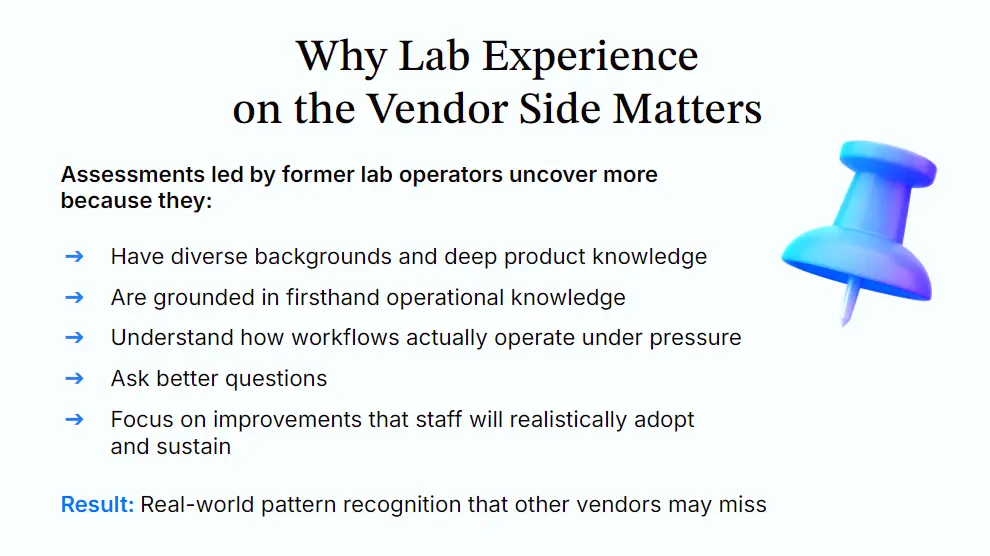
One of the most refreshing moments in the webinar came when Still addressed transparency.
“If we see something we don’t have a good solution for, we’re not going to gloss over it. We want to talk through what that could look like.”
That approach reflects a deeper truth: the best LIS software partnerships are built on honesty, not hype.
Even labs that ultimately choose a different laboratory information system vendor benefit from the insights gained during an assessment.
“Even if you don’t choose LigoLab, it’s still a win for your laboratory,” Still said.
“You’ll be able to ask tougher questions of other vendors.”
In an industry often dominated by feature checklists, that level of confidence stands out.
White Paper: How LigoLab Delivers CIO-Level Insight Through Real-World Lab Experience
System of Record vs. LIS System of Action
The webinar closed with a forward-looking perspective.
Historically, laboratory information system software functioned primarily as a system of record, tracking specimens and storing results.
But modern clinical/pathology lab management demands more.
With digital pathology, artificial intelligence, advanced analytics, and interoperability reshaping the landscape, laboratories need:
- Real-time workflow orchestration
- Automation across departments
- Integrated laboratory billing logic
- Scalable infrastructure
As Bull put it:
The LIS system is the most core application for your entire lab. It’s the one thing that will shut a lab down.”
That reality underscores why laboratory leaders must push their LIS vendors harder.
“If your workflows aren’t as efficient as you’d like them to be, if your LIS system isn’t doing what you need it to do, ask questions. Push your vendor,” she urged.
Industry Insights: ECPC’s Strategic Leap into Digital Pathology - A Connected Vision for the Future
Key Takeaways for Lab Leaders
From this webinar, several strategic insights emerge:
1. Assumptions Are Not Data
True performance improvement requires direct observation and measurable analysis.
2. Shadow Systems Erode Efficiency
Every Excel sheet and manual log weakens your single source of truth.
3. Small Inefficiencies Compound
A few extra clicks per case add up to hours of lost productivity over time.
4. ROI is Often Hiding in Plain Sight
Automation, optimized claims, and FTE reallocation can produce a dramatic financial impact.
5. The Best LIS is a System of Action
Modern LIS lab solutions must orchestrate workflow, not simply record it.
Get Insight: Why “The Safe Move” to a New Version of Legacy LIS Software Is the Wrong Move for Medical Labs
Experience Over Theory: Why the Best LIS Partner Looks Beyond Features to Drive Measurable Lab Performance
What made this webinar particularly compelling was not theory; it was experience.
Bull brought 26 years of laboratory operations expertise.
Still brought firsthand LIS system administration and product leadership experience.
Their message to laboratories was not “buy this.”
It was “look deeper.”
Look at your workflows.
Look at your inefficiencies.
Look at what your LIS system software could be doing, but isn’t.
In a healthcare environment where margins are thin and staffing is strained, workflow clarity is no longer optional. It is strategic.
For labs seeking the best LIS and evaluating the leading laboratory information system vendors, the real question isn’t just what features are available.
It’s whether your LIS partner is willing to walk your lab floor, ask hard questions, and help you transform insight into measurable performance.
Real Expertise. Real Insight. Real Laboratory Performance.
If you're evaluating the best LIS or comparing leading laboratory information system vendors, choose a team willing to go beyond features and walk alongside you from assessment to measurable results.