Blog
Turning Lab Pressure Into Performance: LigoVerse 2026 And What’s Next

November 2, 2026

Executive Summary: Here’s a look back at LigoVerse 2026, LigoLab's two-day customer summit in February, which centered on moving from a laboratory information system of record to an LIS system of action. LigoLab outlined its AI roadmap across imaging, workflow, order processing, quality, revenue cycle management, and analytics, plus a 2026 strategy built on a unified LIS and RCM platform, measurable AI outcomes, and a nimble culture.
As a company, LigoLab entered LigoVerse 2026 with a clear objective: deliver meaningful, practical value to you, our laboratory information system (LIS) and laboratory revenue cycle management (RCM) customers, so you can grow and thrive faster in 2026 and beyond.
I'm proud to say we achieved that goal. Once again, it reinforced a fundamental truth: in an environment defined by rising test volumes, workforce shortages, reimbursement uncertainty, and growing operational complexity, success depends on a comprehensive, flexible informatics platform paired with a hands-on partnership model that drives measurable efficiency and ROI.
Join me in a recap of LigoVerse 2026 and take a forward-looking perspective on the year ahead, highlighting how LigoLab's all-in-one platform continues to position you to compete, scale, and win in your markets.
What Happened at LigoVerse 2026 at a Glance?
What Pressures Are Labs Facing Right Now?
The reality labs face isn't theoretical. Every pathology and clinical lab leader I speak with is navigating constant pressure that keeps growing:
- 1 in 5 histotechs will retire in the next 5 years.
- Case complexity has risen 25-40%.
- Pathology reimbursement has dropped ~20% over the last decade.
- Expectations keep rising from clinicians, patients, payers, and regulators.
These aren't isolated trends. They're compounding forces. They're pushing the traditional lab model of manual work, siloed systems, and limited data visibility to its breaking point.
As our loyal lab customers, you are the heartbeat of LigoVerse, and we deeply respect the responsibility you carry. Our job is to remove friction around that responsibility so that you can spend more time on judgment, quality, and care, and less time on rework, follow-ups, and busywork.
Discover More: Boosting Operational Efficiency - How LigoLab Transforms Laboratory Workflows
Why Is "Doing Nothing" the Real Risk for Labs?
What's changing isn't your commitment or your standards. What's changing is the environment.
The old approach, layering more people and more tools, doesn't scale anymore:
- Fragmented systems create drag.
- Automation is no longer optional.
- The risk of doing nothing isn't falling behind on tech. It's burning out good people while margins keep shrinking.
The labs that win over the next decade will turn complexity into highly efficient systems and activate the data they already generate every day.
Industry Insights: A New Year, A New Foundation - Why Now is the Perfect Time to Modernize Your Laboratory Information System

What Does Moving From a Lab Information System of Record to an LIS System of Action Mean?
For years, the legacy laboratory information system has functioned primarily as a system of record: a digital archive for results and documentation.
That foundation still matters. But it is no longer sufficient.
LigoLab was built on a simple belief: a lab information system shouldn't just record what happened. It should actively help you run better tomorrow than you did today.
That's what we mean by an LIS system of action. Not just storing data, but actively reducing work, improving outcomes, orchestrating tasks, predicting bottlenecks, surfacing risk, and guiding staff.
And in 2026, AI becomes the intelligence layer that turns the LIS system from a passive archive into an active operational engine. Not to replace people, but to replace repetition.
Discover More: Best Practices for Preparing Medical Labs for AI Integration in Technical and Financial Operations
How Can Labs Activate the Data They Already Generate?
Your lab is already a data factory, and AI helps you activate it. Every lab is producing an enormous amount of valuable data:
- Orders, results, QC, audit trails, and images in the LIS.
- Instrument interfaces streaming operational data.
- Whole slide imaging.
- Pathologist sign-out patterns and amendments.
- RCM and denial data downstream.
Most labs already have enough data to run smarter, but it's locked in the LIS system, laboratory billing software, instruments, and spreadsheets. Human teams become "query engines" and "workflow routers" all day.
And the truth is simple: you have a ton of data, but not enough time to use it.
The challenge is not a lack of data. The challenge is activating it. AI helps by interpreting patterns, supporting workflows, and taking the first pass on work that would otherwise fall entirely on humans.
Get Insight: How to Prepare for Tomorrow’s Tech-Enabled Clinical Lab
How Is AI Being Applied as Digital Labor in the LigoLab Platform?
At LigoVerse, we took a practical, workflow-driven look at how AI is being applied across the anatomic pathology software and clinical laboratory management lifecycle, showcasing real use cases already operating in partner labs, or launching soon, all fully integrated within the LigoLab platform.
This means LigoLab's AI strategy is no longer conceptual; it is actively reshaping the laboratory ecosystem. What began as a powerful LIS lab solution is evolving into an intelligent informatics platform that empowers laboratories to shift from reactive oversight to proactive, data-driven performance.
This transformation is deliberate and phased. Each capability delivers measurable value today while laying the groundwork for broader clinical, operational, and financial impact tomorrow. Below is how that evolution is unfolding:
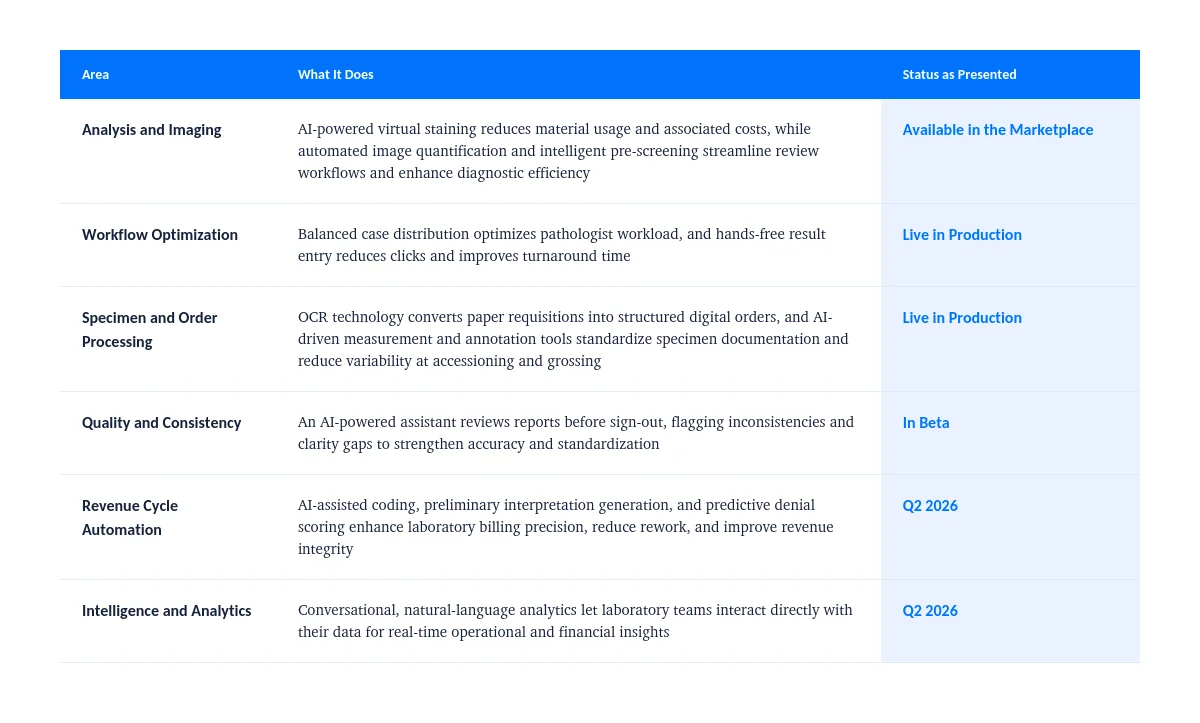
Editor’s Note: What’s listed above reflects what was presented at LigoVerse 2026. Confirm current availability with LigoLab.
Together, these advancements reflect a comprehensive AI roadmap focused on embedding digital labor directly into everyday workflows, reducing friction, strengthening quality, and protecting margins.
On-Demand Webinar: From LIS Systems of Record to LIS Systems of Action
What Does Partnership With LigoLab Look Like in the Real World?
For LigoLab, a “winning strategy” is more than a concept. It reflects real-world experiences and successes of our customers, a central theme throughout LigoVerse, from the opening keynote and interactive workshops to collaborative discussions and peer-to-peer exchanges.
Partnership with LigoLab means:
- Fewer manual steps.
- More visibility.
- Less firefighting.
- Better use of your team's time.
- A single source of truth across technical + financial operations.
Our goal isn't to change how you practice medicine. Our goal is to remove the friction.
Discover More: Leveraging LigoLab for Optimal Return on Investment - An LIS System Guide for Lab Directors

What Were the Key Moments at LigoVerse 2026?
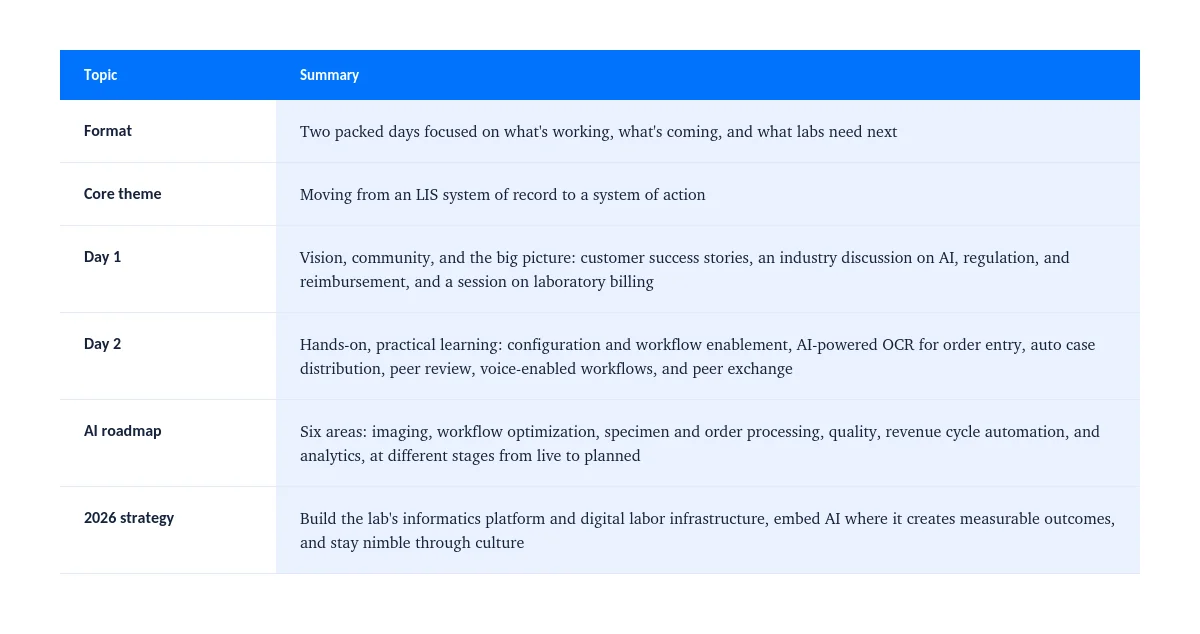
Over two packed days, we focused on what's working, what's coming, and what labs need next.
What Happened on Day 1: Vision, Community, and the Big Picture?
We opened with a theme mentioned earlier: moving from a lab information system of record to an LIS system of action.
From there, we highlighted customer success stories and held an industry-facing discussion on where diagnostics is headed, AI, regulation, and reimbursement realities, alongside partners and leaders shaping the future.
We also dug into our partners' financial engine with a session on laboratory billing, because operational excellence without revenue integrity isn't a strategy; it's a vulnerability.
The day ended the right way: conversations outside the conference room and at an NHL hockey game, building real relationships, and remembering that community is a competitive advantage.
What Happened on Day 2: Hands-On Learning and Peer Exchange?
Day two was built for operators.
Customers dove deep into configuration and workflow enablement, permissions, queues, enhancements, AI-powered optical character recognition (OCR) for order entry, scheduled reporting, auto case distribution, peer review, and voice-enabled workflows.
Then came what I personally value most: peer exchange as labs shared what they've learned, because best practices travel faster when customers teach each other.
We closed with a forward-looking discussion on what's next, what's needed, and how we build it together.
Editor's Note: If you missed out on LigoVerse 2026 and want to reserve your spot for next year's event, contact Jenny Bull (Jenny@LigoLab.com).
Get Insight: Navigating the Future of Pathology - The LigoLab Advantage
What Is LigoLab's 2026 Strategy?
Here's what we're driving in 2026, because the moment demands it.
1) How Is LigoLab Building an Advanced Informatics Platform and Digital Labor Infrastructure?
Staffing shortages and margin compression are not temporary. The "silver tsunami" of retirements and persistent vacancy rates are both forcing a structural change.
Legacy laboratory information systems make this worse by keeping work manual, fragmented, and difficult to automate.
Our strategy is to be the single informatics platform labs rely on: one comprehensive, flexible, automated, interoperable lab information system across technical and financial workflows.
2) Where Does AI Create Measurable Outcomes?
At LigoLab, AI isn't a bolt-on feature or an experiment. Every capability must improve at least one measurable needle:
- Turnaround time.
- Accuracy and error reduction.
- Labor efficiency.
- Revenue integrity.
- Clinical confidence.
If it doesn't move outcomes, it doesn't ship.
3) How Does LigoLab Stay Nimble Through Culture?
Passion. Kaizen. Teamwork. Ownership. Leapfrogging. This is our culture, and that's how we keep engaging with our customers and delivering 30-40 meaningful improvements every month.
The greatest risk is stagnation, and labs don't have time for slow-moving LIS software vendors.
Get Insight: Why “The Safe Move” to a New Version of Legacy LIS Software Is the Wrong Move for Medical Labs

Why Does This Strategy Benefit Customers?
In a market where many laboratory information system vendors are sunsetting products, nickel-and-diming changes, and forcing labs into expensive migrations, our LIS model is different:
- Unified LIS + RCM to remove handoffs and unlock end-to-end automation.
- Flexible configurability so your workflows don't get trapped in rigid software.
- Partnership pricing and risk alignment, because we prosper when you prosper.
- A true LIS system of action that improves collections and reduces denials.
- Continuous innovation that keeps you future-ready instead of stuck in upgrades.
Labs don't just choose LigoLab because it's modern. They choose it because it makes them more capable, operationally, financially, and clinically, without adding complexity.
How Can Labs and LigoLab Build the Future Together?
LigoVerse 2026 reaffirmed that the future of diagnostics belongs to laboratories that can transform complexity into intelligent, scalable systems without compromising quality, compliance, or the people who make it all possible.
LigoVerse exists to foster that kind of progress. It's where we exchange ideas, surface what's working, and collaborate on what needs to evolve next. If something isn't delivering the value it should, we want to hear it. If there's an opportunity to improve it, we're committed to building it together.
Thank you for being the kind of customer who not only partners with us, but also challenges us with real-world insight. That transparency is what drives meaningful innovation.
Continue Your Research
- AI Integration Guide: Best Practices for Preparing Medical Labs for AI Integration in Technical and Financial Operations
- AI in Healthcare: Healthcare AI Has Crossed the Line From Experiment to Infrastructure
- Innovation Approach: A Closer Look at LigoLab's Commitment to Innovation
- Year in Review: LigoLab in 2025: A Year of Innovation, Acceleration, and Transformative Partnerships
Ready to Partner With LigoLab and Transform Complexity Into a Competitive Advantage?
If you're ready, let's keep the conversation going. Schedule a strategy session with our team to explore how LigoLab's all-in-one informatics platform can help you achieve your 2026 and beyond goals.
Don’t Wait: Speak with a LigoLab Product Specialist!
Frequently Asked Questions About LigoVerse 2026 and LigoLab's AI Roadmap
What is LigoVerse?
LigoVerse is LigoLab's customer summit, where the company and its lab partners exchange ideas, surface what's working, and collaborate on what needs to evolve next. LigoVerse 2026 ran over two days and combined keynotes, customer success stories, industry discussion, hands-on workshops, and peer exchange.
What is the difference between a lab information system of record and an LIS system of action?
A lab information system of record is a digital archive for results and documentation. An LIS system of action goes further by actively reducing work, improving outcomes, orchestrating tasks, predicting bottlenecks, surfacing risk, and guiding staff, with AI serving as the intelligence layer that makes the LIS an active operational engine.
Which AI capabilities were live at LigoVerse 2026?
As presented, workflow optimization (balanced case distribution and hands-free result entry) and specimen and order processing (OCR-based order conversion and AI-driven measurement and annotation) were live in production, and analysis and imaging capabilities were available in the Marketplace. Quality review was in beta, and AI-assisted revenue cycle automation and conversational analytics were slated for Q2 2026.
What is LigoLab's 2026 strategy?
The strategy has three priorities: building the lab's informatics platform and digital labor infrastructure as one comprehensive, interoperable LIS across technical and financial workflows, embedding AI only where it creates measurable outcomes, and staying nimble through culture, including delivering 30 to 40 improvements every month.
What standard must a LigoLab AI capability meet?
Every AI capability must improve at least one measurable outcome: turnaround time, accuracy and error reduction, labor efficiency, revenue integrity, or clinical confidence. If it doesn't move outcomes, it doesn't ship.
Is LigoLab's roadmap right for every lab?
Not necessarily. Verify a vendor recap by asking which features are in production today, requesting references, and confirming current status. Labs with fragmented data or unreliable workflows may benefit more from unifying systems first, and labs not ready for AI may still gain most of the benefit from core automation.