Blog
Seamless Diagnosis Mapping: Why LigoLab’s ModMed Integration Matters for Dermatopathology

February 25, 2026
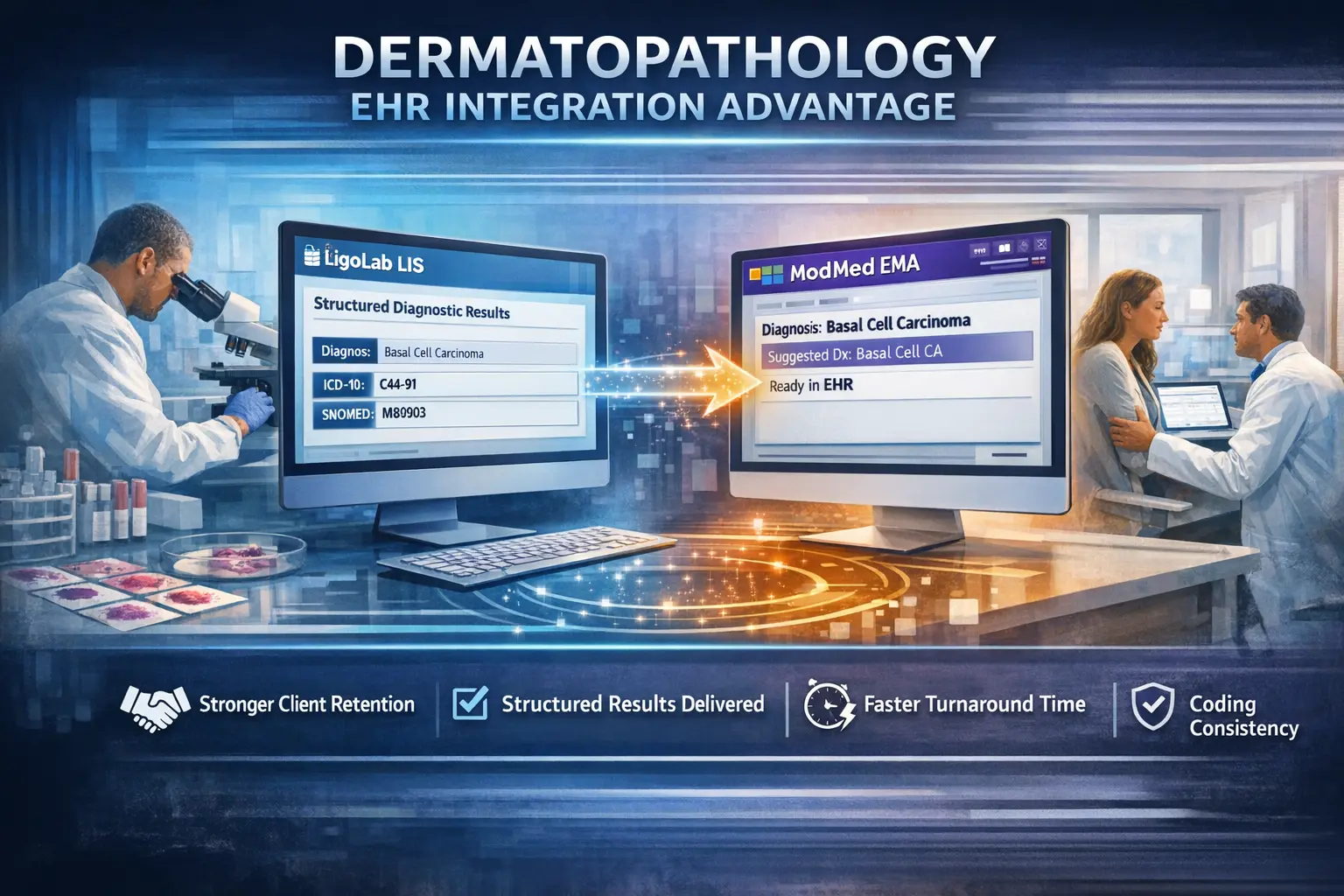
Dermatopathology is one of the highest-volume and operationally intense subspecialties in anatomic pathology. Dermatology practices move fast. They expect structured results, clean coding, and zero friction inside their electronic health record (EHR). When that expectation is not met, they notice.
For laboratories serving practices on ModMed’s Electronic Medical Assistant (EMA) platform, integration is not a technical checkbox. It is a competitive moat.
When diagnosis macros inside LigoLab’s all-in-one laboratory information system (LIS) automatically map to ModMed’s internal suggested diagnosis structure, the experience for the dermatology practice becomes seamless. Results arrive structured, searchable, and workflow-ready. No re-entry. No ambiguity. No missing fields.
That kind of alignment creates more than efficiency.
It creates loyalty.
Dermatology groups rarely leave a lab that fits cleanly into their daily workflow. If switching labs means losing structured EHR convenience, reintroducing manual steps, or disrupting coding consistency, inertia works in your favor.
With LigoLab’s ModMed integration, labs gain:
- Stickier dermatology clients who are less likely to churn
- Reduced onboarding friction for new derm accounts
- Fewer client-side support calls about missing diagnosis fields
- Stronger coding consistency between LIS and EHR
- A differentiated value proposition when competing for derm groups
- Faster turnaround perception because results “just work” inside EMA
- A measurable operational advantage that sales teams can articulate
This is not just interoperability. It is a strategic alignment between the laboratory and the clinic.
In dermatopathology, where volume is high and workflows are standardized, the lab that integrates best often wins and keeps the business.
Just as importantly, LigoLab has engineered a seamless cloud-based connection to ModMed’s EMA, eliminating the traditional friction associated with EHR integrations. Labs can now connect to dermatology practices on EMA up to five times faster than with conventional interface builds.
Instead of lengthy custom development cycles, the integration framework is already structured, tested, and deployment-ready. Even better, onboarding additional clients on the same EHR does not create incremental interface costs. Once the connection architecture is established, scale becomes simple. For high-growth dermatopathology labs, that means faster account activation, lower technical overhead, predictable economics, and the ability to pursue derm groups aggressively without worrying about integration drag.
But to fully appreciate why this integration is so powerful, it is important to understand the environment on the other side of the connection.
The competitive advantage does not come from integration alone. It comes from integrating intelligently into a system that was purpose-built for dermatology.
To see why structured diagnosis mapping and workflow alignment matter so much, we need to look at how ModMed’s EMA platform is designed, how dermatologists use it every day, and why its internal diagnostic architecture plays such a central role in clinical efficiency.
Once you understand how EMA functions inside a dermatology practice, it becomes clear why LigoLab’s alignment with that structure is strategically decisive.
Discover More: The New Era of Laboratory Informatics - From Manual Tasks to Sustained Success
ModMed and EMA: A Dermatology-Focused Cloud EHR
ModMed’s EMA is a cloud-native electronic health record system purpose-built for specialty practices, with dermatology as one of its core focus areas. Rather than adapting a general EHR to fit specialty needs, EMA was developed specifically to support dermatology’s distinct clinical workflows, procedural requirements, and documentation nuances.
As a result, clinical charting, procedure coding, billing processes, and reporting capabilities are all tailored to the specialty, supporting features such as lesion mapping, specialty-specific templates, and streamlined receipt of histopathology results.
ModMed provides both standard and enhanced interface options. In the enhanced configuration, patient chart PDFs can accompany incoming orders, and a structured diagnosis can be transmitted back with the pathology result within a designated HL7 segment.
Like most advanced EHR systems, EMA depends on structured diagnostic identifiers. In addition to standard ICD codes, ModMed maintains its own internal diagnostic code, commonly referred to by interface engineers as the “suggested diagnosis.”
This suggested diagnosis is broader and less granular than ICD, functioning as a shorthand clinical classification within the ModMed environment. If it is not included, physicians still see the complete free-text diagnosis; however, the added structured convenience layer in the EHR is lost.
This is precisely where LigoLab’s integration delivers meaningful value.
Industry Insights: Best LIS Systems in 2026 - Top Laboratory Information Systems Compared for Clinical, Pathology, and Outreach Labs
Understanding Diagnosis Macros in Dermatopathology
In dermatopathology, many cases involve familiar diagnoses, such as actinic keratosis and basal cell carcinoma. Manually retyping the same diagnostic language and corresponding codes for each case slows productivity and increases the risk of mistakes. Diagnosis macros remove that repetition, streamlining documentation while promoting speed, accuracy, and consistency.
As LigoLab Product Manager Allison Still explained in a recent conversation, a diagnosis macro is essentially a preconfigured template for a final diagnosis. A pathologist may type a short code, just a few characters, and the lab information system automatically expands it into:
- The pathologist’s preferred final diagnosis language
- A microscopic description summary
- Textual comments
- Associated ICD codes
- Associated CPT procedure codes
- A ModMed-specific diagnosis code
This macro logic dramatically accelerates reporting and maintains consistency from case to case.
Within LigoLab’s LIS system, once a macro is applied, the expanded text is no longer linked to the template; it becomes part of the case narrative. This ensures that any subsequent edits on a per-case basis do not change the underlying template.
Get Insight: Essential Anatomic Pathology LIS Software Features to Optimize Laboratory Workflow
What Happens Without Integration?
Without structured integration to the EHR:
- The pathology report may be transmitted as free text
- The EHR may receive only a PDF without structured data
- The ModMed suggested diagnosis field may remain blank
- Internal EHR diagnosis codes may not receive proper linkage
- Staff at client practices may need to re-enter diagnoses
- Coding mismatches between laboratory software systems can occur
If the suggested diagnosis is missing, the physician still sees the full diagnosis text, but the streamlined, shorthand classification inside EMA is not populated.
For high-volume derm path labs, that absence creates subtle inefficiencies and reduces the structured power of the EHR workflow.
Discover More: Six Factors That Should Be Considered Before Upgrading Your Lab's Pathology Reporting Software
How LigoLab’s Integration Addresses This
LigoLab’s ModMed integration ensures the EHR receives structured diagnostic information, including the internal suggested diagnosis linked directly to the diagnosis macro.
Here’s what happens:
- A dermatopathologist signs out a case in LigoLab using a macro.
- The LIS system expands the macro into full diagnostic text and linked coding elements.
- A custom data field embedded in the macro stores the ModMed suggested diagnosis code.
- When LigoLab transmits the result to EMA via HL7, the suggested diagnosis is sent back in the specific HL7 segment required by ModMed’s enhanced interface.
- EMA receives a fully structured result aligned with its internal diagnostic schema.
The result is a structured clinical message that supports ModMed’s internal workflow logic.
And critically, this process is invisible to the pathologist. They do not need to think about ModMed’s coding structure. The macro configuration handles it automatically.
It’s automation working under the hood, saving time and protecting data integrity.
White Paper: Vendor to Partner - How Aligning with Your LIS System Provider Can Transform Your Lab
Orders In, Results Out, Cleanly and Efficiently
In a standard bidirectional interface between LigoLab and ModMed:
- Orders flow from the EHR into the LIS system
- Results flow back into the EHR with full structured coding and suggested diagnosis
In ModMed’s enhanced model, chart PDFs can accompany orders, and structured suggested diagnosis data returns with the result. Because LigoLab embeds the suggested diagnosis directly into the macro configuration, a tightly structured diagnostic data set is transmitted to EMA.
That means:
- Dermatologists see results in the correct structured context
- The suggested diagnosis field is populated automatically
- There is less manual interpretation
- Clinical documentation remains clean and standardized
The suggested diagnosis does not replace ICD codes; it complements them inside ModMed’s ecosystem. It acts as a shorthand classification layer that makes the clinician’s life easier.
By supporting this structure, LigoLab enables its clients to enhance support for their clients.
Get Insight: Overcoming LIS System Integration Challenges - How Advanced Platforms Like LigoLab Simplify the Transition
Protecting Clinical and Coding Integrity
Beyond workflow simplicity, this integration also reinforces coding accuracy.
When a macro encapsulates all linked coding elements, including ICD, CPT, and ModMed’s suggested diagnosis, data flows consistently between systems. This consistency:
- Reduces the risk of mismatches between systems
- Ensures alignment between diagnostic language and coded data
- Supports downstream clinical and financial workflows
- Minimizes avoidable reconciliation work
Cleaner data flow means stronger operational integrity across the lab-to-clinic continuum.
Discover More: Keys to Providing Premier Pathology Client Services - How Advanced Laboratory Information Systems Set the Standard
Configurable, Yet Supported
LigoLab empowers clients to configure their own macros, including linked elements such as ICD, CPT, and ModMed codes. While ModMed’s diagnosis codes tend to be universal rather than client-specific, the system is flexible enough to accommodate custom variations if they do occur.
Product experts describe implementation as fast and straightforward, supported by comprehensive interface testing before go-live. As a result, dermatopathology laboratories can deploy the integration efficiently without placing heavy demands on internal IT resources.
Industry Insights: How Modern LIS Systems Empower Labs Through Configurable Reporting, Seamless Integration, and True Partnership
A Simpler Day for the Dermatopathologist
At its core, this integration changes the daily experience for the dermatopathologist in one meaningful way:
Dermatopathologists focus on diagnosis, not data management.
They continue using familiar LigoLab macros to do what they do best, and the LIS system’s automation translates that work into structured data that ModMed’s EMA EHR can immediately consume.
In a specialty where precision and speed must coexist, that’s a significant advantage.
Discover More: Unleashing Laboratory Excellence: Here’s How LigoLab’s Automation Engine Supercharges Lab Performance
Interoperability as a Competitive Strength
Finally, it’s worth noting that the value of this integration extends beyond ModMed alone. The capability to embed structured, custom data elements within macros and transmit them reliably is a testament to LigoLab’s broader interoperability expertise.
For dermatopathology labs evaluating LIS software vendors, this level of integration maturity signals a platform that is built not just for internal workflow optimization, but for real, clinical collaboration across systems.
Get Insight: LigoLab Delivers the LIS System Interoperability Needed to Transform Medical Laboratories into Thriving Businesses
Precision, Efficiency, and Interoperability
For dermatopathology laboratories serving dermatology practices that use ModMed’s cloud-based EHR, LigoLab’s automated diagnosis macro mapping delivers:
- Faster reporting with fewer manual steps
- Higher fidelity data transmission
- Automatic population of ModMed’s suggested diagnosis field
- Consistent alignment between diagnostic language and coded outcomes
- Seamless integration with the clinical EHR environment
In an era where data accuracy drives both clinical outcomes and operational success, this integration is a differentiator.
Ready to Streamline Your Derm Path Workflow?
If your dermatopathology lab supports practices using ModMed’s EHR, it’s time to eliminate manual steps and elevate interoperability.
See how LigoLab’s automated diagnosis macro mapping streamlines reporting, enhances coding precision, and delivers a fully integrated LIS–EHR experience.
Act Now: Schedule a Personalized Demo Today!