Industry Insights
Why LIS And RCM Integration Is A Laboratory Survival Imperative

August 20, 2026
Introduction
Most laboratories run two systems. The laboratory information system (LIS) owns the specimen. The laboratory billing system owns the claim. Between them sits an interface, a nightly file, an HL7 feed, a spreadsheet somebody maintains, and a quiet assumption that whatever leaves one system arrives intact in the other.
It usually does. What does not survive the trip is context. The lab information system knows the ordering provider, the requisition, the diagnosis codes the physician actually wrote, the ABN that was or was not signed, the specimen that was recollected, the test that reflexed. The lab billing system knows the payer's answer. Neither knows both. An interface moves data. It does not move understanding.
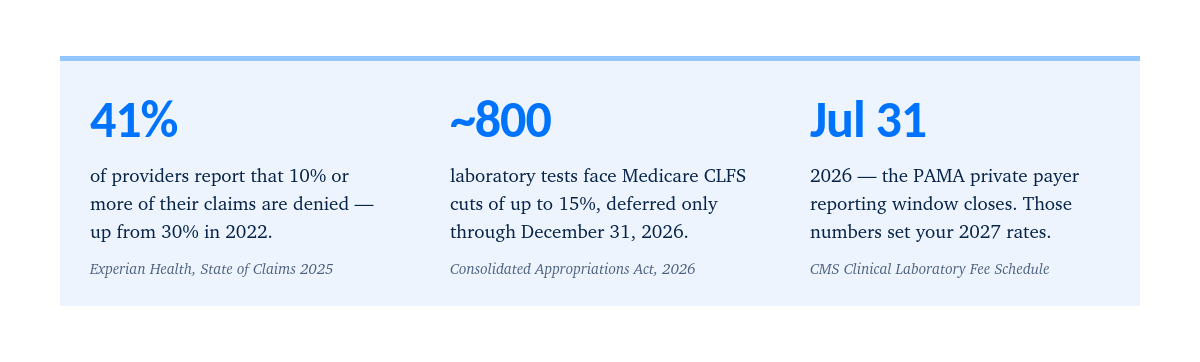
That gap has a price, and in 2026 it is compounding. Denial rates are climbing across every provider segment. Medicare laboratory rate cuts have been deferred, not cancelled. The private payer data that will set your 2027 Clinical Laboratory Fee Schedule rates is being reported to CMS this summer.
Laboratories running an integrated operation will absorb all of this. Laboratories running two systems and an interface will discover, one denial at a time, exactly what the seam costs.
This eBrief makes a specific argument: the boundary between laboratory operations and the revenue cycle is not a workflow problem to be managed better. It’s an architectural problem to be eliminated.
The Interface Tax
Every laboratory running a separate LIS and lab billing system pays a tax. It seldom appears as a line item.
Unbilled Accessions
Tests performed, resulted, and reported that never became a claim. Nobody owns the reconciliation between completed accessions and submitted claims, because neither system can see both numbers.
Missing Context Denials
The claim is coded correctly but denied anyway because the payer wanted a diagnosis supporting medical necessity and the requisition carried a screening code. The fix lives in the LIS. The denial lives in the billing system.
Silent Desynchronization
Test catalogs, CPT mappings, fee schedules, and payer rules are maintained twice. A stale CPT mapping does not throw an error; it produces a clean-looking claim that’s wrong.
Latency
A claim edit discovered in billing takes weeks to become an order-entry rule in the LIS, if it ever does. Meanwhile, the lab keeps manufacturing the same defect.
Rework Economics
Commonly cited industry estimates put the rework cost of one denied claim between $25 and $181, and a large share are never reworked at all. Rework is not recovery; it’s paying twice for revenue you already earned.
These are not billing department problems. They are architectural consequences that happen to land in the billing department.
What a Single Database Changes
An outdated, non-integrated LIS is not an asset. It’s a liability. When anatomic pathology, clinical, molecular, and revenue cycle share one database, the questions change:
Charge capture stops being a transfer and becomes a state. An accession without a claim is a query, not a project.
Coding rules run where the order is placed. NCCI procedure-to-procedure edits, medically unlikely edits, panel arithmetic, and payer LCD frequency limits fire at accessioning, while the specimen is still on the bench and the ordering provider is still reachable.
Eligibility, benefits, and prior authorization resolve before the test runs, not after the remittance arrives.
Denials return to their origin. A CARC code on an 835 maps back to a requisition, a client, an ordering provider, and a test, and becomes a rule rather than a memo.
One source of truth means one number in the board deck. Net collection rate, cost to collect, and days in A/R reconcile to specimen volume without a spreadsheet in between.

Closing the Loop Between the Remittance and the Requisition
The most valuable revenue cycle data in your laboratory is sitting in your remittance files, and in most labs it never travels upstream.
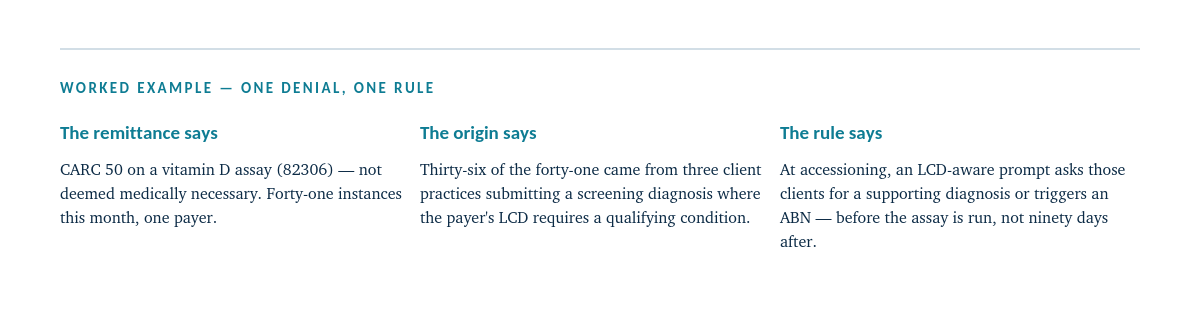
Payers tell you precisely what is wrong. CARC and RARC codes on every 835 identify the defect at the claim line: the diagnosis did not support medical necessity, units exceeded the MUE, the panel was unbundled, a frequency limit was hit, the patient was not eligible on the date of service, the filing window closed.
That is a defect log written by your payer, at no cost to you. In a two-system laboratory, it reaches the people who could act on it as a monthly summary, filtered through a human, weeks late, if it reaches them at all.
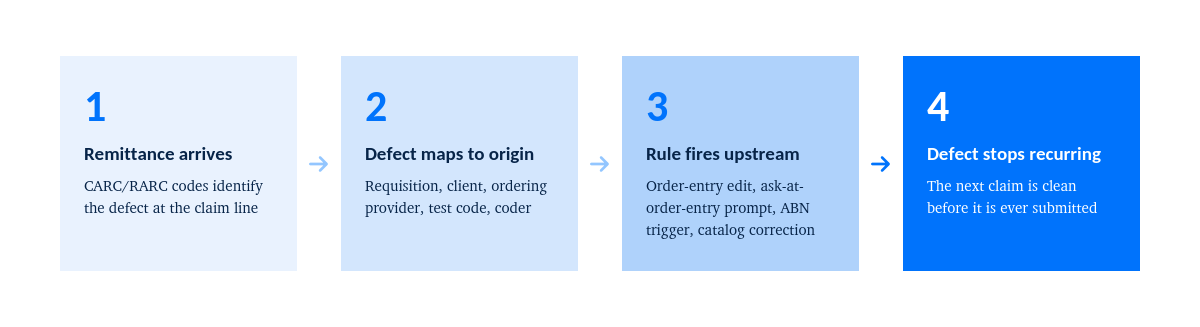
The difference between denial management and denial prevention is whether step 3 is a software change or a staff meeting.
Prevention Happens at Accessioning, Not Appeal
By the time a claim is denied, the laboratory has already spent the reagent, the instrument time, the pathologist's attention, and the courier run. Every dollar spent after that point defends revenue rather than creating it.
The economics are not close. Industry analyses consistently find that a majority of appealed denials are ultimately overturned and paid, meaning most denied claims were payable all along, and the appeal is pure waste recovering money you had already earned. A large share is never appealed at all. Those become permanent write-offs.
Every intervention point that actually matters sits upstream, inside the LIS:
- Eligibility and benefits verified at order, not at billing.
- Medical necessity checked against the payer's LCD before the specimen is processed.
- ABN presented at collection, while the patient is present and the conversation is still possible.
- Diagnosis specificity enforced at order entry, where the ordering provider can still be asked.
- Panel and unbundling logic applied to the order, not to the claim.
- CLIA number, place of service, and rendering NPI validated once, structurally.
A billing system cannot do any of this. It arrives too late by design.
AI Proposes. Credentialed Humans Certify.
Autonomous coding is being sold hard right now, and laboratory leaders should be precise about what they are buying.
When a claim goes out, the laboratory certifies it. Not the vendor, and not the model. The signature and the liability are yours. A system that assigns CPT and ICD-10 codes without a reviewable human decision does not transfer that risk. It conceals it.
This is not an argument against AI in the revenue cycle. It’s an argument about where AI belongs:
- AI should propose codes, flag likely denials, and rank work queues, surfacing judgment, not replacing it.
- Every assignment should be attributable: what proposed it, who reviewed it, what changed, and when.
- Model output should be continuously measured against paid outcomes, not validated once during a sales cycle.
- Domain rules - NCCI, MUE, LCD coverage, quarterly PLA updates, MolDX policy - belong in deterministic, auditable logic, not inferred probabilistically.
A convincing demo is not a deployment. A laboratory information system is a regulated instrument of record that has to be right on the worst day of the year, under audit, with a payer's counsel reading the log.
The Margin Math Is Already Set. What Is Left Is Cost to Collect.
Laboratory reimbursement is not going up.
Under PAMA, Congress has now intervened repeatedly to postpone the Medicare Clinical Laboratory Fee Schedule reckoning; as of February 2026, there had been seven delays to the reporting periods and six to the cuts themselves.
The Consolidated Appropriations Act, 2026, signed February 3, 2026, deferred reductions of up to 15% on roughly 800 tests through December 31, 2026, and moved the private payer data collection period to January 1 – June 30, 2025.
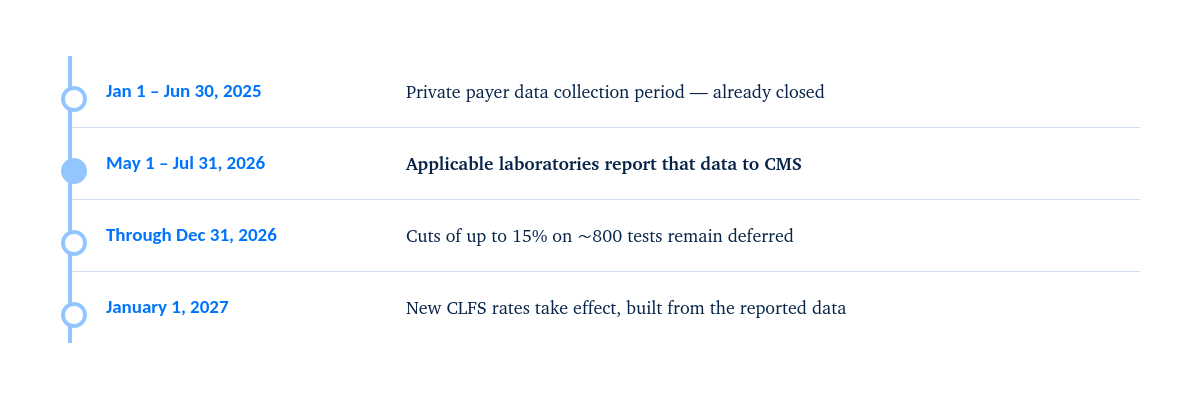
First, the reporting requirement is itself an integration test. Applicable laboratories must report private payer paid amounts and associated volumes by HCPCS code, tied to an NPI. If your remittance data lives in one vendor's system and your test catalog lives in another's, that submission is manual archaeology performed under the threat of civil monetary penalties for misreporting. A laboratory on a single platform runs a query.
Second, the rate is now a fact you no longer control. It is being computed from transactions you already completed. The only variables still in your hands are net collection rate, cost to collect, and first-pass yield, and all three are functions of how much of your revenue cycle happens before the specimen is processed rather than after the denial arrives.

A Leadership Call to Action
The instinct, when denials rise, is to add people to the billing department. It’s the wrong reflex. Adding capacity to the end of a defective process buys throughput on rework and changes nothing upstream.
Laboratory leaders, medical directors, COOs, CFOs, and practice administrators should be asking a harder set of questions:
- How many accessions did we complete last month, and how many claims did we submit? Can anyone produce both numbers from one system?
- What are our top five denial reasons by dollar, and which order-entry rule now prevents each one?
- How long does it take for a payer policy change to become a rule that fires at accessioning?
- When an auditor asks who assigned this code and on what basis, can we answer in one query?
- What is our cost to collect per accession, and is it trending with volume or with headcount?
If answering those questions requires three systems, two vendors, and a week, the architecture is why the margin is thin.
The laboratories still operating profitably in 2028 will be the ones that stopped treating billing as a downstream department and started treating revenue as a property of the specimen, attached at accessioning, carried through resulting, and closed at remittance, inside one system of record.

How LigoLab Helps
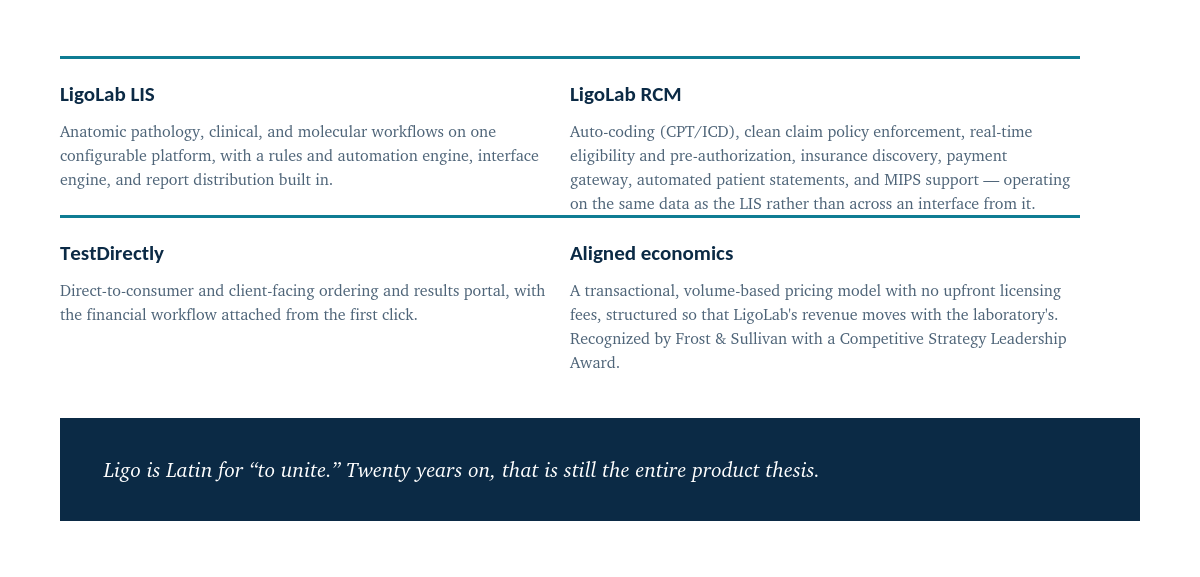
LigoLab was built in 2006 around a single premise: one platform, one database, one source of truth, covering the complete life cycle of a specimen from order entry to remittance.
Sources
CMS — Clinical Laboratory Fee Schedule
cms.gov/medicare/payment/fee-schedules/clinical-laboratory-fee-schedule-clfs
College of American Pathologists — PAMA for Laboratories
cap.org/advocacy/laboratory-oversight-and-regulation/protecting-access-to-medicare-act-for-laboratories
ASCP — Medicare Laboratory Payment Cuts Averted for 2026
ascp.org/news/news-details/2026/02/09/medicare-laboratory-payment-cuts-averted-for-2026
Experian Health — State of Claims 2025
experian.com/blogs/healthcare/state-of-claims-2025/
Experian plc — 3rd Annual State of Claims Survey (Sept 22, 2025)
experianplc.com/newsroom/press-releases/2025/experian-health-s-3rd-annual-state-of-claims-survey-finds-denial
Michigan Health & Hospital Association — CLFS Data Reporting Period Opens May 1
mha.org/newsroom/clinical-laboratory-fee-schedule-data-reporting-period-opens-may-1/
Blue & Co. — New PAMA Reporting Window Announced
blueandco.com/new-pama-reporting-window-announced/
LigoLab — The Power of Integration
ligolab.com/post/the-power-of-integration-unleashing-the-potential-of-ligolabs-lis-lab-rcm-system
LigoLab — Reduce Denials and Increase Your Lab's Revenue
ligolab.com/post/reduce-denials-and-increase-your-labs-revenue-and-net-collections
Author Bio
Suren Avunjian
Co-Founder & CEO, LigoLab Information Systems
Suren Avunjian co-founded LigoLab in 2006 with Edward Kharatian. Both had previously worked at a California laboratory that became the state’s largest privately held lab before being acquired by LabCorp, giving them firsthand insight into how integrated technology can transform a laboratory’s operational and financial performance.
That became LigoLab's founding thesis: a laboratory should run on one platform, not a federation of interfaced systems. He leads the company from Glendale, California, serving clinical laboratories and pathology practices nationwide.
Act Now: Request a demo and see the platform your billing department is currently emulating with spreadsheets.