Industry Insights
What Labs Get Wrong About Laboratory Billing: How High-Performing Labs Prevent Denials Before They Happen

September 2, 2026

Laboratories spend enormous amounts of time, energy, and money trying to improve collections, reduce claim denials, and accelerate reimbursement. Yet many continue to approach laboratory revenue cycle management (RCM) from the wrong direction.
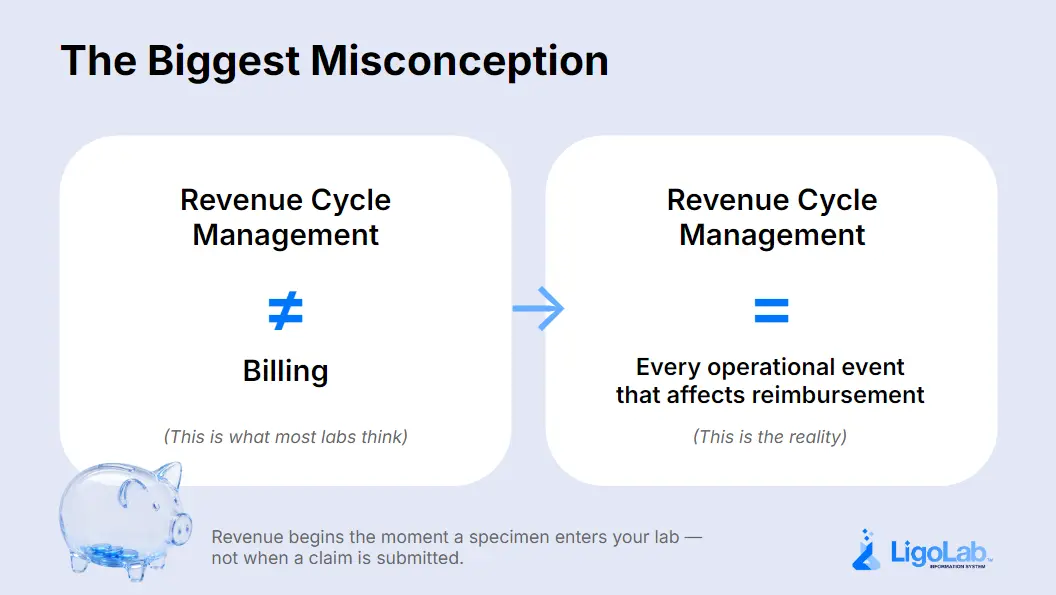
At the heart of this approach is one of the industry’s most persistent misconceptions: revenue cycle management is not the same as laboratory billing.
Laboratory billing is an important part of RCM, but the revenue cycle begins much earlier. In reality, it starts the moment a specimen enters the laboratory, because every operational event that follows, from patient registration and eligibility verification to testing, documentation, coding, and charge capture, can ultimately affect reimbursement.
Recognizing this changes the conversation around denial prevention. Instead of asking, “How can we manage denials more efficiently?” high-performing laboratories are asking a more important question: “How can we prevent the workflow and data issues that cause denials in the first place?”
Increasingly, the answer is to connect laboratory information system (LIS) workflows directly with laboratory billing and the RCM process. By bringing clinical, operational, and financial data together, laboratories can identify revenue risks earlier, address problems closer to their source, and protect revenue integrity before a claim ever reaches the payer.
In this Industry Insights article, we’ll examine the most common misconceptions that contribute to revenue leakage and explore what today’s high-performing laboratories are doing differently to prevent denials, protect reimbursement, and strengthen financial performance.
Case Study: In-House vs. Outsourced Laboratory Billing – Navigating the Best Path Forward for Your Lab
Misconception #1: Laboratory Revenue Cycle Management Starts With Billing
The traditional view of laboratory billing is relatively straightforward: perform the test, generate the claim, submit it to the payer, collect the payment, and work any denials that follow.
But that model overlooks everything that happens before claim creation.
Consider the amount of information generated and processed before a laboratory ever submits a claim:
- Patient demographics and insurance information
- Eligibility verification
- Test orders
- Medical necessity documentation
- ICD-10 diagnosis codes
- CPT codes and modifiers
- Specimen and procedure information
- Payer-specific requirements
- Laboratory workflow events
- Charge capture
Each of these can influence whether a laboratory ultimately gets paid.
That's why modern laboratory revenue cycle management needs to extend upstream into the operational workflow. When LIS systems and lab RCM platforms operate separately, information can break down between them, creating errors, missed charges, delayed payments, and revenue leakage long before the billing department sees a claim.
A laboratory may have an excellent billing team, but that team can only work with the information it receives.
Misconception #2: Denials Are Primarily a Billing Department Problem
A denial appears on the financial side of the organization, so it is natural to treat it as a laboratory billing problem. But the denial itself is often only the visible symptom of something that happened earlier.
The underlying cause might be non-verified insurance eligibility during accessioning, incomplete documentation, incorrect or missing codes, CPT modifier errors, payer-rule violations, or a workflow break between disparate laboratory software systems.
Look across the entire revenue cycle, and the number of potential leakage points becomes obvious.
- Patient Registration: Incorrect demographics, eligibility errors, or the wrong payer can create downstream billing problems.
- Medical Necessity Review: Missing documentation or unsupported ICD-10 codes can jeopardize reimbursement.
- Coding: Incorrect CPT codes, missing modifiers, or undercoding can lead to lost revenue and compliance risks.
- Claim Submission: NCCI edit failures, payer-rule violations, or duplicate claims can result in rejections or denials.
Even after adjudication, underpayments, denials, and inadequate A/R follow-up can prevent the laboratory from collecting what it earned.
The important lesson is that the laboratory billing team often encounters a problem only after the opportunity to prevent it has passed.
Industry Insights: Best Laboratory Billing Software Solutions - A Complete Comparison for Clinical, Pathology, and Outreach Labs
Misconception #3: Effective Denial Management Means Getting Better at Working Denials
Denial management remains essential, requiring laboratories to efficiently identify, correct, appeal, and resubmit denied claims.
But an RCM strategy centered primarily on working denials is inherently reactive.
The conventional process looks something like this:
Denial → manual investigation → claim correction → resubmission → wait for payment.
Every step consumes time and labor while delaying cash flow.
The alternative is to design laboratory workflows that catch problems before the claim leaves the organization.
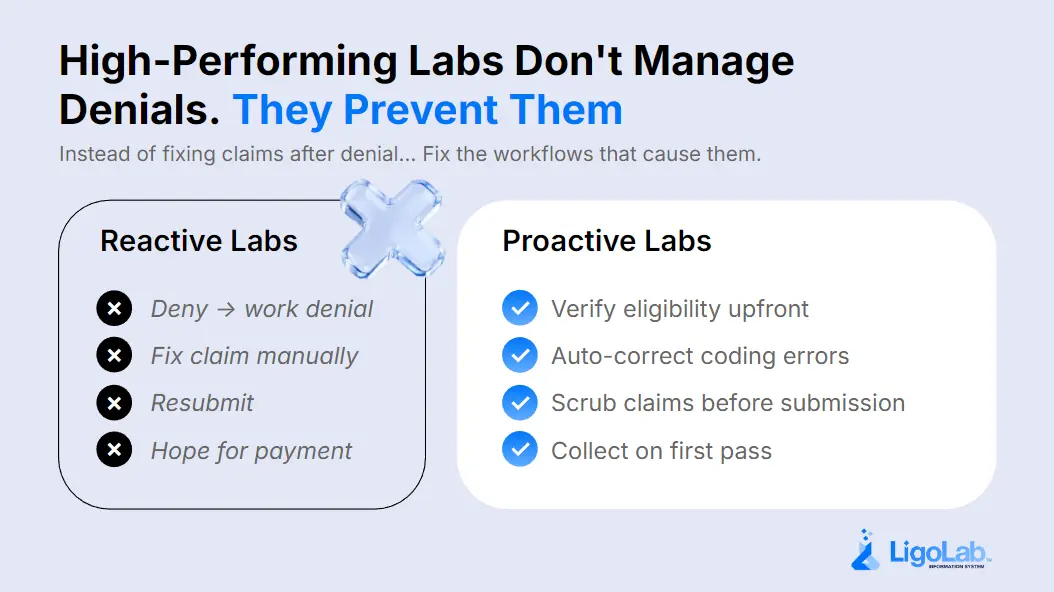
This is the fundamental difference between reactive and proactive laboratories. Reactive labs work denials, manually correct claims, resubmit them, and wait for payment. Proactive labs verify eligibility upfront, automatically correct coding errors, scrub claims before submission, and pursue first-pass collection.
This represents a much larger shift in thinking:
High-performing laboratories don't simply manage denials. They prevent them.
Misconception #4: The Laboratory Billing System Has Everything It Needs
Another common misconception is that once data reaches the laboratory billing stage, the system has what it needs to produce a clean claim.
Not necessarily.
Billing only knows what the laboratory information system knows, and what the LIS successfully passes downstream.
If critical information is missing, incorrect, incomplete, or lost during a handoff between systems, the laboratory billing application can’t magically recreate it.
The LIS captures operational data, the billing system sees what the LIS passes along, and the resulting payment reflects those upstream decisions.
This is a major weakness of disconnected LIS and laboratory billing environments.
Every interface, database, reconciliation process, and manual handoff creates another place where information can become delayed, inconsistent, incomplete, or lost.
Discover More: Six Reasons Why You Should Choose an Integrated Laboratory Billing Solution for Your Medical Lab
Misconception #5: Laboratory Billing Software Only Needs Visibility Into Claims
Traditional laboratory billing software tends to focus on financial transactions such as claims, payments, adjustments, and write-offs.
Those are obviously important. But by the time they appear, much of the laboratory workflow that determined the financial outcome has already occurred.
Modern lab RCM requires broader visibility.
A unified platform connects orders, testing, workflows, operations, and revenue, giving financial teams greater visibility into critical information that would otherwise remain isolated within the LIS.
Why does that matter?
For example, a test may be completed but never billed. A traditional laboratory billing system can identify that no claim exists, but, without visibility into the LIS workflow, it may not recognize that the completed test should have generated a charge and claim.
Or suppose a claim was coded correctly but denied because the diagnosis supplied with the original order did not support medical necessity. The financial problem appears in billing, but the information needed to prevent it originated upstream.
The more of the operational workflow the RCM process can see, the more opportunities a laboratory has to protect revenue.
Integrated LIS and RCM: Creating One Source of Truth
This is where an integrated laboratory information system and laboratory revenue cycle management platform changes the equation.
Instead of maintaining separate clinical and financial databases that must constantly exchange and reconcile information, an integrated LIS and RCM architecture creates a shared data environment.
This LIS model and RCM solution is built around five concepts:
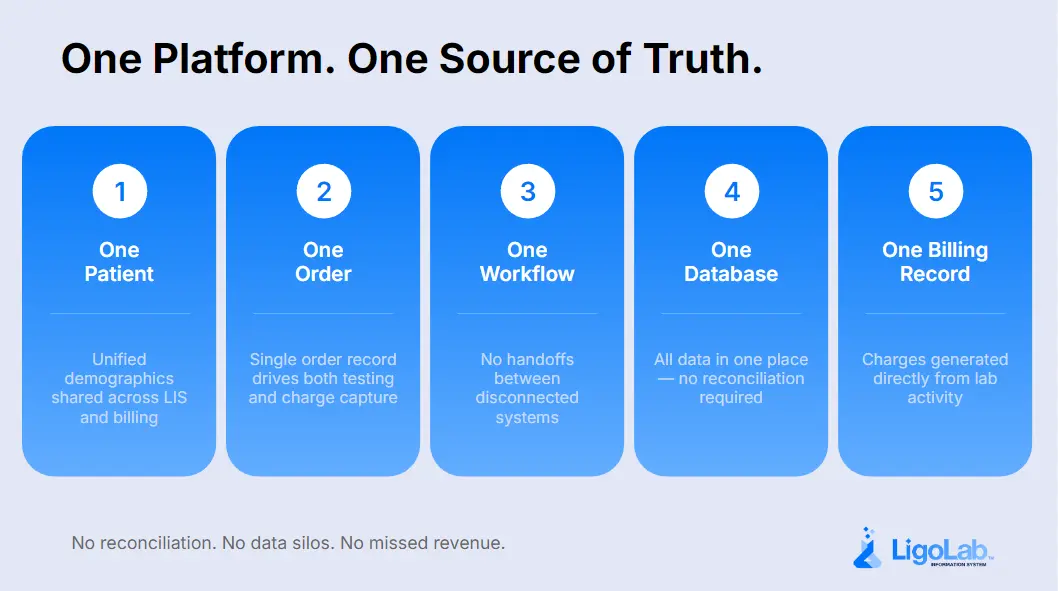
One patient. One order. One workflow. One database. One billing record.
Patient demographics are shared across LIS and billing. A single order drives both testing and charge capture. Workflow handoffs between disconnected systems are eliminated. Data resides in one environment, reducing reconciliation. Charges can be generated directly from laboratory activity.
This creates what we at LigoLab call One Source of Truth.
For laboratory billing, the significance is substantial. Clinical activity and financial activity no longer have to be treated as separate processes connected only after testing is complete.
Discover More: What Are the Best Software Solutions for Laboratory Billing?
Automation Moves Denial Prevention Upstream
Integration creates visibility. Automation makes that visibility actionable.
Every automated check performed before claim submission represents an opportunity to stop a revenue leak before it happens.
Here are several examples of how automation can protect laboratory revenue:
- Eligibility Verification: Confirms insurance coverage at the time of order, before testing begins.
- Automated Coding: Uses diagnosis and procedure data to support accurate CPT and ICD-10 code assignment.
- OCR Capture: Digitizes requisition data, reducing manual entry and errors.
- NCCI Edits: Identifies MUE and PTP bundling issues before claim submission.
- Modifier Automation: Automatically applies appropriate modifiers based on payer requirements.
- Claim Scrubbing: Flags potential errors and inconsistencies before claims reach the payer.
- Payer Rules Engines: Enforces payer-specific billing requirements throughout the claim submission process.
The goal is to place controls where an error can still be prevented. That's a fundamentally different strategy from discovering the problem weeks later when a payer returns a denial.
Discover More: LigoLab Partners with MarginLogic Health AI to Deliver AI-Powered OCR for Laboratories
What High-Performing Laboratories Are Doing Differently
The strongest laboratory revenue cycle management operations are increasingly moving from downstream correction to upstream prevention.
Rather than viewing the LIS as a clinical system and laboratory billing software as a financial system, they recognize that the two workflows are intrinsically connected.
A demographic error made during accessioning can become a billing problem.
A missing diagnosis can become a medical necessity denial.
An undocumented procedure can become lost revenue.
A coding mistake can become an audit risk.
A missed workflow step can become a missed charge.
For this reason, high-performing laboratories are designing controls across the entire workflow instead of concentrating them at claim submission.
Discover More: Blueprint for Success - Building a Strong Financial Foundation Through Effective RCM Implementation
Real-Time Revenue Intelligence Changes the Management Model
Preventing revenue leakage also requires knowing where problems are happening while there is still time to act.
Traditional reporting can tell laboratory leaders what happened last month.
Modern laboratory revenue cycle management should help them understand what is happening now.
An integrated LIS and RCM platform can give leadership visibility into questions such as:
What wasn't billed?
What wasn't paid?
Which payer is underperforming?
Which CPT code is generating the most denials?
Which workflow is creating delays?
What does current A/R aging look like?
Where is revenue coming from by client or provider?
This transforms laboratory analytics from retrospective reporting into operational intelligence.
Instead of discovering a pattern of missed charges or denials weeks or months later, laboratories can identify the underlying issue and intervene much earlier.
Discover More: AI in Laboratory Billing - Real-Time Impact on Revenue Cycle Performance
Laboratory RCM Automation Is Already Producing Results
This approach isn't theoretical.
Here’s a fiscal-year 2026 customer example illustrating the impact of automation.
For demographics workflows, the customer moved from an average turnaround time of five days to one day, with 35% of the work completed through automation and easier scalability.
Automating demographic capture, coding, and claim submission workflows contributed to an approximately $1.6 million increase in net collections within a single month, enabled rapid scaling as claim volumes grew, and reduced billing processing time from hours to minutes.
These results demonstrate an important point: laboratory RCM improvement isn't simply squeezing more productivity from billing personnel. It's redesigning the workflow, so fewer problems require manual intervention in the first place.
Discover More: Boosting Laboratory Revenue with Billing & Coding Automation
The Future of Laboratory Billing Is Integrated
Modern laboratories are becoming increasingly complex.
Anatomic pathology, clinical laboratory testing, molecular diagnostics, digital pathology, artificial intelligence, automation, EHR connectivity, and sophisticated payer requirements all generate and depend on enormous amounts of interconnected data.
Treating laboratory billing as an isolated downstream function makes less sense in this environment.
The stronger model is an integrated informatics architecture in which the laboratory information system, RCM, analytics, automation, AI, digital pathology, and interoperability work together.
For laboratory leaders evaluating their current technology stack, the question should therefore go beyond:
"How good is our laboratory billing software?"
And instead be:
“Can our technology identify and prevent the operational problems that eventually become financial problems?”
That is the difference between managing the revenue cycle after the fact and protecting revenue from the beginning.
Stop Managing Denials. Start Preventing Them.
Modern laboratory revenue cycle management starts upstream, supported by integration and automation. Learn more by contacting LigoLab and requesting an introductory call with a product specialist.
Contact Us: Speak with a LigoLab Product Specialist!
Frequently Asked Questions About Laboratory Billing and Lab Revenue Cycle Management
What is laboratory revenue cycle management?
Laboratory revenue cycle management encompasses the processes that influence reimbursement from the beginning of the laboratory workflow through final payment. It extends beyond claim submission and payment posting to include patient demographics, eligibility, medical necessity, documentation, coding, charge capture, payer rules, claim scrubbing, denials, payments, and accounts receivable.
What is the difference between laboratory billing and laboratory RCM?
Laboratory billing is one component of laboratory revenue cycle management. Billing generally focuses on coding, claim submission, payment processing, denials, and collections, while RCM encompasses the broader operational and financial workflow that determines whether the laboratory ultimately receives appropriate reimbursement.
Why do laboratory claim denials often originate in the LIS system?
Many of the data elements that determine whether a claim will be paid originate in the laboratory information system (LIS), including demographics, insurance information, test orders, diagnoses, procedures, and workflow documentation. If this information is incorrect or incomplete upstream, the resulting problem may not become visible until the claim is submitted.
How does an integrated LIS and RCM platform help prevent denials?
An integrated LIS and RCM platform connects clinical, operational, and financial data within the same informatics environment. This enables laboratories to apply eligibility checks, coding rules, claim edits, payer requirements, and other revenue-integrity controls earlier in the workflow rather than relying exclusively on downstream corrections.
How can laboratory billing automation improve revenue cycle performance?
Automation can minimize manual intervention across key revenue cycle processes, including eligibility verification, CPT coding, modifier application, requisition capture, claim scrubbing, NCCI edits, and payer-specific rule enforcement. By identifying potential errors before claims are submitted, these automated controls help reduce preventable rework, improve accuracy, and support cleaner claims.
Why is real-time analytics important for laboratory revenue cycle management?
Real-time analytics help laboratory leaders identify billing gaps, payer issues, denial trends, A/R problems, workflow delays, and other revenue risks while they can still be addressed. This shifts RCM management from retrospective reporting toward proactive intervention.
What should laboratories look for when evaluating laboratory billing software?
Laboratories should look beyond basic claims processing and evaluate how well the solution connects to the laboratory information system and upstream workflows. Important capabilities include eligibility verification, automated coding, payer-specific rules, claim scrubbing, denial prevention, analytics, workflow automation, charge capture, and visibility across the complete order-to-reimbursement cycle.