Blog
What Are the Best Software Solutions for Laboratory Billing?

September 30, 2026

Laboratory billing has never been simple. Constant payer rule changes, complex test panels, medical-necessity edits, prior authorizations, and incomplete demographic data all threaten clean claims and steady cash flow. For many clinical labs and pathology groups, choosing the right laboratory billing software is now a strategic decision, not just an operational one.
In this post, we'll define what laboratory billing software is, outline what "good" looks like, review several leading solutions, and explain why a fully integrated informatics platform like LigoLab deserves serious consideration if you want laboratory revenue cycle management (RCM) to become a strength rather than a chronic pain point.
Industry Insights: Best Laboratory Billing Software Solutions - A Complete Comparison for Clinical, Pathology, and Outreach Labs
What Is Laboratory Billing Software?
Laboratory billing software is specialized lab revenue cycle management technology designed to handle the full lifecycle of a lab claim. At a minimum, it should help your team:
- Capture and verify patient and insurance information
- Apply correct CPT and ICD-10 codes
- Check eligibility and medical necessity
- Submit clean claims to payers and clients
- Manage denials, rejections, appeals, and underpayments
- Post payments and manage patient responsibility
- Generate analytics on collections, days in A/R, and write-offs
Some laboratory billing solutions are stand-alone software systems that connect to an organization's laboratory information system (LIS) or electronic health record (EHR) via interfaces. Others are part of a larger, integrated platform that spans the LIS, the RCM cycle, and sometimes even direct-to-consumer lab testing workflows.
The more fragmented your tech stack, the greater the risk of data silos, manual rework, and lab vendors blaming each other when issues arise. That's why integrated medical LIS + lab RCM environments are becoming increasingly preferred.
Discover More: Building a Strong Financial Foundation Through Effective RCM Implementation
How Does Laboratory Billing Software Benefit Medical Labs?
Done right, modern billing software for labs can:
- Optimize first-pass payment rates by ensuring cleaner claims and enhanced demographic capture.
- Shorten A/R cycles with automation for follow-up, work queues, and exception handling.
- Reduce write-offs and revenue leakage by flagging missing information and underpayments upstream.
- Support compliance with built-in rules for payer edits, coverage policies, and audit trails.
- Give leaders visibility into payer mix, denial trends, profitability by client, and more.
The most important consideration here is "lab-specific." General medical laboratory billing systems seldom account for the intricacies of testing, panels, reflex rules, or the deep connection between the medical LIS and lab RCM processes.
Discover More: Is Your Lab RCM Software Vendor Putting Your Lab’s Needs First?
Leading Laboratory Billing Software at a Glance
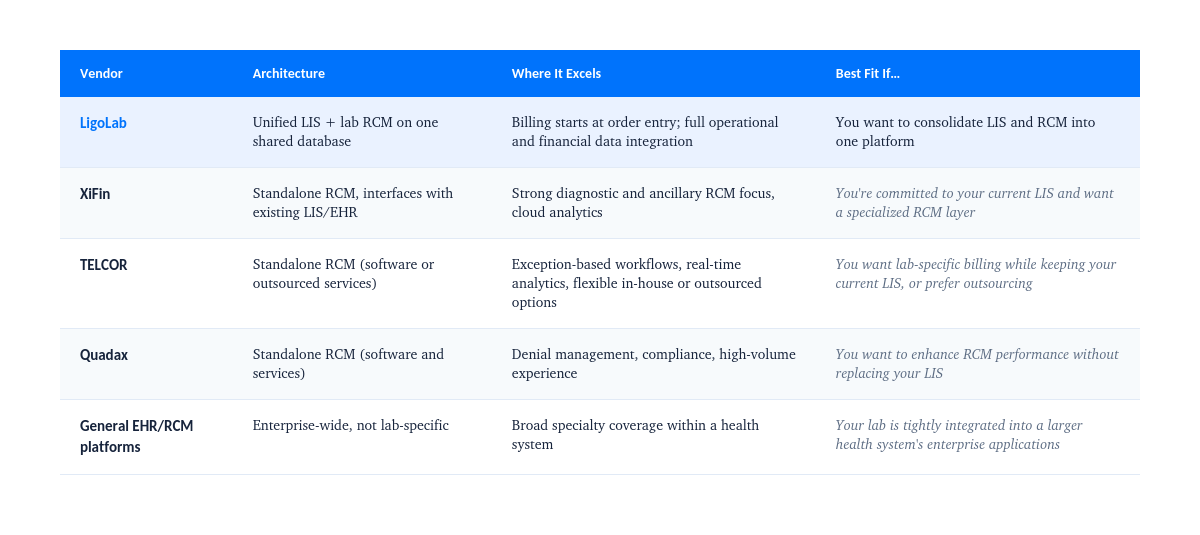
How Does LigoLab's All-in-One Platform Handle Laboratory Billing Differently?
LigoLab takes a different approach than traditional laboratory billing add-ons. Instead of treating lab billing as a back-end, separate process, it embeds advanced laboratory revenue cycle management capabilities directly into its all-in-one informatics platform. All modules share a common database and infrastructure, ensuring end-to-end data integrity (one source of truth) from the moment an order enters the lab information system module.
1. Does Lab Billing Start at Order Entry?
When an order hits the LIS system, LigoLab can immediately kick off demographic verification, eligibility checks, and rules-based edits. That means fewer surprises days later when the claim is generated.
2. How Are Medical LIS and Lab Billing Workflows Unified?
Because the LIS system and lab billing modules live on the same platform and database, there’s no duplicate data entry, nightly flat-file imports, or "lost in translation" moments between disparate systems. Operational events (add-on tests, canceled tests, corrected reports) are automatically sequenced to the billing side.
3. What Does Rules-Based Automation Look Like at Scale?
LigoLab uses a powerful rules engine and workflow automation. For lab billing, this means automated work queues, payer-specific edits, denial routing, and workflow exceptions that spotlight only the accounts requiring human attention.
4. How Does LigoLab Support Compliance and Transparency?
The LigoLab platform supports payer policy rules, detailed audit trails, and robust reporting so labs can (quickly) respond to payer inquiries and internal audits.
5. Is It Really One Platform, Not a Patchwork?
LigoLab brings anatomic pathology, clinical, and molecular workflows together with laboratory billing, direct-to-consumer lab testing, and client portal services in one integrated informatics ecosystem. This unified approach sets LigoLab apart from stand-alone laboratory billing solutions.

Who Are LigoLab's Leading Laboratory Billing Competitors?
Several respected laboratory billing vendors are on the market. Many deliver strong capabilities, especially for labs that want a stand-alone billing engine or outsourced billing services. Below is a closer look at how each compares conceptually with LigoLab's integrated informatics model, including where each competitor is genuinely the better fit.
Where Does XiFin Excel, and When Is It the Better Choice?
XiFin offers cloud-based, purpose-built laboratory revenue cycle management platforms for diagnostic providers, including clinical and hospital outreach labs. Their Empower RCM and related solutions focus on optimized cash collections, lab-specific workflows, and analytics.
Where XiFin excels:
- Strong focus on diagnostic and ancillary RCM
- Cloud architecture with robust analytics and reporting
- Demonstrated track record with large lab and health system clients
- Purpose-built workflows for complex lab billing
Typical trade-offs vs. LigoLab: XiFin is primarily a lab revenue cycle management platform. It usually sits beside an existing laboratory information system or EHR. That means you still manage at least two mission-critical platforms and their interfaces. Operational and financial workflows don't share a single native database as they do in LigoLab, which can create latency, mapping complexity, and more effort to keep systems in sync.
XiFin can be a strong choice if you are committed to your current LIS lab solution and want to bolt on a specialized RCM layer. If you are open to modernizing both LIS and RCM, upgrading to an integrated platform can simplify your environment and reduce overhead.
Industry Insights: Navigating the Coding Minefield - Labs Struggle with RCM Rejections Amid Rising Scrutiny from Payers
Where Does TELCOR Excel, and When Is It the Better Choice?
TELCOR provides lab-specific revenue cycle management software and services, including TELCOR RCM for in-house billing and TELCOR Revenue Cycle Services (RCS) for outsourced billing. Their tools emphasize flexible workflows, exception-based processing, and real-time analytics.
Where TELCOR excels:
- Designed specifically for the complexity of laboratory and pathology billing
- Exception-based workflows that focus staff only on problem claims
- Real-time analytics and strong visibility into lab billing performance
- Options for both software and fully outsourced billing services
Typical trade-offs vs. LigoLab: Like XiFin, TELCOR typically operates downstream of the laboratory information system (LIS). Charges flow from the LIS to TELCOR RCM for claim scrubbing, edits, and billing, creating an ongoing need to maintain integration between the two systems. This separate-system model also means managing multiple vendors, contracts, and support teams, adding complexity to system governance, upgrades, and troubleshooting.
TELCOR can be attractive if you want lab-specific billing capabilities and either keep your existing LIS system or fully outsource RCM. If your strategic goal is to consolidate platforms and bring operational and financial workflows under one roof, LigoLab's integrated architecture offers an alternative path.
On-Demand Webinar: Outsourced vs. In-House Laboratory Billing - How to Make the Right Choice for Your Lab
Where Does Quadax Excel, and When Is It the Better Choice?
Quadax provides laboratory revenue cycle management software and billing services designed to improve reimbursement, financial visibility, and compliance. Its offerings combine technology, outsourced services, and analytics to help laboratories streamline billing workflows and optimize financial performance.
Where Quadax excels:
- A combination of software and services focused on lab RCM
- Emphasis on analytics, denial management, and compliance
- Experience with high-volume lab environments
Typical trade-offs vs. LigoLab: As with other stand-alone RCM software products, Quadax complements, rather than replaces, your LIS system. You still manage and integrate multiple core systems.
Quadax may be a good option if your organization wants to upgrade revenue cycle management while keeping your existing LIS system in place. However, it does not provide the same operational and financial unification as an integrated platform that combines both LIS and RCM capabilities.

When Do General Medical RCM Platforms and EHR Billing Modules Make Sense?
General RCM vendors and EHR-centric billing modules also support many specialties, including laboratories. Some include enterprise RCM platforms and hospital billing systems that extend limited lab capabilities.
These can function adequately when the lab is tightly integrated within a health system that requires enterprise-wide applications. However, because they aren't designed specifically for lab workflows, they often struggle with:
- Complex test panels and reflex rules
- High-volume outreach and split-bill arrangements
- Laboratory-specific compliance requirements
- Fine-grained operational analytics at the accession and test level
In such cases, lab-specific solutions such as LigoLab, XiFin, TELCOR, and Quadax often deliver the best operational fit.
Discover More: Mastering Lab Operations - A Guide to Clinical Laboratory Management Solutions
Integrated Medical LIS + Lab RCM vs. Stand-Alone Laboratory Billing Software: Pros and Cons
When evaluating laboratory billing software, one should consider the underlying architecture and how it supports your laboratory’s broader operational and financial workflows.
Stand-Alone Laboratory Billing Software
Pros:
- Can be added to an existing LIS system with less disruption
- Sometimes easier to "swap out" over time
- Outsourced lab billing options can reduce internal staffing needs
Cons:
- Requires robust interfaces between the LIS system and lab billing software
- Data quality issues can surface late in the RCM cycle
- Separate lab vendors and upgrade cycles to manage
- Limited ability to tie operational changes directly to financial outcomes
Integrated Medical LIS + Lab RCM Platform (LigoLab)
Pros:
- One source of truth for operational and financial data
- Users can trigger billing logic at order entry rather than at claim submission
- Operational changes (like new tests, panels, workflows) update billing rules in the same ecosystem
- Fewer lab vendors, interfaces, and points of failure
- Easier to build holistic analytics and transparency that span operations and revenue
Cons:
- Requires a more comprehensive platform transition if you are coming from separate medical LIS and laboratory billing systems
- The evaluation process is broader because you are choosing both LIS and RCM software
For labs that see billing and operations as inseparable, the integrated route often delivers more sustained value.
On-Demand Webinar: Leverage LIS System Rules, Automation, and Data Analytics to Increase Efficiency and Cut Costs
How Should You Choose the Best Laboratory Billing Solution for Your Lab?
When evaluating laboratory billing software, consider questions like:
- Are we committed to our current laboratory information system for longer, or is it time to modernize? How much are we currently losing to denials, write-offs, and underpayments?
- How many manual steps still exist between order entry and final payment?
- How many separate lab vendors, laboratory software systems, and interfaces do we manage today?
- Do we have real-time visibility into profitability by payer, test, or client?
- Is outsourcing our lab billing the right strategic fit, or do we require more control, insight, and transparency in-house?
If priorities include system consolidation, advanced automation, and enhanced visibility across operations and the revenue cycle, then an integrated laboratory information system and lab billing platform such as LigoLab deserves close consideration.
Case Study: Leveraging LIS System & Lab RCM Integration to Improve the Laboratory Billing Process
Why Does LigoLab Stand Out?
To recap, LigoLab's all-in-one medical LIS and lab RCM platform:
- Combines LIS, RCM, and related workflows on a single, shared database
- Starts the lab billing cycle at the moment of order entry
- Uses a robust rules engine to maximize clean claims, reduce denials, and protect compliance
- Eliminates many manual touchpoints and data handoffs between disparate systems
- Gives leadership end-to-end visibility from specimen to payment
XiFin, TELCOR, and Quadax each offer established, laboratory-focused RCM solutions that work well for organizations looking to retain their existing LIS while adding specialized billing technology. For laboratories seeking to modernize operational and financial workflows within a unified informatics platform, LigoLab takes a different approach by bringing LIS and RCM capabilities together in one integrated environment for greater connectivity, visibility, and control.
Industry Insights: From System of Record to System of Action - The Next Evolution of Laboratory Information Systems
Continue Your Research
- White Paper: Bridging the Gap in Modern Laboratories - Why a Comprehensive Digital Platform Outperforms a Traditional Lab Information System
- Case Study: Documenting the Avero Diagnostics Move From a Legacy Lab RCM System to LigoLab's All-in-One Lab Informatics Platform
- RCM Insight: Navigating the Coding Minefield - Labs Struggle with RCM Rejections Amid Rising Scrutiny from Payers
- Vendor Evaluation: Is Your Lab RCM Software Vendor Putting Your Lab's Needs First?
Next Steps
If you are reassessing your laboratory billing strategy, now’s a great time to step back. Rather than asking "Which lab billing system should we bolt on?" you can ask a more strategic question: "What architecture will give us the cleanest data, the most automation, and the greatest long-term flexibility?"
For many labs, the answer is a modern, integrated medical LIS + lab RCM platform. If you'd like to see how LigoLab's all-in-one lab informatics solution could work in your environment, consider scheduling a conversation or demo with a product specialist.
Act Now: Speak with a LigoLab Product Specialist!
Frequently Asked Questions About Laboratory Billing Software
What is the main difference between LigoLab and standalone RCM platforms like XiFin, TELCOR, and Quadax?
LigoLab embeds lab RCM directly into its all-in-one LIS software platform on a shared database, so billing starts at order entry. XiFin, TELCOR, and Quadax are standalone RCM systems that sit alongside your existing LIS or EHR and require interfaces to keep data in sync.
Which lab billing software is best if I want to keep my current LIS?
XiFin, TELCOR, or Quadax are generally better fits if you're committed to your current LIS and want to add a specialized RCM layer on top of it, since they're designed to bolt onto an existing system rather than replace it.
What should lab billing software do at a minimum?
It should capture and verify patient and insurance information, apply correct CPT and ICD-10 codes, check eligibility and medical necessity, submit clean claims, manage denials and appeals, post payments, and generate analytics on collections and A/R.
Why do general EHR and enterprise RCM platforms often fall short for lab billing?
They aren't designed for lab workflows, so they often struggle with complex test panels, reflex rules, high-volume outreach and split-bill arrangements, and lab-specific compliance and analytics needs.
What are the trade-offs of an integrated LIS + lab RCM platform versus a stand-alone billing system?
Integrated platforms provide a single source of truth, enable billing workflows to begin at order entry, and reduce the number of vendors and interfaces laboratories must manage. However, they typically require a more comprehensive transition and an evaluation that encompasses both LIS and RCM capabilities. Stand-alone systems can integrate with an existing LIS with less initial disruption, but require ongoing interface maintenance and may delay data issues until later in the revenue cycle.
What questions should a lab ask when choosing a billing solution?
Key questions include whether you're committed to your current LIS long-term, how much revenue is lost to denials and write-offs, how many manual steps exist between order and payment, how many vendors and interfaces you currently manage, and whether outsourcing or in-house control is the better strategic fit.