Blog
Laboratory Billing 101: The Differences Between In-House Billing and Outsourced Billing Services

September 29, 2026

In today's fast-paced diagnostic environment, medical laboratories are inundated with patient samples and a mountain of associated data. The challenge? To manage this data efficiently and ensure accurate test results while capturing all Current Procedural Terminology (CPT) and International Classification of Diseases (ICD) codes for services and procedures rendered.
To meet this challenge, most medical labs rely on laboratory billing software and various lab revenue cycle management (RCM) tools. These laboratory software systems streamline financial operations and pathology/clinical lab workflow, offering comprehensive, agile laboratory billing solutions that track all test orders and every issued invoice, ensuring prompt collections and maximized revenue.
Discover More: Six Reasons Why You Should Choose an Integrated Laboratory Billing Solution for Your Medical Lab
In-House vs. Outsourced Laboratory Billing at a Glance
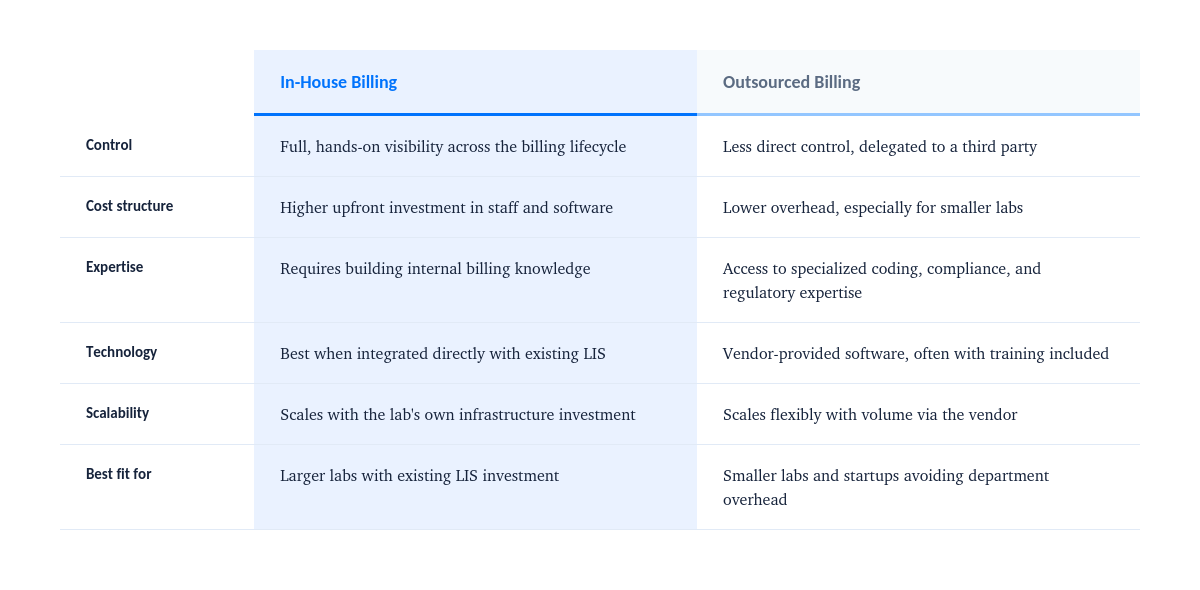
In-house laboratory billing gives testing organizations full control but requires more upfront investment and staff. Outsourced lab billing offers specialized expertise and lower overhead but less direct control. Larger, high-volume businesses typically benefit most from in-house laboratory billing integrated with their LIS (laboratory information system); smaller labs or startups often find outsourcing more cost-effective, at least initially.
Why Do Labs Need Strong Laboratory Billing Solutions?
Every medical lab needs a reliable way to manage the financial side of testing, track test orders, code accurately, and ensure prompt collections. The question isn't whether a lab needs strong laboratory billing solutions, but whether to build that capability in-house or partner with a third-party service.
What Are the Benefits of In-House Laboratory Billing?
In-house laboratory billing systems give medical labs hands-on control across every phase of the billing lifecycle.
The most effective in-house lab billing software integrates directly with existing laboratory information system software, automating administrative tasks that would otherwise require manual entry and (potentially) introduce avoidable clerical errors.
This integration supports more accurate, timely laboratory revenue cycle management, minimizing denials, reducing revenue leakage, and eliminating the inefficiencies often associated with disconnected, standalone billing systems.
Discover More: Maximizing Your Lab’s Profitability - The Case for In-House Lab Billing
Key Features of In-House Laboratory Billing Solutions
- Dashboard Overview: This isn't just a snapshot; it's the pulse of your laboratory billing process in one convenient, highly accessible place. With real-time updates on claim status, labs can monitor progress and quickly address any lab billing issues as they arise.
- Denied Claim Management: Even with the best laboratory billing process, some denials are inevitable, but don't have to be final. With robust RCM tools and advanced laboratory billing system features, organizations can swiftly manage, edit, and resubmit denied claims. This reduces revenue loss and streamlines the entire RCM process.
- Integrated Systems: Cohesion is key. A unified informatics platform with lab information system and laboratory billing platform capabilities ensures patient data, payment schedules, and other essential data are transferred seamlessly. This integration eliminates redundancy and ensures every piece of information is where it needs to be.
- Secure Payment Portals: In today's digital landscape, both security and convenience are essential. Patient payment portals include robust data protection measures to keep sensitive information safe, while also providing an intuitive interface that simplifies laboratory billing and speeds payment collection.
Get Insight: The Top Five KPIs - Driving Successful Lab Revenue Cycle Management
Tangible Benefits of In-House Laboratory Billing Solutions
- Enhanced Efficiency: Time is critical in laboratory revenue cycle management. Advanced laboratory billing software automates time-consuming manual tasks, enabling staff to focus on more complex, strategic work while accelerating RCM workflows and improving overall laboratory performance.
- Digital Accuracy: Human errors are natural but costly in lab billing. Digital laboratory billing solutions rigorously check for inconsistencies, ensuring that every claim is accurate. This precision improves net collections and enhances the lab's reputation as a trusted business partner.
- Swift Reporting: Knowledge is power. With digital laboratory billing solutions, labs can generate detailed financial reports with one or two clicks. Easy access to high-level or granular information provides insights that are invaluable for decision-making, helping labs identify trends, challenges, and opportunities.

What Are the Benefits of Outsourced Laboratory Billing?
Outsourced laboratory billing can be a strategic choice for labs that want to focus on diagnostics and patient care and aren't prepared to build or expand an in-house laboratory billing department.
What Do Third-Party Laboratory Billing Services Offer?
- Specialized Expertise: Third-party laboratory billing services offer the specialized knowledge a lab needs to operate without an in-house lab billing department. The best lab billing services employ experienced staff who understand medical billing codes, regulations, and compliance requirements.
- Software and Training: Third-party laboratory billing vendors often provide dedicated lab billing software that integrates seamlessly with a lab's LIS laboratory information system, along with comprehensive training to ensure staff can use the platform effectively and efficiently.
The Tangible Benefits of Outsourced Lab Billing
- Cost Effectiveness: Outsourced laboratory billing services can be a cost-effective alternative for smaller medical labs and startups that view an in-house lab billing department as a prohibitive expense at their current stage of business development.
- Access to Expertise: By partnering with third-party lab billing services, diagnostic providers can tap into specialized knowledge. This expertise can be invaluable in navigating the intricate waters of lab revenue cycle management.
- Scalability: Outsourced laboratory billing services enable scaling based on volume. Medical labs can adjust services as needed.
- Access to Advanced Technology: RCM vendors often use advanced software to streamline and optimize laboratory billing, providing technology and automation that many medical laboratories may not have when managing revenue cycle operations in-house.
Get Insight: What Are the Best Software Solutions for Laboratory Billing?
In-House vs. Outsourced Laboratory Billing: Which Is Right for Your Business?
Every medical laboratory, regardless of size or specialization, faces a crucial decision: how to manage its lab RCM process. Choosing between in-house laboratory billing and outsourced lab billing services is more than just a preference. The right approach should align with the laboratory’s strategic goals, operational requirements, and long-term vision.
1. Scale and Scope
Larger labs: With vast volumes of patient data and laboratory billing requirements, larger labs most often need robust, customizable laboratory information systems and laboratory billing solutions that can scale. In-house laboratory billing, tailored to the lab's specific needs, can deliver the features, flexibility, and required depth.
Smaller labs: With limited resources and a narrower scope, smaller organizations might find more value in outsourcing their lab billing. This enables them to tap into established expertise without the overhead of setting up and managing an in-house laboratory billing system.
2. Infrastructure Assessment
Existing investments: Labs need to evaluate their current technological landscape. If the lab has already invested in laboratory software systems like cloud storage, or has a highly interoperable medical LIS or laboratory information management system (LIMS), an in-house laboratory billing platform may be the best fit.
Future tech plans: If a lab plans to upgrade its tech infrastructure or expand its digital footprint, it should consider how each laboratory billing solution fits into those plans.
3. Control vs. Expertise
In-house laboratory billing solutions: These offer labs unparalleled control over their laboratory billing process. From customization to real-time adjustments, labs can shape the lab billing software to their exact needs.
Outsourced lab billing services: While it may seem like ceding control, outsourcing gives labs specialized expertise at a lower cost. Third-party services focus on lab billing, bringing best practices and updated knowledge.
No matter the choice, certain imperatives are non-negotiable:
- Patient-Centricity: Laboratory billing solutions should prioritize patient needs, ensuring clarity, transparency, and usability.
- Real-Time Responsiveness: In the dynamic world of healthcare, real-time updates are crucial. Whether tracking a claim or validating patient data, the chosen laboratory billing solution should offer accurate, real-time data.
- Actionable Insights: Laboratory billing should go beyond day-to-day operations by delivering strategic value, offering detailed financial reports, trend analysis, and actionable insights that inform decision-making and long-term strategy.
On-Demand Webinar: Outsourced vs. In-House Laboratory Billing - How to Make the Right Choice for Your Lab

Why Are Labs Moving Toward Integrated LIS Systems and Lab Billing Software?
By combining laboratory information system functions with laboratory billing workflows on a single informatics platform, diagnostic laboratories can eliminate data silos, streamline operations, improve consistency, and gain greater visibility across both clinical and financial processes.
Discover More: The Power of Integration - Unleashing the Potential of LigoLab's LIS System & Lab RCM Platform
What Are the Benefits of LIS System and Lab Billing Integration?
When the LIS system and laboratory billing modules operate harmoniously within the same lab database software infrastructure, organizations experience a transformative shift in efficiency and profitability.
- Enhanced Efficiency: Seamless information flow between the two modules eliminates data silos, ensuring accurate, consistent, and readily accessible data at every stage of the clinical laboratory workflow.
- Optimized Laboratory Revenue Cycle Management: With a fully integrated LIS system & lab billing platform, businesses can have a holistic view of their technical and financial operations. This means more accurate coding, faster claim processing, expedited cash flow, efficient denial handling, and maximized net collections.
- Strategic Decision-Making: Combined insights from both modules in this all-in-one lab information system give labs a wealth of actionable data. This data translates into strategic insights and growth opportunities.
What Is LigoLab's Vision for Integrated Laboratory Billing?
At LigoLab, we’re helping laboratories realize this potential by unifying laboratory information system software and lab revenue cycle management within a single informatics platform.
Purpose-built to connect technical and financial workflows, the LigoLab platform helps laboratories modernize operations, improve efficiency, scale with confidence, and deliver the personalized services and expanded testing options today’s clients expect.
If you're curious and want to learn how all this works, check out our white paper, Leveraging LIS & RCM Integration to Improve the Laboratory Billing Process. And if you're wondering about the real-world challenges of non-integrated laboratory software systems, read our blog post, Understanding the Real Costs of Non-Integrated RCM Systems.
Continue Your Research
- White Paper: Leveraging LIS & RCM Integration to Improve the Laboratory Billing Process
- Cost Analysis: Understanding the Real Costs of Non-Integrated RCM Systems
- Case Study: Documenting the Avero Diagnostics Move From a Legacy Lab RCM System to LigoLab’s All-in-One Lab Informatics Platform
- KPI Guide: The Top Five KPIs - Driving Successful Lab Revenue Cycle Management
Get Started with LigoLab
If your laboratory faces workflow bottlenecks, lab billing inefficiencies, or growth constraints, our team is ready to help. We offer advanced laboratory information system software and fully integrated laboratory billing solutions designed to eliminate friction, strengthen revenue integrity, and support long-term scalability.
Take the first step today; connect with a LigoLab product specialist and schedule your discovery call.
Act Now: Speak with a Product Specialist!
Frequently Asked Questions About In-House vs. Outsourced Lab Billing
What is the main difference between in-house and outsourced laboratory billing?
In-house laboratory billing gives labs complete control and hands-on visibility across the billing lifecycle; outsourced billing delegates that process to a third-party vendor with specialized expertise, usually at lower upfront overhead.
Which type of lab benefits most from in-house billing?
Larger labs with vast amounts of patient data and existing technology investments, such as a highly interoperable LIS system or lab LIMS, are generally better positioned to get the most value from in-house billing's flexibility and depth.
Which type of lab benefits most from outsourced billing?
Smaller labs and startups that view building an in-house billing department as a prohibitive expense often find outsourcing more cost-effective, while still gaining access to specialized expertise and advanced billing technology.
What key features should in-house laboratory billing software include?
Look for real-time dashboards, denied claim management tools, seamless LIS integration that eliminates redundant data entry, and secure patient payment portals.
Why are labs moving toward integrated LIS and lab billing platforms instead of separate laboratory software systems?
Combining LIS and lab billing in one platform eliminates data silos, improves coding accuracy and claim processing, and gives lab leadership a unified view of technical and financial operations for better strategic decision-making.
Is one approach, in-house or outsourced, always the better choice?
No. The right choice depends on the lab's scale, existing technology investments, and whether it prioritizes direct control (favoring in-house) or access to specialized expertise at lower overhead (favoring outsourcing).
.jpg)