Industry Insights
AI-Native Is Not the Same as AI-Ready

August 25, 2026

Artificial intelligence is transforming the way software is developed. It enables teams to write code more efficiently, identify defects earlier, automate testing, and deliver new capabilities faster than ever before. At LigoLab, we're embracing these advancements to accelerate innovation while maintaining the quality and reliability our customers expect.
What Laboratories Should Demand From Their Technology Partners
But in healthcare technology, speed of development cannot substitute for reliability, deep domain expertise, security, and accountability.
A new generation of lab vendors describes itself as "AI-native." In some cases, that means AI has been thoughtfully embedded into the product and the engineering process. In others, it means large portions of the software were generated through prompts, assembled from third-party components, and released before the system accumulated any meaningful operational experience (and real-life cases at scale). The engineering world refers to this as "vibe-coded" software.
For a consumer application, that approach may be acceptable. For a laboratory information system responsible for patient data, diagnostic workflows, laboratory billing operations, interfaces, compliance, and business continuity, it introduces an entirely different level of risk.
Industry Insights: Best LIS Systems - Top Laboratory Information Systems Compared for Clinical, Pathology, and Outreach Labs
Laboratories Don't Run On Demos
It’s easy to build software that looks impressive in a demonstration. A prototype can produce a clean interface, automate a simple workflow, and generate an attractive report. The hard questions only appear after go-live:
- How does the system behave when workflows involve hundreds of exceptions - split specimens, add-on orders after accessioning, amended reports, and reflex cascades that depend on payer and provider context?
- Can it withstand real production volume across anatomic pathology, clinical laboratory, molecular, and lab revenue cycle management operations simultaneously?
- What happens when an instrument, HL7 interface, payer rule, or client configuration behaves unexpectedly at 2 a.m. on a Saturday?
- Can the vendor support the laboratory through outages, upgrades, acquisitions, and rapid growth?
- How is the system funded? If the vendor is an early-stage startup, laboratories should carefully evaluate its long-term financial stability before entrusting it with mission-critical operations. The laboratory information system serves as the backbone of the business, making vendor longevity and sustainability important considerations.
Laboratories don't invest in screenshots or product demos; they invest in systems that must perform accurately for every specimen, every day. The true measure of laboratory software isn't how quickly it was developed, but how reliably it manages the complex clinical, operational, and financial workflows that emerge after implementation. A laboratory information system is more than software; it's the foundation of a lab's operations and the cornerstone of a long-term technology ecosystem that must evolve and remain dependable despite changing technologies and market conditions.
Discover More: How to Modernize Your Medical Lab Without Disruption
The Risk Of Vibe-Coded Healthcare Software
AI-assisted coding can significantly increase the productivity of experienced engineering teams. But AI-generated code is not inherently production-ready, especially when that software supports mission-critical healthcare operations.
Software built primarily through natural-language prompts can contain subtle defects, insecure dependencies, inconsistent architecture, and incomplete error handling. These problems can be difficult to detect because the code often looks correct. That is one of the fundamental challenges with large language models: they are exceptionally good at producing plausible outputs, but plausible does not necessarily mean accurate, secure, or reliable.
For laboratories, this creates risk across virtually every area the laboratory information system touches, including:
- Patient and specimen identification
- Result integrity and delivery
- Instrument and system interfaces
- Billing accuracy and reimbursement
- Regulatory obligations under CLIA, CAP, and HIPAA
- Data security and auditability
These risks are particularly concerning because the laboratory information system serves as the authoritative system of record for patient demographics, specimens, orders, results, amendments, provider information, billing data, audit histories, and workflow events.
Under CLIA, the responsibility for validating the system ultimately rests with the laboratory. If a vendor cannot fully explain, test, and defend the software it created, that uncertainty becomes the laboratory's problem.
AI can generate code. It cannot assume responsibility for the consequences. Mission-critical LIS software still requires experienced engineers who understand the technology, the laboratory environment, and the downstream impact when something goes wrong.
When Software Risk Becomes Reputational Risk
For a laboratory, unreliable software can cause more than downtime, lost revenue, or compliance exposure. It can damage something harder to recover: trust.
That risk increases when AI-generated or AI-driven functionality behaves like a black box. When an error occurs, laboratory personnel must determine what happened, why, and which records were affected. If the underlying logic cannot be explained or traced, identifying and containing the problem becomes far more difficult.
That’s why a system-of-record LIS requires predictable workflows, validation controls, audit trails, and deterministic business logic. The most dangerous failures aren’t always obvious. A system may continue operating while quietly misrouting information, overlooking exceptions, associating incorrect data, or executing improper billing actions. By the time a pattern emerges, numerous cases may be affected, creating regulatory, financial, and reputational consequences.
AI is best deployed as a controlled intelligence layer that enhances a validated system of record, not replaces it. Critical workflows still require human oversight, auditability, and accountable engineering.
For laboratories evaluating AI-native technology, the key question is simple: When the AI is wrong, will the laboratory know, and can the vendor quickly explain, trace, and correct the problem before trust is compromised?

The Research Is Clear: AI-Generated Code Demands Rigorous Review
This isn’t speculation; the evidence is now substantial. Veracode's GenAI Code Security Report, which tested over 100 large language models, found that AI-generated code introduced security vulnerabilities in 45% of coding tasks, and security pass rates remained flat even as newer models improved functionally.
Read the Vercode Report: 2026 GenAI Code Security Report - AI Is Writing More of Your Code, But Security Hasn’t Caught Up
Additionally, a December 2025 CodeRabbit Blog analysis found AI-co-authored pull requests contained 2.74 times more security issues than human-written ones, including nearly twice the rate of improper credential handling.
Read the CodeRabbit Findings: State of AI vs. Human Code Generation Report
Moreover, GitClear research across more than 200 million lines of code documented an eightfold rise in duplicated code and a collapse in refactoring, the signature of software that grows harder to maintain safely, and a Stanford study published at the ACM Conference on Computer and Communications Security (ACM CCS) found that developers using AI assistants wrote measurably less secure code while rating it as more secure.
Read GitClear’s Research: AI Copilot Code Quality - 2025 Look Back at 12 Months of Data
Read the Stanford Study: Do Users Write More Insecure Code with AI Assistants?
The consistent conclusion across this research is not that AI-generated code is unusable. It’s that AI-generated code is dangerous without disciplined human review, validation, and security controls, which is precisely the infrastructure that separates an engineering organization from a prompt.
Every Laboratory Should Demand Independent Security Validation
This is why independent attestation matters. LigoLab is SOC 2 certified, meaning its security controls, availability practices, and data-handling processes have been examined by an independent auditor against a recognized standard, not merely described in a sales deck.
Every laboratory should require this level of assurance from any vendor that handles protected health information. While SOC 2 certification does not guarantee flawless software, it does validate that the organization follows independently audited controls for security, access management, change management, incident response, and third-party risk.
A polished demonstration cannot provide that level of confidence. Independent audits verify that a vendor's security practices are real, repeatable, and consistently followed. Before selecting a laboratory technology partner, request the vendor's SOC 2 report and evaluate its experience supporting healthcare organizations. A mature vendor should be able to demonstrate not only innovative software but also a proven commitment to security, compliance, and operational excellence.
Discover More: How LigoLab Safeguards Data Privacy, Security, and Compliance in Today’s Digital Lab Environment
LigoLab Uses AI - But Does Not Outsource Judgment To It
LigoLab is not anti-AI. We embrace artificial intelligence throughout our organization, integrating it into our informatics platform, software development lifecycle, quality assurance processes, and internal operations. Our engineering teams leverage AI-assisted development and AI-powered code review to accelerate software delivery, strengthen code quality, and identify potential issues earlier in the development lifecycle.
The distinction is accountability.
At LigoLab, software is not accepted simply because one AI system generated it and another AI system reviewed it. Every line is reviewed by human engineers who remain responsible for the architecture, logic, security, testing, and release of the platform. AI supports the work. It does not replace engineering judgment and decades of serving the labs.
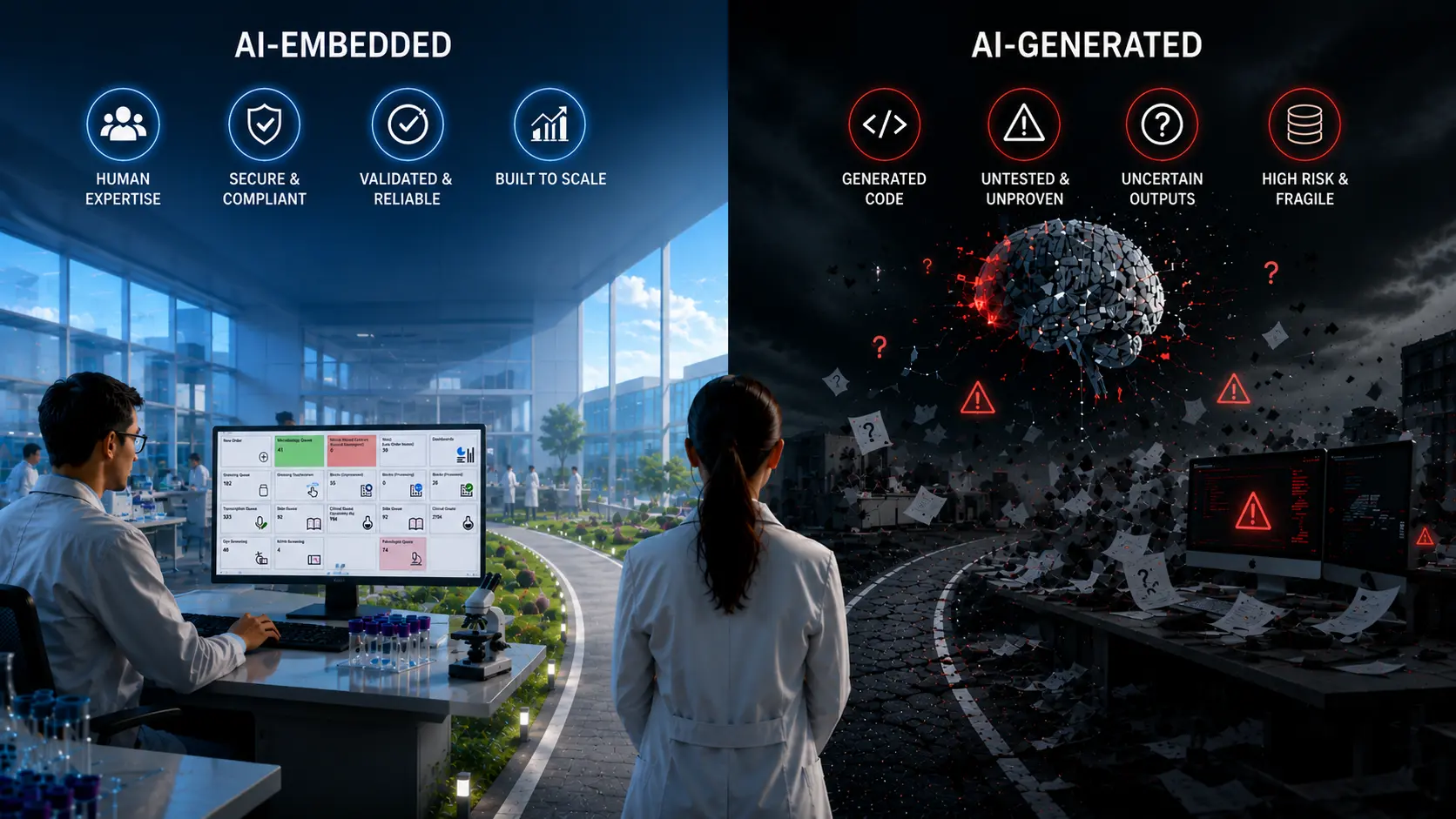
This is the difference between AI-embedded and AI-generated: we capture the speed of modern tooling while preserving the discipline that mission-critical healthcare software requires.
Industry Insights: The Modern Laboratory Blueprint - Aligning People, Processes, and Technology for Long-Term Success
What AI-Embedded Looks Like In Practice
This isn’t a philosophy statement. LigoLab is deploying AI, which eliminates real friction in laboratory workflows:
AI-powered requisition scanning and order entry automation. The platform scans incoming paper requisitions, extracts patient demographics, test orders, insurance information, and clinical details, and maps them directly into structured orders - cutting order entry time significantly while improving accuracy. Built-in validation flags discrepancies between requisition and specimen, missing information, and potential medical necessity issues at the front of the workflow, before they become downstream rework, denials, or billing leakage.
Embedded AI speech-to-text dictation and voice navigation. Pathologists dictate reports, trigger macros, and navigate the entire platform by voice - natively inside the LIS, not through a third-party dictation tool bolted onto the side. Fewer clicks, faster sign-out, and more time on the microscope instead of the keyboard.
Natural language queries - talk to your data. Instead of building reports or waiting for an analyst, laboratory staff can ask questions of their operational and financial data conversationally and get answers drawn from the platform's unified LIS and RCM data model.
Intelligent workflow automation. Rules-based auto case assignment with integrated scheduling routes cases to the right pathologist automatically, and the roadmap extends AI deeper into accessioning, revenue cycle intelligence, and digital pathology - where the LIS becomes the connective layer for AI-assisted image analysis.
AI-assisted ICD and CPT coding. The platform analyzes case documentation, diagnoses, and procedures to automatically suggest ICD-10 and CPT codes, thus building on the rules-based coding engine LigoLab has been refining for years. Accurate coding at the point of sign-out is where clinical work becomes clean revenue: correct codes mean fewer denials, less coder rework, faster reimbursement, and a smaller compliance surface. Because coding errors carry both financial and regulatory risk, AI-generated code recommendations are subject to the same business rules and human oversight as every other workflow within the platform, helping laboratories avoid undercoding, overcoding, and the downstream consequences of each. The system proposes; qualified staff and compliance logic confirm.
Notice what these features have in common: each one automates a task, not a judgment. The AI extracts the requisition data and the validation rules, and humans confirm it. The AI transcribes the diagnosis; the pathologist owns it. That’s the design principle - AI removes friction from expert work without removing the expert.
Industry Insights: Healthcare AI Has Crossed the Line From Experiment to Infrastructure
Domain Expertise Can’t Be Prompted Into Existence
A laboratory information system is not a database with a modern interface. It must reflect the real relationships between orders, specimens, containers, tests, results, interpretations, clients, providers, payers, instruments, billing rules, and compliance requirements - and it must get the edge cases right, because in this industry the edge cases are the job.
Consider what two decades of production deployments encode that no prompt can reproduce: date-of-service and 14-day rule logic; medical necessity edits that vary by payer and region; client-bill, insurance-bill, and patient-bill splits on a single requisition; chain of custody for toxicology; HL7 interfaces to hundreds of instruments and EHRs, each with its own dialect of non-compliance with the standard.
None of this is captured in a technical specification, and none of it lives in a training corpus. It lives in the fixes, the support tickets, the inspections survived, and the engineers who have watched real laboratories operate for twenty years. It’s embedded in LigoLab's exception handling, configuration depth, audit trails, implementation methodology, and thousands of operational details that will never appear in a sales demo.
A new vendor can reproduce the appearance of a feature in weeks, but can’t reproduce the knowledge and depth of each use case accumulated through decades of production use - because that knowledge was earned, not generated.
White Paper: How LigoLab Delivers CIO-Level Insight Through Real-World Lab Experience
Software Is Only Half The Product. The Other Half Is People.
An LIS vendor is not just a codebase. It’s an organization the laboratory will depend on for years, through go-live, the first payer contract change, and the acquisition that doubles specimen volume overnight.
LigoLab maintains entire departments of qualified specialists behind the platform. Implementation teams who have taken hundreds of laboratories live, integration engineers who build and maintain instrument and EHR interfaces, dedicated support staff who understand laboratory operations, and development teams deep enough to fix, extend, and customize the platform in parallel. When a growing lab needs a new interface, a new client configuration, and a support escalation in the same week, there are separate teams for each - not the same three people who wrote the code, run the demos, and answer the tickets.
A five-person "AI-native" startup can’t offer that, no matter how good its tooling is. There is no implementation methodology refined across hundreds of go-lives. There is no interface team with tribal knowledge of how a specific analyzer misbehaves. There is no bench depth when the one engineer who understands the billing module is on vacation during your outage.
To be fair, not every laboratory requires an enterprise-grade platform from the outset. For organizations with straightforward workflows, lower testing volumes, and limited operational complexity, a lightweight solution may adequately support their immediate needs.
The challenge arises as laboratories grow. Adding new clients, expanding test menus, increasing specimen volumes, opening additional locations, or pursuing acquisitions all place greater demands on both the software and the organization supporting it. Because replacing an LIS is one of the most disruptive and costly initiatives a laboratory can undertake, long-term scalability should be a key consideration from the beginning. Laboratories with ambitious growth plans are best served by a platform and a technology partner that can evolve alongside them, ensuring the solution that supports 500 specimens per day remains just as effective at 5,000 and beyond.
Discover More: How Modern LIS Systems Are Transforming Clinical Workflow, Laboratory Billing, and Scalability
Ownership Determines Priorities
There is one more structural difference that rarely appears on a feature comparison sheet: who the vendor actually answers to.
Most of the new "AI-native" entrants are venture-backed. That’s not a character flaw, but it’s an incentive structure, and incentive structures determine behavior. A venture-funded company must prioritize what its investors need: rapid growth metrics, an expanding valuation story, and an exit - acquisition or IPO - on a fund's timeline. When those needs conflict with what a customer needs, the investors sit on the board, and the customer does not.
Venture backing also introduces a risk that laboratories should consider with any decision: burn rate. A startup that raised on the AI narrative must raise again in 18 to 24 months, in whatever funding climate exists at that time. If the next round doesn't materialize, the outcomes are a fire-sale acquisition, a pivot away from your use case, or a shutdown - and in every one of those scenarios, the laboratory running its daily operations on that platform absorbs the consequences. Ask any lab that has lived through its LIS vendor being acquired and sunset: the migration costs land on you, on your timeline's worst possible day.
LigoLab is not owned by outside investors. There is no board pushing for an exit, no fund clock running, no pressure to chase valuation metrics at the expense of the platform. The company answers to its customers, because its customers are the business. That independence is why LigoLab can invest in unglamorous fundamentals that punish venture math, such as support depth, implementation quality, and long-term architecture, and why it can commit to supporting a laboratory for the next 20 years, not the next funding cycle.
When you choose an LIS vendor, you are choosing its incentives. Choose one whose success is defined by your laboratory's operations, not by a term sheet.
Industry Insights: Why LigoLab’s Funding Choice Nearly Two Decades Ago Continues to Benefit the Company and Its Customers
Battle-Tested Doesn’t Mean Outdated
Laboratories should not have to choose between innovation and reliability.
LigoLab's advantage is not merely that we have been in the market for more than 20 years. It’s that we combine that operational history with continuous investment: embedding AI into workflows where it creates genuine value, expanding automation, modernizing architecture, and interoperability - all without abandoning the controls, validation, and human oversight that laboratories require.
That’s what it means to be AI-ready: not generating software with AI, but responsibly integrating AI into a proven, accountable, continuously improving platform.
The Questions Every Laboratory Should Ask
Before selecting any vendor that leads with "AI-native," look past the marketing language and ask:
- How long has this product been operating in live laboratory environments, and at what volumes?
- How long has the team been servicing the lab industry in the U.S.?
- Who reviews and accepts AI-generated code - engineers with laboratory domain expertise, or another AI?
- Walk me through a challenging scenario: split billing on a multi-payer requisition, an amended report cascade, a reflex order triggered after accessioning. What happens?
- What testing, validation, and release controls are in place, and who is accountable when something goes wrong?
- Who answers the phone during a Friday night interface outage - and can they actually debug their own product?
- How many people are on the implementation, integration, and support teams - as distinct functions, not the founders wearing three hats?
- Who owns the company, what is its funding runway, and whose priorities win when investor timelines and customer needs conflict? (Be prepared not to get the real answer here)
- Will this company still exist and be capable of supporting us five years after the launch excitement fades?
- Can you provide a current SOC 2 report, and how do you handle security incident notification and PHI safeguards contractually?
- What LLMs are being used, and what’s the data governance like?
These questions matter because the true cost of a laboratory information system isn’t its subscription price. It includes implementation risk, operational disruption, interface instability, billing leakage, compliance exposure, downtime, and the very real possibility of ripping the system out after discovering it cannot handle the laboratory's actual complexity.
Cheap software becomes extraordinarily expensive when it sits at the center of a laboratory.
White Paper: Vendor to Partner - How Aligning with Your LIS Provider Can Transform Your Lab
Innovation With Accountability
AI will play an increasingly important role in laboratory medicine and in the software that runs it. LigoLab believes that the future should be welcomed.
But healthcare doesn’t benefit from innovation without accountability. The strongest platforms will not be the ones that generate the most code in the shortest time. They’ll be the ones that combine AI with experienced engineers, deep domain knowledge, disciplined quality controls, and a long-term commitment to the laboratories they serve.
We are AI-embedded and optimized, but human-governed. We use modern development tools, but we do not hand critical engineering decisions to them.
We continue to innovate daily on a platform refined for 20-plus years and proven in laboratories nationwide.
For laboratories, that difference isn’t philosophical. It’s critical, operational, financial, and clinical.
And it matters every day.