Industry Insights
The Future of Laboratory Operations Is Intelligent, Connected, and Automated

October 16, 2026
Executive Summary: Clinical and anatomic pathology laboratories face a familiar dilemma: monolithic systems that bundle everything under one vendor roof, yet leave critical gaps in lab revenue cycle management (RCM), compliance automation, and cross-departmental visibility. A new model is emerging, built on composable, unified platforms that organize around the laboratory’s mission rather than forcing the lab to organize around the software.
The laboratory industry is at a turning point. After decades of relying on fragmented technology environments, where laboratory information system (LIS) software operates alongside separate laboratory billing applications and disconnected compliance tools, a new architectural model is emerging. This approach reflects the broader enterprise shift away from traditional monolithic ERP systems toward more unified, flexible, and intelligent platforms designed to meet the complex operational, financial, and regulatory demands of modern diagnostic laboratories.
The parallel is striking: just as enterprises are breaking free from monolithic ERP vendor lock-in through composable architectures and AI orchestration, laboratories are discovering that their most pressing operational challenges - denied claims, compliance fragmentation, and manual coding bottlenecks - stem from the same root cause: systems that were never designed to work as one.
This briefing examines how unified, composable laboratory platforms are reshaping the economics and operations of clinical and anatomic pathology labs. It draws on industry data, practitioner experience, and emerging technology trends to map the path forward for laboratory leaders seeking to modernize without the disruption of rip-and-replace migrations.
Industry Insights: Best LIS Systems - Top Laboratory Information Systems Compared for Clinical, Pathology, and Outreach Labs
What Is a Monolithic Laboratory Information System?
The monolithic LIS model, where operations, lab billing, compliance, and reporting live in separate systems or loosely interfaced modules, creates an integration tax that compounds over time, draining margin and slowing innovation.
Unified platforms that embed LIS and RCM on a single lab database software infrastructure eliminate the reconciliation burden, enabling the revenue cycle to start at order inception rather than as a back-end afterthought.
Built-in compliance workflows (CAP, CLIA, HIPAA) that travel with the data, rather than being bolted on after the fact, reduce audit risk and create defensible, end-to-end traceability across every case lifecycle.
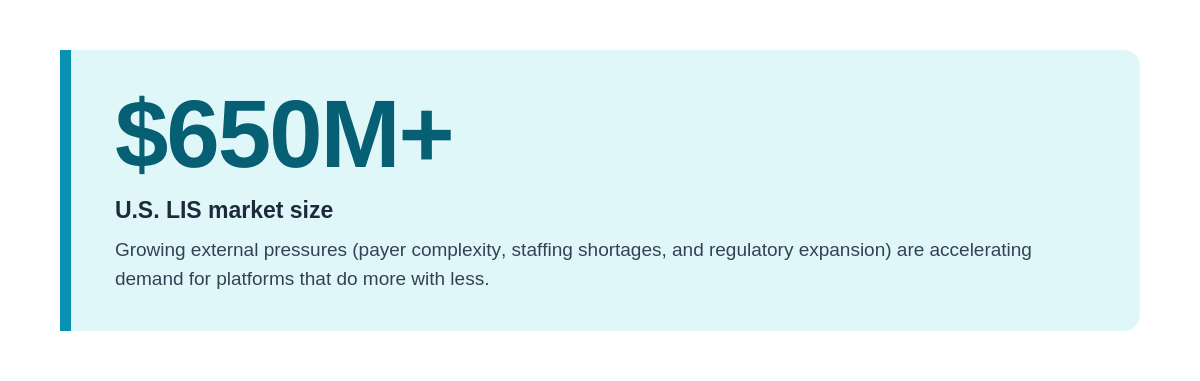
The Hidden Cost of Fragmented Laboratory Systems: Understanding the Integration Tax
Laboratory leaders are all too familiar with the challenges of disconnected systems: rejected claims caused by data inconsistencies between the laboratory information system and lab billing software, compliance documentation scattered across applications with separate audit trails, and turnaround-time delays resulting from manual handoffs between accessioning, pathology, and result distribution.
These challenges are not isolated problems. They reflect what is often called the integration tax, the hidden accumulating costs of managing laboratory operations through disconnected systems never designed to operate as one platform. Even when interfaces connect these applications, they open data synchronization issues, processing delays, and ongoing maintenance requirements that become more complex with every payer policy change, test code update, or new regulatory requirement.
The financial consequences can be substantial. Fragmented laboratory systems increase the risk of claim denials, delayed reimbursement, and compliance gaps while creating additional administrative work. When clinical and billing information live in separate applications, opportunities for errors multiply, including incorrect CPT codes, missing diagnosis information, and insurance eligibility discrepancies that may not be discovered until claims are submitted. In contrast, unified LIS and lab revenue cycle management platforms help laboratories identify and resolve these issues earlier, reduce manual reconciliation, and improve operational efficiency and revenue integrity.
Industry Insights: Why LIS And RCM Integration Is A Laboratory Survival Imperative
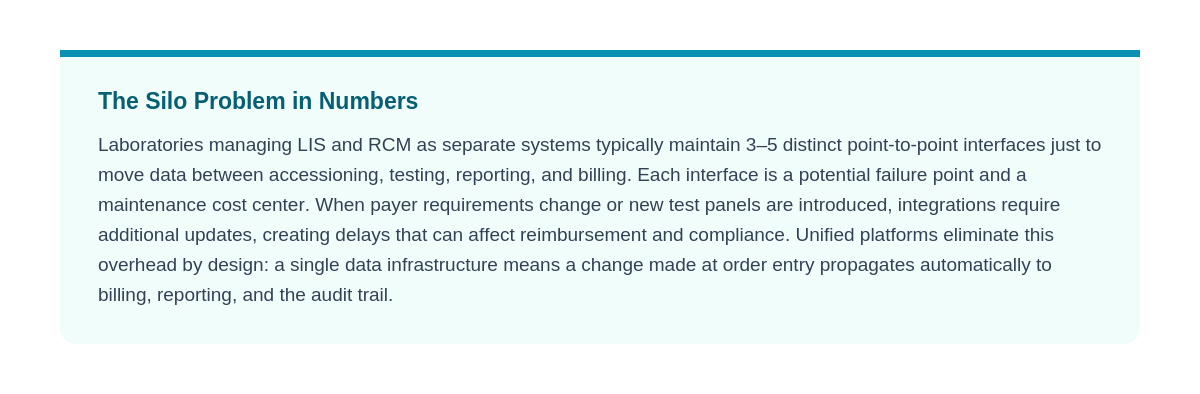
Beyond direct financial impact, the integration tax extracts a subtler organizational cost: it constrains the laboratory’s ability to innovate. When IT resources are consumed by maintaining fragile integrations, there’s little bandwidth for platform-level improvements such as AI-assisted coding, real-time analytics, and digital pathology workflows that increasingly separate market leaders from the rest of the field.
This mirrors a pattern the broader enterprise technology world has seen with legacy ERP: maintenance budgets crowd out innovation budgets, and vendors who control the upgrade cycle effectively dictate the pace of their customers’ evolution. In the laboratory context, the dynamics are even more acute because regulatory stakes raise the cost of errors and the complexity of change management.
White Paper: Transitioning from CoPath to LigoLab - A Seamless Path to LIS System Modernization
Why Unified LIS and RCM Platforms Represent a Different Approach
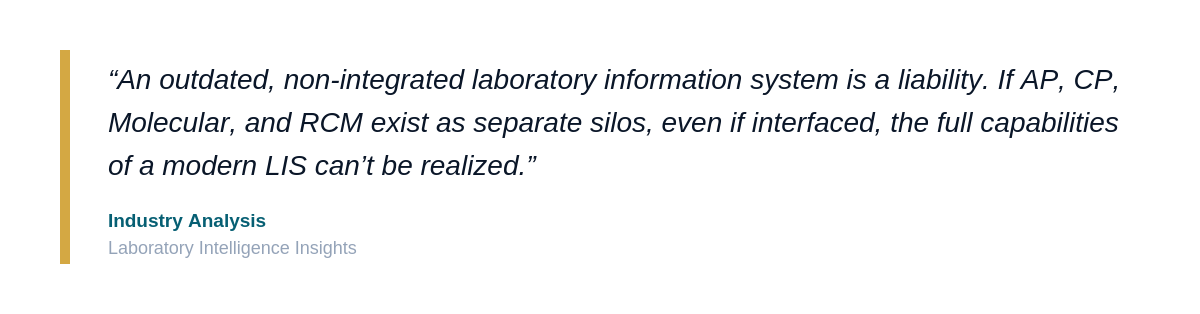
The antidote to monolithic fragmentation is not more integration; it’s integration by design. A growing class of laboratory informatics platforms takes a fundamentally different architectural approach: instead of interfacing separate LIS, RCM, and compliance modules after the fact, they build all three on a shared data infrastructure from the ground up.
This isn’t a marketing distinction. The architectural difference has cascading operational consequences. When the LIS and RCM share a single lab organization software, the revenue cycle can begin at order inception, and verification, eligibility checks, and coding rules engage the moment a specimen enters the system, not after results are finalized. This front-loading of financial intelligence is what transforms billing from a reactive back-office function into a proactive margin-optimization process.
How Unified LIS and RCM Platforms Improve Laboratory Efficiency, Compliance, and Scalability
Real-Time Revenue Cycle Initiation - Verification, scrubbing, and eligibility checks begin at order entry, not as a laboratory billing afterthought. This catches denial-triggering issues before they propagate, materially improving clean claim rates and accelerating cash flow.
End-to-End Compliance Traceability - When every action across the case lifecycle, from accessioning through result delivery and payment collection, is logged in a single audit trail, CAP and CLIA readiness becomes a continuous byproduct of normal operations rather than a periodic, resource-intensive preparation exercise.
Cross-Departmental Visibility - Anatomic pathology, clinical laboratory, molecular diagnostics, and billing teams all work from the same source of truth. This eliminates reconciliation cycles that consume staff hours and create opportunities for error in multi-system environments.
Composable Scalability - Unlike traditional monolithic systems that often require extensive upgrades to support new capabilities, unified platforms offer modular functionality that enables laboratories to add new test panels, expand reporting capabilities, and incorporate advanced analytics without disrupting their existing technology infrastructure.
Discover More: How the Best LIS Systems Support CAP and CLIA Compliance
Compliance by Design: Making Regulatory Readiness Part of Daily Operations
For laboratory directors and medical directors, compliance isn’t a feature to evaluate; it’s an existential requirement. CAP accreditation, CLIA certification, and HIPAA obligations create a regulatory surface that spans every specimen, every result, and every transaction. The question isn’t whether a platform supports compliance, but how deeply that logic is embedded in the operational workflow.
In fragmented systems, compliance is typically a layer applied on top: audit trails assembled from multiple sources, validation rules configured separately from the workflows they govern, and documentation that lives in different repositories than the clinical data it describes. This surface-level approach creates gaps, not because individual systems fail, but because the seams between them are inherently less visible and less controlled.
Unified platforms take a different approach. When compliance logic is woven into the same data model that drives accessioning, testing, reporting, and billing, every stage of the case lifecycle automatically generates the documentation, validations, and chain-of-custody records that auditors require. The result is what practitioners describe as “compliance by operation,” regulatory readiness that emerges from doing the work, not from preparing for the audit.
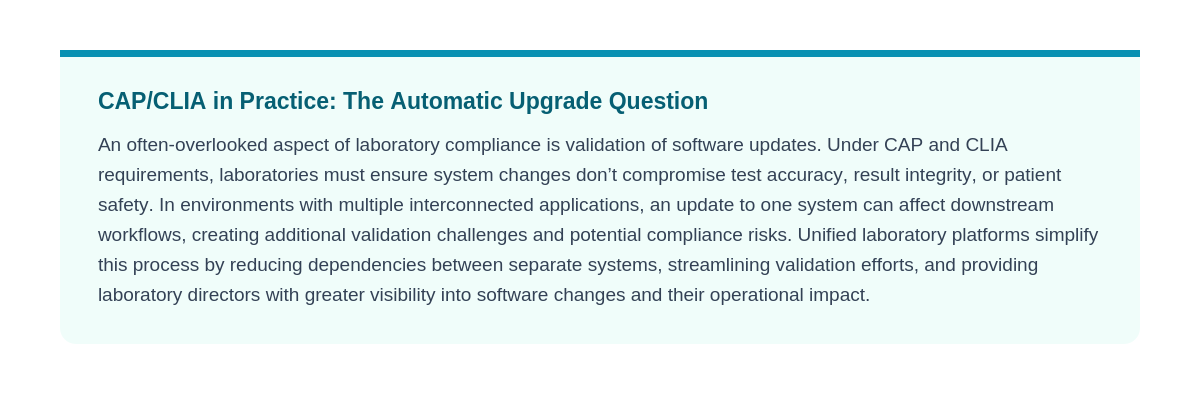
This architectural approach to compliance also creates a defensibility advantage. When regulators or payers request documentation of processes, decision points, or chain-of-custody records, a unified audit trail provides a single, authoritative source. There’s no need to reconcile timestamps across systems, no risk of version conflicts between modules, and no ambiguity about which record of truth to reference.
Discover More: A Detailed Look at How Modern Laboratory Information Systems Fully Support Quality Control
From the Field: Practitioners on Platform Consolidation
The operational impact of moving from siloed systems to a unified platform is best understood through the lens of practitioners who have made the transition. Across interviews with laboratory directors, operations managers, and billing leaders, several consistent themes emerge.
Pathologist Productivity and Turnaround Time
Pathologists who transition from legacy systems to unified platforms consistently report improvements in daily throughput. The driver isn’t faster reading; it’s the elimination of workflow friction. When case data, specimen history, images, and report templates all live within a single interface, the cognitive overhead of context-switching between systems disappears. One multi-site pathology group documented significant improvements in pathologist productivity within the first year of platform consolidation, attributing the gains primarily to streamlined navigation and automated case distribution.
Revenue Cycle Acceleration
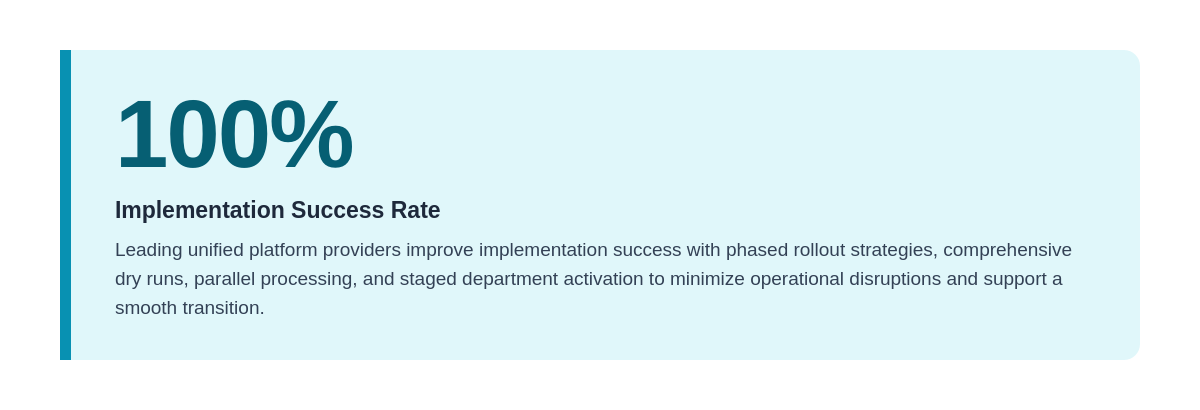
The financial impact of unification is often the most immediately measurable. Laboratories report that moving billing onto the same platform as clinical operations reduces denial rates by catching eligibility and coding issues earlier in the workflow. When LIS and RCM modules share verification and scrubbing components, real-time patient and payer data verification tools integrate seamlessly into live, queue-facilitated workflows, preventing rejections rather than managing them after the fact.
Specimen Tracking and Error Reduction
Barcode-driven specimen tracking within a unified platform creates an unbroken chain of custody from collection through result delivery. Unlike multi-system environments where specimens must be “re-identified” at system boundaries, unified specimen tracking maintains a consistent record of every scan, handoff, and processing step. This end-to-end visibility helps laboratories minimize specimen identification errors, strengthen chain-of-custody documentation, and accelerate root-cause analysis when exceptions occur.
The Intelligence Layer: AI on a Unified Foundation
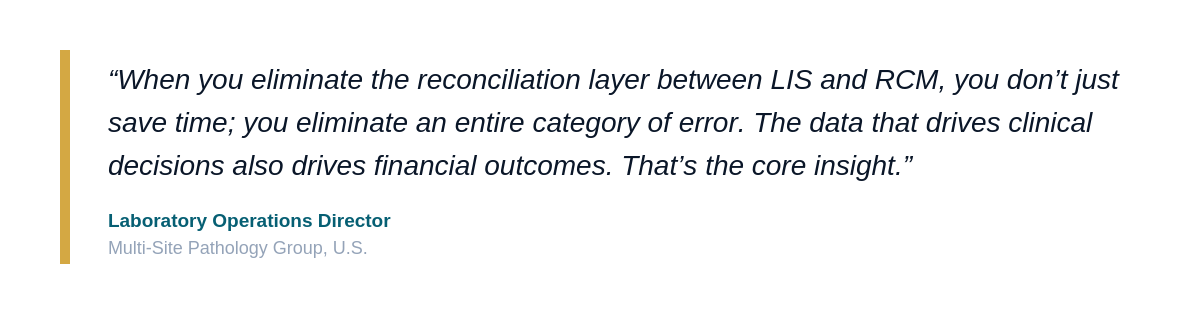
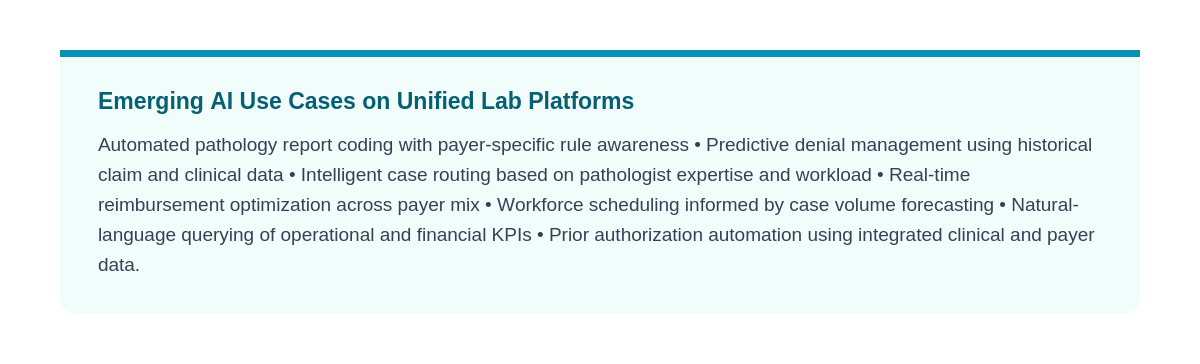
AI capabilities converging with unified laboratory platforms create possibilities that fragmented architectures fundamentally can’t support. When AI accesses a single, comprehensive data model spanning clinical, financial, and operational domains, it can identify patterns and automate decisions that would require manual reconciliation across multiple systems.
Consider automated CPT and ICD coding, a function that sits squarely at the intersection of clinical and financial workflows. In a fragmented environment, AI coding tools must bridge systems to access both the clinical context (pathology reports, specimen data, test methodologies) and the financial context (payer rules, reimbursement history, denial patterns). Each bridge introduces potential latency, data loss, and integration maintenance costs.
On a unified platform, the same AI engine can see the complete picture natively: the specimen’s journey from accessioning through diagnosis, the payer’s specific coding requirements, historical denial patterns for similar cases, and real-time eligibility status. This isn’t a theoretical advantage; it’s the difference between AI that automates a narrow task and AI that optimizes an entire workflow.
A Platform-Ready Foundation for Agentic AI
The agentic AI paradigm, where autonomous software agents coordinate multi-step workflows across system boundaries, is accelerating across enterprise technology. For laboratories, this evolution favors platforms where the data is already unified. An agentic system built on a single-platform architecture can orchestrate complex processes (from order intake through result delivery and payment collection) without the fragile inter-system handoffs that plague multi-vendor agent deployments.
This positions unified laboratory platforms not just as operational improvements for today, but as the architectural foundation for the next generation of AI-driven laboratory operations.
Industry Insights: AI-Native Is Not the Same as AI-Ready
A Modernization Playbook for Laboratory Leaders
The shift from fragmented to unified laboratory operations doesn’t require a leap of faith. Based on the experiences of laboratories that have successfully navigated this transition, several practical principles emerge:
Audit the Integration Tax - Before evaluating new laboratory technology platforms, assess the true cost of fragmented systems, including staff time spent reconciling data across applications, claim denials caused by information discrepancies, resources devoted to compliance preparation, and IT expenses associated with interface maintenance. Quantifying these inefficiencies establishes a clear baseline for building a compelling business case for modernization.
Prioritize Architectural Unity Over Feature Lists - Individual features can be added over time. Architectural decisions are permanent. A platform with genuine single-database integration across LIS and RCM will compound advantages over years; a system that achieves similar feature parity through interfaces will compound maintenance costs.
Evaluate Compliance by Design - Ask not whether a platform supports CAP and CLIA compliance, but how. Does the audit trail span the full case lifecycle on a single infrastructure? Do validation workflows trigger automatically, or require manual configuration across system boundaries?
Plan for the Intelligence Layer - Any platform decision made today will either enable or constrain AI capabilities for the next decade. Unified data architectures are a prerequisite for cross-domain AI optimization, coding automation, predictive denial management, and intelligent scheduling that will define next-generation laboratory operations.
Align Pricing with Growth - Volume-based and transactional pricing models that scale with laboratory testing volume, rather than relying on per-seat or per-module licensing fees, help align technology costs with operational growth. This approach creates a shared incentive for the software provider and laboratory, linking long-term value to the laboratory’s success and expansion.
Discover More: Is Your Laboratory Information System and LIS Lab Vendor Holding Your Laboratory Hostage?
The Next Chapter
The laboratory industry is entering an era where the systems that run the business can finally organize around the laboratory’s mission, not the other way around. Unified platforms that eliminate the integration tax, embed compliance into operations, and create a foundation for AI-driven optimization represent more than an incremental improvement. They represent an architectural shift that will increasingly separate laboratories that merely operate from those that thrive.
For laboratory directors and C-suite leaders evaluating their technology roadmap, the question is no longer whether to modernize, but whether to modernize around a unified architecture or continue paying the compounding cost of fragmentation. The early movers are already making their choice clear.
About This Briefing
“Beyond the Monolith: Reimagining Laboratory Operations for the Intelligence Age” is an industry briefing paper produced by Laboratory Intelligence Insights in partnership with LigoLab Information Systems. The analysis draws on publicly available industry data, practitioner interviews, and trend research. Laboratory Intelligence Insights independently collected and reported on all findings contained in this paper.
From the Sponsor
LigoLab Information Systems is a leading provider of enterprise-grade laboratory informatics, serving hundreds of laboratory facilities nationwide. The all-in-one LigoLab LIS & RCM Informatics Platform™ is a comprehensive, fully integrated solution with modules for anatomic pathology, clinical laboratory, molecular diagnostics, lab revenue cycle management, and direct-to-consumer lab testing, all on a single platform that supports every role, every department, and every case lifecycle.
Recognized with Frost & Sullivan’s Competitive Strategy Leadership Award in the North American Laboratory Information Systems industry, LigoLab empowers clinical laboratories to differentiate in their markets, scale efficiently, improve compliance, and increase their bottom line through operational transparency and automation.