Blog
Laboratory Management Software Must Evolve in 2027
October 22, 2026

The challenges confronting medical laboratories are interconnected, and their consequences extend throughout the organization.
Workforce shortages: Laboratories must maintain testing capacity and quality despite difficulties recruiting and retaining qualified professionals.
Reimbursement pressure: Medicare payment changes, payer requirements, claim denials, and rising operating expenses are squeezing laboratory margins.
Increasing diagnostic complexity: Molecular diagnostics, anatomic pathology, digital pathology, and specialized testing require sophisticated information systems and data management.
Fragmented technology: Disconnected laboratory information system (LIS) software, laboratory billing solutions, reporting, and other information management applications create redundant work, data inconsistencies, and costly interfaces.
Growing operational expectations: Multi-site laboratory organizations and outreach programs need standardized processes, real-time visibility, and scalable infrastructure.
These pressures explain why investing in advanced medical LIS technology has become a strategic necessity as we look ahead to 2027.
Industry Insights: The Modern Laboratory Blueprint - Aligning People, Processes, and Technology for Long-Term Success
Advanced LIS Systems vs. Legacy LIS Systems: What's the Difference?
Traditional laboratory information systems were built primarily to record and manage laboratory information. Advanced LIS software platforms go further by connecting workflows, automating decisions, and delivering actionable intelligence.
The advantages become clear when comparing their capabilities.
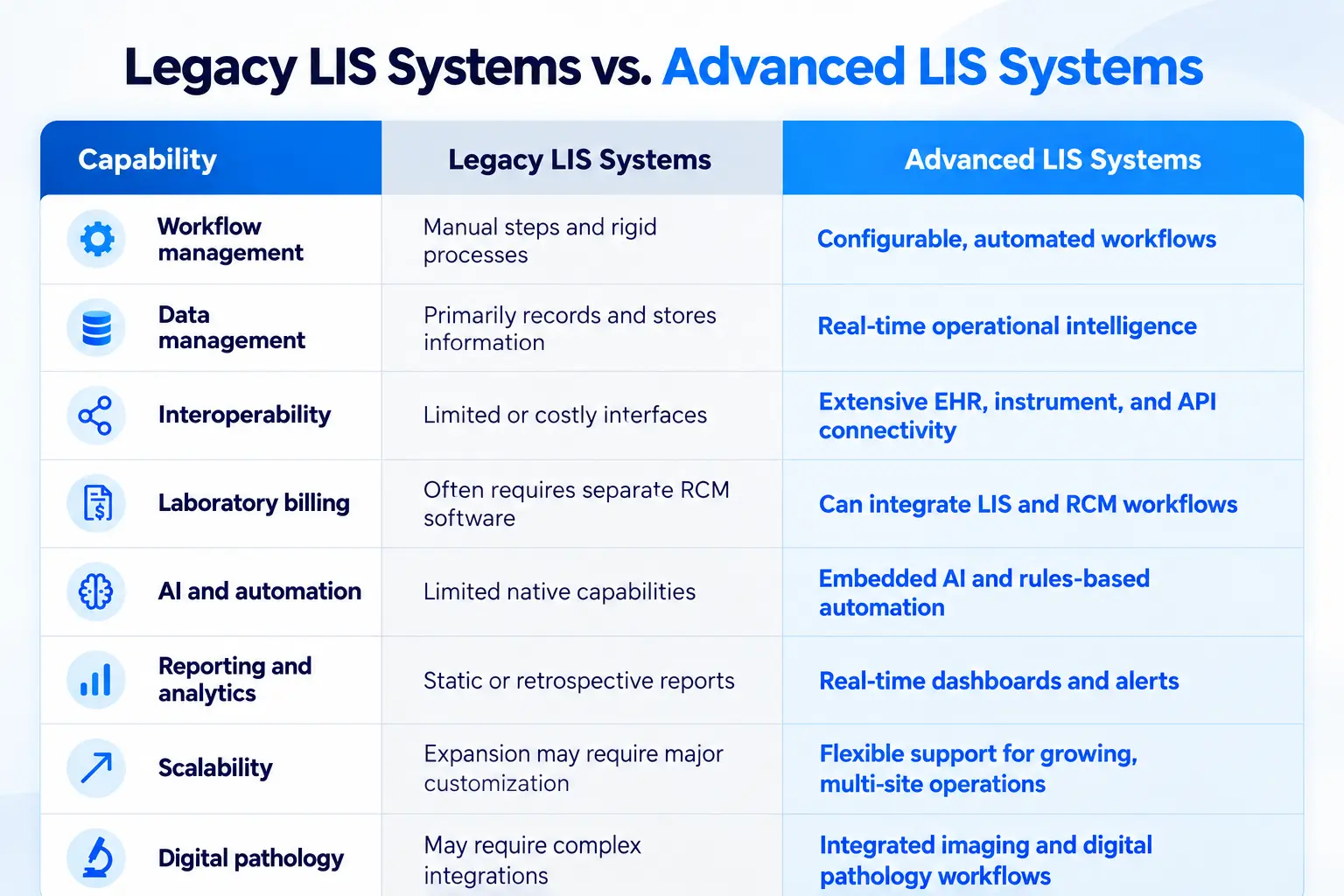
These are general architectural distinctions, not universal limitations. Some established LIS systems have been extensively modernized, and laboratory buyers should evaluate actual capabilities rather than software age alone.
The central question is whether the platform can support tomorrow's laboratory requirements without creating additional complexity.
Discover More: How to Prepare for Tomorrow’s Tech-Enabled Clinical Lab
Seven Essential Capabilities of Modern Lab Management Software
1. Intelligent Laboratory Workflow Automation
Modern laboratory workflow management software must eliminate repetitive tasks while maintaining accuracy and regulatory oversight.
Advanced LIS lab automation can streamline electronic order entry, specimen accessioning, barcode generation, test routing, quality control, reflex testing, result verification, and report distribution.
Rules-based automation also allows laboratories to identify exceptions, prioritize urgent cases, and assign tasks to the right personnel.
The objective isn't simply to process more tests. It's to increase productivity without requiring proportional increases in staffing or operating costs.
Discover More: A LigoLab Presentation - How to Increase Total Laboratory Billing Revenue Without Adding Operating Costs
2. AI-Powered Laboratory Operations
Artificial intelligence is rapidly becoming an important component of advanced clinical laboratory management software.
AI-enabled capabilities can support requisition scanning, data extraction, clinical documentation, pathology dictation, coding assistance, and operational analytics.
For example, intelligent document processing can extract information from handwritten or scanned laboratory orders, reducing manual entry during accessioning.
Voice-enabled LIS system interfaces can help pathology professionals dictate findings, navigate supported anatomic pathology software workflows, and order stains without relying exclusively on keyboards and mice.
These capabilities should operate within established quality controls, with appropriate human review and validation.
"AI shouldn't be a black box. It should be transparent, user-driven, and integrated into the daily workflow to help people work smarter," said LigoLab CEO Suren Avunjian.
Discover More: Voice Is the New User Interface - LigoLab Introduces LigoLab Voice
3. Integrated Laboratory Revenue Cycle Management
One of the most important developments in laboratory management software is the convergence of operational and financial workflows.
Traditionally, laboratories have managed diagnostic testing through their lab information system and reimbursement through separate laboratory billing software.
This disconnect can lead to data inconsistencies, delays in resolving billing errors, and avoidable claim denials.
In contrast, an integrated laboratory information system (LIS) and revenue cycle management (RCM) platform connects operational and financial workflows from the outset, enabling laboratories to identify and address billing issues earlier in the process.
Key capabilities include:
- Insurance eligibility verification and demographic validation.
- Automated CPT and ICD-10 coding assistance.
- Medical necessity and payer-rule checks.
- Pre-submission claim validation and denial prevention.
- Payment reconciliation, reporting, and financial analytics.
By identifying billing problems earlier, laboratories can improve clean-claim performance, accelerate reimbursement, and reduce revenue leakage.
Industry Insights: Why LIS And RCM Integration Is A Laboratory Survival Imperative
4. Real-Time Visibility and Actionable Analytics
Laboratory managers cannot improve processes they cannot effectively measure.
Modern LIS software should provide dashboards that reveal specimen status, turnaround times, productivity, backlogs, quality indicators, and financial performance.
More importantly, the LIS system should proactively identify issues that require attention.
A delayed specimen, unresolved quality-control exception, or potentially problematic claim should trigger an actionable notification rather than remain buried in a retrospective report.
Discover More: How Modern LIS Software Powers Smarter Lab Decision-Making and Performance Analytics
5. Advanced Pathology and Clinical Laboratory Workflows
Modern laboratory management technology must accommodate the distinct requirements of different diagnostic disciplines.
For anatomic pathology, that includes specimen hierarchies, grossing documentation, histology tracking, image acquisition, pathology reporting, and digital slide integration.
Clinical laboratory workflows require instrument connectivity, autoverification, quality control, result management, and high-volume processing.
Molecular diagnostics adds specialized requirements for complex test panels, reflex rules, and structured result reporting.
The best laboratory information systems support these varied workflows through configurable functionality rather than forcing every department into a rigid process.
6. Seamless Interoperability and Scalable Infrastructure
Laboratories increasingly operate within interconnected healthcare networks.
Advanced LIS systems must exchange information reliably with electronic health records (EHRs), hospital information systems, diagnostic instruments, reference laboratories, digital pathology platforms, and lab billing services.
Support for standards such as HL7, FHIR, X12, and modern APIs helps reduce integration barriers.
Cloud-ready deployment, enterprise-grade security, disaster recovery, audit trails, and role-based access controls are equally important.
For growing laboratory organizations, scalability must extend across locations, specialties, users, and testing volumes without compromising performance.
White Paper: Comparing LigoLab Informatics Platform with Legacy Laboratory Information System Software
7. Flexibility for Continuous Improvement
Laboratory technology cannot remain static while reimbursement rules, diagnostic techniques, and customer expectations evolve.
Modern LIS software should enable laboratories to update workflows, introduce testing services, configure business rules, and adopt new automation without repeatedly replacing core infrastructure.
That flexibility helps laboratories respond faster to change while protecting their long-term technology investments.
Discover More: Unleashing Laboratory Excellence: Here’s How LigoLab’s Automation Engine Supercharges Lab Performance
Why LigoLab Is Positioned to Lead Modern Laboratory Management
LigoLab's all-in-one laboratory informatics platform reflects the evolution toward intelligent, integrated laboratory operations.
Unlike traditional environments built around disconnected applications, LigoLab combines advanced medical LIS functionality and laboratory revenue cycle management within a unified lab organization software platform.
Its configurable architecture supports anatomic pathology, clinical laboratory testing, molecular diagnostics, laboratory billing, digital pathology integrations, and multi-site operations.
LigoLab also emphasizes intelligent automation, real-time operational visibility, interoperability, and AI-enabled workflows that reduce manual effort and improve coordination.
This combination enables laboratories to manage diagnostic and financial performance through a connected infrastructure rather than separate technology silos.
As Avunjian explained when discussing the company's approach:
"Our lab information system platform drives workflows supported by automation and rules that help the laboratory become super-efficient and virtually mistake-free. The platform removes the bottlenecks and barriers that prevent scalability."
For laboratory leaders evaluating LIS vendors in 2027, this unified approach offers an alternative to maintaining multiple systems, vendors, and interfaces.
Discover More: The Best Laboratory Information System Companies and the Advantages They Offer to Their Laboratory Clients
The Future of Laboratory Management Is Connected, Intelligent, and Proactive
The laboratory management software decisions organizations make today will influence their operational and financial performance for years.
Laboratories that continue relying on fragmented, manual processes risk falling behind. Those investing in advanced LIS systems with automation, AI, interoperability, and integrated RCM will be better equipped to improve productivity, protect revenue, and expand services.
The future belongs to laboratory information systems that do more than document what happened. They help laboratory professionals decide what needs to happen next.
Ready to Modernize Your Laboratory?
Discover how LigoLab's advanced LIS and integrated RCM platform can help your laboratory automate workflows, strengthen financial performance, and prepare for 2027.
Don’t Wait: Contact a LigoLab Product Specialist!
Frequently Asked Questions About Lab Management Software
What is lab management software?
Lab management software coordinates laboratory operations, including test ordering, specimen tracking, workflow management, quality control, result reporting, data analysis, and administrative processes. In medical laboratories, the LIS laboratory information system typically serves as the central operational platform.
What is the difference between an LIS and a LIMS?
A laboratory information system (LIS) primarily supports clinical diagnostic testing, patient information, and medical reporting. A laboratory information management system (LIMS) traditionally focuses on sample management, scientific workflows, and research or industrial testing. Their capabilities can overlap.
What should laboratories look for in an LIS in 2027?
Laboratories should prioritize configurable automation, AI readiness, interoperability, comprehensive specimen tracking, advanced reporting, cybersecurity, scalability, and integration with laboratory revenue cycle management.
How does advanced LIS software improve laboratory efficiency?
Advanced LIS software reduces manual data entry, automates repetitive tasks, standardizes workflows, identifies exceptions, and provides real-time visibility into laboratory operations. These capabilities help staff process work more efficiently while maintaining quality.
Why is integrated LIS and RCM software important?
Integrated LIS and RCM software connects laboratory operations with lab billing and reimbursement. It helps identify missing information, coding discrepancies, and potential claim problems earlier, reducing administrative rework and supporting stronger financial performance.
How does LigoLab support pathology and clinical laboratory management?
LigoLab provides a unified laboratory informatics platform that combines LIS, workflow automation, pathology and clinical laboratory functionality, digital pathology integrations, analytics, and laboratory revenue cycle management to support efficient, scalable operations.