Industry Insights
The Hidden Challenge of LIS Adoption: Why Most Labs Struggle, and How the Right Vendor Can Change Everything

November 5, 2026

Executive Summary: Most laboratory information system implementations struggle because traditional LIS software vendors often handle configuration, integration, data migration, and training one after another, so problems surface late. LigoLab handles four workstreams in parallel from day one, starts interfaces early, migrates data in three stages, and trains staff in a sandbox before go-live.
Upgrading or replacing a laboratory information system (LIS) is one of the most important and difficult decisions a clinical laboratory or pathology group can make. While a modern lab information system promises greater efficiency, automation, data interoperability, and improved financial performance, the path there is full of obstacles. For many laboratories, the transition is so daunting that they delay or abandon it altogether, even if their current LIS system is holding them back operationally, financially, and strategically.
Why is adopting LIS software often so difficult, and how can labs make the process smoother and more successful?
According to Suren Avunjian, CEO of LigoLab, the answer lies not only in the medical LIS but in the methodology laboratory information system vendors use to implement it.
"Adopting or upgrading a laboratory information system is one of the hardest decisions a lab can make. It affects their entire organization, clients, staff, workflows, compliance, and finances. Costs are high, and the transition takes time. Labs often struggle with training, data migration, and system integration. Staff may resist change, worried about disruptions to daily work. All of this can slow operations and hurt morale," he said.
In this article, we unpack these common challenges and explain how a better, more holistic implementation approach can help laboratories accelerate digital transformation with less risk, less disruption, and greater long-term success.
Discover More: The New Era of Laboratory Informatics - From Manual Tasks to Sustained Success
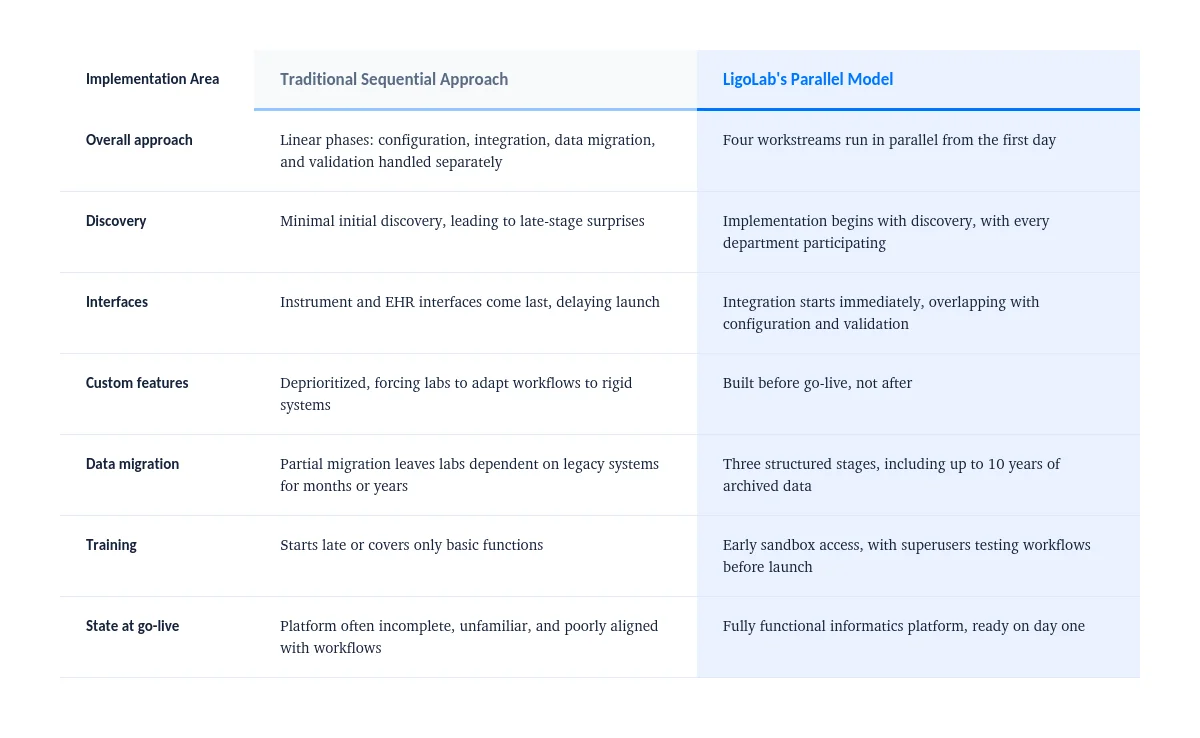
How Does a Traditional Sequential Lab Information System Implementation Compare With LigoLab's Parallel LIS Model?
Why Do Most LIS System Implementations Struggle?
Laboratory leaders recognize the importance of digital transformation. They know that modern LIS lab platforms can unify operations, automate workflows, optimize revenue, connect systems, and generate insights. But the leap from recognition to action is where problems begin.
Labs typically encounter the same pain points across every stage of their lab information system journey.
1. Why Are the Stakes So High?
Laboratory information system implementations affect nearly every aspect of laboratory operations, from daily workflows and quality control to regulatory compliance, customer experience, and financial performance. When an implementation falls short, the consequences can extend well beyond operational disruptions, potentially affecting patient care, reimbursement, regulatory standing, and long-term business sustainability.
With so much at stake, labs typically proceed with caution. Concerns about choosing the wrong platform, facing extended downtime, or unexpected costs often lead to hesitation, leaving many organizations stuck with outdated laboratory information systems that limit performance and growth.
Industry Insights: Why the Future of the Laboratory Information System Must Be Active, Intelligent, and Integrated
2. Why Do Sequential Legacy Laboratory Information System Implementations Run Slowly?
Traditional LIS software vendors often follow linear, sequential implementation processes. They handle configuration, integration, data migration, and validation in separate phases. While predictable, this approach is inefficient, siloed, and often causes rework.
- Minimal initial discovery leads to late-stage surprises.
- Interfaces with instruments and EHRs come last, delaying launch.
- Custom features are deprioritized, forcing labs to adapt their workflows to rigid systems.
- Partial data migration leaves labs dependent on legacy LIS systems for months, or even years.
When go-live finally arrives, the LIS medical platform is often still incomplete, unfamiliar, and poorly aligned with actual workflows.
Discover More: Is the Fear of Failing a Problem at Your Laboratory?
3. Why Does Resistance to Change Derail Adoption?
Even the best LIS lab solution will struggle if users feel uncertain, overwhelmed, or unprepared. Implementation efforts often overlook change management and training, leaving staff to scramble at go-live.
Employees worry about:
- Workflow disruption
- Increased workload during changeover
- Loss of control or expertise
- Poor usability of the new LIS system
If training starts too late or is limited to only basic laboratory information system functions, staff feel unprepared. Morale suffers, adoption slows, and reliance on old workarounds persists, defeating the purpose of the upgrade.
Industry Insights: Choosing a Vendor - Guidance for Your LIS System Upgrade

4. Why Is Data Migration the Silent Dealbreaker?
Data migration is one of the biggest pain points during transition, and one of the least addressed early enough.
Labs often discover too late that:
- Historical data is only partially imported.
- Mapping errors lead to mismatched or inaccessible records.
- Labs need duplicate systems to maintain access to past results.
- PHI, compliance, and legal retention standards increase complexity.
Incomplete migration undermines trust, slows adoption, and creates operational gaps that labs may never fully recover from.
Discover More: Transitioning from CoPath to LigoLab - A Seamless Path to LIS System Modernization
How Does LigoLab's Parallel, People-Centric Implementation Model Work?
Where traditional laboratory information sysLigoLab designed an LIS model that works differently, faster, smarter, tem companies rely on linear configurations and reactive issue resolution, and in parallel.
"LigoLab takes a different approach. From the first day, four workstreams run in parallel," explained Avunjian. "Within 48 hours of signing, the lab has a dedicated environment set up."
The four parallel workstreams include:
- System Configuration and Validation
- Integration and Connectivity
- Data Migration
- Training and Change Enablement
Specialists lead each workstream and coordinate across teams to ensure nothing falls through the cracks. Let's explore each workstream.
Discover More: Two Major Reasons Why You Should Consider LigoLab for Your LIS System Upgrade
1. How Does Early Discovery Shape Configuration and Workflow Alignment?
Implementation begins with discovery, not configuration.
Every department participates: accessioning, technical, laboratory billing, QA, compliance, client services, and administration. LigoLab maps current workflows, identifies inefficiencies, and flags early opportunities for improvement.
Rather than fitting workflows into pre-packaged templates, LigoLab’s informatics platform is configured to support the lab's actual, unique needs.
Customized features, whether for advanced digital pathology solutions, molecular diagnostics, lab billing queues, or outreach portals, are all built before go-live, not after.
Industry Insights: The Competitive Edge in Laboratory Outreach - Enhancing Value Beyond Price
2. Why Does Integration Start Immediately, Not at the End?
In legacy implementations, laboratory software system interfaces (EHR, instruments, analyzers, lab revenue cycle management platforms, portals, state registries) are built last. Yet integrations are typically where timelines break.
LigoLab starts integration work from day one, overlapping it with configuration and validation.
- Instrument interfaces go live early for real testing.
- EHR interfaces for inbound/outbound data are developed and validated in parallel.
- Client-specific formats (PDF, HL7, FHIR, XML) are tested in sandbox environments.
- Laboratory billing systems, clearinghouses, and payment posting tools are all connected before launch.
This eliminates the "integration crunch" that typically pushes go-live dates back by months.
Discover More: Why LigoLab’s LIS System Implementation Model Outpaces Legacy Lab Vendors
3. How Does Three-Stage Data Migration Work?
LigoLab's migration model avoids the partial-transfer trap that plagues many projects.
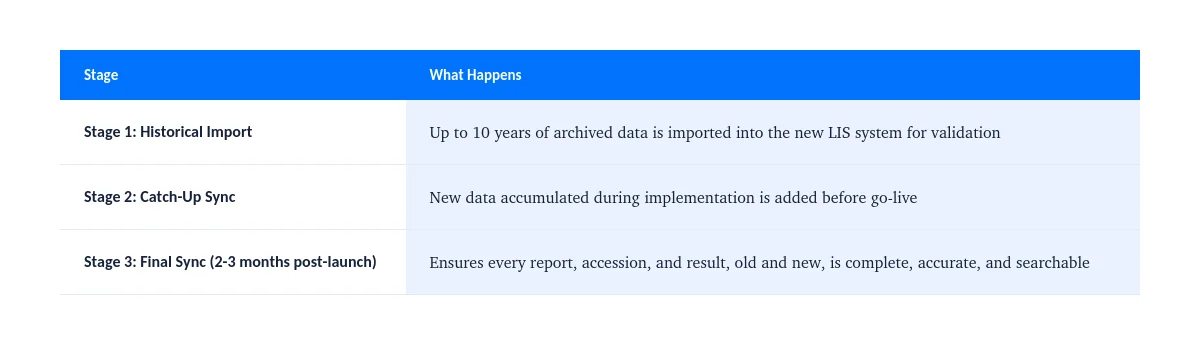
This staged model enables labs to retire legacy LIS systems, ensuring a clean transition and reducing IT maintenance overhead.
Discover More: Best Practices Guide - Managing LIS System Timelines for Vendor Research and Implementation
4. How Does Training Build Confidence, Ownership, and Adoption?
Change management is much more than LIS software training; it's mindset training.
Instead of waiting until just before go-live, LigoLab introduces early access through sandbox environments. Superusers test workflows, approve changes, and fine-tune configurations. Staff become familiar with real scenarios, not generic demos.
This leads to:
- Confident go-live readiness
- Strong internal champions
- Early workflow optimization
- Higher staff adoption from day one
By launch, the LIS system no longer feels "new"; it feels like theirs.
Discover More: Keys to Keeping Your LIS System Implementation on Track

What Do Labs Report After a Parallel Implementation?
Unlike the conventional stop-and-start model, LigoLab's implementation approach limits risk, minimizes disruption, and maintains operational continuity.
Laboratories report:
- Faster implementations
- Less stress for staff
- Fewer post-go-live fixes
- Higher user adoption
- Faster ROI from automation
- Full reliance on the new platform, without legacy crutches
Instead of forcing labs to adapt to the system, the LIS software adapts to the lab.
Why Should an LIS Medical Implementation Be a Strategic Partnership?
Undergoing a successful digital transformation requires both a LIS software upgrade and an understanding of how that software fits into a lab's workflows, priorities, and growth strategy.
The most successful labs don't just choose a vendor; they select a laboratory information system partner. A partner that:
- Understands the lab's unique vision and growth plan
- Builds for scalability, not just current needs
- Empowers internal teams with training and flexibility
- Provides ongoing support without nickel-and-diming for service requests
- Designs LIS lab platforms that evolve with the organization
For laboratories that want to grow aggressively through digital pathology, molecular expansion, new client networks, or direct-to-consumer lab testing services, choosing the right LIS company can mean the difference between maintaining the status quo and leading the future.
Discover More: Why Medical Labs Should Consider Deeper Alignment with Their LIS System Partner
Is a Parallel Implementation Right for Every Lab?
Not necessarily. Running four workstreams at once means more simultaneous involvement from the lab: discovery with every department, early sandbox testing, superuser time, and interface and migration work happening at the same time. A smaller lab with limited staff may find that harder to resource than a simpler, more sequential rollout, and the practical constraint is often internal time rather than the vendor's method.
The problems described for traditional implementations are patterns lab vendors often follow, not universal rules. Not every vendor sequence works the same way, so ask any vendor, including LigoLab, how they handle discovery, interfaces, data migration, and training, and ask for references from labs of your size and complexity. The outcomes listed above are what laboratories report to LigoLab, so treat them as claims to verify with those references.
Scope matters too. A lab with minimal historical data or only a handful of interfaces may find the sequence matters less than a lab with years of archived records and many instrument and EHR connections. Confirm migration scope up front as well: LigoLab's model imports up to 10 years of archived data, so labs with longer retention needs should ask how older records will be handled.
For labs facing heavy integration loads, deep archives, and staff worried about disruption, though, running these workstreams in parallel addresses exactly the pain points described above.
Industry Insights: The Modern Laboratory Blueprint - Aligning People, Processes, and Technology for Long-Term Success
What Is the Final Takeaway on LIS System Adoption?
Laboratory information system adoption will always involve complexity. But with the right implementation approach, one that moves quickly with every department, accounts for real-world complexity, and builds for the future, labs can achieve smoother transitions, better outcomes, and stronger long-term value.
"The result is a fully functional informatics platform ready on day one. The new LIS system adapts to the lab's workflows, not the other way around," concluded Avunjian.
Continue Your Research
- Large-Scale Implementation Guide: A Best Practices Guide for Large-Scale Laboratory Information System Implementations
- Timeline Guide: Best Practices Guide - Managing LIS System Timelines for Vendor Research and Implementation
- Migration White Paper: Transitioning from CoPath to LigoLab - A Seamless Path to LIS System Modernization
- Vendor Evaluation: Choosing a Vendor - Guidance for Your LIS System Upgrade
Ready to See How Modern LIS Software Implementation Can Transform Your Laboratory?
Schedule a conversation with a LigoLab product specialist today.
Act Now: Speak with a Product Specialist!
Frequently Asked Questions About Laboratory Information System (LIS) Adoption and Implementation
Why is adopting a new laboratory information system (LIS) so difficult for labs?
Laboratory information system deployment affects workflows, quality control, compliance, customer experience, and financial performance, so the stakes are high. Concerns about choosing the wrong platform, extended downtime, unexpected costs, training, data migration, system integration, and staff resistance often lead labs to delay or abandon the transition.
Why do traditional LIS medical implementations run behind schedule?
Traditional LIS vendors often approach configuration, integration, data migration, and validation as separate, sequential phases. Insufficient upfront discovery can lead to unexpected challenges late in the implementation process, while delayed instrument and EHR integrations can postpone go-live dates. Incomplete data migration can further complicate the transition, forcing laboratories to maintain legacy systems for months or even years.
How does LigoLab's parallel implementation model work?
Four workstreams run in parallel from day one: System Configuration and Validation, Integration and Connectivity, Data Migration, and Training and Change Enablement. Specialists lead each workstream, and LigoLab sets up a dedicated environment within 48 hours of signing.
How does LigoLab migrate data from a legacy lab information system?
Migration happens in three stages: a historical import of up to 10 years of archived data for validation, a catch-up sync that adds new data accumulated during implementation before go-live, and a final sync 2 to 3 months after launch that confirms every report, accession, and result is complete, accurate, and searchable.
How does sandbox training improve LIS system adoption?
Early sandbox access lets superusers test workflows, approve changes, and fine-tune configurations. It also lets staff practice on real scenarios rather than generic demos. The goal is go-live readiness, strong internal champions, early workflow optimization, and higher adoption from day one.
Is a parallel implementation right for every lab?
Not always. Running several workstreams at once requires more simultaneous involvement from the lab. This can be difficult for smaller teams to resource. Labs should ask any vendor how they sequence discovery, interfaces, migration, and training, and request references from labs of similar size and complexity.