Industry Insights
LigoLab vs. LabWare: Comparing Laboratory Information Systems, Automation, and Lab Revenue Cycle Management

November 4, 2026

Choosing the right laboratory information system (LIS) software is one of the most important technology decisions a diagnostic laboratory can make.
Today's laboratories need more than a database for managing specimens and test results. They require connected laboratory workflow management technology that supports accessioning, sample tracking, testing, quality control, workflow automation, reporting, interoperability, regulatory compliance, analytics, and, increasingly, laboratory revenue cycle management (RCM).
That makes comparisons between leading laboratory software systems more complex, particularly when evaluating platforms designed for different laboratory environments.
Two established companies worth comparing are LigoLab and LabWare.
Both offer sophisticated laboratory informatics technology, configurable workflows, automation capabilities, and enterprise-level solutions for managing laboratory data and operations.
However, their primary markets and architectural priorities are different.
LabWare is best known for its laboratory information management system (LIMS) and electronic laboratory notebook (ELN) solutions, which support laboratory operations across pharmaceutical, biotechnology, manufacturing, environmental, food and beverage, and other scientific industries.
LigoLab focuses on diagnostic healthcare, providing a unified laboratory information system and lab revenue cycle management platform purpose-built for anatomic pathology, clinical laboratories, molecular diagnostics, microbiology, and related medical testing operations.
For laboratories comparing LigoLab vs. LabWare, the central question isn't simply which company offers more features.
A more useful question is:
Which laboratory informatics platform best aligns with your organization's testing environment, regulatory requirements, operational workflows, financial processes, and long-term growth strategy?
The answer depends heavily on whether the organization primarily manages scientific laboratory processes or delivers diagnostic testing services that must connect clinical operations with patient care and reimbursement.
Industry Insights: Best LIS Systems - Top Laboratory Information Systems Compared for Clinical, Pathology, and Outreach Labs
LigoLab vs. LabWare: Laboratory Software Comparison at a Glance
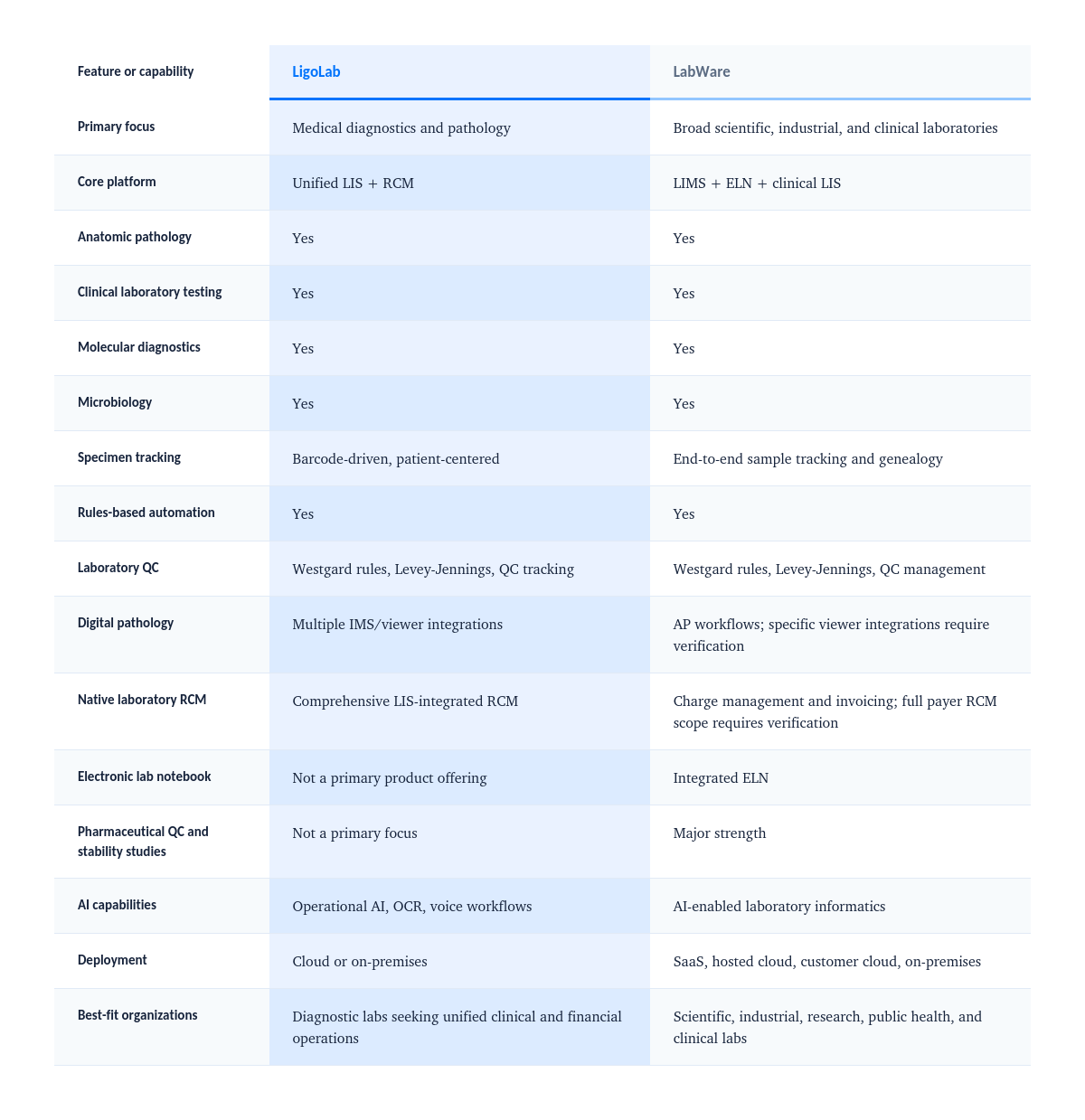
Editor’s Note: LabWare's published product documentation confirms that its healthcare offering includes anatomic pathology, clinical diagnostics, molecular testing, charge management, and quality control. It should not be characterized as exclusively an industrial LIMS vendor.
What Is LabWare?
LabWare supports laboratory operations across numerous industries, including pharmaceuticals, biotechnology, contract research, environmental testing, food and beverage, manufacturing, public health, and clinical diagnostics.
LabWare's core strength is its configurable architecture, which allows organizations to manage complex laboratory workflows, testing protocols, instrument data, quality processes, and regulatory documentation.
Its capabilities include sample management, batch and lot tracking, stability studies, environmental monitoring, inventory control, instrument integration, electronic records, analytics, and configurable reporting.
LabWare also offers a dedicated clinical lab information system solution supporting multiple medical testing specialties.
That includes anatomic pathology, cytology, chemistry, hematology, microbiology, molecular biology, cytogenetics, immunology, and toxicology.
This combination of scientific laboratory management and clinical diagnostic functionality makes LabWare relevant to organizations operating across research, production, quality control, and medical testing environments.
For organizations seeking comprehensive lab LIMS software capabilities, integrated electronic laboratory notebooks, and configurable scientific workflows, LabWare offers a compelling solution.
Discover More: Differences Between Laboratory Information Management Systems (Lab LIMS) and Laboratory Information Systems (LIS Systems)
What Is LigoLab?
LigoLab approaches laboratory informatics from a diagnostic healthcare perspective.
Rather than focusing on general-purpose scientific laboratory management, LigoLab provides an all-in-one LIS and laboratory revenue cycle management platform designed specifically for medical laboratories and pathology organizations.
Its comprehensive, configurable architecture supports anatomic pathology, cytology, chemistry, hematology, microbiology, molecular biology, cytogenetics, immunology, and toxicology, plus specimen management, digital pathology, laboratory billing, business intelligence, operational AI, and direct-to-consumer lab testing.
LigoLab's central architectural advantage is its “One Source of Truth” LIS model, which connects clinical, operational, and financial workflows within the same informatics environment.
Instead of treating testing and laboratory billing as separate processes managed by disconnected applications, the platform enables information to move friction-free across the diagnostic and revenue cycles.
This is important for medical laboratories because patient demographics, insurance information, test orders, diagnosis codes, specimen data, and lab billing requirements are inherently connected.
LigoLab also positions its technology as a System of Action, using real-time information, configurable rules, automation, and exception management to move work forward rather than simply record completed activities.
For pathology groups, reference laboratories, hospital outreach operations, and growing diagnostic organizations, this integrated approach provides a foundation for improving operational efficiency and financial performance.
Industry Insights: From System of Record to System of Action – The Next Evolution of Laboratory Information Systems
LIS vs. LIMS: Understanding the Fundamental Difference
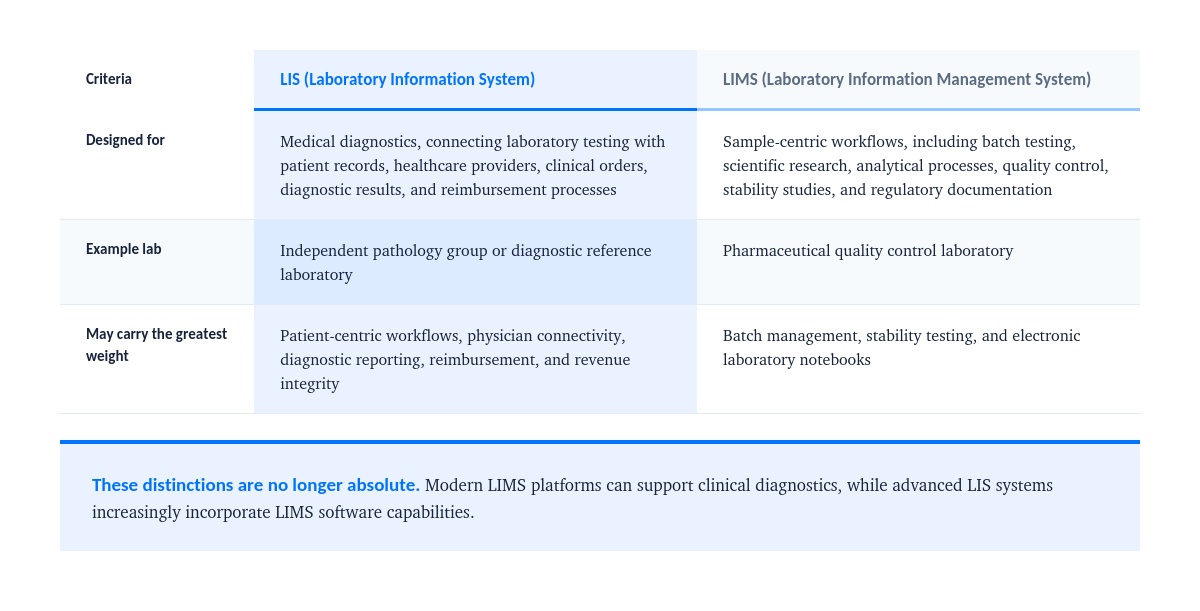
Discover More: How the Best LIS Systems Support CAP and CLIA Compliance
Anatomic Pathology Software: LigoLab vs. LabWare
Anatomic pathology software is an important consideration for laboratories processing surgical pathology specimens, biopsies, cytology samples, and other diagnostic cases.
Both LigoLab and LabWare offer anatomic pathology LIS functionality, although their broader product strategies differ.
LabWare provides an anatomic pathology solution that can operate independently or as part of its integrated clinical laboratory environment. This makes it relevant for organizations seeking pathology capabilities within a larger laboratory informatics deployment.
LigoLab's Anatomic Pathology LIS is a foundational module.
It supports the pathology case lifecycle through accessioning, barcode generation, specimen tracking, grossing, electronic histology, cytology, result entry, case distribution, image acquisition, synoptic reporting, quality control, and final sign-out.
Additional capabilities include grossing touchscreens, document management, peer review, pathologist scheduling, automated case assignment, and integrated digital pathology workflows.
A key differentiator for LigoLab is its ability to seamlessly connect anatomic pathology workflows with laboratory revenue cycle management within a unified informatics platform.
This integration enables coordinated diagnostic case management, coding, billing, reimbursement, and financial reporting, helping streamline operations, strengthen revenue integrity, and improve financial performance.
Discover More: The Role of Anatomic Pathology LIS Software in Optimizing Laboratory Workflow Management
Sample Tracking and Laboratory Workflow Management
Accurate specimen identification and traceability are essential requirements for both clinical and nonclinical laboratories.
LabWare provides extensive sample management functionality, including sample registration, barcode tracking, batch processing, chain-of-custody documentation, testing status, and sample genealogy.
These capabilities are particularly valuable for scientific and industrial laboratories that require precise management, tracking, and documentation of multiple samples, lots, batches, and analytical workflows.
LigoLab provides comprehensive, patient-centered specimen tracking throughout the diagnostic testing lifecycle, using barcode-driven workflows to connect accessioning, grossing, cassette creation, histology, slide preparation, clinical testing, and final reporting.
With configurable specimen labels, scanning requirements, automated routing, and detailed audit trails, the platform maintains end-to-end traceability while supporting accountability, turnaround-time monitoring, and efficient exception management. By linking patients, orders, specimens, results, and billable services within a unified environment, LigoLab enhances workflow visibility, operational efficiency, and data integrity.
Discover More: How Best Practices and Advanced Technology Help Ensure Laboratory Data Integrity
Molecular LIS Software and Complex Testing Workflows
Molecular diagnostics is an area where both laboratory informatics platforms offer substantial functionality.
LabWare supports molecular and genomics workflows involving nucleic acid extraction, PCR, next-generation sequencing, Sanger sequencing, microarrays, flow cytometry, cytogenetics, FISH, and related analytical processes.
Its integrated LIMS and ELN architecture is particularly useful for laboratories managing complex experimental procedures, multi-well plates, large datasets, and frequently changing testing protocols.
LigoLab also provides configurable Molecular LIS software for diagnostic laboratories performing PCR, sequencing, FISH, cytogenetics, flow cytometry, and other esoteric testing.
Its capabilities include batch processing, specimen tracking, configurable testing panels, workflow automation, instrument interfaces, result management, and integrated reporting.
The key difference is how molecular testing connects with the rest of the laboratory organization.
LabWare is particularly well suited to organizations that require a combination of research-oriented and diagnostic molecular workflows.
LigoLab is differentiated for medical laboratories that want molecular testing integrated with anatomic pathology, clinical laboratory operations, physician reporting, and lab revenue cycle management.
Discover More: What Is the Best LIS for Molecular Testing Labs?
Clinical Laboratory Information System Capabilities
Clinical laboratory software must support high testing volumes, accurate instrument communication, quality control, timely reporting, and reliable connectivity with healthcare systems.
Both companies provide capabilities in this area.
LabWare's clinical LIS software supports chemistry, hematology, urinalysis, coagulation, immunology, serology, microbiology, virology, and other diagnostic specialties.
Its healthcare solution includes analyzer interfaces, configurable testing rules, autoverification, reference ranges, delta checks, phlebotomy, patient management, physician portals, and preliminary and final reporting.
LigoLab also supports multidisciplinary clinical laboratory testing through bidirectional instrument connectivity, automated result processing, batch workflows, quality control, autoverification, specimen tracking, and configurable exception management.
Its microbiology functionality includes plate management, organism identification, susceptibility data, preliminary results, and reporting.
A differentiator is LigoLab’s ability to manage clinical laboratory operations alongside anatomic pathology LIS workflows and lab RCM within a unified informatics environment.
Discover More: Manage Complex Processes with LigoLab's Clinical Laboratory Management Solutions
Digital Pathology Integration
Digital pathology is becoming increasingly important for laboratories seeking to modernize diagnostic workflows, support remote collaboration, and incorporate artificial intelligence into pathology operations.
Both companies recognize the growing convergence of traditional pathology and advanced digital technologies.
LabWare's December 2025 anatomic pathology update enhanced histology workflows, molecular testing integration, case assignment, and pathology reporting. While these improvements strengthen its pathology capabilities, laboratories should confirm compatibility with their preferred whole-slide imaging viewers, image management systems, and digital pathology interfaces before making a purchasing decision.
LigoLab has developed a broad digital pathology integration strategy.
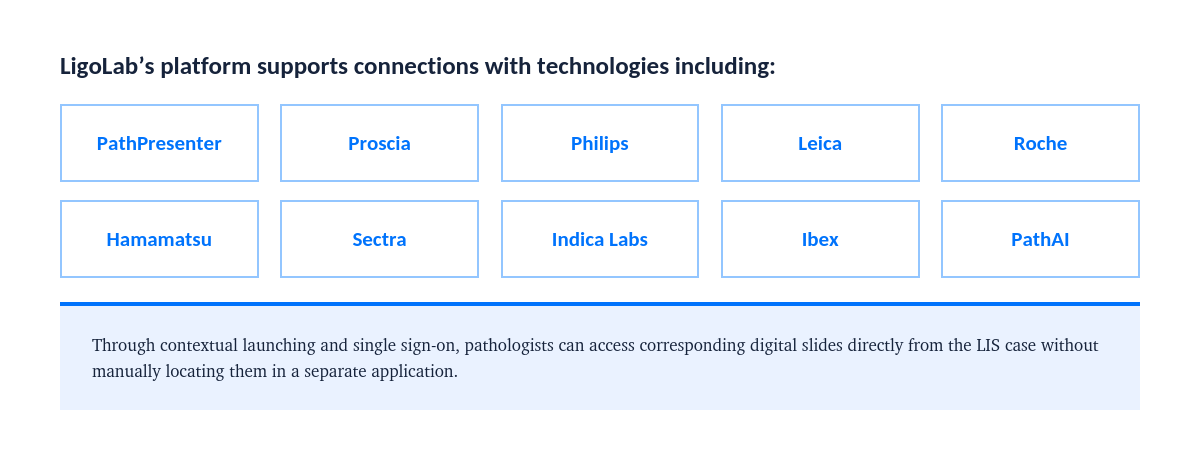
Through contextual launching and single sign-on, pathologists can access corresponding digital slides directly from the LIS case without manually locating them in a separate application.
This approach helps connect specimen management, image review, diagnostic interpretation, and pathology reporting.
For pathology practices investing in digital transformation, LigoLab's documented digital pathology ecosystem is an important consideration.
Industry Insights: ECPC's Strategic Leap into Digital Pathology – A Connected Vision for the Future
Laboratory Revenue Cycle Management: A Major Differentiator
LabWare supports clinical laboratory financial workflows through charge management, patient billing information, contract pricing, client invoicing, and medical necessity verification.
These features can be valuable for laboratories managing client accounts and service-based billing.
However, organizations requiring comprehensive U.S. diagnostic laboratory revenue cycle management should evaluate whether their LabWare configuration provides the necessary payer-focused functionality natively or through integrations.
LigoLab takes a different approach by incorporating laboratory RCM software directly into its core informatics architecture.
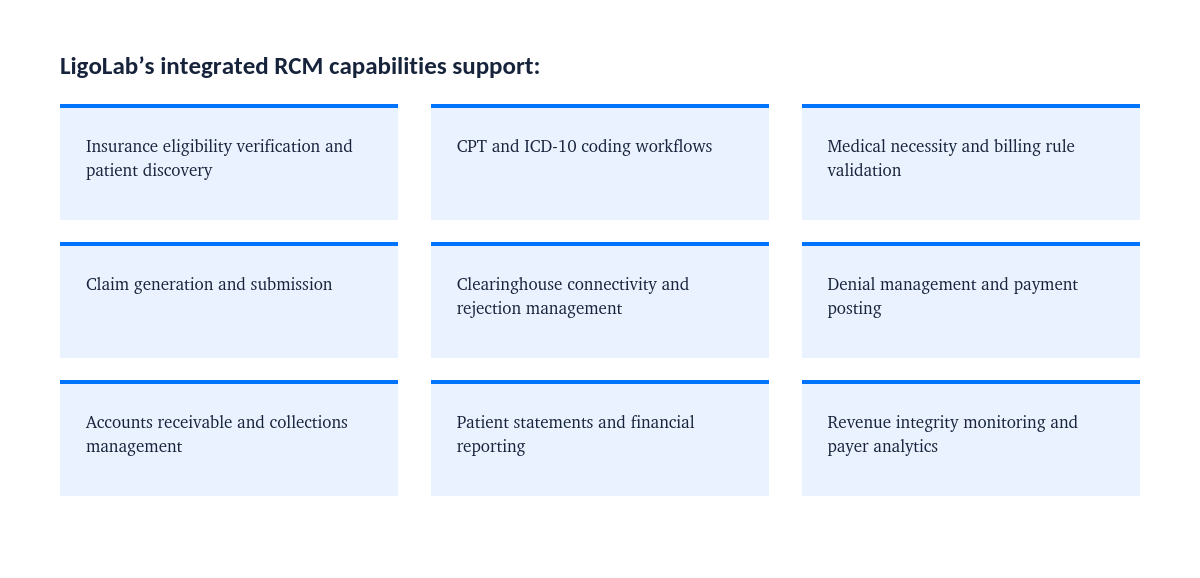
More importantly, LigoLab's LIS and RCM modules share the same underlying data environment.
This enables information generated during order entry, accessioning, testing, and reporting to support downstream financial processes without depending on synchronization between separate LIS and billing databases.
For example, the platform automatically identifies missing insurance information, incomplete patient demographics, coding discrepancies, and documentation errors, and then routes these issues for correction before claims are submitted to reduce denials, avoid costly rework, and accelerate reimbursement.
For independent pathology groups, reference laboratories, and diagnostic organizations facing mounting reimbursement pressure, this proactive approach to laboratory billing offers a significant advantage by improving claim accuracy, protecting revenue, reducing administrative costs, and strengthening financial performance.
Industry Insights: Why LIS and RCM Integration Is a Laboratory Survival Imperative
Automation and Rules Engines
Automation is a central capability of both LigoLab and LabWare.
LabWare’s Rules Manager supports conditional actions involving test interpretation, flags, reflex testing, result comments, and reporting.
LigoLab's automation architecture is designed specifically around diagnostic laboratory workflows and their financial consequences.
Its Rules and Automation Engines support order processing, specimen routing, testing, autoverification, case distribution, reporting, and exception management.
Because LigoLab incorporates native RCM, automation can extend beyond the technical laboratory into billing-related workflows.
This means operational and financial activities can be coordinated through shared data, business rules, and work queues.
For laboratories seeking to reduce manual intervention while maintaining control over complex diagnostic workflows, this integrated automation LIS model can help improve productivity, turnaround times, and billing readiness.
Discover More: How LigoLab's Automation Engine Supercharges Laboratory Performance
AI Features and Intelligent Laboratory Automation
Artificial intelligence is becoming an increasingly important component of laboratory informatics.
Both companies are investing in capabilities that extend beyond traditional rules-based automation.
LabWare promotes machine learning, advanced statistics, data visualization, anomaly detection, and predictive analytics.
Its AI strategy emphasizes using structured laboratory data to identify trends, improve process control, and support better operational decisions.
LigoLab's AI strategy focuses heavily on automating operational activities within diagnostic laboratories.
Examples include AI-assisted requisition processing, intelligent case distribution, voice-enabled workflows, and assistance with pathology documentation.
LigoLab is also developing additional AI-assisted capabilities for grossing, pre-sign-out review, and other laboratory operations.
The primary distinction is how each vendor applies AI.
LabWare emphasizes scientific data analysis, predictive insights, and laboratory process optimization across multiple industries.
LigoLab emphasizes diagnostic workflow automation and utilizing AI to reduce repetitive tasks and improve operational decision-making.
Discover More: Best Practices for Preparing Medical Labs for AI Integration
Quality Control, Compliance, and Audit Readiness
Laboratory quality management is essential regardless of testing specialty.
Both platforms offer tools to manage quality control data, ensure traceability, document laboratory procedures, and support regulatory compliance.
LabWare's quality management capabilities include electronic records, audit trails, analyst training, certification tracking, instrument management, inventory control, and configurable QC rules.
Its clinical laboratory solution supports Westgard rules and Levey-Jennings charts, while its broader LIMS capabilities address requirements associated with scientific testing, manufacturing, and regulated research.
LigoLab provides laboratory quality control functionality designed around clinical diagnostic workflows.
Its QC/QA capabilities include automated quality control data capture, Levey-Jennings charts, Westgard rules, trend monitoring, configurable alerts, and audit-ready reporting.
The platform also supports specimen tracking, document management, user activity logs, and other functions relevant to CLIA and CAP inspection preparation.
The distinction is the regulatory environment each laboratory must navigate.
LabWare's broad industry coverage makes it particularly relevant for organizations managing diverse quality systems and scientific testing requirements.
LigoLab's focus on medical diagnostics is attractive to laboratories that want to integrate clinical quality control with specimen management, diagnostic reporting, and operational oversight.
Discover More: A Detailed Look at How Modern Laboratory Information Systems Fully Support Quality Control
Reporting and Customization
Reporting is an important consideration when selecting laboratory software because reports are among the most visible outputs of laboratory operations.
LabWare supports configurable reporting across scientific, industrial, and clinical applications.
Its reporting capabilities include certificates of analysis, analytical data summaries, configurable dashboards, clinical laboratory results, and other structured outputs.
LigoLab also provides extensive reporting configuration, with particular emphasis on diagnostic pathology and clinical laboratory requirements.
Its Dynamic Reports functionality enables administrators to customize report templates, layouts, images, diagnostic content, and distribution requirements.
Pathology reports can incorporate case information, synoptic data, diagnostic interpretations, and other relevant clinical details.
LigoLab's broader reporting capabilities also connect laboratory operations with financial performance.
For organizations that need customizable diagnostic reports alongside integrated laboratory billing and operational analytics, this is an important consideration.
Discover More: How Modern Laboratories Produce and Distribute Reports
Interoperability: Connecting the Laboratory Technology Ecosystem
Modern laboratory software must connect with instruments, healthcare systems, external applications, and other enterprise technologies.
Both LigoLab and LabWare place significant emphasis on interoperability.
LabWare provides extensive integration capabilities for scientific instruments, laboratory automation systems, enterprise applications, and clinical systems.
Its Integration Platform supports standards and formats including REST/JSON, XML, ASTM, HL7, CSV, and other connectivity methods.
LigoLab features a native Interface Engine that connects diagnostic laboratories with electronic health records, hospital systems, analyzers, reference laboratories, digital pathology solutions, clearinghouses, and other external applications.
Supported healthcare integration formats include HL7, FHIR, XML, JSON, ASTM, CCD, and CDA.
LigoLab's interoperability strategy focuses on the diagnostic laboratory ecosystem, where connectivity between orders, specimens, results, providers, patients, and reimbursement processes is especially important.
Discover More: LIS-EHR Integration Doesn't Have to Be Painful
Business Intelligence and Operational Visibility
Both platforms provide analytics and dashboard functionality.
LabWare supports configurable dashboards, statistical analysis, trend identification, process monitoring, and visualization of scientific and operational data.
These capabilities can be especially valuable for organizations managing quality control, instrument performance, production testing, and multi-site laboratory operations.
LigoLab includes customizable Dashboards and Business Intelligence tools that support operational, clinical, statistical, and financial reporting.
Laboratory leaders can monitor specimen volumes, turnaround times, staffing productivity, workflow bottlenecks, payer performance, reimbursement trends, and revenue cycle indicators.
Because LigoLab's operational and financial modules share a unified architecture, users can evaluate laboratory performance and reimbursement-related metrics within the same informatics environment.
Discover More: Unlocking Smarter Lab Operations – LigoLab's Optional Automation and Intelligence Features
Cloud LIS and LIMS Software: Deployment Options
Deployment flexibility is another important factor when comparing laboratory software vendors.
LabWare offers multiple deployment models, including SaaS, vendor-hosted cloud, customer-managed cloud, and traditional on-premises installations.
Its preconfigured SaaS solutions are for rapid implementation, while more customized deployments support organizations with complex requirements. Availability and service commitments vary by offering and region.
LigoLab also supports cloud and on-premises deployment.
Its Microsoft Azure hosting infrastructure provides scalability, security, availability, and disaster recovery capabilities.
LigoLab reports a 99.9% uptime commitment for its cloud hosting environment, along with security and business continuity features.
Laboratories should base their deployment decisions on infrastructure needs, internal IT capabilities, cybersecurity requirements, regulatory compliance, disaster recovery planning, and long-term costs.
Industry Insights: Examining the Pros and Cons of Cloud-Based LIS Solutions
Pricing, Support, and Implementation
Implementation quality and long-term vendor support are critical considerations when evaluating laboratory information systems.
Both companies offer enterprise software that may require workflow discovery, configuration, interface development, data migration, validation, and staff training.
LabWare provides implementation services and a global support organization. Its configurable platform can accommodate complex scientific and clinical requirements, with implementation scope depending on the selected modules, integrations, and deployment model.
LigoLab emphasizes a partnership-driven approach to implementation and ongoing customer success.
Its deployment methodology includes workflow discovery, system configuration, interfaces, data migration, testing, validation, training, and go-live preparation.
LigoLab also provides dedicated customer success resources, ongoing optimization, and unlimited support under its published licensing model.
Its tiered pricing approach includes Essential, Professional, Advanced, and Enterprise offerings intended to accommodate laboratories with different operational requirements.
When comparing pricing, laboratories should consider total cost of ownership rather than licensing fees alone.
Important factors include implementation, interfaces, training, hosting, upgrades, support, additional modules, customization, internal IT requirements, and the costs of maintaining separate software applications.
White Paper: Vendor to Partner – How Aligning with Your LIS Provider Can Transform Your Lab
Where LabWare Stands Out
LabWare is a strong contender for organizations seeking a flexible, enterprise-grade laboratory information management system with extensive scientific and industrial functionality.
Its major strengths include:
- Decades of experience in laboratory informatics
- Broad support for scientific, industrial, research, and clinical laboratories
- Integrated LIMS and electronic laboratory notebook functionality
- Advanced batch, lot, and sample management
- Pharmaceutical stability studies and environmental monitoring
- Extensive instrument connectivity and enterprise integration
- Highly configurable workflows and reporting
- Quality management and regulatory documentation
- Machine learning, statistical analysis, and AI capabilities
- Flexible cloud, SaaS, and on-premises deployment
- Global implementation and support resources
LabWare's clinical LIS and updated anatomic pathology capabilities also make it an option for medical laboratories, particularly those combining diagnostic testing with research or other scientific operations.
For organizations requiring broad LIMS functionality and scientific data management across multiple disciplines, LabWare deserves serious consideration.
Where LigoLab Stands Out
LigoLab's primary differentiation is its comprehensive, diagnostic-focused architecture that unifies operations and laboratory revenue cycle management.
Rather than treating the medical LIS as a standalone testing application, LigoLab connects the clinical, operational, and financial activities that drive diagnostic laboratory performance.
Its major differentiators include:
- Native LIS and laboratory RCM integration
- One Source of Truth data architecture
- Anatomic pathology, clinical, molecular, and microbiology support
- Highly configurable diagnostic workflows
- Rules-driven automation across laboratory and financial processes
- Integrated specimen tracking and pathology case management
- Digital pathology and image management integrations
- AI-assisted requisition processing and operational automation
- Voice-enabled pathology workflows
- Native Interface Engine and healthcare interoperability
- Integrated financial and operational analytics
- Direct-to-consumer lab testing through TestDirectly
- Cloud and on-premises deployment options
- Tiered pricing, unlimited users, and ongoing customer support
For pathology practices, diagnostic reference laboratories, and multidisciplinary medical testing organizations, these capabilities address challenges that extend beyond specimen management and result reporting.
They help connect laboratory productivity, diagnostic quality, operational visibility, and revenue integrity.
White Paper: Bridging the Gap in Modern Laboratories – Why a Comprehensive Digital Platform Outperforms a Traditional LIS
The Bottom Line: Which Laboratory Software Platform Is the Better Fit?
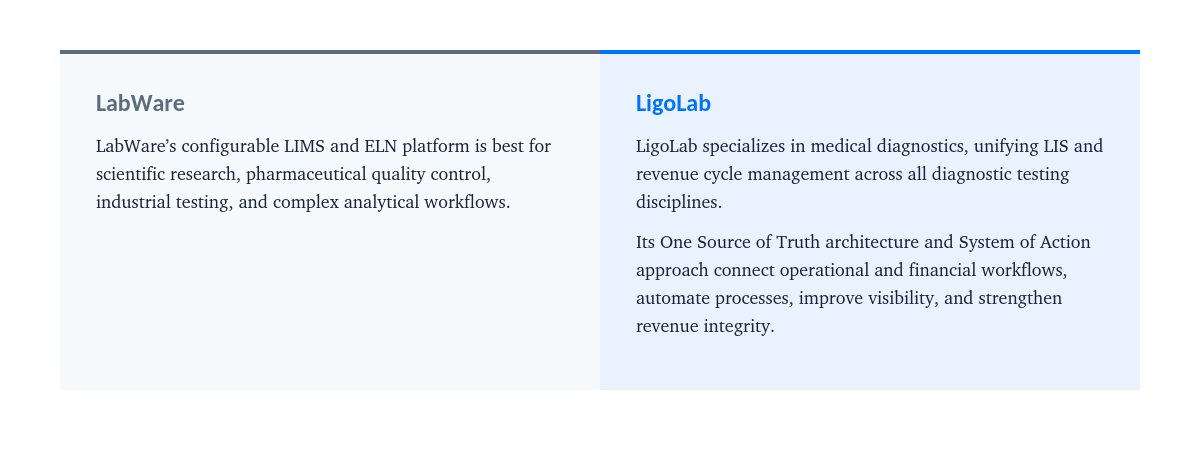
LabWare’s configurable LIMS and ELN platform is best for scientific research, pharmaceutical quality control, industrial testing, and complex analytical workflows.
LigoLab specializes in medical diagnostics, unifying LIS and revenue cycle management across all diagnostic testing disciplines. Its One Source of Truth architecture and System of Action approach connect operational and financial workflows, automate processes, improve visibility, and strengthen revenue integrity.
Ultimately, the best platform should deliver the flexibility, automation, and scalability needed to support current operations and future growth.
Ready to See What a Unified LIS + RCM Platform Can Do?
Discover how LigoLab can help your laboratory streamline workflows, increase automation, strengthen revenue integrity, and create a scalable foundation for long-term success.
Act Now: Speak with a LigoLab Product Specialist!
Frequently Asked Questions: LigoLab vs. LabWare
What is the main difference between LigoLab and LabWare?
LabWare is a broad laboratory informatics provider offering LIMS, ELN, and clinical LIS solutions for scientific, industrial, research, and healthcare environments. LigoLab specializes in diagnostic laboratory informatics, integrating medical LIS and lab revenue cycle management into a single platform for pathology groups, clinical laboratories, and other medical testing organizations.
Is LabWare a LIMS or an LIS?
LabWare offers both. Its core product is an enterprise laboratory information management system, and it also provides a clinical laboratory information system supporting anatomic pathology, clinical chemistry, microbiology, molecular diagnostics, and other medical testing disciplines.
Is LigoLab an LIS or a LIMS?
LigoLab is primarily a medical laboratory information system with integrated laboratory revenue cycle management. Its platform also includes specimen tracking, workflow automation, quality control, instrument integration, and other capabilities commonly associated with LIMS software.
Does LabWare support anatomic pathology?
Yes. LabWare offers an anatomic pathology solution that supports histology protocols, specimen processing, case coding, molecular testing integration, workload assignment, and pathology reporting.
Does LigoLab support anatomic pathology?
Yes. LigoLab provides comprehensive anatomic pathology software supporting surgical pathology, histology, cytology, grossing, specimen tracking, case management, synoptic reporting, digital pathology integration, and diagnostic sign-out.
Which platform is better for clinical laboratory testing?
Both support clinical laboratory operations. LabWare provides clinical LIS functionality across multiple diagnostic specialties. LigoLab is best for medical laboratories seeking to integrate clinical testing, anatomic pathology, molecular diagnostics, and laboratory revenue cycle management.
Which system is better for lab RCM?
LigoLab offers a more clearly documented, comprehensive native lab RCM platform that supports claim processing, eligibility, coding workflows, denial management, payment posting, and financial analytics. LabWare provides charge management, client invoicing, and related clinical financial functionality, but laboratories should verify the scope of its payer-focused RCM capabilities.
Does LabWare offer an electronic laboratory notebook?
Yes. LabWare offers an integrated ELN that supports scientific documentation, experimental workflows, data capture, and collaboration.
Does LigoLab offer integrated laboratory revenue cycle management?
Yes. LigoLab's LIS and RCM modules operate within a unified informatics environment, allowing diagnostic and financial workflows to share data and support upstream revenue integrity.
Do LigoLab and LabWare support molecular diagnostics?
Yes. Both support molecular testing workflows, including PCR, sequencing, cytogenetics, and other specialized diagnostic processes. LabWare also offers extensive research-oriented molecular functionality through its LIMS and ELN architecture.
Which platform offers better laboratory automation?
Both provide configurable automation and rules engines. LabWare offers extensive scientific and analytical workflow automation, while LigoLab focuses on diagnostic laboratory automation that can extend into lab revenue cycle management.
Do LigoLab and LabWare offer AI capabilities?
Yes. LabWare promotes machine learning, advanced analytics, anomaly detection, and predictive insights. LigoLab focuses on operational AI, including requisition processing, intelligent workflow automation, voice-enabled functionality, and emerging pathology assistance tools. Feature availability should be confirmed during demonstrations.
Which platform is better for digital pathology?
LigoLab has a documented integration ecosystem that includes multiple digital pathology viewers and image management platforms. LabWare supports anatomic pathology workflows and technology integration, but laboratories should confirm compatibility with their preferred digital pathology solutions.
Is LabWare cloud-based?
Yes. LabWare offers SaaS, hosted cloud, customer-managed cloud, and on-premises deployment options. Availability depends on the selected product and region.
Is LigoLab cloud-based?
Yes. LigoLab offers both Microsoft Azure cloud hosting and on-premises deployment. It gives laboratories the flexibility to select the infrastructure that best meets their operational, security, and IT requirements.
Which system is better for a small pathology practice?
Both may be suitable depending on requirements. LigoLab's tiered pricing and integrated diagnostic workflows may appeal to smaller pathology practices seeking a scalable LIS with a path toward expanded functionality.
Which platform is better for enterprise laboratories?
Both support enterprise-scale operations. LabWare is especially relevant for large organizations managing scientific, manufacturing, research, and clinical testing environments. LigoLab is best for multi-site diagnostic organizations seeking to unify clinical laboratory operations and lab revenue cycle management.
What should laboratories compare before selecting LigoLab or LabWare?
Laboratories should evaluate specialty coverage, workflow configuration, specimen tracking, instrument interfaces, reporting, quality control, compliance, AI, automation, digital pathology, lab RCM, deployment, security, implementation, support, pricing, scalability, and total cost of ownership.
How should a laboratory choose between LIS and LIMS software?
Begin by identifying the organization's primary workflows and business requirements. Laboratories focused on research, manufacturing, and scientific quality control may prioritize traditional LIMS capabilities. Diagnostic laboratories should emphasize patient-centered workflows, clinical reporting, healthcare interoperability, and reimbursement.
Why is LIS and RCM integration important?
Laboratory operations and financial performance are closely connected. Patient demographics, insurance information, medical necessity, diagnoses, test orders, and coding directly affect reimbursement. Integrating LIS and RCM enables laboratories to identify potential lab billing problems earlier, reduce reconciliation work, and improve revenue integrity.
Is replacing a legacy LIS or LIMS worth the investment?
It can be when an existing system limits automation, interoperability, reporting, scalability, compliance support, or financial performance. Organizations should evaluate potential improvements alongside migration complexity, implementation costs, training requirements, and operational disruption.