News
Optimize Your Laboratory Billing Solutions with LigoLab's Comprehensive LIS & RCM Platform

March 26, 2026

For independent pathology groups and clinical laboratories to truly optimize laboratory billing (lab revenue cycle management), the laboratory billing process must start at order entry.
That’s the belief shared by Edward Kharatian, Medical Director and Co-Founder of LigoLab, a thriving Los Angeles laboratory software systems enterprise specializing in pathology lab reporting software, such as advanced laboratory information system (LIS) software for medical labs throughout the United States.
During a recent site visit with a LigoLab partner lab, Kharatian provided in-depth explanations of why staff must fully integrate lab billing across all workflows and processes. Without full transparency in the lab RCM cycle, organizations are leaving money on the table.
Get Insight: Maximizing Your Lab’s Profitability - The Case for In-House Lab Billing
Break Free from Fragmented Systems: How LigoLab Unifies Medical LIS and Lab Billing Workflows on One Platform
As a robust, all-in-one medical laboratory information system with advanced laboratory billing solutions embedded within the comprehensive platform, LigoLab offers its customers the power and full transparency of a unified lab database software and infrastructure, supporting all technical and financial workflows, rather than the typical multi-system arrangement of a standalone lab information system and laboratory billing system.
How the Unified Clinical Laboratory Management Works from Order Entry Onward
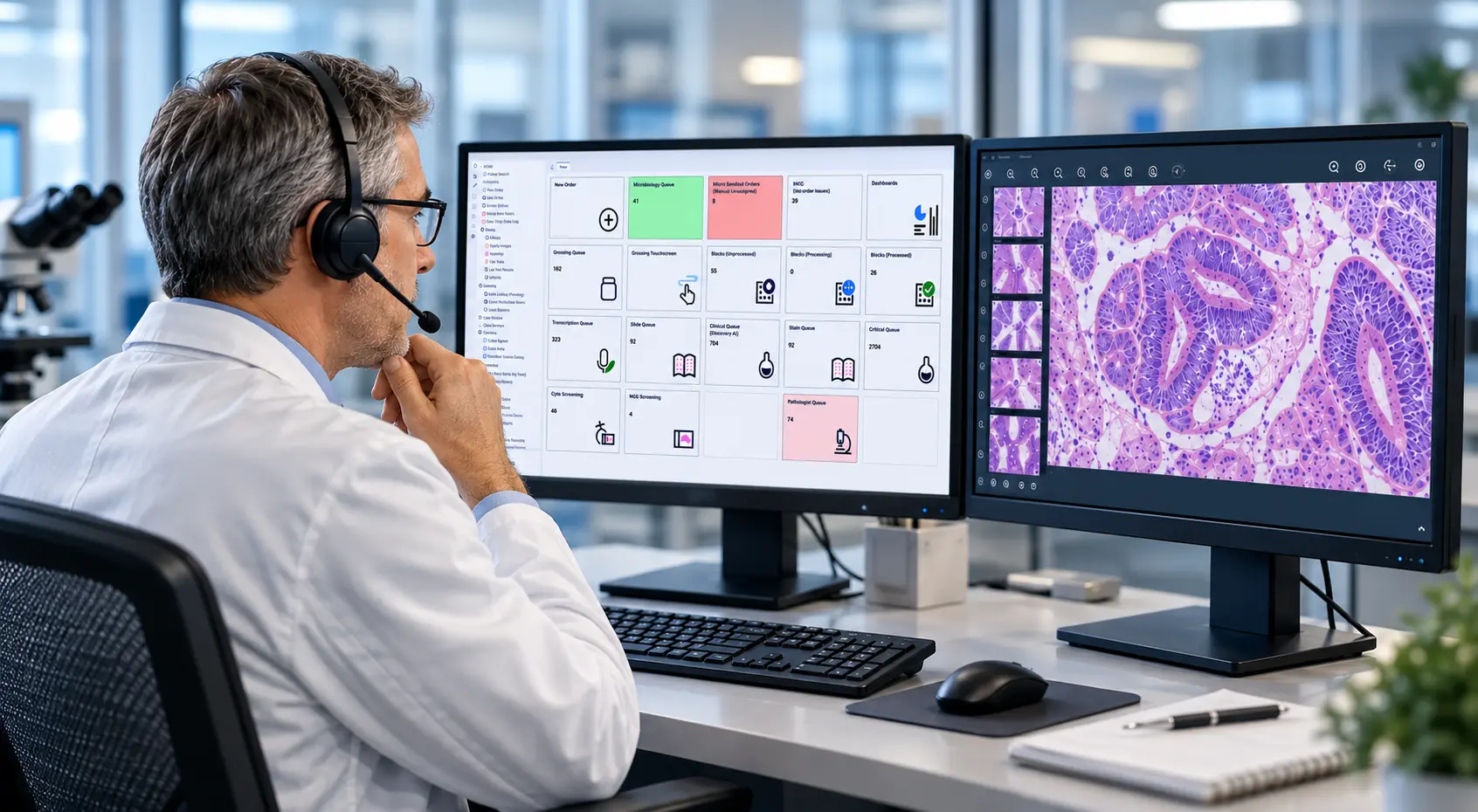
From the moment a specimen is accessioned into the LIS system, a seamless workflow is set in motion, consolidating critical information into a centralized “encounter” view that simplifies and accelerates every step of the laboratory process.
This unified view consolidates patient demographic verification, address validation, insurance eligibility checks, coverage discovery, and preauthorization, creating an efficient, click-minimized laboratory billing workflow that reduces friction and improves accuracy from the start.
The lab organization software automatically creates a patient profile and audit trail while checking for duplicate records (all in the background), and thanks to the unified nature of the pathology lab management system, there's no need for manual entry or data synchronization.
Eliminating Manual Claim Scrubbing and Coding Errors
Traditional laboratory billing solutions rely on manual claim scrubbing and coding, a process that’s both time-consuming and error-prone. However, LigoLab’s intelligent billing software for labs eliminates these issues by automating CPT and ICD coding, claim validation, and error correction, while also streamlining workflows and improving accuracy.
Staff review coding and documentation in real time, identify any errors, and place them in real-time workflow queues for resolution before sending the claim to the payer.
Industry Insights: How Modern LIS Systems Empower Labs Through Configurable Reporting, Seamless Integration, and True Partnership
Case Study: How Avero Diagnostics Recovered $4.75M with LigoLab's Integrated Laboratory Billing Solutions
Avero Diagnostics, a national physician-operated enterprise with locations in Washington and Texas, faced mounting challenges due to disconnected laboratory software systems: one for its pathology information system (healthcare LIS) operations and another for lab billing. This fragmented setup created inefficiencies, data silos, and a backlog of 47,000 unresolved claims, significantly hindering cash flow and operational performance.
The Challenge: A Legacy Laboratory Billing System Blocking Revenue
Upon returning to Avero as Senior Director of the Business Office in December 2022, Tina Quevedo was tasked with resolving these issues and restoring financial stability. Backed by 30 years of experience in medical lab billing, Quevedo quickly identified the legacy lab revenue cycle management (lab RCM) system as the core problem. Its scrubbers routinely blocked valid claims, real-time eligibility checks were nonexistent, and the lack of automation forced manual workarounds that delayed payments and strained resources.
The Solution: Transitioning to LigoLab's Integrated Medical LIS & Lab RCM Platform
After a thorough evaluation, Quevedo recommended transitioning to LigoLab’s integrated medical LIS and lab RCM platform, a move that leadership approved in early 2023. Implementation began in February and, thanks to responsive support and Avero’s existing use of LigoLab’s LIS software module, the migration was seamless. Within just two days, the team transferred the 47,000 stuck encounters, and within six weeks, they processed and submitted them.
The Results: $4.75M Recovered and Industry-Leading Metrics Achieved
The benefits didn’t stop there. Within the first 30 days of using LigoLab’s end-to-end informatics platform, Avero saw improvements in data transparency, lab billing efficiency, and real-time analytics. The billing team refined their claims processing, significantly reducing rejections, and replaced manual steps with newly configured automation.
Between November 2023 and January 2024, Avero’s lab billing department reported:
- 4–8 hours to complete and submit claims with same-day acknowledgments
- 98.1% of claims paid on first submission
- 99% clean claim rate with LigoLab’s integrated clearinghouse support
These metrics exceeded industry standards, enabling Avero to reduce days in A/R while accelerating revenue.
What Avero's Lab Billing Director Said
Quevedo praised platform features such as automated insurance eligibility checks, real-time rejection queues, and integrated documentation, all of which are embedded within LigoLab’s all-in-one informatics platform.
"The unified database eliminates the guesswork," she said. "We know exactly where a claim stands, and we no longer need to chase missing data or duplicate processes across systems."
LigoLab's automated RCM tools proved especially valuable for handling client-specific lab billing rules.
"Now we can predefine lab billing logic for each hospital, payer, and location," Quevedo noted. "Once staff set those rules, the LigoLab platform does the rest."
LIS system and lab revenue cycle management usability was another standout. New hires adapted quickly, and even seasoned billers found LigoLab intuitive and efficient. Quevedo also highlighted LigoLab's customer support:
"They always provide a solution. You never feel stuck," she said.
Beyond Lab Billing: LIS System Performance and Client Satisfaction Also Improved
The move to LigoLab’s fully integrated clinical laboratory management platform also elevated LIS system performance and client satisfaction. Turnaround times shortened, reports were delivered faster, and client complaints about delays disappeared.
In summary, Avero’s transition to LigoLab’s all-in-one medical LIS and lab RCM solution eliminated inefficiencies and improved cash flow. It also empowered the team to operate with confidence, proving that a truly integrated lab informatics platform can drive both financial and operational success.
Read Full Case Study: Documenting the Avero Diagnostics Move From a Legacy Lab RCM System to LigoLab’s All-in-One Lab Informatics Platform

See the Impact: Higher Revenue and Fewer Denials with LigoLab’s Integrated Medical LIS & Lab RCM Platform
Clinical laboratories and pathology groups that have adopted LigoLab’s end-to-end medical LIS lab solution are seeing dramatic improvements, significantly fewer claim denials, and a noticeable boost in revenue. These gains are made possible by automated, accurate claim generation and timely billing once claims are processed.
Data-Driven Lab Management Through Unified Reporting
With LigoLab’s fully integrated LIS software, customers generate more clean claims and access detailed statistical reporting to monitor trends, track key performance indicators, and measure operational benchmarks. The result is a more confident, data-driven approach to clinical laboratory management, powered by the most transparent and unified LIS system platform available today.
Discover More: Reduce Denials and Stop Revenue Leakage With Integrated Laboratory Billing Management
Connect with a LigoLab Product Specialist Today
For more information or to request a personalized LIS system or lab billing demo, use the link below to contact LigoLab.
Act Now: Speak With a Product Specialist!
Frequently Asked Questions About Laboratory Billing Optimization
Why must the laboratory billing process start at order entry?
Starting lab billing at order entry, rather than after testing is complete, enables real-time patient demographic checks, insurance eligibility verification, and claim scrubbing before a specimen is even processed. This front-end approach catches errors immediately, prevents downstream claim denials, and accelerates reimbursement by ensuring every claim is clean before it ever reaches a payer.
What problems do fragmented LIS systems and lab billing platforms cause?
When a laboratory information system and lab billing platform operate as separate entities, data must be manually transferred between them, creating data silos, duplicate entries, synchronization errors, and processing delays. As Avero Diagnostics experienced, this fragmentation can result in tens of thousands of unprocessed claims, significant revenue loss, and strained operational resources.
What is a clean claim, and why does the clean claim rate matter?
A clean claim is accepted and paid by the payer on the first submission without rejection or correction. The clean claim rate measures the percentage of a lab's claims that meet this standard. A higher rate means faster payments, lower administrative costs, and reduced compliance risk. Avero Diagnostics achieved a 99% clean claim rate after switching to LigoLab’s all-in-one platform for LIS system and lab billing workflows, well above the industry standard.
What is TC/PC splitting, and how does LigoLab handle it?
TC/PC splitting refers to the automated separation of a lab test's technical and professional components for accurate billing. When handled manually, it is a common source of claim errors and underpayments. LigoLab’s LIS system module automates this process as part of an integrated lab billing workflow, ensuring staff bill both components correctly every time without manual intervention.
How does LigoLab's real-time claim scrubbing work?
Staffers review coding and documentation in real time as they generate claims using LigoLab's platform. Any errors, such as incorrect CPT or ICD codes, missing patient data, or eligibility mismatches, are automatically flagged and placed into a resolution queue before the claim is submitted. It prevents errors from reaching payers, dramatically reducing denial rates.
How quickly can a lab transition to LigoLab's platform?
Based on the Avero Diagnostics case study, the transition can be remarkably fast. The Avero team transferred 47,000 stuck encounters to LigoLab's platform within two days of implementation and processed and submitted them all within six weeks. LigoLab's responsive support team and Avero’s existing familiarity with the lab information system module contributed to a smooth, rapid migration.
What laboratory billing metrics should labs use to measure RCM performance?
The most important metrics include clean claim rate, first-pass acceptance rate, days in accounts receivable, denial rate by payer and reason, cost to collect, and reimbursement turnaround time. LigoLab's dashboards provide real-time visibility into all these KPIs, enabling lab directors to identify bottlenecks and make data-driven decisions.
What makes LigoLab different from standalone laboratory billing solutions?
Unlike standalone laboratory billing solutions that operate separately from the LIS system, LigoLab natively unifies both on a single shared database. It means billing logic, patient data, coding, and claim scrubbing all operate from the same source of truth, eliminating the data gaps, manual workarounds, and synchronization errors that standalone laboratory billing systems create. The result, as demonstrated by Avero Diagnostics, is a faster, more accurate, and significantly more profitable lab billing operation.