Blog
LigoVerse: Where Laboratory Innovation, LIS Software, and Customer Success Come Together

November 15, 2026

For today's pathology groups and clinical laboratories, selecting the best laboratory information system (LIS) software is only the beginning. Long-term success depends on how effectively organizations implement, optimize, and expand their system capabilities.
That's where LigoVerse, LigoLab's annual user conference, makes a meaningful difference.
More than a traditional clinical and pathology lab management software conference, LigoVerse brings technology experts and LigoLab customers together to exchange ideas, share real-world experiences, and explore ways to maximize the value of the all-in-one LigoLab Informatics Platform.
For one experienced laboratory operations leader attending LigoVerse 2026, the event reinforced how modern LIS software can transform technical workflows while creating new opportunities for continuous improvement.
Industry Insights: Best LIS Systems - Top Laboratory Information Systems Compared for Clinical, Pathology, and Outreach Labs
Why Is LigoVerse Important for Laboratory Leaders?
Advanced laboratory information systems help address the increasingly complex challenges that all medical labs face today through workflow automation, end-to-end specimen tracking, configurable and customized reporting, seamless integrations, and real-time operational visibility.
However, even the most capable LIS systems deliver limited value if laboratories don't fully utilize their features.
LigoVerse helps bridge that gap by giving customers opportunities to learn directly from LigoLab experts and other laboratory professionals.
Attendees discover new functionality, discuss implementation strategies, exchange workflow optimization ideas, and identify opportunities to expand automation.
As one laboratory operations director explained during the conference:
"Talking with other laboratories has shown me different ways to use the platform and opportunities to improve our workflows even further."
This collaborative environment is especially valuable for laboratories transitioning from legacy LIS systems to modern, configurable pathology and clinical laboratory management software.
Related Content: Discover How Vivid Pathology Overcame Legacy Software Limitations to Drive Business Growth
How Modern LIS Software Simplifies Pathology Sign-Out
One of the most impactful improvements was the streamlining of pathology case sign-out.
Traditional LIS systems rely on fragmented workflows, repetitive data entry, and manual navigation between applications.
These inefficiencies increase administrative workloads and delay diagnostic reporting.
LigoLab’s anatomic pathology software module addresses these challenges by connecting accessioning, histology, case management, diagnostic reporting, and pathology sign-out within a unified LIS system environment.
"Making sign-out easier for our pathologists was one of our biggest priorities,” she said. “The time savings have been tremendous."
Discover More: Essential Anatomic Pathology LIS Software Features to Optimize Laboratory Workflow
From Days to Minutes: Improving Laboratory Quality Control Reporting
Perhaps the most compelling example shared during LigoVerse involved laboratory quality assurance and quality control (QA/QC).
Before implementing LigoLab, the organization relied on an older laboratory information system that made retrieving quality data difficult and time-consuming.
Preparing QA/QC documentation for a single hospital required approximately two days of manually extracting, reviewing, and consolidating information.
With LigoLab, the operations director reported being able to compile the necessary information in approximately 15 minutes.
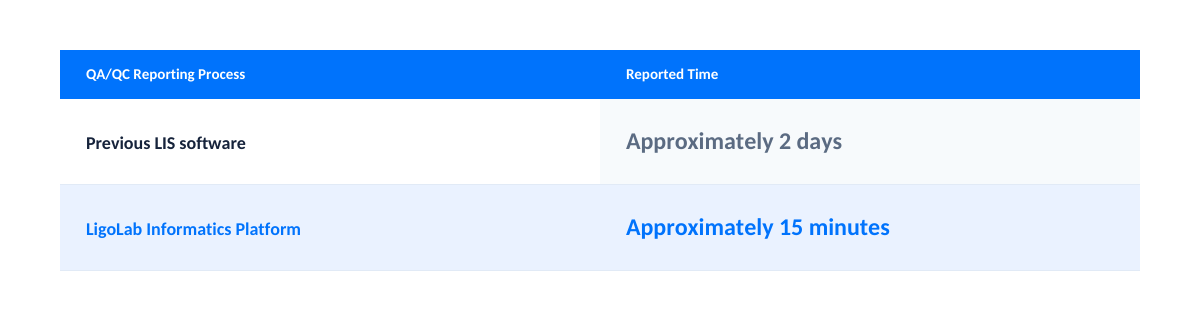
These customer-reported results demonstrate how improved data accessibility significantly reduces administrative workloads and enhances laboratory efficiency.
The key takeaway: Modern laboratory information system software can do more than manage data. It can transform information into actionable insights that help laboratories operate more efficiently, make informed decisions, and continuously improve performance.
On-Demand Webinar: Leverage LIS System Rules, Automation, and Data Analytics to Increase Efficiency and Cut Costs
How LIS System Automation Improves Workflows
Workflow automation is another important theme connecting LigoVerse discussions with daily operational challenges.
The laboratory featured in this blog post previously relied on numerous manual processes, including fax-based report delivery and administrative tasks.
After implementing LigoLab, the organization began transitioning to more efficient digital workflows.
Automation streamlined specimen accessioning, histology processing, pathology reporting, and report distribution. The operations director also reported improved turnaround times as staff became more familiar with the new system and its capabilities.
Discover More: How Modern LIS Software Powers Smarter Lab Decision-Making and Performance Analytics
Improving Client Service With LigoLab’s Provider Portal
Effective laboratory management software must also strengthen communication between diagnostic laboratories and their healthcare clients.
For this operations director, LigoLab's Provider Portal became especially valuable.
Before the transition, the organization relied heavily on traditional faxing to distribute pathology reports.
With LigoLab, referring physicians and authorized office personnel gained secure, convenient access to reports through a web-based portal.
The response was overwhelmingly positive.
Some clients preferred the portal so strongly that they stopped requesting faxed reports altogether.
Discover More: LigoLab’s Provider Portal Facilitates Faster Order Processing and Improved Turnaround Times
Why LIS Implementation and User Training Matter
Replacing a legacy laboratory information system creates uncertainty among employees accustomed to familiar processes.
The operations director acknowledged that staff initially expressed concerns about transitioning to LigoLab.
However, hands-on experience in the software's test environment helped ease those concerns.
"Once our staff started using the test environment, they realized the transition wasn't nearly as difficult as they anticipated," she said.
The organization implemented in phases, initially focusing on essential workflows such as accessioning, histology, sign-out, and reporting.
This gradual approach allowed the path lab to establish a strong operational foundation before expanding functionality.
White Paper: Keys to Keeping Your LIS System Implementation on Track
Unlocking More Value Through Laboratory Software Integration
For growing pathology practices, implementation should be viewed as an ongoing optimization process rather than a one-time technology project.
The operations director described plans to expand the organization's use of LigoLab through additional integrations and automation.
These planned enhancements included:
- IHC instrument interfaces: Connecting immunohistochemistry equipment to reduce manual workflows.
- Tumor registry interfaces: Streamlining the exchange with state tumor registries.
- Automated case assignment: Reducing manual administrative work associated with distributing pathology cases.
- Scheduled QA/QC reports: Simplifying recurring reporting and documentation requirements.
These capabilities reflect the broader value of a scalable, configurable laboratory information system.
For laboratory leaders planning future growth, this flexibility is an important consideration when evaluating LIS vendors and laboratory software systems.
Discover More: What You Need to Know Before Contracting with a Laboratory Information System (LIS) Company
LigoVerse Connects Laboratory Professionals With the People Behind the Platform
Technology is only one part of the laboratory transformation process.
Equally important are the relationships between LIS vendors, implementation specialists, customer support teams, and the laboratories they serve.
The operations director highlighted the value of connecting face-to-face with LigoLab team members after previously communicating through implementation meetings, support calls, and email.
LigoVerse created an opportunity to strengthen those relationships while gaining insight into the platform's capabilities.
White Paper: Vendor to Partner - How Aligning with Your LIS Provider Can Transform Your Lab
Discover the LigoLab Difference
Learn how the LigoLab Informatics Platform and LigoVerse community can help your laboratory streamline operations, improve efficiency, and prepare for sustainable growth.
Act Now: Contact a LigoLab Product Specialist!
Frequently Asked Questions About LigoVerse and LIS Software
What is LigoVerse?
LigoVerse is LigoLab's annual user conference, bringing together customers and technology experts to share best practices, explore LIS software capabilities, and identify opportunities for operational improvement.
What is a laboratory information system (LIS)?
A laboratory information system is specialized software that manages diagnostic laboratory workflows, including order entry, specimen accessioning, sample tracking, testing, quality control, result reporting, and report distribution.
How does LigoLab improve LIS pathology workflows?
LigoLab connects essential anatomic pathology processes within a configurable LIS software platform. Its capabilities include specimen tracking, histology management, pathology sign-out, diagnostic reporting, workflow automation, and provider connectivity.
Can LigoLab help reduce manual laboratory reporting?
Yes. LigoLab supports configurable reporting, data retrieval, and scheduled reports that can reduce repetitive administrative work. One customer reported reducing the time required to compile hospital QA/QC information from approximately two days to 15 minutes.
Does LigoLab support laboratory growth?
Yes. The LigoLab Informatics Platform supports expanding laboratory operations through configurable workflows, interfaces, automation, and integrated LIS and laboratory revenue cycle management capabilities.
When and where is LigoVerse 2027?
LigoVerse 2027 is scheduled for February 17–18, 2027, in Los Angeles, California.