News
LigoLab Offers Labs Automated and Real-Time LIS Software Solutions for Prior Authorization Requirements

November 3, 2026


Executive Summary: LigoLab embeds prior authorization and eligibility checks into its all-in-one laboratory information system (LIS) and lab revenue cycle management (RCM) platform, so laboratory billing starts at order creation, not after testing. By using third-party interfaces for eligibility, insurance discovery, and prior authorization management, plus over one million configurable rules, labs can flag requirements before work begins and scrub claims before submission.
Clinical laboratories and pathology practices are under growing pressure to collect accurate reimbursement, comply with evolving payer requirements, and minimize revenue leakage, all while handling rising test volumes and shrinking margins. Yet for many labs, laboratory billing and prior authorization remain among the most time-consuming and error-prone parts of the workflow.
LigoLab, a leading LIS software vendor and developer of enterprise clinical and pathology lab management solutions, addresses these challenges head-on with an all-in-one laboratory information system (LIS) and lab revenue cycle management (RCM) platform that embeds automated, real-time laboratory billing solutions directly into core workflows.
By integrating its medical LIS software and laboratory revenue cycle management module into a single, comprehensive informatics platform, LigoLab enables organizations to start lab billing at order creation, streamline prior authorization, prevent denials, and accelerate reimbursement without relying on disconnected laboratory software systems or manual workarounds.
Discover More: Best Pathology Lab Reporting Software - Buyers Guide and Checklist
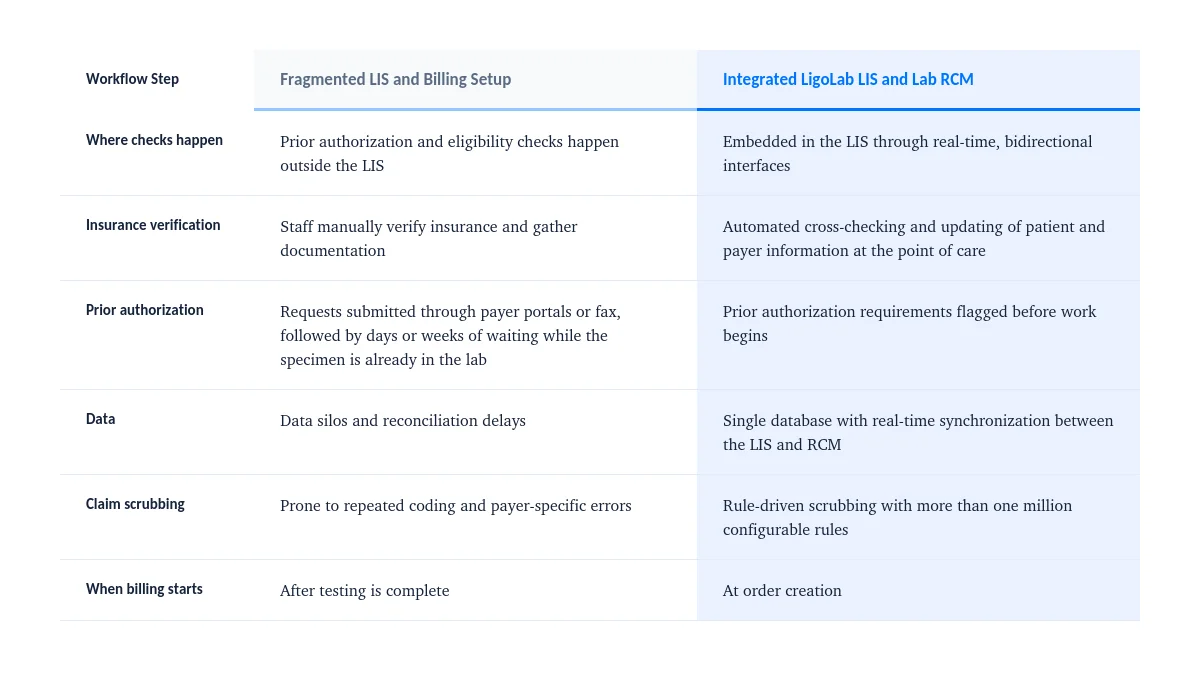
How Does a Fragmented Prior Authorization Workflow Compare With an Integrated One at a Glance?
Why Are Laboratory Billing and Prior Authorization Breaking Traditional LIS Systems?
Prior authorization has become one of the most burdensome and costly administrative processes in pathology and clinical laboratory management. Each payer has different documentation requirements, coverage rules, and submission protocols, making it nearly impossible to standardize workflows using legacy laboratory information systems and standalone laboratory billing solutions.
"Obtaining prior authorization is often difficult and labor-intensive, and it usually requires a substantial amount of supporting documentation, plus several faxes and phone calls," said Farzad Abdi, Billing Manager at LigoLab. "The process also typically varies greatly from one insurer to another, which makes it extremely hard to standardize."
In many labs, staff complete prior authorization and eligibility checks outside the lab information system. Staff must manually verify insurance, gather documentation, submit requests through payer portals or fax, and then wait days or weeks for approval, all while the specimen is already in the lab.
The consequences are significant:
- Delayed testing and treatment
- Increased claim denials
- Rework and resubmissions
- Audit exposure
- Lost laboratory revenue
- Poor patient experience
These inefficiencies reflect structural flaws in fragmented laboratory information systems and laboratory billing architectures.
Get Insight: Tips for Laboratory Billing Reimbursement Challenges

What Makes a Fully Integrated Lab Information System and Lab RCM Platform Different?
The LigoLab Informatics Platform takes a fundamentally different approach.
Instead of treating the LIS and laboratory revenue cycle management as separate modules, LigoLab unifies both in a single lab database software. This creates a true single source of truth across technical and financial workflows.
Key advantages of this integrated architecture include:
- Real-time data synchronization between the LIS and RCM
- No data silos or reconciliation delays
- Continuous validation from order creation to claim submission
- A single workflow spanning clinical and financial operations
This seamless integration enables laboratory billing to start as soon as an order enters the laboratory information system, rather than waiting until testing is complete.
By linking technical workflows to RCM cycle workflows in real time, LigoLab empowers labs to verify demographics, check insurance eligibility, confirm coverage, and flag prior authorization requirements before work begins.
Discover More: Reduce Denials and Stop Revenue Leakage With Integrated Laboratory Billing Management
How Does Embedded Real-Time Prior Authorization and Eligibility Verification Work?
One of the most impactful features of LigoLab's laboratory billing application is its ability to interface directly with third-party services that specialize in:
- Patient demographic verification
- Insurance eligibility checks
- Insurance discovery
- Prior authorization management
- Claim submission
- Claim status tracking
These embedded interfaces operate bidirectionally within the LIS medical application, automatically cross-checking and updating patient and payer information at the point of care.
"By directly interfacing with clearinghouses, mailing companies, the NPI Registry, and payment processors, labs gain access to live payer and patient verification RCM tools," Abdi explained. "These tools not only assist with prior authorization but also ensure all claims are scrubbed sufficiently before submission."
The result is cleaner upstream data and dramatically fewer downstream denials.
On-Demand Webinar: Unifying Technical and Financial Operations to Minimize Denials and Prevent Revenue Leakage
How Does Rule-Driven Claim Scrubbing Work in Laboratory Revenue Cycle Management?
Even with eligibility verification and authorization checks in place, claims can still fail due to coding inconsistencies, missing modifiers, or payer-specific requirements.
This is where LigoLab's rule-driven automation engine becomes a strategic differentiator among LIS software vendors. The platform includes more than one million configurable rules that laboratories can tailor to:
- Specific payer regulations
- Test-specific lab billing rules
- Client-specific billing profiles
- Historical denial patterns
"With our informatics platform and its million-plus rules, laboratory operators can set up custom rules based on identified payer regulations and requirements," Abdi said. "These rules automatically check for denial patterns so the same mistakes aren't repeated."
This automated claim scrubbing layer protects labs from repetitive errors, reduces manual rework, and improves first-pass acceptance rates.
Discover More: How to Turn Your Mid-Sized Medical Laboratory into a Thriving Large-Scale Operation
What Common Laboratory Billing Problems Does an Integrated Platform Solve?
Traditional laboratory billing solutions suffer from a predictable set of structural limitations:
- Heavy manual data entry
- High clerical error rates
- Slow reimbursement cycles
- Poor scalability
- Data silos between the medical LIS and lab billing systems
- Limited visibility into financial performance
LigoLab's all-in-one LIS system with embedded lab RCM eliminates these bottlenecks.
Unlike standalone laboratory billing systems, the LigoLab platform begins the RCM cycle as soon as a case order arrives in the lab. From that moment forward, the LIS software and lab RCM modules operate as one continuous workflow. This approach:
- Reduces denials and revenue leakage
- Accelerates reimbursement
- Improves compliance
- Lowers labor costs
- Enhances scalability
- Improves patient satisfaction
Can one LIS software solution cover every lab workflow?
LigoLab supports a wide range of laboratory environments, including:
The LIS software includes dedicated modules for each lab workflow while maintaining unified data integrity across the entire enterprise.
Additional capabilities include:
- Advanced data validation RCM tools
- Synchronized workflow queues
- Executive-level reporting dashboards
- Real-time KPI analytics
- Deep rule-driven automation
This makes LigoLab one of the best LIS platforms for pathology groups and clinical laboratories seeking a future-ready laboratory information system.
Get Insight: What is the Best LIS for Molecular Testing Labs?
Why Do Integrated Medical LIS and Lab RCM Models Outperform Legacy LIS Systems?
Healthcare systems consultant Dennis Winsten, with over 30 years of industry experience, has long advocated for integrated LIS-RCM architectures.
He argues that traditional models, where the LIS system and laboratory billing operate independently, are no longer viable in a reimbursement environment dominated by payer complexity and regulatory scrutiny.
Integrated LIS software and laboratory revenue cycle management platforms provide:
- Higher financial transparency
- Faster reimbursement
- Lower denial rates
- Better compliance controls
- Improved operational resilience
As reimbursement pressure intensifies, labs that fail to modernize their laboratory information systems will fall behind.
Industry Insights: Why Replace Your Laboratory Information System? Things To Consider
What Does This Mean for the Future of Laboratory Workflow Management?
The laboratory industry is entering a period of structural change driven by:
- Shrinking reimbursement
- Workforce shortages
- Rising test volumes
- Regulatory expansion
- Payer consolidation
In this environment, organizations can no longer afford fragmented laboratory software systems or reactive RCM cycle workflows. Modern clinical and pathology lab management requires:
- End-to-end workflow integration
- Real-time validation
- Automated RCM process controls
- Configurable rule engines
- Unified LIS and lab RCM data
LigoLab's comprehensive and flexible platform embodies this future-state architecture.
Get Insight: The Power of Integration - Unleashing the Potential of LigoLab's LIS System & Lab RCM Platform
Why Does LigoLab Stand Out Among LIS Software Vendors?
Unlike many LIS software vendors that bolt lab billing modules onto legacy LIS systems, LigoLab engineered its platform from the ground up as a unified ecosystem. Key differentiators include:
- A single shared database
- A single operating system
- Deep rule-driven automation
- Embedded third-party integrations
- Modular scalability
- 20+ years of industry experience
This design philosophy positions LigoLab as one of the best LIS vendors for laboratories seeking both operational excellence and financial sustainability.
Industry Insights: Best LIS Systems - Top Laboratory Information Systems Compared for Clinical, Pathology, and Outreach Labs
Is an Integrated LIS-RCM Platform the Only Way to Handle Prior Authorization?
A lab committed to its current lab information system, or one that fully outsources laboratory billing to a partner that already manages prior authorization well, can reasonably use a standalone authorization tool or billing service, instead of switching platforms.
Automation also has limits. Prior authorization remains payer-dependent: requirements, documentation, and response times differ between insurers, and software can reduce the effort and catch missing requirements earlier, but it can't remove payer variability or approval wait times.
For labs seeing delays, denials, and rework from checks that happen outside the LIS, moving verification and authorization flags to order entry targets the root of the problem.
What Is the Smarter Path Forward for Laboratory Billing?
LigoLab's all-in-one LIS system and laboratory revenue cycle management platform represent a modern blueprint for laboratory billing excellence.
By embedding real-time eligibility verification, prior authorization workflows, claim scrubbing automation, and financial analytics directly into the laboratory information system, LigoLab enables labs to:
- Reduce denials
- Prevent revenue leakage
- Accelerate reimbursement
- Improve compliance
- Scale operations
- Enhance patient experience
For pathology practices and clinical laboratories evaluating the best LIS software and laboratory billing solutions, integrated LIS-RCM platforms are no longer optional; they are mission-critical.
Continue Your Research
- Prior Authorization Workflow Tips: Workflow Tips to Help Manage Prior Authorization Requirements
- Billing Software Comparison: What Are the Best Software Solutions for Laboratory Billing?
- Revenue Leakage: Reduce Denials and Stop Revenue Leakage With Integrated Laboratory Billing Management
- Case Study: Documenting the Avero Diagnostics Move From a Legacy Lab RCM System to LigoLab’s All-in-One Lab Informatics Platform
- Integration Deep Dive: The Power of Integration - Unleashing the Potential of LigoLab's LIS System & Lab RCM Platform
Ready to Modernize Your Laboratory Information System?
To learn more about LigoLab's all-in-one medical LIS & lab RCM Informatics Platform and how it can transform your laboratory billing and laboratory workflow management, start a conversation with a product specialist today.
Act Now: Speak with a LigoLab Product Specialist Today!
Frequently Asked Questions About Prior Authorization and Integrated Laboratory Billing
What is prior authorization in laboratory billing, and why is it so hard?
Prior authorization is the process of obtaining payer approval before performing certain services. Each payer has different documentation requirements, coverage rules, and submission protocols, and the process often requires substantial supporting documentation plus several faxes and phone calls.
How does LigoLab handle prior authorization and eligibility verification?
LigoLab interfaces directly with third-party services for patient demographic verification, insurance eligibility checks, insurance discovery, prior authorization management, claim submission, and claim status tracking. These interfaces operate bidirectionally within the medical LIS, so labs can verify demographics and coverage and flag prior authorization requirements before work begins.
Why start laboratory billing at order creation instead of after testing?
Starting at order creation lets a lab verify demographics, check eligibility, confirm coverage, and flag prior authorization requirements before work begins, with continuous validation through to claim submission. Waiting until testing is complete means problems surface when the specimen is already in the lab.
How does rule-driven claim scrubbing reduce denials?
LigoLab's platform includes more than one million configurable rules that labs can tailor to payer regulations, test-specific billing rules, client-specific billing profiles, and historical denial patterns. According to Billing Manager Farzad Abdi, the rules automatically check for denial patterns so labs don't repeat the same mistakes.
What are the consequences of manual prior authorization?
Manual processes contribute to testing and treatment delays, higher claim denial rates, costly rework and resubmissions, increased audit and compliance risks, lost laboratory revenue, and a diminished patient experience.
Is an integrated LIS-RCM platform the only way to manage prior authorization?
Not always. Labs committed to their current LIS or using a trusted outsourced laboratory billing partner can reasonably use standalone tools or services. Automation also can't remove payer variability, so ask vendors which payers and services their interfaces support and how rules are governed.