Industry Insights
CMS Data Collection Module for Clinical Laboratory Fee Schedule Reporting: Why Laboratories Need to Pay Attention

June 2, 2026
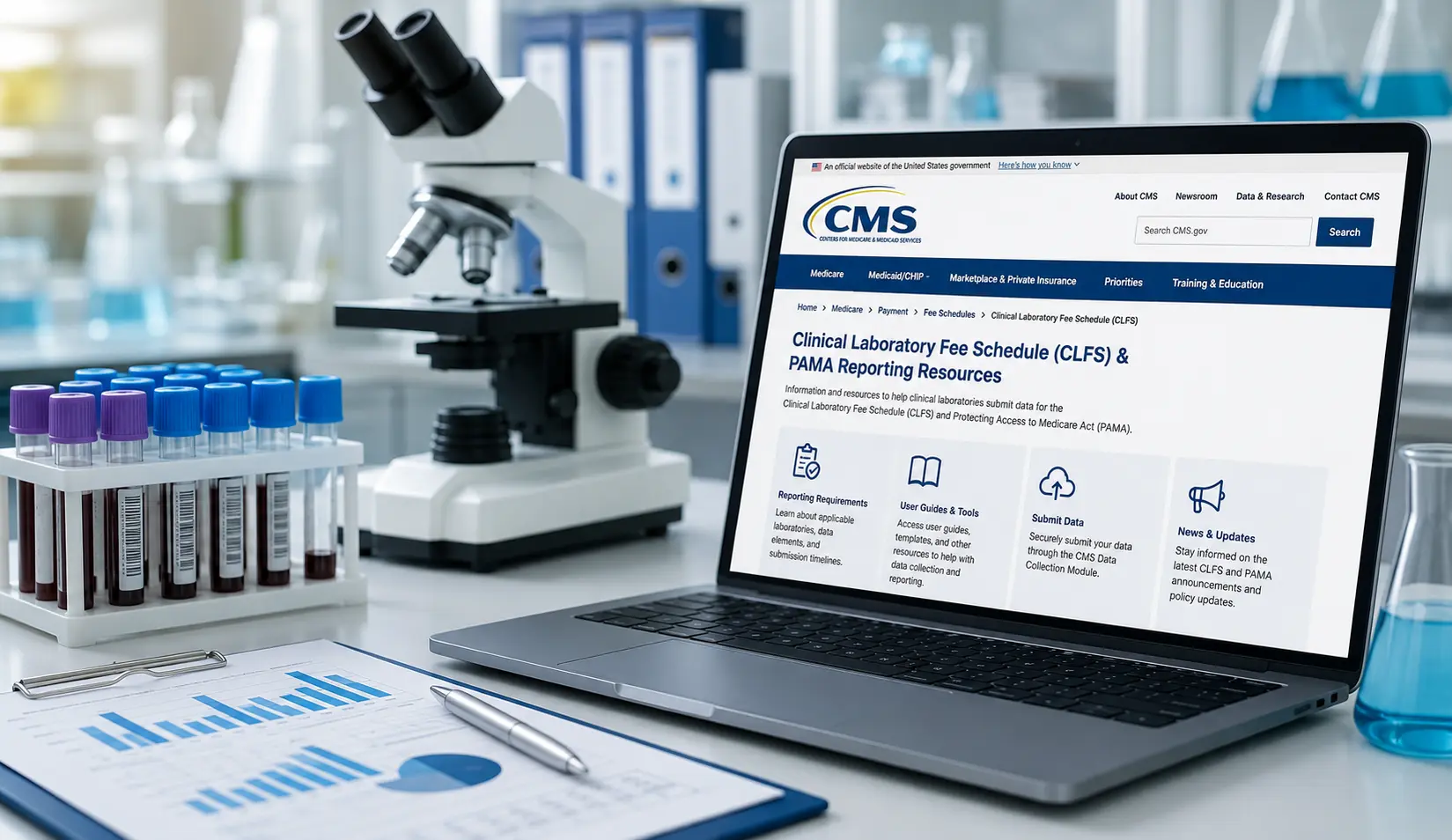
Regulatory reporting requirements continue to grow more complex for clinical laboratories and pathology groups. Among the most important initiatives affecting many organizations is the CMS Data Collection Module for Clinical Laboratory Fee Schedule (CLFS) reporting. While it may initially appear to be another administrative requirement, the information laboratories submit can directly influence future reimbursement rates and financial performance across the industry.
For laboratories already managing staffing shortages, reimbursement pressure, rising operational costs, and increasingly complex payer requirements, the burden of regulatory reporting can become significant. Collecting, validating, and organizing large volumes of financial and laboratory billing data often requires substantial effort, especially when information resides across disconnected laboratory software systems.
As healthcare becomes increasingly data-driven, laboratories that rely on manual processes and fragmented technology infrastructures face growing challenges. This is why laboratory leaders should understand not only what the CMS Data Collection Module is, but also how modern laboratory information system (LIS) technology can simplify compliance and reduce reporting burdens.
Discover More: Understanding the Real Costs of Non-Integrated Laboratory Billing Systems
What Is the CMS Data Collection Module?
The CMS Data Collection Module is a reporting mechanism used by the Centers for Medicare & Medicaid Services (CMS) to collect private payer rate information from applicable laboratories under the Clinical Laboratory Fee Schedule.
The requirement originated under the Protecting Access to Medicare Act (PAMA), which established a methodology intended to align Medicare reimbursement rates more closely with private market payment data.
Under this process, certain laboratories designated as "applicable laboratories" must periodically submit information such as:
- Private payer payment rates
- Associated test volumes
- Lab billing and reimbursement data
- Specific CLFS-related payment information
- Required reporting period metrics
CMS then uses the submitted data to calculate future Medicare reimbursement amounts for laboratory tests.
The objective is straightforward:
CMS seeks to understand market-based pricing and use that information to establish reimbursement rates across the CLFS.
However, from an operational perspective, gathering this information is often far from simple.
Industry Insights: Navigating the Coding Minefield - Labs Struggle with RCM Rejections Amid Rising Scrutiny from Payers

Why Laboratories Should Be Paying Attention
For many organizations, CLFS reporting feels like an infrequent administrative exercise. However, inaccurate or incomplete reporting can create consequences that extend far beyond a single reporting cycle.
Potential impacts include:
Financial Consequences
Submitted data contributes to reimbursement calculations that can influence future revenue levels.
Even small inaccuracies can potentially affect:
- Revenue forecasting
- Test profitability analysis
- Budget planning
- Strategic growth initiatives
Compliance Risks
CMS reporting obligations include documentation requirements and potential penalties for noncompliance.
Manual reporting processes increase the possibility of:
- Missing required data
- Inconsistent records
- Human error
- Audit complications
Administrative Burden
Many laboratories still manage financial and operational data across multiple disconnected systems:
- Laboratory information systems
- Lab billing platforms
- Clearinghouses
- Spreadsheets
- Data warehouses
- Manual reporting workflows
When data exists in separate locations, reporting often becomes a time-consuming reconciliation process.
Laboratories may spend weeks collecting information that should be available immediately.
Industry Insights: Regulators Are Rewriting HIPAA - Survival Guide for Clinical & Pathology Labs
Why Legacy Laboratory Information Systems Create Reporting Challenges
Many older laboratory environments were built for a very different era.
Historically, a medical laboratory information system was primarily responsible for storing specimen information, patient demographics, and test results.
Today's reporting requirements demand substantially more than that.
Modern laboratories need visibility across:
- Clinical workflows
- Operational performance
- Financial metrics
- Laboratory billing activity
- Compliance documentation
- Regulatory reporting
Legacy LIS systems frequently struggle because:
Data Silos Create Visibility Problems
Clinical data may reside in one application while laboratory billing and lab revenue cycle management (lab RCM) information exists elsewhere.
Teams then rely on manual extraction and reconciliation.
Limited Reporting Flexibility
Older laboratory information systems often provide static reports with little customization.
Generating CMS-specific reports frequently requires:
- IT assistance
- External databases
- Spreadsheet manipulation
- Manual calculations
Greater Potential for Errors
Manual intervention introduces risk.
When teams transfer information between laboratory software systems, organizations increase exposure to:
- Missing fields
- Duplicate entries
- Coding inconsistencies
- Outdated information
These inefficiencies create hidden costs that accumulate over time.
Discover More: The Top Five KPIs - Driving Successful Lab Revenue Cycle Management
The Growing Importance of Modern Laboratory Information Systems
As reporting requirements continue evolving, laboratories increasingly need LIS systems designed for automation, visibility, and compliance.
Fortunately, modern laboratory information systems have evolved beyond static repositories of information into advanced LIS software platforms that actively orchestrate workflows and create a connected operational environment.
For CLFS reporting and broader regulatory initiatives, several capabilities become particularly valuable.
Discover More: Why “The Safe Move” to a New Version of Legacy LIS Software Is the Wrong Move for Medical Labs
Unified Information Systems and Data Management
An integrated (all-in-one) medical LIS and laboratory revenue cycle management platform creates a centralized environment where clinical and financial information coexist within a single architecture.
Rather than assembling information from multiple disparate systems, laboratories gain:
- Centralized payer data
- Reimbursement visibility
- Test volume metrics
- CPT coding information
- Claim status reporting
- Audit-ready documentation
The result is greater consistency and less manual effort.
Advanced Reporting and Analytics Capabilities
Modern reporting engines enable laboratories to generate customizable reports that align with organizational and regulatory requirements.
Capabilities may include:
- Real-time dashboards
- Scheduled reports
- Custom report generation
- Payer analytics
- Denial trend analysis
- Reimbursement reporting
- Operational KPI tracking
Instead of reacting to reporting requirements, laboratories gain the ability to monitor their performance proactively.
Automated Compliance Support
Advanced LIS platforms increasingly embed compliance-oriented functionality directly into operational workflows.
Examples include:
- Automated documentation capture
- Audit trails
- Workflow validation rules
- Coding verification
- Exception reporting
- Compliance monitoring alerts
Rather than relying on staff to manually identify issues, automation continuously evaluates processes behind the scenes.
Discover More: Unleashing Laboratory Excellence - Here’s How LigoLab’s Automation Engine Supercharges Lab Performance
Improved Data Integrity
Because modern laboratory information systems minimize duplicate data entry and maintain synchronized workflows, laboratories reduce opportunities for inconsistencies.
Accurate reporting begins with accurate operational data.
When information flows through an integrated system, organizations gain confidence in accuracy.
Discover More: The New Era of Laboratory Informatics - From Manual Tasks to Sustained Success

What Laboratories Should Do Now
Laboratories do not need to wait until reporting deadlines approach before taking action.
Organizations can prepare proactively through several practical steps.
Evaluate Reporting Workflows
Identify how reporting information currently moves through the organization.
Questions may include:
- Where does laboratory billing data originate?
- How many systems are involved?
- How much manual intervention exists?
- How long does reporting preparation require?
Understanding current processes often reveals hidden inefficiencies.
Review Technology Capabilities
Assess whether current systems support:
- Configurable reporting
- Real-time analytics
- Integrated financial visibility
- Audit trails
- Compliance workflows
- Scalable automation
If reporting requires extensive spreadsheet work, technology limitations may already be creating risk.
Standardize Data Management Processes
Consistency across:
- Coding
- Documentation
- Lab billing workflows
- Payer management
- Test categorization
can significantly improve reporting accuracy.
Consider Long-Term Modernization Strategies
Regulatory complexity is unlikely to decrease.
Laboratories that continue operating on fragmented infrastructures may find compliance demands increasingly difficult to manage.
A future-ready laboratory information system with integrated reporting and compliance functionality creates a stronger foundation for long-term operational performance.
Discover More: How LigoLab Safeguards Data Privacy, Security, and Compliance in Today’s Digital Lab Environment
Regulatory Reporting Is Becoming an Operational Strategy
The CMS Data Collection Module represents more than just another regulatory requirement.
It reflects a broader shift occurring throughout healthcare: organizations increasingly succeed or struggle based on their ability to collect, manage, and act upon data.
For laboratories, reporting is no longer simply an administrative responsibility.
It is becoming a strategic capability that affects:
- Financial performance
- Operational efficiency
- Reimbursement visibility
- Compliance readiness
- Long-term scalability
Modern laboratory information systems equipped with advanced reporting, automation, and integrated laboratory billing capabilities position organizations to navigate this environment with greater confidence.
As reporting requirements continue evolving, laboratories that invest in connected, intelligent infrastructures will likely spend less time gathering data and more time using it to improve performance.
Ready to Transform Your Laboratory?
Discover how a modern, all-in-one laboratory information system with integrated laboratory billing, compliance monitoring, workflow automation, and advanced reporting capabilities can simplify regulatory requirements while improving operational visibility and financial performance.
Act Now: Contact a LigoLab Product Specialist to Start the Conversation
FAQs About the CMS Data Collection Module for Clinical Laboratory Fee Schedule Reporting and Modern Laboratory Information Systems
What is the CMS Data Collection Module?
The CMS Data Collection Module is a reporting system used to collect private payer payment data from applicable laboratories for Clinical Laboratory Fee Schedule reporting requirements established under PAMA.
Why is CLFS reporting important for laboratories?
CLFS reporting affects Medicare reimbursement calculations and helps determine future payment rates for laboratory services. Accurate reporting also supports compliance and reduces audit risk.
Which laboratories must submit CLFS data?
CMS defines specific criteria for "applicable laboratories." Eligibility can vary based on factors such as revenue sources and organizational structure.
What challenges do laboratories face with CLFS reporting?
Common challenges include fragmented data systems, manual reporting processes, limited visibility into reimbursement information, dependency on spreadsheets, and increased risk of errors.
How can a modern laboratory information system improve compliance reporting?
Modern laboratory information systems can automate data collection, centralize financial and operational information, generate custom reports, provide audit trails, and improve data integrity.
Why are integrated LIS and laboratory billing systems valuable?
Unified LIS and laboratory revenue cycle management platforms create synchronized clinical and financial workflows, reducing duplicate data entry, improving reporting accuracy, minimizing denials, and simplifying regulatory reporting requirements.
What reporting capabilities should laboratories look for in an advanced LIS system?
Laboratories should look for:
- Configurable reporting tools
- Real-time dashboards
- Automated compliance monitoring
- Audit trails
- Scheduled reports
- Payer analytics
- Revenue cycle visibility
- Customizable workflow automation