News
Automate Administrative Tasks and Optimize Medical LIS & Lab RCM Workflow with LigoLab
September 15, 2026

Editor’s Note: This blog post was originally published on April 12, 2020, with consultation from LigoLab's laboratory revenue cycle management specialists.
A study by the nonprofit Council for Affordable Quality Healthcare (CAQH) revealed that the healthcare industry could save billions annually by upgrading eight revenue cycle management administrative tasks from manual to automated billing processes.
All eight tasks outlined below are core elements of traditional laboratory revenue cycle management (RCM). Each activity carries a real operational cost and is often slow, repetitive, and highly susceptible to human error.
In this blog post, we’ll first examine these manual tasks and then highlight how highly automated laboratory billing solutions, embedded within an all-in-one laboratory information system (LIS) and lab revenue cycle management platform, can dramatically reduce labor costs, minimize errors, and make lab operations more efficient, scalable, and profitable.
Discover More: Clinical Laboratory Management Solutions for Lab Revenue Cycle Management (Lab RCM)
What Administrative Tasks Are Most Costly to Process Manually?
The CAQH Index examined the state of administrative transactions within the U.S. healthcare system, focusing on the potential benefits of automating these processes. The report identified eight key administrative tasks that, if the healthcare industry moved them from manual to fully electronic processes, could save over $13 billion annually.
All eight tasks below are core elements of a traditional lab RCM cycle. Each activity carries a real operational cost and is often slow, repetitive, and highly susceptible to human error.
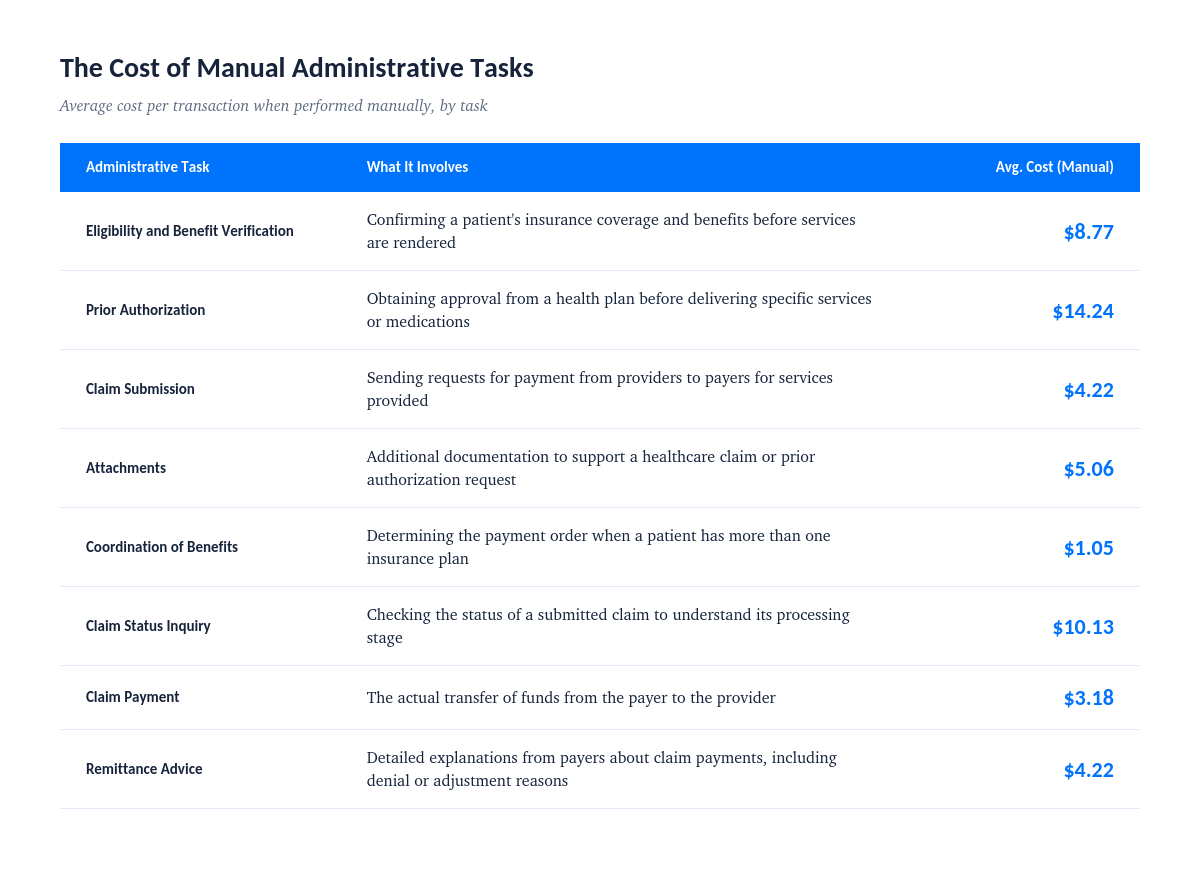
The CAQH Index report emphasized that automating these transactions would deliver significant cost savings while reducing the time and resources spent, improving overall efficiency in healthcare operations.
Get Insight: CAQH Index Findings
How Does LigoLab Automate Lab RCM and Medical LIS Workflows?
The CAQH Index provides timely news for the laboratory C-suite and those motivated to cut costs, increase profit margins, and improve the lab RCM cycle with advanced laboratory billing solutions.
For lab leaders ready to act, LigoLab offers a comprehensive, flexible laboratory information system and lab revenue cycle management capabilities. It flips the script on traditional laboratory billing by unifying medical LIS and lab RCM workflows to create a faster, more reliable laboratory billing process.
The LigoLab platform accomplishes this by using advanced automation to capture accurate patient information (such as demographics and insurance validation) as a specimen enters the laboratory.
With LigoLab's modern laboratory billing solutions, CPT and ICD-10 coding is instant and automated, fully integrating the RCM cycle with technical operations throughout the clinical lab workflow. This is possible because all medical LIS & lab RCM module functionality rests within one all-encompassing lab database software.
This means no interfaces, silos, duplication, or synchronization issues: the most common challenges associated with using separate laboratory software for LIS and lab billing workflow management.
Discover More: Six Reasons Why You Should Choose an Integrated Laboratory Billing Solution for Your Medical Lab
Is Manual Lab Billing Ever Still a Reasonable Option?
To be candid: if a medical lab processes a very small number of claims per month, the absolute dollar savings from automating any single task may look modest in isolation, and some very small operations manage manual RCM adequately for a time. But the CAQH per-transaction costs above are largely fixed regardless of volume, so those costs compound quickly as claim counts grow.
Most labs processing more than a handful of claims a week will recover the cost of automation well within the first year through reduced denials and faster reimbursement alone.
A fully integrated platform like LigoLab’s LIS model with embedded lab RCM is less of a slam dunk for organizations that already have a highly customized, tightly optimized in-house laboratory billing process built around a single, low-complexity payer mix; in that narrow case, the migration effort may take longer to pay off.
For nearly everyone else, especially labs juggling multiple payers, prior authorization requirements, and growing volume, unifying LIS and laboratory billing workflows is the more defensible long-term choice.
Industry Insights: What Labs Get Wrong About Laboratory Billing - How High-Performing Labs Prevent Denials Before They Happen
Why Choose LigoLab's Billing Software for Labs?
It's time for labs to empower themselves to scale efficiently, boost margins, and collect every dollar they've earned. Here are five ways the all-in-one LigoLab platform helps lab customers do that.
1. Complete Integration of All Laboratory Workflow Management
LigoLab unifies lab information system and laboratory revenue cycle management processes into one united platform with a shared database. This eliminates clunky interfaces between disconnected laboratory software systems, eliminating data silos, duplication, and syncing issues.
2. Automation from Start to Finish
The platform uses advanced rules and automation to handle critical lab billing tasks:
- Patient demographics capture
- Insurance verification
- CPT and ICD-10 coding
- Claim scrubbing, submission, and appeals
This reduces human error, speeds up reimbursement, and minimizes denials.
3. Real-Time Data & Visibility
Unlike traditional laboratory billing models that operate in the dark, LigoLab provides real-time business analytics for clinical and financial workflows. Lab staff and the laboratory billing team can make informed decisions instantly.
4. Increased Efficiency = Higher Margin
By streamlining RCM process workflows and reducing manual touches, labs can:
- Cut operational costs
- Speed up collections
- Capture more revenue
5. Compliance & Audit Readiness Built In
The platform's advanced laboratory billing solutions are transparent and traceable, making it easier to stay compliant with payer policies and regulatory requirements.
Get Insight: Understanding the Real Costs of Non-Integrated RCM Systems
The traditional laboratory revenue cycle management model is slow and lacks transparency. In contrast, the LigoLab platform provides unparalleled visibility and accurate data (in real time), which leads to successful lab billing. This gives customers the power to unlock their revenue potential and collect on all claims and appeals promptly.
Discover More: Enhancing Laboratory Workflow Efficiency with Advanced Laboratory Billing Automation - A Look at LigoLab's LIS & RCM Solution
What Is LigoLab, and Who Is It Built For?
LigoLab is transforming medical laboratories with a single, fully integrated LIS software platform that combines advanced medical laboratory information system functions with end-to-end lab revenue cycle management. By eliminating disconnected systems and streamlining complex workflows, LigoLab empowers labs to work smarter, faster, and more profitably.
Founded in 2006 and headquartered in Los Angeles, LigoLab supports modern pathology and clinical laboratory management, from order entry and sample tracking to reporting, compliance, and analytics. With advanced automation and intelligent workflow design, labs reduce errors, speed turnaround times, and stay compliant as regulatory demands evolve.
LigoLab stands out for its ability to scale and adapt to labs of all types and sizes, including clinical, reference, anatomic pathology, and molecular diagnostics. The platform's built-in business intelligence tools give labs real-time performance insights that drive informed decision-making and sustainable growth.
Discover More: LigoLab Informatics Platform - Uniquely Designed with Pricing Tiers to Deliver Maximum Value
LigoLab is helping labs improve care delivery, optimize operations, and unlock new revenue potential. The LIS company is a trusted clinical and pathology software vendor redefining lab management, empowering laboratories to scale with confidence, operate more efficiently, and thrive in an increasingly complex healthcare environment.
Continue Your Research
- Related Solution: Clinical Laboratory Management Solutions for Lab Revenue Cycle Management (Lab RCM)
- Industry Data: CAQH Index Findings
- Cost Analysis: Understanding the Real Costs of Non-Integrated RCM Systems
- Pricing: LigoLab Informatics Platform - Uniquely Designed with Pricing Tiers to Deliver Maximum Value
Ready to Modernize Your LIS and Laboratory Billing Operations?
Contact LigoLab today to discover how its all-in-one informatics platform can transform your lab's performance, profitability, and future growth.
Act Now: Contact a LigoLab Product Specialist!
Frequently Asked Questions About Automating Lab RCM and Medical LIS Workflows
How much could the healthcare industry save by automating RCM administrative tasks?
According to the CAQH Index, transitioning eight key administrative tasks from manual to fully electronic processes could save the healthcare industry over $13 billion annually.
Which manual RCM task costs the most per transaction?
Prior authorization is the most expensive manual task, averaging $14.24 per transaction, followed by claim status inquiries at $10.13 and eligibility and benefit verification at $8.77.
How does LigoLab automate lab billing and LIS medical workflows?
LigoLab captures patient demographics and validates insurance as a specimen enters the lab, then automates CPT and ICD-10 coding, claim scrubbing, submission, and appeals, all within one shared LIS and lab RCM database.
Is it ever reasonable for a lab to stick with manual billing processes?
Very low-volume labs or those with a highly customized, low-complexity in-house process may see a longer payoff period from switching platforms. Still, most labs processing more than a handful of claims weekly recover automation costs within the first year through reduced denials and faster reimbursement.
What are the main benefits of an integrated LIS system and lab RCM platform?
Key benefits include complete workflow integration with no data silos, end-to-end automation of lab billing tasks, real-time analytics and visibility, lower operational costs with faster collections, and built-in compliance and audit readiness.
When was LigoLab founded, and what labs does it serve?
LigoLab was founded in 2006 and is headquartered in Los Angeles. It serves clinical, reference, anatomic pathology, and molecular diagnostics labs of all sizes with its all-in-one informatics platform.