Blog
How to Turn an Economic Downturn into an Opportunity for Your Clinical and Pathology Laboratory

September 21, 2026

Running a clinical laboratory or pathology practice in today’s uncertain economy comes with plenty of challenges. With recession concerns growing and margins under pressure, laboratory leaders have good reason to focus on building greater operational and financial resilience.
Rather than simply weathering a slowdown, forward-thinking labs can use it as an opportunity to modernize by adopting a rules-based laboratory information system (LIS), automating and standardizing workflows, strengthening customer service, and improving overall efficiency. This can help labs control costs today while positioning themselves to pursue new business opportunities as conditions improve.
Laboratories also don’t have to develop their strategies in isolation. Organizations across industries have faced similar periods of economic and operational strain. By examining how other sectors have adapted, lab leaders can identify practical strategies and proven best practices that stabilize performance during challenging periods and create a stronger foundation for future growth.
Why Does Innovation Matter More During Economic Downturns?
Economic downturns affect healthcare differently than many other industries because medical care remains an essential service regardless of broader economic conditions. People still need treatment when they are sick, and health insurance helps cover much of the cost of necessary and emergency care.
Still, healthcare isn’t immune to economic pressure. As uncertainty rises and consumer confidence declines, patients may become more cautious about spending, delaying elective procedures, routine care, or other services they consider less urgent.
Across industries, weaker demand and tighter margins place a greater premium on efficiency and cost control. Strong organizations respond not simply by cutting expenses, but by finding smarter ways to operate. They streamline workflows, eliminate waste, automate repetitive tasks, and invest strategically in technologies that enable greater value with fewer resources.
The same principles apply to clinical laboratories and pathology groups. Strategic investments in laboratory workflow management optimization, automation, and operational intelligence can help control costs, increase productivity, and protect margins during challenging economic periods. Just as importantly, these improvements can build a more scalable foundation for pursuing new opportunities and accelerating growth as economic conditions improve.
Discover More: Automation in Pathology Labs Using Advanced LIS System Software

Is Your Medical LIS Software Actually Ready for Economic Uncertainty?
When was the last time you evaluated the digital infrastructure and laboratory software systems your team relies on every day?
Is your current environment truly optimizing efficiency and productivity, or are hidden inefficiencies slowing you down? When you assess your laboratory information system (LIS) software, would you describe it as modern, flexible, and innovation-ready, or as a rigid pathology/clinical laboratory management platform that requires costly vendor intervention for even minor configuration changes?
Get Insight: What You Need to Know Before Contracting with a Laboratory Information System (LIS) Company
Where Do Modern Rules-Based Laboratory Information Systems Drive the Greatest Gains?
Modern, rules-driven medical LIS platforms help clinical laboratories and pathology groups improve efficiency and productivity without adding headcount or unnecessary costs. By automating critical lab workflows and reducing manual touchpoints, today's best laboratory information system software delivers measurable improvements in accuracy, turnaround time, and operational control.
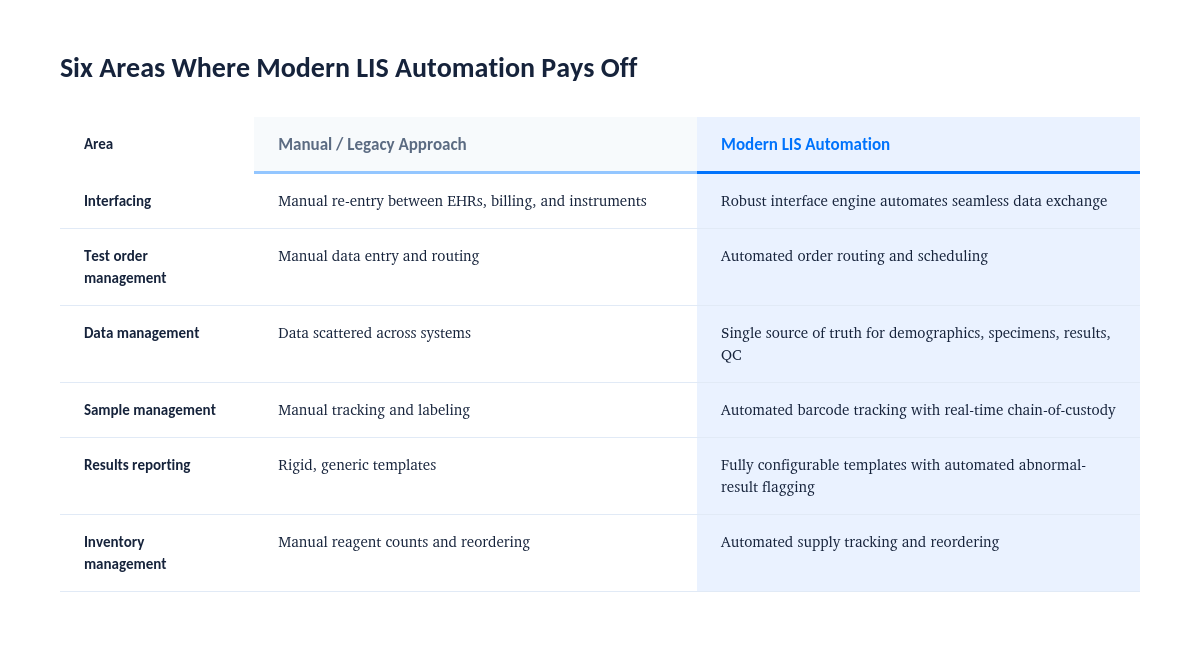
Together, these capabilities transform the lab information system from a passive record-keeping tool into an active engine of laboratory performance.
Industry Insights: Best LIS Systems - Top Laboratory Information Systems Compared for Clinical, Pathology, and Outreach Labs
How Can Labs Simplify Workflows During Slower Periods?
By investing in new, advanced medical laboratory information system solutions and adopting new procedures during quiet times, organizations can keep working toward their business goals at a more measured pace while preparing for what's to come when the economy heats up again.
During this time, labs can use the slower pace to adjust laboratory workflow management, simplify processes, and reduce reliance on human resources.
Clinical laboratories and pathology groups can leverage the best laboratory information system software, along with targeted operational improvements, to streamline workflows and strengthen performance. Here are several high-impact strategies:
- Automation: Integrating automation, robotics, and rules-driven LIS lab workflows expands testing capacity while reducing manual touchpoints and human error, which is especially critical during periods of rapid volume growth.
- Standard Operating Procedures (SOPs): Clearly documented and consistently enforced procedures for specimen collection, processing, and reporting create operational stability and reduce variability across departments.
- Quality Control: Routine monitoring of testing accuracy and precision, supported by LIS-based tracking and audit tools, enables labs to proactively identify improvement opportunities and implement corrective actions before issues escalate.
- Ongoing Staff Training: Sustainable process improvement begins with engagement. Continuous training and transparent communication clarify roles, reinforce accountability, and empower team members at every level to own performance outcomes.
Get Insight: Top 10 Medical Laboratory Mistakes and How to Prevent Them from Happening in Your Lab
Does Your Lab Take a Customer-Centric Approach?
The more clearly you understand what your customers genuinely value, the faster you can refine your services to meet and exceed their expectations.
Does your laboratory organization understand what providers and patients expect today? Does it know how to (consistently) deliver on those expectations? If it's been a while since you've examined those questions closely, now is the ideal moment to take a deeper look.
- Accurate and Reliable Results: Your customers expect this, but do you have the right laboratory information system software and procedures in place to earn their trust?
- Clear, Concise, and Configurable Reports: Do your lab reports support customer preferences (desired look and feel) and how and when they are delivered? Are the reports easy to understand and interpret? Do they not only explain test results but also associated risks and implications?
- Fast Turnaround Times: Expectations are speed and accuracy, as delays can negatively affect a patient's diagnosis and treatment. Does your current lab information system provide easy access to dashboards and widgets for business insights (such as start times and end times for tests)? Can the LIS system provide real-time stats that reflect lab operations? Can it identify workflow deficiencies?
- Top-Notch Customer Service: What’s your lab's solution for customer service management (CSM)? How responsive is your laboratory staff when customers ask for help? Do you use the best laboratory information system software to provide prompt, helpful service, or is this service mainly manual? Modern clinical and pathology LIS systems often include a CSM module that automates and streamlines customer interactions.
Discover More: LigoLab’s Advanced Tier - The Ideal Fit for Expansive High-Volume Laboratories Seeking Top-Level Efficiency, Automation, and Insight

Is Now Really the Right Time to Invest in New Technology?
Not every laboratory is positioned to make a significant technology investment during an economic downturn. For labs facing serious cash flow constraints or concerns about financial viability, the immediate priority should be controlling costs and stabilizing the business. In these circumstances, a major investment may be better deferred until the laboratory is on stronger financial footing.
Similarly, a lab that's already lean and high-performing, with minimal manual bottlenecks and well-documented SOPs, may find that a full platform overhaul delivers diminishing returns relative to the disruption of implementation. For that kind of organization, targeted process improvements or smaller-scope automation projects may be the more sensible move right now, with a broader platform evaluation revisited later.
For most labs burdened with real inefficiencies, manual workflows, or data silos, though, a downturn's slower pace is genuinely a good window to make changes that would be far more disruptive during a demand surge.
Discover More: Why LigoLab’s LIS System Implementation Model Outpaces Legacy Lab Vendors
How Can Labs Prepare to Seize New Business Opportunities?
When the economy rebounds, will your clinical lab or pathology group be ready to seize the moment and outpace the competition?
Now's the time to lay the groundwork.
Here are a few key considerations to ensure your lab is primed for success when the tide turns in your favor.
- Conduct Market Research: A good way to identify new business opportunities is to research the market. Take the time to analyze trends and identify gaps.
- Assess Current Capabilities: After you've evaluated your customers' needs, shift your focus internally to assess your business capabilities. Look at the laboratory software systems, tools, and resources currently supporting your operations.
- Develop a Comprehensive Business Plan: Now that you've gathered information about your ideal customer and have a complete understanding of what the lab is capable of, you're ready to move forward and create a business plan that lists the opportunities and the costs associated with going after these opportunities (resources, timelines, budgets, etc.).
- Invest in Technology: Next, assess the lab's technology and invest in solutions that support the business plan and make it achievable. Does the lab need to upgrade its LIS model or IT infrastructure? Does the lab need to invest in a new laboratory instrument to achieve its ultimate goal?
Industry Insights: Process Improvement and Advanced Technology to Help Relieve Laboratory Staffing Burden
Turn Economic Pressure Into Operational Advantage
In summary, treat this economic downturn as an opportunity to perfect processes and embrace innovation. With this mindset, you'll make your clinical laboratory or pathology group more competitive and better positioned for long-term success.
Continue Your Research
- Staffing Insights: What Caused the Current Shortage of Medical Laboratory Technologists and What Steps Need to Be Taken to Solve the Problem
- Platform Comparison: Best LIS Systems in 2026 - Top Laboratory Information Systems Compared for Clinical, Pathology, and Outreach Labs
- Vendor Evaluation: What You Need to Know Before Contracting with a Laboratory Information System (LIS) Company
- Solution Tier: LigoLab’s Advanced Tier - The Ideal Fit for Expansive High-Volume Laboratories Seeking Top-Level Efficiency, Automation, and Insight
Explore What LigoLab Offers
The all-in-one LigoLab Informatics Platform is a unified, enterprise-grade laboratory information system software that streamlines clinical, pathology, molecular, and outreach workflows. With intelligent automation, real-time visibility, rules-based routing, seamless interfacing, and integrated laboratory revenue cycle management (lab billing), LigoLab transforms fragmented processes into a single source of truth that boosts efficiency, reduces errors, and drives measurable operational and financial results.
Act Now: Schedule Your Introductory Call Today!
Frequently Asked Questions About Navigating an Economic Downturn as a Lab
Why doesn't a recession affect healthcare labs the same way it affects other industries?
Healthcare is an essential service people need regardless of economic conditions, so demand for lab testing doesn't disappear during a downturn. However, consumer sentiment and behavior still shift, and cost pressures like inflation and supply chain disruption still affect lab margins.
What areas of LIS system automation deliver the biggest efficiency gains?
The six highest-impact areas are interfacing (EHR/instrument/billing connectivity), test order management, data management, sample management, results reporting, and inventory management, all of which reduce manual touchpoints and errors.
Is it ever a bad idea for a lab to invest in new LIS technology during a downturn?
Yes. Labs facing severe cash flow constraints should prioritize cost containment over major technology investments. Labs that are already lean and efficient may also see diminishing returns from a full platform overhaul and could focus on smaller, targeted improvements instead.
What workflow strategies can labs use to simplify operations during slower periods?
High-impact strategies include automation and rules-driven LIS system workflows, clearly documented standard operating procedures (SOPs), routine LIS-based quality control tracking, and ongoing staff training to reinforce accountability.
How can a lab become more customer-centric?
Focus on four areas: delivering accurate, reliable results; providing clear, configurable reports; achieving fast turnaround times with real-time operational visibility; and offering responsive customer service, ideally supported by a CSM module built into the LIS model.
What steps should a lab take to prepare for new business opportunities before the economy rebounds?
Labs should conduct market research to identify gaps, assess current technology and operational capabilities, build a comprehensive business plan with cost projections, and invest in the LIS system or instrument upgrades needed to support that plan.